
The Pulse of a Silent Killer
In the heart of Texas, beneath the endless sky,
A silent storm is raging, where young lives slip by.
Not in the clamor of gunshots, not in the streets’ cries,
But in the chambers of hearts, where the rhythm slowly dies.
They come seeking a rush, a fleeting spark,
To fill the emptiness, to outrun the dark.
But methamphetamine, with its deadly guise,
Whispers promises of strength, then pulls them to demise.
It tightens its grip on their hearts so frail,
A strain too heavy, a bloodline set to fail.
The muscle weakens, the arteries plead,
As the drug takes what the body cannot feed.
These are the young, vibrant and bold,
The future of Texas, stories untold.
Now, their names are carved in obituary lines,
Victims of a poison that steals their time.
Cardiomyopathy—an echo of pain,
A slow and silent, irreversible drain.
It strikes without mercy, no age to defend,
Leaving families shattered, lives at an end.
So we stand at the crossroads, physicians and peers,
Fighting to awaken those caught in the years.
For every heartbeat lost in this tragic sweep,
We pledge to save the lives we can, before they sleep.
Samra Iqbal, MD
Commentary
Dr. Iqbal’s touching poem reflects thoughtfully on the thrill that methamphetamine addicts and even casual users get from “…a rush, a fleeting spark / To fill the emptiness, to outrun the dark.” This is a powerful testament in its own right, but what makes the piece truly impactful for readers of the Methodist DeBakey Cardiovascular Journal is the poet’s focus on the drug’s penchant to produce significant and lasting cardiovascular complications. These include, but are not limited to, methamphetamine-induced cardiac arrhythmias, myocardial infarction, and cardiomyopathy leading to heart failure. This particular addiction is becoming increasingly prevalent in the youth of our time and far too often is escaped only through the death of its sufferer. For this reason, if no other, practitioners of the medical profession, especially those in the cardiovascular world, must familiarize themselves with the subject of methamphetamine abuse, the effects of its toxicity, and the challenges of its treatment. It is the hope of this column that “The Pulse of a Silent Killer” will motivate readers to do just that.
The opening lines are reminiscent of one of the state’s anthems, “Deep in the Heart of Texas,” which is a perennial fan favorite at rodeos and sporting events across the Lone Star State. This light-hearted beginning, however, belies the turmoil that is evident just beneath the surface of the myocardium for those suffering from one of methamphetamine’s most damaging effects. The poem was authored by Dr. Samra Iqbal, who was inspired to write it as an Internal Medicine resident at Texas Tech University Health Sciences Center in Amarillo, Texas. During her training there, she cared for several young patients suffering the effects of methamphetamine abuse, including its associated cardiomyopathy. She has noted that witnessing this intersection of addiction and heart failure in vulnerable individuals was both sobering and motivating, providing the inspiration for her poetry that is on display here.
The piece chronicles not only the pathophysiological destruction we observe in these patients but also the emotional weight of their stories. They begin not in the third decade of the 21st century but long before, with the advent of this powerful and ubiquitous stimulant. In their paper, Lineberry and Bostwick tell the story of the substance from its initial synthesis in 1893. According to their rendering, the abuse of methamphetamine was “a perfect storm of complications,”1 with the first “meth” epidemic likely occurring in Japan during the years surrounding World War II. The Japanese military had foisted large quantities of the drug upon both its service members and the civilian population, perhaps in an attempt to enhance workforce productivity and battlefield fitness. It has since evolved into an extremely habit-forming street drug, due in large part to the “rush” described in both Iqbal’s poem and within the medical literature.
According to Lineberry, these sensations include “enhanced well-being, heightened libido, increased energy, and appetite suppression” with psychological manifestations of “euphoria, paranoia, agitation, mood disturbances, violent behavior, anxiety, depression and psychosis.”1 One can see how the drug, which is generally less expensive than cocaine, may have gained in popularity, as it is synthesized in home-grown labs using recipes that include extractions of ephedrine available from over-the-counter cough and cold treatment preparations. The agent can then be administered by intravenous injection, smoke inhalation, nasal snorting, and ingestion, with a few slang terms for the agent being meth, speed, ice, trash, Tina, and yaba.
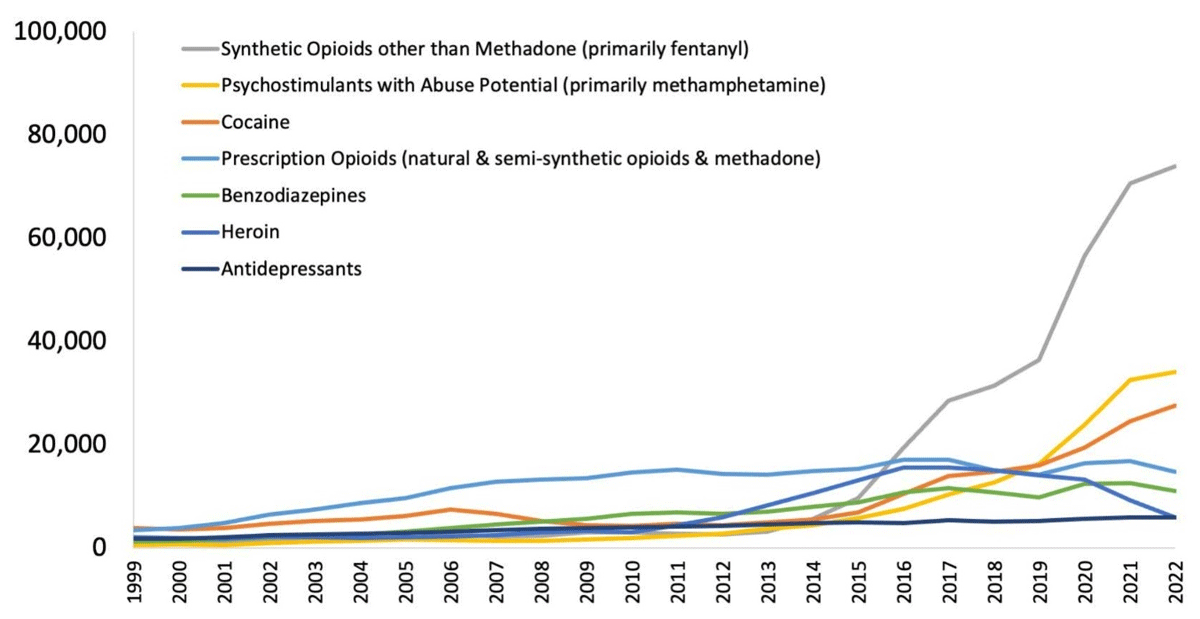
US drug overdose deaths from 1999-2022 encompass all age groups and are largely attributed to synthetic opioids and psychostimulants (ie, fentanyl and methamphetamine. respectively). Source: CDC WONDER
As the poem suggests, the substance appears to be particularly attractive to the youth among us, though relatively older generations are by no means impervious to its use. Those of college age, where demands of study and peer pressure can be overwhelming, seem to be especially at risk of methamphetamine addiction, although the same can also be said for the early career population. Many of the clinical characteristics of methamphetamine use are artfully depicted in Iqbal’s writing, with arguably the most concerning of these symptoms being the development of cardiomyopathy. This is represented by the poem’s wording, “It tightens its grip on their hearts so frail … The muscle weakens, the arteries plead / As the drug takes what the body cannot feed.” This progression to cardiovascular manifestations begins with an induced sympathetic nervous activity leading to coronary vasospasm, hypertension, and tachycardia, which is followed by elevated myocardial wall stress and ischemia, ultimately producing contractile dysfunction and inflammation. The result is myocardial fibrosis and acute versus chronic cardiomyopathy, which together are productive of arrhythmias, heart failure, and, in some cases, sudden cardiac death.2,3
The management of methamphetamine-induced cardiomyopathy is, of course, based on recognizing the syndrome and getting the patient to stop using this dangerous and harmful substance. No one will say that this is an easy task, but it may help clinicians and consulting cardiologists to have a low threshold of suspicion for illicit drug use when caring for young patients with persistent arrhythmias and symptoms of heart failure. After the diagnosis is made, the next approach is the compulsory guideline-directed medical therapy (GDMT) that has been extensively promulgated in the medical literature4 along with consideration of a referral for treatment of substance use disorder.
It is promising to note that the United States appears to be making some progress in the arena of overdose deaths, as evidenced by a 27% drop in fatality rates in 2023, including a reduction in deaths from methamphetamine.5 The challenge is still great, however, and “The Pulse of a Silent Killer” is a stellar example of how the medical humanities can make our profession aware of pressing challenges that need to be recognized and addressed. The poem stimulates readers to think of the “meth challenge” writ large, encouraging them to consider the presence and pathophysiology of its associated cardiomyopathy—a not so unusual problem that is likely overlooked in more than a few scenarios. The pathway to improving care for these patients will take vigilance, empathy, and targeted treatment, each of which may be promulgated through writing like Dr. Iqbal to broaden awareness of this devastating disease.
Disclaimer
The views expressed are solely those of the authors and do not reflect the official policy or position of the US Army, US Air Force, US Navy, the Department of Defense, the US Government, or Houston Methodist Hospital.
Competing Interests
The authors have no competing interests to declare.