
Table 1
Summary table of endoscopic bariatric and metabolic therapies (EBMTs). BMI: body mass index; HbA1c: hemoglobin A1c; TWL: total weight loss
| EBMTs | INDICATIONS | PLACEMENT DURATION | ADVANTAGES | DISADVANTAGES | TWL | ADVERSE EVENT RATE |
|---|---|---|---|---|---|---|
| Intragastric balloons (IGBs) | Class I-III obesity (BMI 30-40 kg/m2) ≥ one obesity-associated comorbid condition | 4-12 months |
|
| 7-14% | 2% |
| Endoscopic suturing | Treatment naïve: Class I-III obesity (BMI 30-50 kg/m2) | Semi-permanent |
|
| 15-25% | < 2% |
| Weight regain after bariatric surgery: Class I-III obesity (BMI 30-50 kg/m2) | 8-12% | |||||
| Gastric plication | Treatment naïve: Class I-III obesity (BMI 30-50 kg/m2) | Semi-permanent |
|
| 15-25% | < 2% |
| Weight regain after bariatric surgery: Class I-III obesity (BMI 30-50 kg/m2) | 8-12% | |||||
| Duodenal mucosal resurfacing | Patients with poorly-controlled type II diabetes (typically HbA1c > 7.5% based upon literature) | One-time treatment |
|
| 2-8% | < 2% |
| Duodenal-jejunal bypass liner (Endobarrier) | Patients with poorly-controlled type II diabetes (typically HbA1c > 7.5% based upon literature) | 12 months |
|
| 12-20% | < 5% |
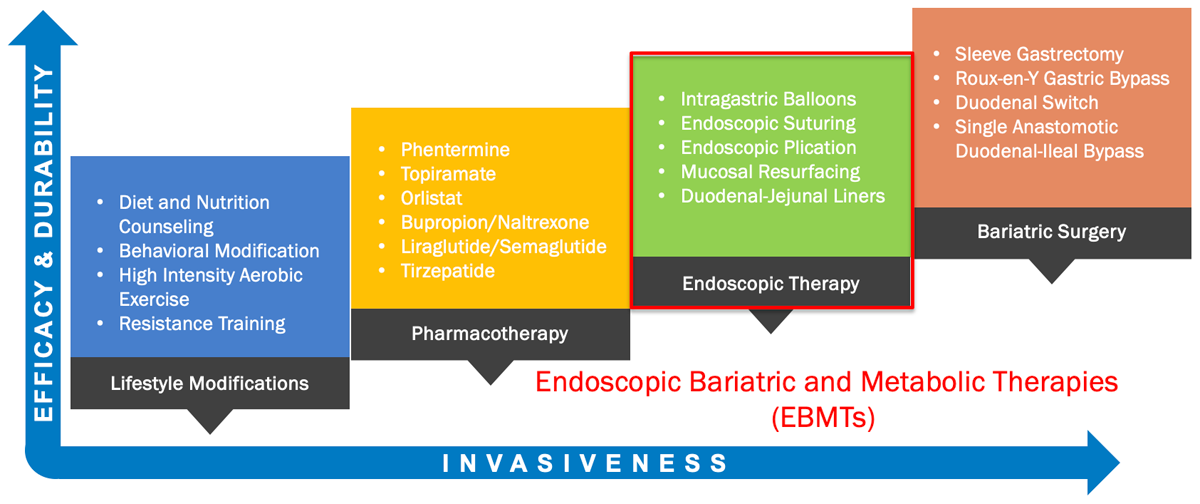
Figure 1
Treatment spectrum of obesity: lifestyle modifications, pharmacotherapy, endoscopic treatment, and bariatric surgery.
Table 2
American Society for Gastrointestinal Endoscopy (ASGE) and American Society for Metabolic and Bariatric Surgery (ASMBS) recommendations for endoscopic bariatric and metabolic therapies (EBMTs).
| ASGE AND ASMBS SUMMARY RECOMMENDATIONS FOR EBMTS | |
|---|---|
| I. | For primary obesity therapies in patients with obesity class I, II, and III, a minimum goal of 25% excess weight loss at 12 months |
| II. | For nonprimary EBMTs including metabolic therapy, bridging to surgery, and early intervention, a goal of ≥ 5% total weight loss |
| III. | For serious adverse events, ≤ 5% is recommended for all EBMTs |