
Introduction
Atrial fibrillation (AF) is the most common sustained arrhythmia encountered in clinical practice, with an estimated global prevalence of 50 million as of 2020.1 In the United States, the incidence of AF is projected to increase to 2.6 million by 2030.2 This poses a significant clinical challenge due to AF’s established association with increased risks of mortality, heart failure (HF), myocardial infarction (MI), stroke, and cognitive impairment.3 The combination of high prevalence and severe outcomes places a considerable burden on healthcare systems, with AF-related healthcare costs estimated at $28.4 billion.4
Given this substantial impact, risk factor modification has emerged as the “fourth pillar” of AF management alongside thromboembolism prevention, rhythm control, and rate control, as emphasized in the 2023 American College of Cardiology/American Heart Association/ American College of Clinical Pharmacy /Heart Rhythm Society guidelines. Obesity, one of the major modifiable risk factors for AF, is also rising globally.5 Studies suggest a 4% increase in AF risk for each unit increase in body mass index (BMI), with a 5-unit increase contributing to 30% of AF cases.6
Individuals with obesity not only face a higher incidence of AF but also tend to develop more persistent AF and experience poorer outcomes with rhythm control therapies.7 As a result, the interplay between AF and obesity has become an important focus of research aimed at understanding mechanisms and identifying strategies to prevent or mitigate the impact of both conditions.
This review explores the intricate relationship between AF and obesity, providing a contemporary overview of their incidence, mechanisms, associated comorbidities, and therapeutic strategies.
Obesity and AF: Epidemiological Considerations
The rise of obesity is historically noted to have started in the 1980s, with an increase in prevalence from 15% to nearly 30% by the 2000s.8 It has been hypothesized that the introduction of ultra-processed foods, sugar-sweetened beverages, and an increase in dietary fat have been linked to this epidemic in the Western world.9 In parallel, AF has also been increasing worldwide, with a reported 300% increase in prevalence over the past 50 years.10 In addition, the incidence of both diseases has been similar since 2000, at 31% for AF and 42% for obesity.11,12 While correlation may not indicate causation, it certainly creates a suspicion for interaction between AF and obesity.
Mechanisms
The relationship between AF and obesity is complex and involves both direct and indirect mechanisms of action (Figure 1). Thus, it is imperative to understand these different pathophysiologies to appropriately manage either disease.
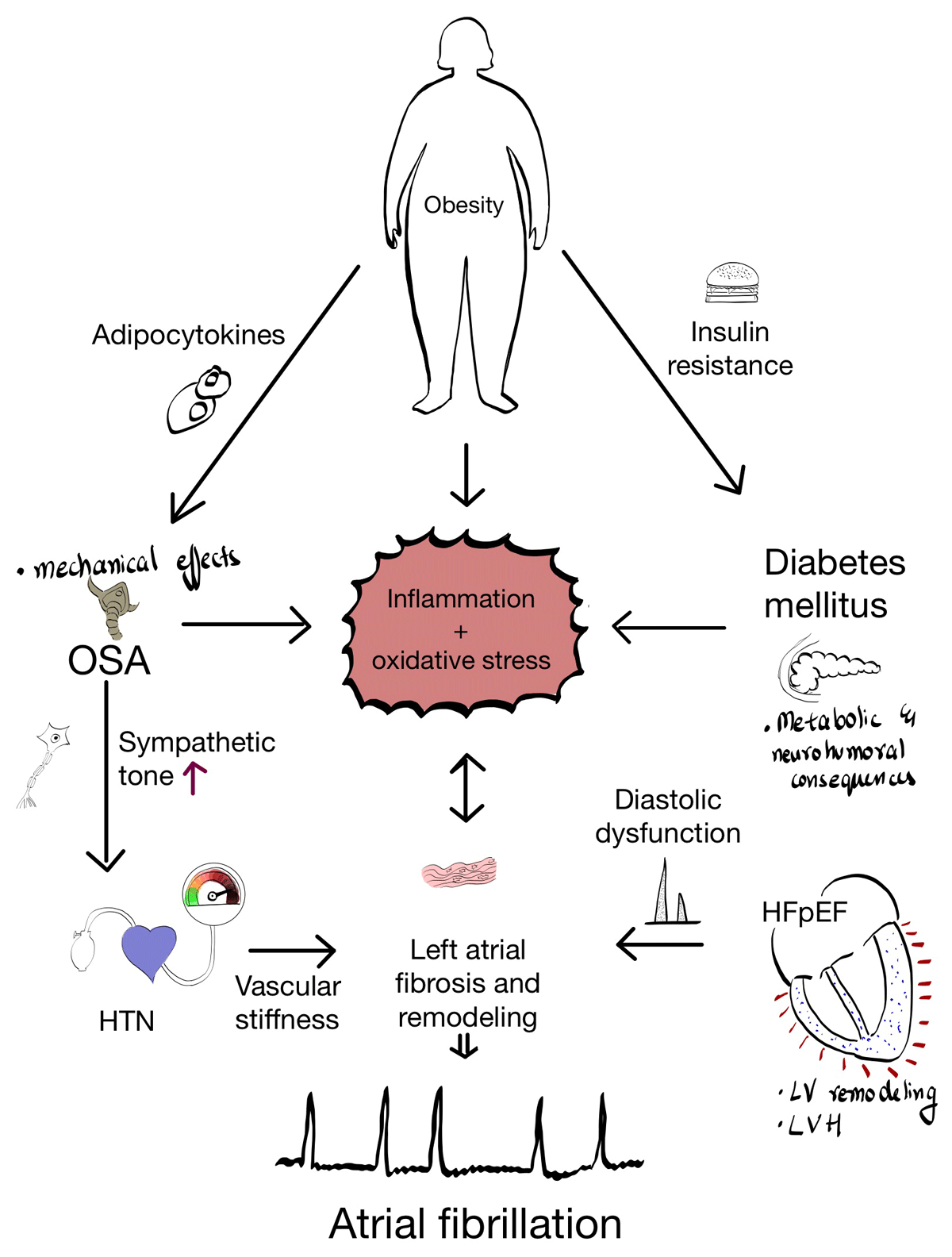
Figure 1
Mechanisms involved in the increase of atrial fibrillation in obesity. OSA: obstructive sleep apnea; HTN: hypertension; HFpEF: heart failure with preserved ejection fraction; LVH: left heart hypertrophy
Inflammation, Fibrosis, and Oxidative Stress
The pathophysiological link between AF and obesity is driven by a complex interplay of chronic inflammation, oxidative stress, and fibrosis.13
Serologic and histologic studies have demonstrated that patients with AF exhibit elevated levels of inflammatory markers compared to those in sinus rhythm.14 The primary mediators of this inflammation are tumor necrosis factor-alpha (TNF-α) and interleukin-6 (IL-6). Excessive adipose tissue has been shown to increase the production of both TNF-α and IL-6.15 In atrial tissue, TNF-α promotes structural remodeling through alterations in connexin-43 and metalloproteases while also reducing sarcoplasmic reticulum Ca2+ content, thereby contributing to structural remodeling.16,17 IL-6, through activation of the pSTAT3/STAT3 signaling pathway, induces early fibrosis by impairing connexin production and disrupting intracellular calcium homeostasis, which compromises both the electrical and structural mechanisms of the heart.
Obesity exacerbates this disrupted physiology by augmenting the sympathetic nervous system, further promoting AF.18 The inflammation associated with obesity also activates the renin-angiotensin system, where elevated angiotensin II levels suppress metalloprotease expression and stimulate collagen synthesis in cardiac fibroblasts, leading to atrial tissue fibrosis.19 Additionally, epicardial adipose tissue has been found to have numerous ganglionic plexi that integrate into and exacerbate the imbalance of sympathetic and parasympathetic activity affecting myocardium function.
Moreover, obesity is associated with early accumulation of oxidative stress, significantly increasing the likelihood of developing AF.20 Reactive oxidative species, generated under these conditions, enhance late sodium currents and induce early depolarization.21 This triggered activity, in combination with the effects of oxidative stress on ryanodine receptor 2 and L-type calcium channels, prolongs the action potential duration. These oxidative and inflammatory mechanisms not only heighten the risk of developing AF but also contribute to its persistence, even after therapeutic intervention, as demonstrated by recent findings.22
Left Atrial Remodeling
Left atrial remodeling is a significant prognostic predictor of AF. Enlargement of the left atrium is strongly associated with a higher risk of AF recurrence following ablation.23 Moreover, alterations in the shape of the left atrium have been linked to the development of non-pulmonary vein triggers for AF.24 The biochemical mechanisms underlying left atrial remodeling—inflammation, fibrosis, and oxidative stress—parallel those observed in obesity.25 Therefore, left atrial remodeling likely represents the clinical manifestation of how obesity creates a vulnerable substrate for AF.
Genetics and Epigenetics
The prevalence of AF in the younger population has generated interest in a potential genetic pathophysiologic mechanism. Through familial linkage analysis, genome-wide association studies, and polygenic risk assessments, many genes have been linked to early-onset AF.26 Although the increased prevalence of obesity has been linked to the modern diet and lifestyle, this does not exclude the presence of genetic causes of spontaneous obesity and hyperphagia such as congenital leptin deficiency or proopiomelanocortin deficiency. Furthermore, the gene-environment interactions have also been shown to cause epigenetic changes that alter gene expression affecting obesity.27 Though no gene has been shown to connect these two diseases directly, a recent profiling of the UK Biobank cohort demonstrated that obesity was a key contributor to the risk of AF regardless of genetic risks.28
Obstructive Sleep Apnea
Obstructive sleep apnea (OSA) has been shown to significantly influence AF pathogenesis. The accumulation of adipose tissue around the pharyngeal airway increases the potential to cause nocturnal obstruction, leading to OSA.29 Studies have found that a 10% weight gain can predict a 32% increase in the apnea-hypopnea index and a 6-fold higher risk of moderate to severe OSA.30 Given the overlap in risk factors between obesity and OSA, it is not surprising that OSA similarly elevates AF risk in obesity. The intermittent hypoxia and frequent nocturnal arousals heighten sympathetic nervous system activity, systemic inflammation, and oxidative stress, which together promote structural and electrical remodeling that contributes to AF development.31 While continuous positive airway pressure (CPAP) therapy has been shown to reduce AF burden and improve clinical outcomes,5 some patients continue to experience persistent AF despite CPAP. This persistence may reflect the additive effects of obesity, which drives similar pathological pathways.
Type 2 Diabetes Mellitus
The increased adipose tissue associated with obesity often leads to elevated blood glucose levels, contributing to the development of type 2 diabetes mellitus (T2DM).32 Although the association between AF and diabetes is modest, the interplay among hyperglycemia, insulin resistance, and inflammation increases atrial susceptibility to arrhythmias. Importantly, effective glycemic control has been linked to a reduced incidence of AF.18 However, it is challenging to determine if this reduction in AF risk stems directly from improved diabetes control or enhanced overall metabolic health, as the mechanisms improved by T2DM control closely mirror those affected by obesity.33 Nonetheless, T2DM remains a significant comorbidity in AF, and weight loss—known to benefit both T2DM and metabolic health—may further reduce AF risk.
Heart Failure with Preserved Ejection Fraction
Although heart failure with preserved ejection fraction (HFpEF) is a heterogeneous syndrome with multiple phenotypes, the obesity-related phenotype is characterized by increased arterial stiffness, excessive sympathetic activation, and hypoxemia.34 As mentioned before, epicardial adipose tissue has also emerged as an independent risk factor for the obesity phenotype of HFpEF.35 The diastolic dysfunction and myocardial stiffness of HFpEF elevate left atrial pressures, which can lead to structural remodeling and contribute to the development of AF.36 The relationship between AF and HFpEF is likely bidirectional, as a high burden of AF can further remodel the left atrium and contribute to heart failure symptoms.37 The interconnection among these three conditions is further underscored by the common emphasis on weight reduction in their treatment strategies.
Hypertension
Obesity is a well-established risk factor for hypertension,38 driven by the secretion of various hormones, activation of proinflammatory pathways, and generation of reactive oxygen species. These mechanisms parallel those implicated in the development of AF associated with obesity. Chronic hypertension induces hemodynamic changes that lead to atrial remodeling and fibrosis, creating a substrate conductive of AF.39 Notably, even in patients without obesity, effective blood pressure control remains crucial in AF management since improving hemodynamics can help mitigate fibrosis and reduce the risk of atrial remodeling.40
Approach to Therapy and Challenges
The Effect of Weight Reduction on Atrial Fibrillation
While the mechanistic links between obesity and AF are well-established, data on the impact of weight loss on major outcomes in AF remain mixed. The “obesity paradox,” first noted in a sub-study of the AFFIRM trial, suggested that patients with overweight/obesity had a reduced risk of death and major adverse outcomes, with risk decreasing progressively with each 1 kg/m2 increase in BMI.41 However, these findings may be influenced by confounders and biases in sub-studies supporting this association.42 Conversely, randomized trials assessing weight loss in AF have shown improvement in symptom burden and severity, providing stronger evidence for the benefits of weight reduction.43 Though the effect of weight loss on arrhythmia recurrence has not been studied in randomized clinical trials, observational data has found that a 5% decrease in weight loss is associated with a decrease in arrhythmia recurrence.44 Furthermore, a 5-year follow-up of patients undergoing goal-directed weight management revealed a 6-fold higher probability of arrhythmia-free survival with a 10% weight loss.45 Thus, despite ongoing debate around the obesity paradox in AF, current guidelines recommend weight loss to reduce AF symptoms, burden, recurrence, and progression.45
Lifestyle modifications, particularly diet and exercise, are the foundation of weight loss, but medical and surgical options also play a role. The development of glucagon-like peptide-1 receptor agonists (GLP1-RA) has generated interest due to their potential benefits in AF. The drugs are currently approved for patients with T2DM, and some are also approved for obesity and secondary prevention for atherosclerotic coronary artery disease. While strong clinical evidence of direct benefit in AF is lacking, animal studies suggest a protective effect of GLP1-RAs in AF.46 Bariatric surgery also offers a therapeutic option for obese patients with AF. Weight loss following surgical interventions has been shown to reduce both the incidence and burden of AF, likely due to improvements in metabolic and inflammatory profiles. Furthermore, post-bariatric surgery ablation outcomes are improved, with a more than 3-fold reduction in AF recurrence after significant weight loss.47 Research on the optimal timing and sequencing of bariatric surgery and ablation is ongoing.
The Effect of Obesity on AF Medical Treatment
Given the changes in gastric emptying, volume of distribution, and impaired drug penetration, obesity can alter the pharmacokinetics and pharmacodynamics of medications.48 Thus, it remains important to consider the effect of obesity on all facets of medical management for AF.
Effect on Anticoagulation
Since stroke is the most serious complication of AF, thromboembolism prevention remains a cornerstone of medical management, with direct oral anticoagulants (DOACs) as the primary drug of choice. The use of DOACs in individuals with class III obesity (BMI > 40) has been uncertain due to limited representation in early clinical trials. Concerns center on potential alterations in pharmacokinetics with higher body weight, which may necessitate dose adjustments.40 Additionally, obesity raises the risk of bleeding complications, requiring careful monitoring and individualized dosing to ensure both efficacy and safety.39 However, clinical practice has generally embraced DOACs for obese patients, supported by meta-analyses demonstrating their safety and efficacy compared to vitamin K antagonists.49 Warfarin, a fat-soluble drug, may be sequestered in adipose tissue, affecting its distribution,49 thus reinforcing the preference for DOACs in obese patients. In a recent meta-analysis evaluating the efficacy and safety of DOACs and warfarin among patients with various BMIs and weights, the event probability of stroke was favorable with DOAC use, but this favorability towards DOACs was reduced in patients with a higher BMI with regard to bleeding.50 Notably, after bariatric surgery, warfarin may be preferable, as meta-analyses indicate that up to 42% of patients experience reduced peak drug levels with DOACs.51
Effect on Rate Control
Vaughan Williams class II and IV medications, comprising beta-blockers and calcium channel blockers, are the primary drugs used for rate control. Most beta-blockers prescribed for AF are moderately to highly lipophilic, and while obesity alters their pharmacokinetics, it does not appear to significantly impact therapeutic efficacy.52 Non-dihydropyridine calcium channel blockers, diltiazem and verapamil, are highly lipophilic. Studies have shown that verapamil has a prolonged half-life, an increased volume of distribution, and higher plasma concentrations in obese patients, although its total clearance and maximal PR interval prolongation remain unaffected.53 Consequently, there are currently no formal recommendations for dose adjustments in either of these drug classes for obese patients.
Effect on Rhythm Control – Antiarrhythmic Medications
Rhythm control medications for AF include Vaughan Williams class IC and III antiarrhythmic drugs (AAD), with metabolism and distribution often affected by obesity.54 Studies have shown that patients with obesity experience a reduced symptomatic response to these medications compared to those of normal weight.55 This effect seems less related to pharmacokinetics or pharmacodynamics than to the changes in cardiac sodium channel expression and increased oxidative stress in obesity.56 Except for sotalol, medications for rhythm control—including flecainide, dofetilide, amiodarone, and dronedarone—are lipophilic, raising the possibility that dose adjustments may be necessary due to their significant side effect profiles. However, limited evidence currently supports a direct link between AAD accumulation and increased side effects.54,57
Effect on Catheter Ablation
Catheter ablation has become an established treatment option for patients with symptomatic AF or AF unresponsive to medical management. However, obesity presents unique challenges, including prolonged procedure time, extended radiation duration, and increased rates of minor complications such as bleeding. Notably, left atrial enlargement and remodeling, which are common in obesity, are associated with higher rates of AF recurrence post-ablation. Indeed, patients with obesity have been found to have higher rates of recurrence.58 Additionally, bariatric surgery before ablation has been shown to be associated with lower rates of AF recurrence after ablation.53 The epicardial adipose tissue has also been associated with low-voltage areas in the left atrium, creating an arrhythmogenic substrate less responsive to ablation.59 Advances in ablation technology, including contact force-sensing catheters and advanced imaging techniques, have helped improve outcomes, yet it remains uncertain how newer methods, such as pulse-field ablation, will be affected by obesity.7,19 Continued research will be essential as further data on pulse-field ablation outcomes in obese patients become available.
Conclusion
Obesity and AF share a relationship that intertwines with various other diseases and conditions through biochemical and hemodynamic mechanisms. Consequently, effective management for patients with both conditions requires a comprehensive and individualized approach, addressing obesity through lifestyle modifications, pharmacological interventions, and surgical options to significantly impact AF incidence and progression. Given all these separate components of care, a multidisciplinary effort with effective communication between primary care physicians, cardiologists, endocrinologists, weight-loss specialists, and bariatric surgeons will be critical to providing optimal care. Therefore, future studies are needed to determine whether weight-loss strategies with bariatric surgery or medical management before ablation impact the efficacy of ablation. Ongoing research into novel biomarkers, genetic predispositions, and targeted therapies offers promise for improving outcomes by addressing specific pathways involved in obesity and AF. As the prevalence of both obesity and AF continues to rise, enhancing our understanding of their interaction will be crucial to providing balanced and effective care to our patients.
Key Points
Obesity creates a biochemical mechanism focused on inflammation and oxidative stress, leading to a fibrotic, remodeled substrate vulnerable to atrial fibrillation.
Atrial fibrillation and obesity share a complex relationship that overlaps with several other disease processes.
Management of obesity has both direct and indirect implications for the safety and efficacy of treatment for atrial fibrillation.
Competing Interests
The authors have no competing interests to declare.