
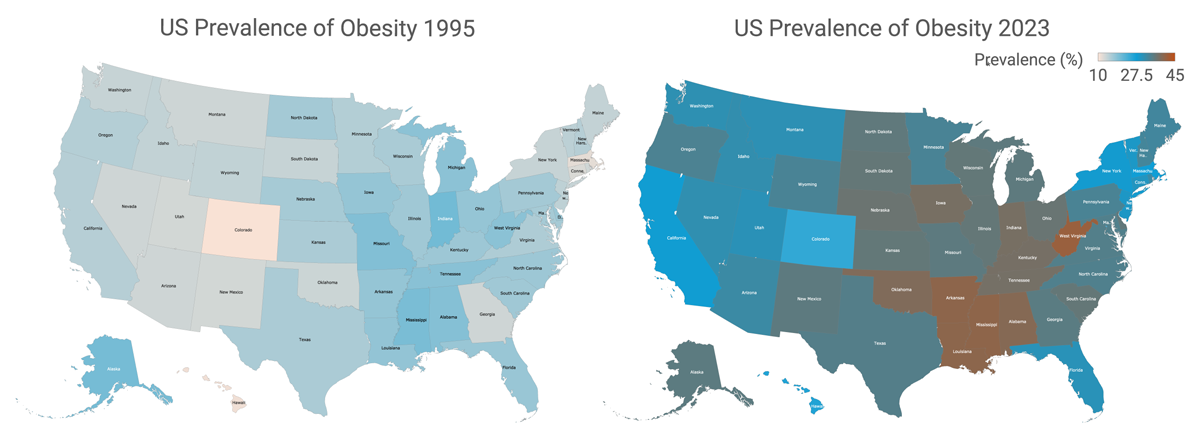
Figure 1
United States prevalence of obesity in 1995 and 2003 illustrating a marked increase in obesity rates across the nation. For Pennsylvania and Kentucky, data from 2022 were utilized instead of 2023 due to insufficient data available for estimating 2023 figures.
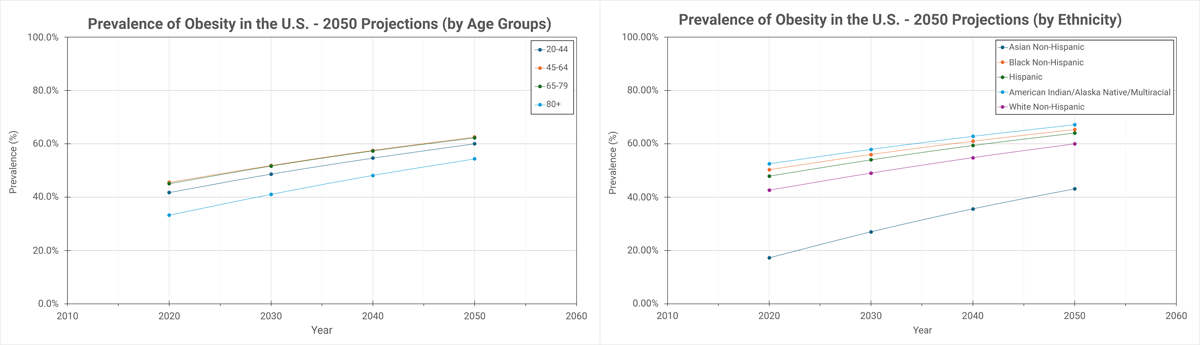
Figure 2
Projections of obesity prevalence from 2020 to 2050, stratified by age and ethnicity.
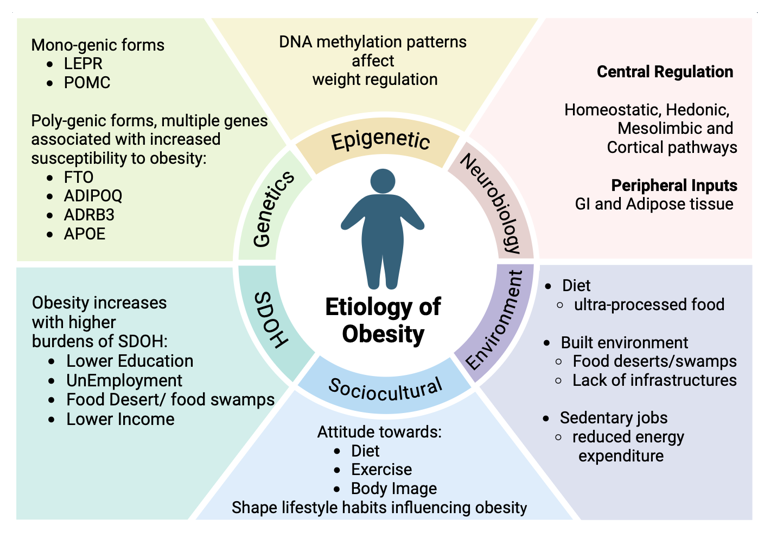
Figure 3
A schematic representation of the main causes of obesity, encompassing neurobiology, environment factors, sociocultural influences, social determinants of health, genetics, and epigenetics. LEPR: leptin receptor; POMC: proopiomelanocortin; FTO: fat mass and obesity-associated (FTO) gene; ADIPOQ: adiponectin, C1Q and collagen domain containing Homo sapiens (human) gene; ADRB: adrenoceptor beta 3; APOE: apolipoprotein E gene; SDOH: social determinants of health; GI: gastrointestinal
Table 1
Relative risk factor and (%) weight loss required for therapeutic benefits for complications related to obesity.25,50,51,52,53,54,55 T2DM: type 2 diabetes mellitus; MAFLD: metabolic dysfunction-associated fatty liver disease; CAD: coronary artery disease; OSA: obstructive sleep apnea
| COMPLICATIONS | RELATIVE RISK FACTOR | (%) WEIGHT LOSS REQUIRED FOR THERAPEUTIC BENEFIT | |
|---|---|---|---|
| MALE | FEMALE | ||
| T2DM | 6.74 | 12.41 | > 2.5 (improvement) 10-15 (remission) |
| Hypertension | 1.84 | 2.42 | 5 |
| CAD | 1.72 | 3.10 | > 10 |
| Osteoarthritis | 4.20 | 1.96 | > 5-10 |
| OSA | 2.00 | 2.00 | > 10 |
| MAFLD | 5.51* | 5.51* | > 10 |
| Breast cancer | - | 1.13 | - |
| Colorectal cancer | 1.95 | 1.66 | - |
| Endometrial cancer | - | 3.22 | - |
| Kidney cancer | 1.82 | 2.64 | - |
| Ovarian cancer | - | 1.28 | - |
| Pancreatic cancer | 2.29 | 1.60 | - |
[i] * Calculated odds ratio
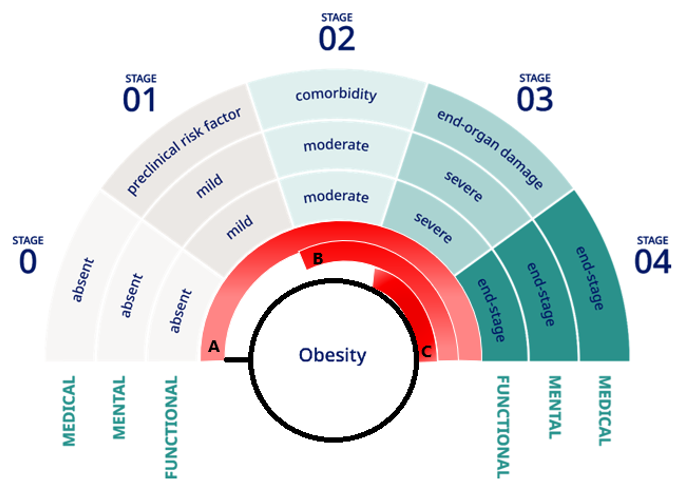
Figure 4
The Edmonton Obesity Staging System (EOSS) categorizes obesity into four progressive stages based on medical, mental, and functional health, ranging from absence of disease to end-stage disease. Medical health includes progression of chronic diseases such as T2DM and hypertension; mental health spans from minimal stress to severe depression linked to obesity; and functional health assess quality of life, from mild discomfort to limitations in daily activities. Treatment tiers (A, B, and C) align staging with lifestyle intervention to be incorporated at all stages of obesity (A), medical intervention (B) to be started at Stage 2, and surgical options (C) to be considered for Stage 3 and 4.