
Introduction
Obesity is a pandemic that continues to impact people of all backgrounds, ages, and races, and the widening gap in healthcare disparities contributes to this underrecognized and suboptimally managed health condition. The obesity epidemic first appeared in the United States (US) in the late 1970s and then spread to other westernized countries.
Globally, 50 million people die every year from noncommunicable diseases compared to 24 million who die from infectious disease. Two billion people go to bed overweight and 800 million go to bed hungry.1 About one in two people in the US have diabetes or prediabetes, and one in four of these are teenagers. A food monopoly of $15 trillion is controlled by Big Food, Big Seed, Big Agriculture, and fertilizer companies,2 with food waste accounting for 40%.
Additionally, only 2% of American farmland is used to grow fruits and vegetables for human consumption, despite the US Food & Drug Administration recommendation that 50% of our diet should come from fruits and vegetables.
Interestingly, the increase in obesity shows minimal association with changes in Americans’ intake of fat and carbohydrates. Rather, obesity likely has resulted from changes in the quantity of calories consumed, the quality of the food supply, and marketing of convenient, highly processed foods from cheap agricultural inputs. In fact, the factor most closely linked to the epidemic is ultra-processed foods (UPFs), foods with a high content of calories, salt, sugar, and fat but with very low nutritional value. Consumption of sugar-sweetened beverages (SSBs) also leads to higher energy intake and more weight gain.1
A similar pattern is seen with other low-priced UPFs that are increasingly popular at fast-food restaurants. Approximately 60% of the American diet comes from processed food, and for every 10% of a diet from processed food, the risk of death increases by 14%.1 While many believe that one’s personal sense of discipline in their eating habits is the solution to reducing the obesity pandemic (see related article on obesity as a disease by Avenatti et al., Methodist DeBakey Cardiovasc J. 2025;21[2]), there is a need to modify inadequate policies, including the Farm Bills implemented by the US Department of Agriculture. How we grow food, how we produce, distribute, and promote it, what we eat and what we waste are indeed complex labyrinthine processes. However, these types of policies are a dominant force that promote destruction across the globe, depleting human, social, economic, and natural capital. If a physician’s first priority is “To first do no harm,” then we all must explore the entire food chain: from seed to field to fork to landfill. A reluctance to recognize the interrelated nature of this problem will only perpetuate disease-related suffering.
This article highlights the prevalence, epidemiology, and pathophysiology of obesity in the US followed by discussion of food policies and their healthcare impact. The policies discussed range from societal to regional, state, and federal levels. While multiple examples show success in reducing the obesity pandemic across the globe, much research is still needed to demonstrate the robust impact of these multipronged interventions.
The obesity pandemic
Definition, Prevalence, and Epidemiology
Obesity is the plague of our era, doubling in prevalence globally since 1990 and rising to alarming levels among the young and in high-income countries. Even low- and middle-income countries have rising obesity rates despite their younger populations, and their obesity rates will soon match those of high-income countries. The World Health Organization (WHO) defines obesity as an abnormal accumulation of adipose tissue, with a body mass index (BMI) of over 30 kg/m2. Asian countries have lower obesity cutoffs, with China > 28 kg/m2 and Japan and Korea > 25 kg/m2.3 The US Centers for Disease Control and Prevention reports that in every US state, at least one in five adults are obese, and at least one in three adults are obese in almost half of the states,4 with the prevalence varying by age, education level, and ethnicity.
Children with obesity are five times more likely to become adults with obesity compared to children without obesity. Targeting weight gain and preventing obesity in the young is key to cardiovascular disease (CVD) prevention.5 Rising socioeconomic disparities in obesity rates are mostly driven by lower education levels, especially among women.6 Non-Hispanic Black individuals have the highest prevalence of obesity in the US, followed by Hispanic adults.7 Despite the increasingly appreciated link between obesity and CVD, obesity has been underrecognized and suboptimally addressed by cardiologists. The increase in obesity is closely linked to an increase in CVD burden.8 Patients with obesity have an almost 2-fold risk of all-cause mortality, and two-thirds of that (67.5%) is due to CVD.9
Obesity directly affects the heart, independent of other CVD risk factors, and is a major target for CVD risk reduction.10 Moreover, it leads both to premature deaths and to a growing economic burden. The highest number of obese individuals live in the US, China, and India.11
Causes and Underlying Pathophysiology
While the root causes and ramifications of obesity are many, it is likely that the prevalence of obesity has tripled in the last 50 years due to environmental factors more than genetic ones. While BMI provides the most useful population-level measure of obesity, variations in the amount, type, and distribution of fat are not reflected in the BMI.12 Fat distribution and fat type are key: higher visceral (not subcutaneous) abdominal fat carries a greater CVD risk.13 This underlies the Y-Y paradox (named after the study authors, Yajnik and Yudkin), whereby similar BMIs do not carry similar adiposity or cardiometabolic risk.14
At its most basic level, obesity is an imbalance between overeating and physical inactivity, with a possible underlying genetic disorder of energy homeostasis.15 There are 74 key obesity genes on energy expenditure and homeostasis based on the genome-wide association study and the latest bioinformatics tools. Excess calories from the diet are stored within the abdominal region in different distributions.16 Yet the association between obesity and intake of fat and carbohydrates is tenuous. Rather, the obesity pandemic probably resulted from the quantity of caloric consumption and the quality of the food supply accompanied by marketing of convenient, highly processed foods from cheap agricultural inputs. UPFs with a high content of calories, salt, sugar, and fat but few whole foods along with consumption of SSBs are likely causes of the obesity pandemic.17
Obesity has a domino-like effect triggering elevated blood pressure, dyslipidemia, and impaired glucose metabolism, and the speed of this effect is accelerated by genetic predisposition, socioeconomic status, and ethnicity. Excess adipose tissue sets off a proinflammatory cascade leading to systemic insulin resistance and glucose and fatty acid dysregulation.18 The Visceral Adiposity Index (VAI) is a specific and sensitive marker of obesity’s cardiometabolic risk.19
Obesity is not a stand-alone disease entity with a specific constellation of requirements; rather, it is a significant risk factor for cardiometabolic diseases.20 It appears to impact the immune system by “switching on” a proinflammatory macrophage phenotype from the anti-inflammatory macrophage phenotype seen in those without obesity.21 In addition, the cells of adipose tissue behave differently depending on whether an individual has obesity. Individuals without obesity secrete anti-inflammatory adipokines, while those with obesity secrete pro-inflammatory cytokines.22
The pathophysiological change from obesity leads to metabolic dysfunction on a small scale and organ dysfunction on a broad scale. Adipose tissue plays an integral role in the endocrine system, since aggregated fat composes the largest endocrine tissue and communicates with all the other tissues.23 Leptin is a proinflammatory cytokine secreted proportional to the person’s amount of fat.24 A major anti-inflammatory adipokine is adiponectin, which is reduced in those with obesity.25 Adiponectin reduction in obesity induces insulin resistance and leads to diabetes mellitus.26 The stimulating effect of leptin on cell proliferation and differentiation is a key link to obesity, significantly increasing the risk of cancer for an individual since these processes are also found in cancerous tissue.27
Solutions and policies
Understanding the Policy Pathophysiology: How We Got Here
By World War II, it became common knowledge that ammonia mixed with fuel oil, chemically fixed as ammonium nitrate, could make either explosives for bombs or fertilizers for crops. Using the leftover ammonium nitrate from the war, the US government converted all 10 of its bomb-producing plants to fertilizer-producing plants.28 The fertilizer production catapulted US farming from relying on solar energy (photosynthesis) to fossil-fuel energy by creating monocultures of livestock and crops: the fertilizer boosted productivity enough to separate livestock and its manure production from crop production and crop rotation, ending the cycle where animals replenished the fertilization (manure) that crops depleted. Crop yields exploded with this new fertilizer and flooded the market with cheap grains, since the government began paying farmers the difference between the farmers’ cost to grow the crops and the market price. These subsidies also allowed livestock to be fed this cheap grain since it cost less to buy than it cost farmers to grow, which created the feedlots of meat and dairy animals.29
The US Farm Bill, a multiyear law, is the main policy legislation that sets these subsidies.30 While the US government sponsored grain crop subsidies, it simultaneously kept sugar prices high by limiting sugar imports with sugar quotas. This seemingly paradoxical stance has led to the use of cheaper corn subsidies—incorporating high fructose corn syrup (HFCS), sugar’s less expensive substitute—in almost all processed foods. HFCS is not taxed and is supported by farm bills, leading to low retail prices for HFCS-filled foods and drinks.31 In fact, the latest farm bill, HR 8467, has allocated a net increase of about $43.4 billion over 9 years for the commodity support program (subsidies).32 The policies to subsidize HFCS created the onslaught of cheap processed foods that were filled with HFCS, keeping prices low for the average US citizen. Since then, the obesity epidemic has been driven by widely available and affordable highly processed “junk” food filled with cheap sugars, starches, and oils.
In addition, since the 1970s, the US government has promulgated low-fat diets, initially in the Dietary Guidelines for Americans federal nutrition program. This was reinforced by societies and institutions, such as the American Heart Association (AHA) and National Institute of Cancer (NCI), promoting the concept that heart disease and cancer were linked to fat consumption. This snowballed into the WHO and the US Surgeon General issuing their own documents, further perpetuating low fat a decade later in the 1980s.33 Businesses rode this wave of low-fat enthusiasm to increase their profits in conjunction with the AHA endorsing their low-fat heart healthy products with their stamp of approval etched on every product. By the end of the 1990s, 55 companies had over 600 products certified as low fat, many of which were sugary cereals (ie, Kellogg’s Frosted Flakes). These policies paradoxically led to products low in fat but high in sugar and calories, contributing to a 50% increase in obesity within the US since the 1970s.33 Thus, the policies that created the fast-food industry now fuel patients with chronic diseases seen in the healthcare industry. Figure 1 summarizes the issues impacting the US food chain and cycle.
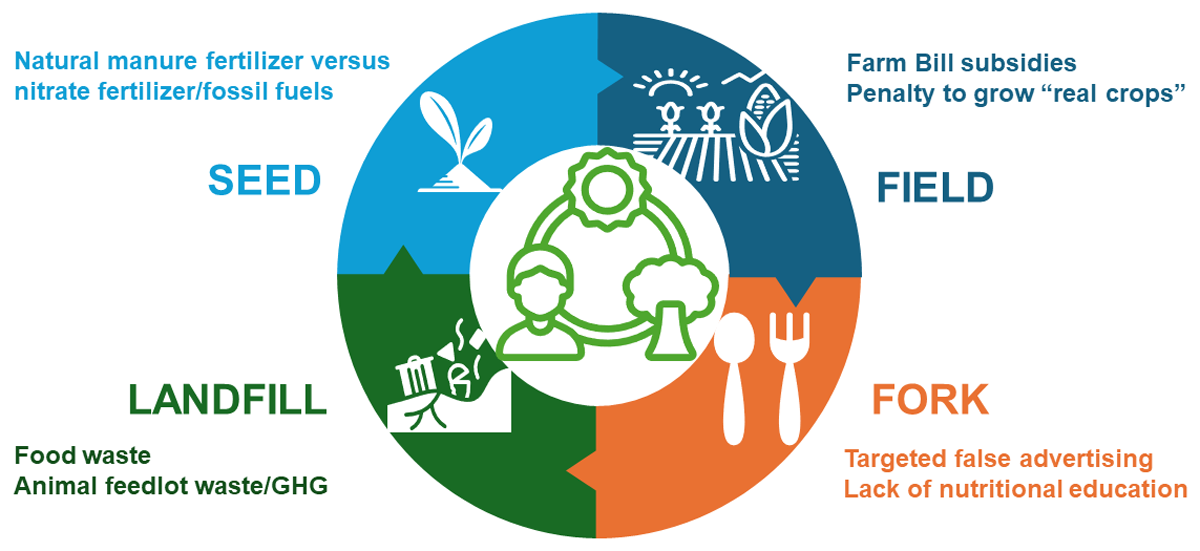
Figure 1
Issues impacting the US food chain. GHG: greenhouse gas
The meteoric rise of obesity in the US has prompted policy changes at multiple levels. Despite wide-ranging impacts of these policies, the quality of evidence informing them may be moderate to low. The US Department of Health and Human Services defines best practices as “at least preliminary evidence of effectiveness in small-scale interventions or for which there is potential for generating data that will be useful for making decisions about taking the intervention to scale and generalizing the results to diverse populations and settings.”34 Additionally, these policies may focus exclusively on population health without considering equity between subgroups. Next, we explore specific policy solutions to the obesity pandemic at the system and societal levels.
Levels of policy interventions
Consumer Policies
Menu Labeling
Calorie labeling on restaurant menus has been practiced with mixed results, with many people failing to notice labels35 but several studies demonstrating small decreases in total calories per meal.34 Since 2018, the US Food and Drug Administration has required food establishments with 20 or more locations to have calorie labels on their menus. Several large US cities have similar requirements in place. Cities and states could strengthen this policy by extending it to all food establishments regardless of size.
Sugar-Sweetened Beverage Tax
Excess sugar intake is a key driver of excess weight gain and cardiometabolic disease.36 On average Americans consume more than three-times the daily recommended limit of added sugars.37 Sugar-sweetened beverage taxes, which may reduce demand for SSBs due to higher prices, have been instituted in several large US cities.37 Instituting state-wide or federal excise taxes on SSBs could significantly extend this policy impact.
Transparent Marketing
Food and beverage companies spend over $14 billion yearly on marketing, most of which promotes unhealthy foods. These advertisements specifically target minoritized groups such as children and adolescents and Black and Hispanic individuals.38 Though food companies have pledged to self-regulate according to the Children’s Food and Beverage Advertising Initiative, research has demonstrated failure to meet self-imposed standards.39 Federal standards must be enacted to regulate food marketing to children and limit targeted marketing practices, particularly for high-calorie foods with low-nutrient density. Figure 2 illustrates causes of and solutions to the obesity pandemic.
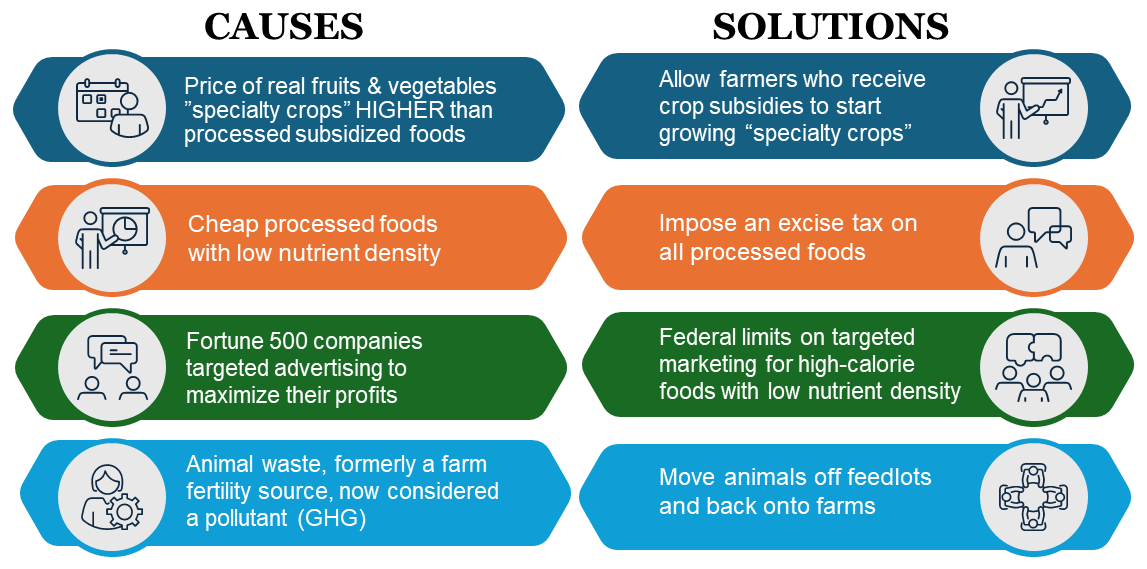
Figure 2
Food chain and food policies: causes and solutions for the obesity pandemic. GHG: greenhouse gas
Social Safety Net
Child Tax Credit
US households with children are more likely to be food insecure, and the paradoxical relationship between food insecurity and obesity has drawn recent attention. Food insecurity may lead to a lower-quality diet with increased consumption of energy-dense foods, which then increases obesity risk.40 Child tax credits (CTCs) have consistently demonstrated positive impacts on family food security, including the CTC expansion in the American Rescue Plan in 2021.40 Permanent expansion of CTCs could improve childhood food security and subsequent metabolic health outcomes.
Education System
School Curriculum
Many children and adolescents lack basic food preparation skills and knowledge. School-based nutrition and cooking skills curricula are an effective tool to improve knowledge, skills, and self-efficacy and can ultimately improve healthy eating.41 A successful example is the Eatiquette 360 program in partnership with the Philadelphia public schools, which provides hands-on nutrition and cooking skills education for students and caregivers.42 Similar programs can be adapted to school needs and local food environments and sustained with community partnerships.
Early Childhood Intervention
Early life nutrition is particularly critical for long-term health outcomes. Several states have successfully instituted early childhood nutrition intervention programs to address this need. These include GO NAPSACC (Nutrition and Physical Activity Self-Assessment for Child Care), Catch Early Childhood, and Harvest for Healthy Kids, among others. Instituting a broader national strategy for early childhood nutrition interventions in care centers could provide great benefit to later childhood and adult health.
Food and Food Assistance System
Food Waste
One-third of all food in the US goes uneaten.43 Food is wasted at multiple levels—in agricultural harvest, in retail grocery processing, in retail food establishments, and in home kitchens. Several local programs are working to address produce accessibility and food security. One such example is a partnership with the Supplemental Nutrition Assistance Program (SNAP) educators and local farmers in Maine. Local groups recover produce from fields (“field gleaning”), which is then distributed to food banks, health clinics, and other community establishments. Interestingly, overnutrition has been recognized as a form of food waste and may be mitigated through dedicated educational efforts. Obesity and food waste both challenge the sustainability of the current food system. Given the multiple levels of food waste, development of multipronged interventions are needed. Research funding to develop innovative food waste solutions may improve accessibility of high-quality nutrient-dense foods.
Food “Deserts” and “Swamps”
Food deserts are defined by the US Department of Agriculture as geographic regions where individuals have limited access to a variety of healthy and affordable foods. Individuals living in food deserts experience more barriers to healthy eating, which may contribute to obesity and chronic disease risk.44 Food swamps are geographic areas with a higher density of food establishments selling high-calorie, low-nutrient foods such as in fast food restaurants and convenience stores. Previous research has demonstrated that residing within a food swamp is a stronger predictor of obesity propensity than residing within a food desert.45 Thus zoning interventions limiting fast-food establishments and providing incentives for establishing grocery stores with healthier options may improve community health. Additionally, improving community infrastructure such as public transportation routes may enhance community access to resources beyond their immediate neighborhood.
Improving Access and Quality of Food Assistance Programs
Public food assistance programs such as SNAP and Special Supplemental Nutrition Program for Women, Infants, and Children (WIC) provide critical nutrition and food security support for low-income Americans. Despite this, they are underutilized by eligible individuals—with research demonstrating barriers including administrative inefficiency, lack of coverage for preferred foods, limited shopping options, and difficulties attending in-clinic WIC appointments.46 Eligible foods are not always healthy options—although this is improving with the introduction of additional fruit/vegetable incentive programs (ie, GusNIP). To maximize the benefit to participants and achieve population health benefits of these programs, streamlining participation for individuals and families and enhancing benefit packages is critical.
Healthcare System
“Food is Medicine” Interventions
Recognizing the rise in diet-related chronic diseases and obesity, healthcare organizations and systems are increasingly incorporating “food is medicine” style interventions. This includes a recent American Heart Association (AHA) “Health Care by Food” initiative.47 These interventions include a range of services, from medically tailored meals to fresh fruit and vegetable prescriptions, and have an emerging evidence base. Providing research funding to establish appropriate use, as well as federal regulatory policy to allow Medicare and Medicaid financing, could accelerate their impact on patient care.
Medicaid Obesity Treatment
Despite evidence supporting an array of obesity treatment services, including intensive behavioral interventions, medication, or surgical options, most Medicaid programs only cover a small portion of these treatments.48,49 Thus low-income Americans, many of whom have a higher risk of obesity, have fewer treatment options. State Medicaid program expansion of obesity services may improve outcomes for this vulnerable population.
Moving Forward
National and state or regional policies have unique strengths. National policies scale impact and allow integration between federal systems. State or regional interventions can engage communities, prioritize regional preferences, and enhance networking. However, both face challenges. For example, efforts at the federal level to reduce childhood obesity such as the “Let’s Move” campaign demonstrate underwhelming results. This campaign focused on increasing children’s opportunities for physical activity, improving nutritional standards of the National School Lunch Program, and improving community access to high quality foods.50 Despite these efforts, nationwide childhood obesity rates did not significantly decrease during the campaign period, emphasizing the need for more comprehensive policy solutions and community-based interventions. The lack of strong evidence for effective interventions is striking, despite the high prevalence of obesity. Funding nutrition and nutrition policy research is a national imperative for creation of more evidence-based policies.
Conclusion
The obesity pandemic and rise in chronic cardiovascular disease go hand in hand. As described in this review, policies play a critical role at local, regional, and federal levels. Interventions must start early, be multipronged, and target reduced food wastage and improved access with focus on lifestyle changes and healthy habits. More dedicated research is required to better understand the impact of the policies in place, and establish improved plans for future directions.
Key Points
Obesity results from changes in the quantity of caloric consumption as well as the quality of the food supply. Marketing plays an important role in promoting convenient, highly processed foods produced from cheap agricultural inputs.
How we grow, produce, distribute, and promote food matters, as does how we handle waste. However, the dominant force to promote changes across the globe are policies that seem to deplete our human, social, economic, and nature capital.
While multiple examples exist for successfully reducing the global obesity pandemic, much research is still needed to demonstrate the robust impact of these multipronged interventions.
Competing Interests
Dr. Vijayaraghavan is a consultant for Aventyn Inc., Impact Xcelerate, Arizona Heart Foundation, Twinepidemic Inc., Life 365, Luminary Clinical Research, Project CURE, Edwards Lifesciences, Rovicare, SC Pharma, Bayer, Learnroll, Lara Health, Bridge Bio, and Novo Nordisk; he is also on the Speakers Bureau for AstraZeneca and Kiniksa Pharmaceuticals, and has an ownership interest in Pulse Graft. The other authors have no competing interests to declare.