
Stopping by Woods on a Snowy Evening
Whose woods these are I think I know.
His house is in the village though;
He will not see me stopping here
To watch his woods fill up with snow.
My little horse must think it queer
To stop without a farmhouse near
Between the woods and frozen lake
The darkest evening of the year.
He gives his harness bells a shake
To ask if there is some mistake.
The only other sound’s the sweep
Of easy wind and downy flake.
The woods are lovely, dark and deep,
But I have promises to keep,
And miles to go before I sleep,
And miles to go before I sleep.
Robert Frost
From New Hampshire (New York: Henry Holt & Company, 1923)
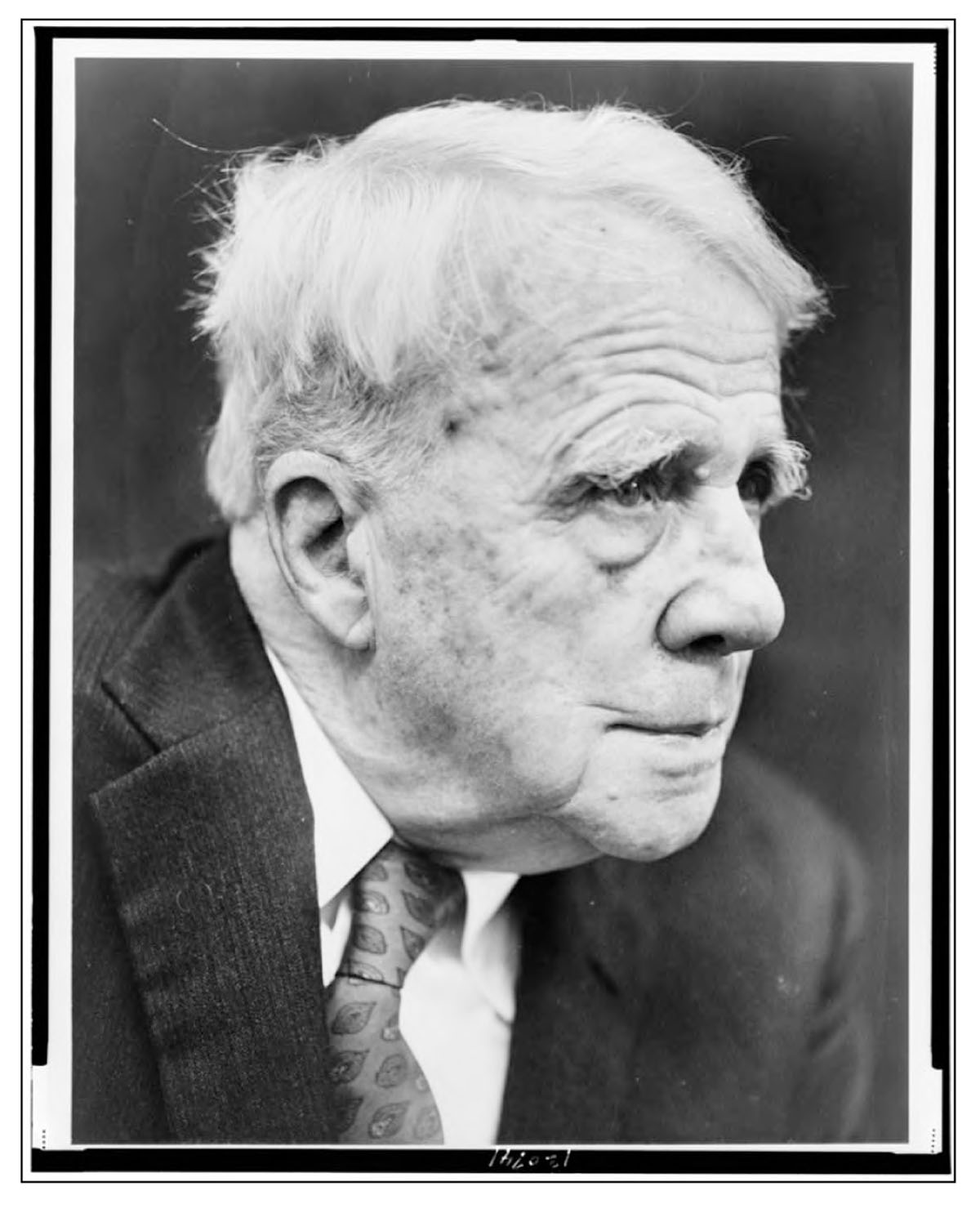
Robert Frost on his 85th birthday. Photo 1959 by Walter Albertin, New York World-Telegram and the Sun Newspaper Photograph Collection (Library of Congress)
Commentary
When “Stopping by Woods on a Snowy Evening” was first published in 1923, it was met with almost instantaneous and widespread acclaim, quickly becoming a favorite poem for many. The 16 now-famous lines—what Frost called the “short poem with a long name”—have held a remarkable place in literary history. Vladimir Nabokov, known as one of the preeminent novelists of the 20th century, called it “one of the greatest short poems in the English language,”1 and it has been reprinted countless times in its 100-year history. The poem and its author are worthy of further exploration and consideration, particularly for those who find comfort in the written verse of one of the country’s most notable poets.
Robert Lee Frost was born in San Francisco, California, on March 26, 1874. Ten years later, he and his family relocated to New England, where Frost grew up and later gained renown as a poet. His writing career had an inauspicious start, as he could not find an American publisher for his first collection, A Boy’s Will. It was printed in 1913 by David Nutt, a publishing company in England, where Frost had been living since the year before. He returned to the United States (US) in 1915, a year after releasing his second volume of poetry, and there he embraced the life of a celebrated poet. He went on to publish nine other volumes of poetry and held teaching positions at Amhurst, Harvard, Columbia, and Yale.
Frost won the first of his four Pulitzer Prizes in 1924 for New Hampshire, which included “Stopping by Woods,” and he received the award again in 1931, 1937, and 1943. Only two other individuals, Eugene O’Neill and Robert E. Sherwood, have won as many, although neither were in the poetry category. Frost was awarded a Gold Medal from the American Academy of Arts and Letters in 1939 and served as the US Consultant in Poetry (the precursor to the modern position of Poet Laureate) from 1958 to 1959. He received the Congressional Gold Medal in 1960 and recited a poem at the inauguration of President John F. Kennedy in 1961, becoming the first poet to do so and the only one to date who recited rather than read their work.2 Frost passed away in 1963 at the age of 88.
“Stopping by Woods” became widely popular when it was first published in The New Republic, perhaps on account of its simple language and memorable rhyme scheme. An argument can be made, however, that it has endured for different reasons altogether—namely, its versatility and mystique. It has been categorized as a Christmas poem on account of its winter theme, though Frost chose not to include it as one of his annual Yuletide poems for family and friends.3 It also was not written specifically for a juvenile audience although it has been included in numerous collections of children’s poems. Some readers have even taken a sinister reading of the poem, wondering if its speaker was contemplating suicide as he considered the “lovely, dark and deep” woods before him.3 Frost has rebuffed such an interpretation, indicating that the tale was of a sorrowful father returning home empty-handed from the market in the days before Christmas.3
Whatever the intention or interpretation of “Stopping by Woods,” the difficulty readers have had in characterizing it has lent the poem a level of universality that is unlikely to be replicated. This includes a correlation to the field of medicine as well as to the men and women who practice it. Frost was no stranger to poetry dealing with death and illness, and his work has been part of a few anthologies specifically related to the field of medicine, including Poetry in Medicine (2015, Persea Books, Michael Salcman, ed.) and On Doctoring (2010, Simon & Schuster, Richard Reynolds and John Stone, eds.) For example, in Frost’s “Out, Out—,” a young boy bleeds to death after doctors could not save him from a sawing accident; in “Home Burial,” a man and woman cope with the loss of their firstborn child, while in “Not to Keep,” a convalescing service member who is sent home to heal after a bullet wound must face the prospect of returning to combat.
In “Stopping by Woods,” it is easy to imagine the protagonist as an early 20th century physician making a home visit or as a modern physician who stops to ponder the comforts of her home life amidst a pressing call shift or busy clinic panel. Due to the inexorable nature of the medical profession, doctors must often shun the “lovely, dark and deep” woods of home and hearth to continue in their clinical duties. The “promises they have to keep” still involve providing direct patient care, but many have increasing obligations away from the bedside. While some are advancing medical research, others are directing resources to address social determinants of health, while still others are working to educate clinicians of the future. These physicians can relate directly to the poem’s final stanza but may find solace in its uplifting tone. More so than ever, they have miles to go before they sleep, and miles to go before they sleep.
Disclaimer
The views expressed are solely those of the authors and do not reflect the official policy or position of the US Army, US Navy, US Air Force, the Department of Defense, the US Government, or Houston Methodist Hospital.
Competing Interests
The authors have no competing interests to declare.