
Introduction
Sixteen years ago, the World Health Organization (WHO) revolutionized the approach to addressing health inequities by providing a groundbreaking framework that highlighted the role of social determinants of health (SDOH)—the conditions in which individuals are born, live, and work.1 Since then, increasing evidence suggests that SDOH determine nearly 80% of a person’s health status and are the primary upstream drivers of disparities in health and health care.2 Additionally, it is known that social determinants do not act in silos; rather, SDOH across different domains influence each other to predict health risk and downstream outcomes.3 Thus, screening for SDOH in clinical practice has been highlighted as a key step in providing effective medical care.4 Despite this knowledge, efforts to quantify the health burden of social determinants as experienced across distinct categories are limited, which limits holistic assessment of cumulative SDOH effects on individual and population health.
Individuals with cardiovascular disease (CVD) are particularly susceptible to the adverse effects of unfavorable SDOH. In our prior work, we have shown that individuals with CVD and/or cardiovascular risk factors may experience multiple unfavorable SDOH and a more unfavorable social risk profile compared to the general population.5,6 We also have shown the negative consequences of unfavorable SDOH on various cardiovascular outcomes, including obesity, stroke, myocardial infarction, maternal health, and others.5,7 Our work and that of others highlight the critical need for a robust approach to assess aggregate social risk factor burden and associated outcomes in the clinically vulnerable CVD population.
In recent years, efforts have been made to highlight the role of SDOH as independent risk factors for CVD and to develop novel approaches for holistic social risk assessment. However, until recently, efforts to develop polysocial risk scores (PsRS)—novel indices to capture cumulative social disadvantage across distinct SDOH domains and predict health outcomes—have been limited. PsRS offer a unique opportunity to assess patients’ social risk burden experienced across multiple SDOH themes. The score accounts for traditional clinical and demographic risk factors and quantifies disease risk attributable to cumulative SDOH risk. In this review, we examine and summarize existing knowledge of various PsRS overall and how they relate to CVD. Additionally, we review existing literature and real-world examples of PsRS integration for patient risk assessment and stratification.
Polysocial Risk Scores for CVD: Current Evidence
The value of PsRS lies in the conceptual and methodological underpinnings of the model, which allow for risk estimation using a diverse array of risk factors that span traditional clinical predictors, demographics, and SDOH domains (Figure 1).8 Given recent advances in data science, including but not limited to machine learning (ML) and artificial intelligence (AI), PsRS promise to address several shortcomings in current practices of assessing disease risk by expanding upon models that rely solely on traditional risk factors.8
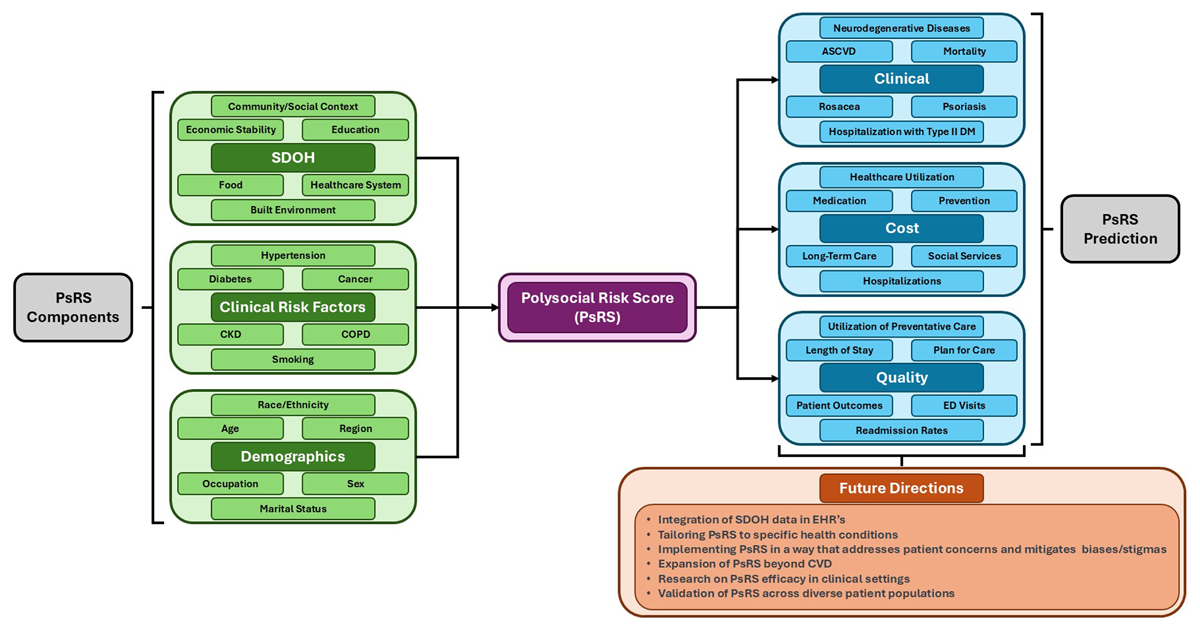
Figure 1
Polysocial risk score: individual components and risk assessment. PsRS: polysocial risk score
Evidence regarding PsRS for CVD risk estimation is relatively limited; however, significant strides have been made in recent years using diverse data sources and methodological approaches. In our prior work, we developed and validated the first polysocial risk score to assess atherosclerotic CVD (ASCVD) risk in the general United States (US) population.9 We included nearly 40 social risk factors across established SDOH domains and demonstrated the discriminant validity of PsRS as a robust tool for quantifying cumulative social disadvantage and predicting the risk of ASCVD. This work provided important insights into integrating PsRS into contemporary cardiovascular risk prediction models and potentially improving the identification of individuals with high risk of ASCVD.9
In a unique county-level study to assess the prevalence of CVD, Hong et al. examined race, poverty, education level, grocery store to fast-food restaurant ratio, and primary care physician access in the risk scoring model and found good model fit and discriminatory power. The study showed that PsRS had better cardiopredictive capabilities than existing area-level indices such as the Center for Disease Control and Prevention Social Vulnerability Index.10
In a clinic-based study of middle-aged and elderly adults, Palacio and colleagues developed a social risk score and reported that a higher (worse) polysocial score was consistently associated with poor control of modifiable cardiovascular risk factors.11 The authors reported that higher social risk factor burden was associated with higher odds of failing to meet preventive benchmarks for CVD (eg, blood pressure goals) as well as a higher risk of common cardiovascular risk factors such as smoking.
Ping et al. developed another polysocial index using 14 SDOH factors and evaluated the impact of SDOH on mortality in older adults.12 The study found that higher social burden as captured by PsRS was strongly predictive of mortality and comprehensively captured the aggregate impact of SDOH. Similarly, a meta-analysis by Singh et al. reported that incorporating SDOH into cardiovascular risk prediction models improved their accuracy by identifying individuals susceptible to CVD as a result of poor social metrics.13 These findings suggest that PsRS has useful applications for social risk estimation and prediction of diverse cardiovascular and related outcomes, including mortality.12
PsRS in Other Clinical Contexts
The concept of PsRS has been applied in diverse clinical contexts. In a unique study by Li et al., PsRS was developed in the context of neurodegenerative diseases, including Alzheimer’s disease and vascular dementia.14 Using a PsRS model comprised of 10 social factors and a polygenic risk index, the authors found that the hybrid model was effective in identifying individuals with the highest risk of dementia in a population of 345,439 patients over a median follow-up of 12.5 years.14 He et al. developed a polyexposure risk score for type 2 diabetes that included an array of social and environmental exposures and behavioral/lifestyle factors and reported increased predictive capacity compared with traditional clinical risk factors alone.15
In a prospective study from Hunan, China, Chen et al. determined the impact of SDOH on rosacea while also investigating any correlations between PsRS and incidence of rosacea.16 The study found that adults with a larger PsRS had a substantially higher risk of developing rosacea compared to those with lower social risk. A similar large-scale prospective study of the UK Biobank by Tian et al. aimed to uncover any associations between PsRS and incidence of psoriasis.17 Individuals with a higher PsRS had a 1.53-times higher risk of developing psoriasis than low-risk individuals, implying that high PsRS values are positively correlated to greater risks of psoriasis. In a retrospective analysis of the Health and Retirement Study, Jawadekar et al. found that adding additional SDOH to race, education, gender, and insurance only marginally improved prediction of cognitive decline and mortality.18 The authors suggest that more specific SDOH, such as food insecurity and social support, may be explained partially by upstream factors such as race and education.
Existing evidence strongly supports the important role of SDOH as key determinants of overall health, well-being, and quality of life. Future work should focus on harmonizing PsRS development efforts across clinical disciplines in order to generate holistic risk prediction indices that can be validated in diverse clinical and sociodemographic settings.
Polysocial Risk Scores: Real-World Integration and Uptake
PsRS presents unprecedented opportunities for holistic risk prediction and informed clinical decision making for favorable patient—and population—outcomes. Recent advancements in big data and interoperability of new electronic health record (EHR) platforms offer unique avenues for PsRS integration into real-world clinical decision support systems. This is valuable not only for holistic risk assessment/stratification but also for informed, evidence-based community navigation to identify and address outstanding social barriers (Figure 2). Several recent efforts address important practice gaps and provide useful frameworks for PsRS integration and mitigation of SDOH burden.
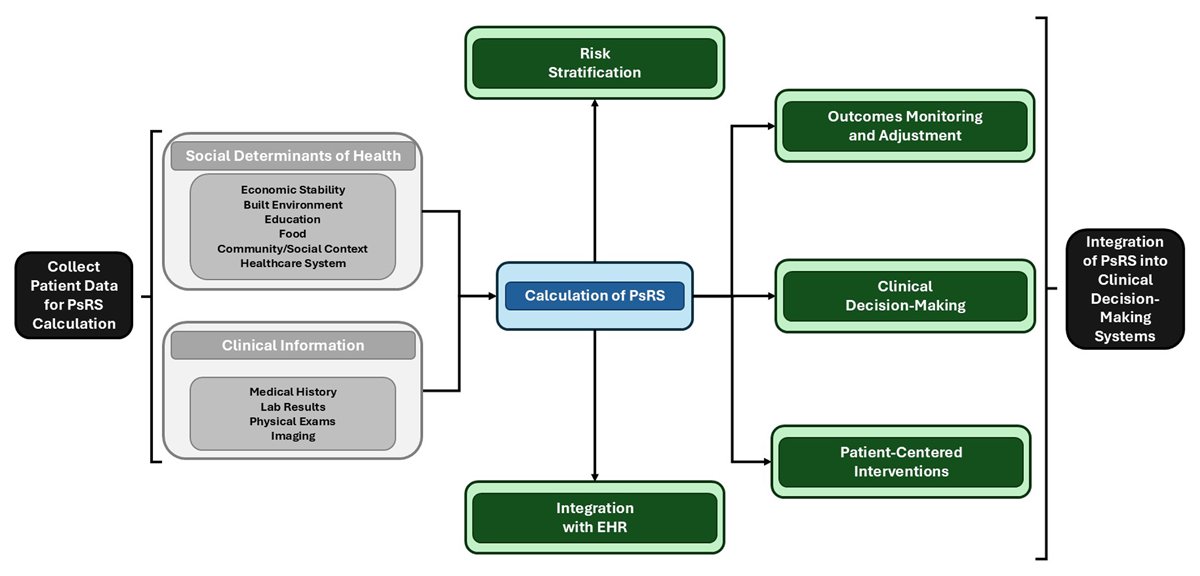
Figure 2
Polysocial risk score: opportunities for real-world integration.
In a pioneering real-world SDOH integration and implementation effort, Rogers et al. developed a customized PsRS screening tool for Medicare and Medicaid beneficiaries and integrated the index into the Epic EHR system (Epic Systems Corporation). The screening tool was further integrated into a novel community resource referral program, thereby creating a unique workflow encompassing clinical documentation, SDOH screening, and community referral for holistic patient care.19 Within 3 years, the integrated PsRS tool identified nearly 8,000 SDOH risk factors and connected over 6,000 patients with community resources.
A novel study by Huang et al. used an EHR-based machine learning approach to validate PsRS in predicting hospitalization with type 2 diabetes.20 The authors analyzed 10,192 real-world patients with type 2 diabetes from the EHR system and found that after accounting for most traditional risk factors, the risk score predicted more than 40% of observed variation in hospitalization risk. The authors also tested PsRS performance across sociodemographic subgroups and reported variation across racial/ethnic groups, including potential risk misclassification for Hispanic patients, which underlines the need for tool validation in diverse social and environmental settings.
In a large-scale SDOH screening, integration, and community referral initiative, a polysocial integrated SDOH screening tool was developed and deployed across seven emergency department sites in a large health system.21 The tool screened over 8,000 patients in the first 5 months of program implementation and determined that nearly 20% of patients experienced a social need spanning housing, food insecurity, and transportation.
Polysocial screening tools such as PRAPARE (Protocol for Responding to and Assessing Patients’ Assets, Risks and Experiences) are standardized risk assessment indices that cover most of the core SDOH domains, including personal/demographic variables, social and emotional context, housing, assets/resources, and family.22 PRAPARE offers templates for seamless EHR integration standardized across ICD, SNOMED, and LOINC coding frameworks and has been translated in over 20 languages, thereby enabling robust SDOH screening in diverse clinical and sociodemographic settings.
Similarly, the Centers for Medicare & Medicaid Services’ health-related social needs (HRSN) tool—a comprehensive polysocial risk assessment model—has been implemented at diverse health systems nationwide for SDOH screening and community referral, with favorable impacts on patient outcomes.23 Findings from this community health center implementation highlighted food insecurity as the most commonly reported social barrier.
There is additional evidence to suggest that incorporating SDOH into pooled cohort equations and the PREVENT (Predicting Risk of CVD Events) score equations may improve clinical risk assessment. A study of four large prospective cohorts found that adding area-level SDOH (education, income, and employment) improved calibration of risk prediction models, whereas considering both individual- and area-level SDOH improved both model calibration and discrimination, albeit with relatively modest improvements in risk prediction.24 While this study examined a relatively limited number of social factors and did not account for race/ethnicity, these results still highlight the potential for PsRS to augment existing clinical risk assessment tools.
Implications and Future Directions
Traditional risk modeling approaches for CVD and other leading health indicators have inherent shortcomings, including a lack of attention to nonclinical/social determinants as predictors of health outcomes and as key drivers of health disparities. The downstream consequences of the relative inattention toward SDOH are reflected in persistent inequities in CVD outcomes. The polysocial risk scoring framework presents unique opportunities to capture the true extent of patients’ disease risk, encompassing both clinical and social domains. Existing evidence strongly suggests a clear, consistent, and independent role of SDOH—as measured using the PsRS—for CVD risk estimation and stratification. However, current utilization of available polysocial frameworks or SDOH screening and identification is limited, highly fragmented, and needs urgent attention to address persistent disparities in CVD.
It is estimated that nearly 40% of US hospitals do not have a systematic, integrated process to screen for SDOH risk factors.25 Future work should focus on health system-level and broader policy initiatives to create processes that enable efficient integration of PsRS and other SDOH indices into clinical workflows. Tools such as PRAPARE and HRSN are compatible with the Epic EHR system and screen for the majority of SDOH domains. Additional efforts are needed to improve data standardization and harmonization across multiple incoming data streams such as clinical, demographic, SDOH, and others.
Completeness of EHR data is key to successfully developing and implementing PsRS in clinical settings.26 A systematic review of 71 studies found that integration of individual-level SDOH data into EHR systems improved predictive performance of various outcomes—such as service referrals and medication adherence—compared with systems that only incorporated external, area-level SDOH data.27 Area-level SDOH data are also extremely valuable,28 and geographic information systems may aid in the assessment of cumulative social risk in clinical settings.29 With tools such as the Epic SDOH wheel (which screens for SDOH during registration and in-person check-in) being integrated into more hospital systems,30 there are more opportunities for prospective clinical trials to assess PsRS efficacy in real-world settings.
Concurrently, EHR systems are known to have a high level of missing SDOH information, which has been shown to limit the effectiveness of social risk assessment. Large language processing models are useful tools to address gaps in SDOH collection and documentation. Such models are already being used in practice to address SDOH data missingness using unstructured EHR text.31,32 Leveraging deep learning and artificial intelligence can enhance the acquisition of this EHR data for use in PsRS, potentially improving future integration within clinical settings.33,34 Machine learning-based methods can also help overcome patient- and provider-related barriers to acquiring SDOH.35
Newer models are being developed based on the concept of the “exposome,” inclusive of SDOH and environmental risk factors such as air quality, noise pollution, neighborhood characteristics, and other variables. For instance, Hu and colleagues developed a polyexposomic risk index for predicting hypertensive disorders of pregnancy, using over 5,000 diverse social, ecological and built environment factors including air pollution, economic stability, housing, climate, and others.36 Recent advances in big data processing, especially through the use of novel machine learning and artificial intelligence algorithms, offer tremendous opportunities to study a wide array of diverse polysocial and/or polyexposomic data from multiple data streams.
Community navigation and referral is integral to the success of PsRS implementation, translation, and adoption. Community stakeholder partnerships are key, and health systems should make deliberate efforts to bridge the clinic-to-community gaps via long-term partnerships with community organizations to build a collaborative environment that fosters mutual trust. Validated community engagement tools such as the GRID framework and others are useful for engaging community as well as patient partner stakeholders and to meaningfully involve socially vulnerable populations in the research process for informed clinical decision-making.37 SDOH frameworks should incorporate community navigation as an integral part of efforts to address outstanding social risk factors. Frameworks such as the Kaiser Family Foundation and Centers for Disease Control and Prevention extend the traditional SDOH model by integrating broader policy initiatives, leveraging community-based solutions, and utilizing advanced data technologies to identify and potentially address the root causes of health disparities.38
Concerns of Polysocial Risk Scores
Despite the potential promise of PsRS, there are several concerns that should be addressed. SDOH vary in intensity and duration of exposure, thus exerting different influences on individuals of different ages and social, cultural, and economic circumstances. The optimal risk score could differ across sociodemographic and clinical subgroups and may vary over time. Often, the “treatment” of SDOH relies on policy shift.39 Greater evidence from population-based, community-connected studies is needed to address these knowledge gaps. There is also a need to assess the temporal effects of SDOH. Most available evidence regarding PsRS for CVD and related conditions is cross-sectional in nature, which limits assessment of causality. Future studies should use relevant methodological tools to examine temporal variation in SDOH and assess life-course effects of polysocial risk on CVD and other outcomes.40
It is also important to consider the design of PsRS implementation to enhance their effectiveness in future trials and clinical practice. A qualitative survey conducted by Byhoff et al. found that patients believe screening for social factors is important, and that for such screening to be implemented effectively, it must be patient-centered and conducted with appropriate sensitivity.41 Perceived bias and discrimination should also be addressed, as patients in a similar qualitative study also expressed concerns about divulging deeply personal, potentially stigmatizing information to their healthcare provider.42 With privacy being a major concern for patients regarding detailed SDOH screening, strict confidentiality policies are essential to ensure ethical use of individual- and area-level SDOH data. Patients also recognize the limitations of the healthcare system in addressing social factors,41 which further underlines the importance of ongoing efforts to incorporate social services and community resources into the clinical workflow.43,44
Conclusions
Traditional cardiovascular risk assessment tools often fail to capture the full impact of upstream SDOH on patient health outcomes, potentially limiting their efficacy in holistic patient risk assessment encompassing social and clinical risk, with implications for clinical decision-making and outcomes. The relative inattention to SDOH measurement is a key driver of persistent disparities in leading health indicators, including CVD. Anchored by an abundance of population-based data that can be integrated into EHR systems, PsRS may help address this problem and improve outcomes by measuring SDOH and identifying clinically and socially vulnerable populations in a variety of settings. However, there is a lack of research evaluating the feasibility and efficacy of PsRS in real-world settings. Future work should emphasize completeness of SDOH data, seamless integration with existing EHR systems, and community navigation/referral as well as protection of private patient data and confidentiality regarding sensitive social information. The results from such studies can help inform the optimal implementation of PsRS in real-world clinical settings, with the ultimate goal of efficiently identifying patients with the highest burden of adverse SDOH and improving downstream outcomes.
Key Points
Polysocial risk scores (PsRS) can help improve risk assessment for atherosclerotic cardiovascular disease and in a variety of other clinical settings.
Electronic medical records and deep learning tools can facilitate extraction of patients’ socioeconomic data.
Further research is needed to optimize implementation of PsRS screening in real-world clinical settings.
Competing Interests
The authors have no competing interests to declare.