
Introduction
Clinical trials are the cornerstone of medical research and provide practice-changing evidence to recommend interventions that work best to improve patient outcomes.1 However, the participants of clinical trials often fail to adequately include populations most impacted by chronic diseases. These include underrepresented groups defined by gender identity, sexual orientation, ethnicity, race, socioeconomic status, and disability, among others.2 Of the 55 drugs approved by the US Food and Drug Administration (FDA) in 2023, only nine drug trials enrolled at least 10% of individuals identifying as Black race despite comprising 12% of the United States population.3,4 Similarly, those of Asian, Hispanic, American Indian or Alaskan Native descent were enrolled significantly less than their population prevalence.3,4 Gender minorities are rarely reported in clinical trials (0.1% of trials in one estimate), and those with intellectual or physical disability are often excluded from participation.5,6 Finally, in cardiovascular medicine, studies have found that race is reported in only 23% of clinical trials and, when reported, these groups are vastly underrepresented compared to their population estimates.7,8 This underrepresentation threatens external validity and precludes benefit for these communities, who carry a disproportionate burden of disease. Recent attempts have been made to improve representation in clinical trials, identifying structural, social, and economic barriers for individuals and their communities but also identifying similar barriers inherent in current trial design on an institutional level.2,9,10 Thus, the prominence of the social determinants of health in clinical trials—namely economic stability, education access and quality, healthcare access, social and community context, and neighborhood environment—cannot be understated. This review summarizes key issues regarding recruitment of underrepresented groups in clinical trials, with a particular focus on the social determinants of health from the institutional level to the individual level, and provides proven and burgeoning processes to combat recruitment barriers.
Barriers
Institutional and Trial Level
Clinical trials require a scientific question, study population, research site, protocol, and funding. Research questions are developed by scientists, whose interests may not fully reflect the needs of underrepresented groups.9 Research questions are also often driven by funding opportunities, narrowing their scope to fulfill investor expectations. In recent years, industry-funded trials have skyrocketed while government-funded trials have decreased.11 Industry funding alone has been associated with reduced representation, including minority race and ethnic groups.12,13,14 Further disparities exist within the exclusion criteria used to select the trial population itself, as underrepresented groups often fail to meet eligibility criteria.15,16,17,18,19 Reasons cited include lack of preexisting data, advanced disease at presentation, and comorbidities, all of which relate to inequities in healthcare access and treatment. Inclusion criteria may also promote under-enrollment, such as in heart failure trials that establish eligibility using natriuretic peptides even though there are racial differences in baseline levels, likely related to access to care and chronic disease management.20,21 Research sites and recruitment are often at large academic medical institutions, leading to lack of geographic and rural diversity as well as lack of socioeconomic, racial, and ethnic diversity.22,23,24,25 If there is recruitment outside of the medical institution, it may be through a website or journal that does not reach underrepresented groups.9 Protocol development includes the language and words used in all materials of the study, including recruitment material, consent forms, and qualitative surveys, which can be inadequate for the nuanced dialect and literacy level of participants from underrepresented groups.25,26,27 In addition, trial protocols often place undue burden on participants, requiring multiple clinic visits or laboratory draws, without patient-centric end points.28
Underrepresentation is prevalent among trial investigators as well, widening dissimilarities between participants and research. Less than 10% of pharmaceutical and biotechnology CEOs are female, and there are significantly less principal investigators of racial and ethnic minorities.29,30 While seemingly distant from trial participants, studies have shown associations between trial leadership and congruent recruitment. For instance, cardiovascular clinical trials with female principal investigators and a greater number of women authors were associated with higher enrollment of women participants.31,32 Trial staff, such as those involved in enrollment, clinic site visits, and data collection, also play roles in trial perceptions and concordant care.9,33
Community Level
The community context of underrepresented groups is an important social determinant for study recruitment. At the community level, engagement of stakeholders by clinical trials is often suboptimal, leading to decreased recruitment of underrepresented groups. Time and budget constraints and stakeholder unawareness of trial opportunities were commonly cited barriers to stakeholder engagement.9,10 Stakeholders may include community primary care physicians, who may be unable to support clinical trial recruitment due to structural and regulatory challenges and the impact on workload and productivity.34 Finally, there may be mistrust in certain groups rooted in structural discriminatory practices in research and science, although recent studies suggest that this barrier can be overcome through targeted outreach and community engagement.35,36
Individual Level
There are several barriers at the individual level for clinical trial participation, including economic, environmental, and healthcare access. While cited at the individual level, these barriers are a product of systemic inequities. Women, Black, Hispanic, and disabled individuals have consistently lower median incomes and less paid leave than their white, male counterparts.37,38,39 Time and even the cost of transportation can be significant barriers to trial participation, particularly when considering the loss of potential wages.9,10 Unstable housing, more common among historically marginalized groups, can lead to frequent moves and loss of trial follow-up.40 Similarly, reliable telephone access constitutes another barrier for individual enrollment and drop out.40 Finally, regular access to a primary care provider and satisfaction with health care (in terms of knowledge, trust, and perception) are significant reasons an individual may or may not participate in a trial.9,41,42
Proposed Solutions
Structural
For trial design, several structural changes have been posited to improve underrepresented recruitment (Figure 1). The first, seemingly basic solution is to have prespecified enrollment targets for certain underrepresented groups based on census and disease prevalence data.9 The FDA’s new guidance on recruitment of underrepresented populations formally recommends that enrollment goals be submitted along with investigational drug or device applications.43 Loosening eligibility criteria—such as including all New York Heart Association classes of heart failure or any multitude of natriuretic peptide levels in cardiovascular trials2,20— to allow for those with more comorbidities may additionally lead to greater representation given the higher burden of chronic diseases among minority groups. Selecting medical institutions that serve a higher prevalence of underrepresented groups for clinical trial sites can facilitate recruitment.9 In addition, hybrid or decentralized trials that utilize community sites, home visits, and remote technology can eliminate geographic and time barriers.2
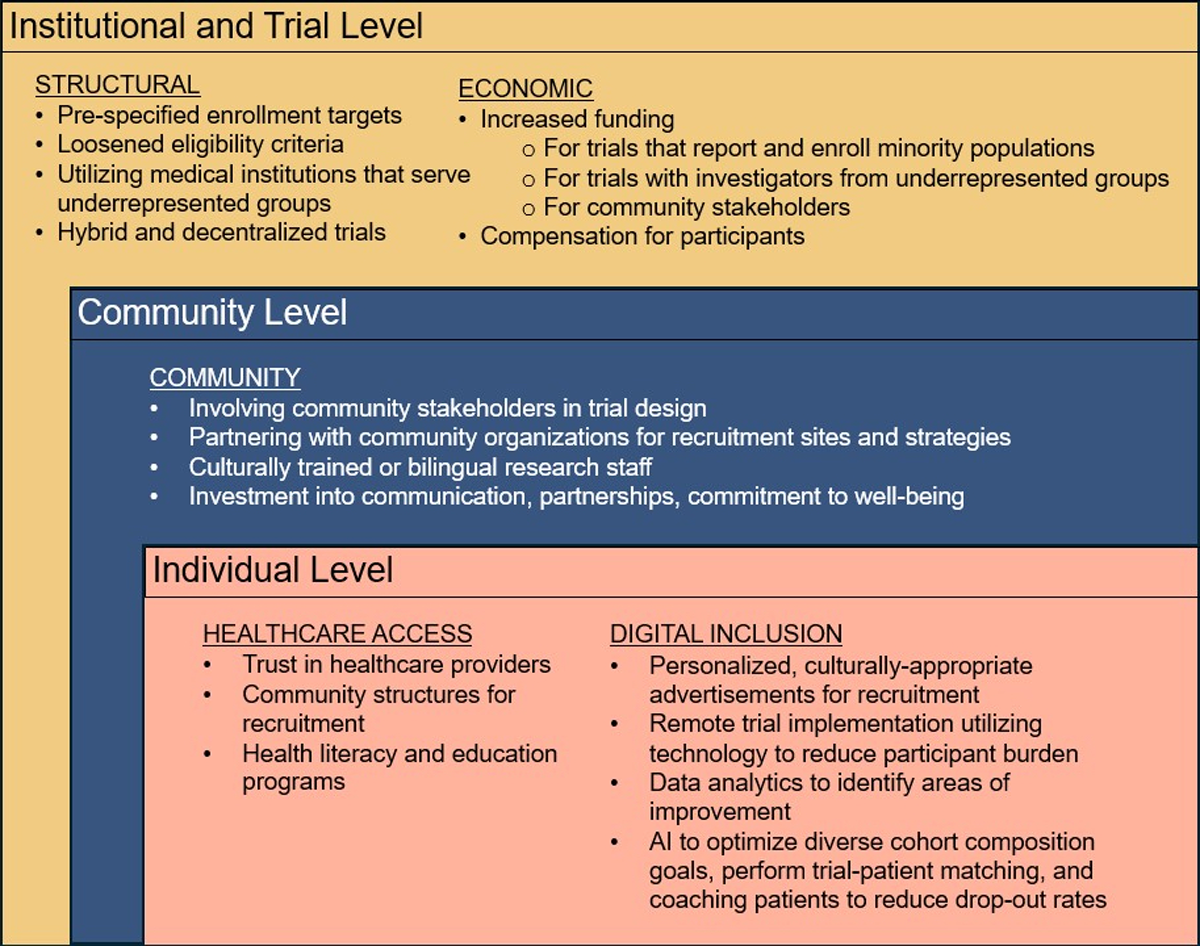
Figure 1
Social determinant-based toolkit for recruitment of underrepresented groups at the institutional/trial, community, and individual level. Toolkit includes structural, economic, community, healthcare access, and digital inclusion solutions.
Economic
Increased funding for trials that report and enroll representative minority populations is a clear solution to the current homogeneous state of clinical trials. The National Institutes of Health, one of the largest federal funders of clinical trials, has dozens of grants to increase trial funding for underrepresented groups, and even industry and pharmaceutical giants such as Pfizer have created specific grants for funding research that aims to reduce disparities.44,45 Increased funding for trials with investigators from underrepresented groups can also indirectly increase minority representation in clinical trials.2,9 For enrollment and retention, greater funding for community stakeholders to increase trial accessibility, and flexible funding for longer enrollment periods, recruitment materials, and more research staff can aid in increasing the diversity representation in clinical trials.9,10 Finally, significant debate surrounds compensation of trial participants given the concern for coercion and is limited by processes through the Institutional Review Board.46 However, identifying ways of compensation and assistance for transportation, time, and effort ensures fair compensation and combats undue burden on these individuals, aligning with ethical principles.46
Community
The social and community context of the trial is another determinant that can be targeted to improve representation. Involving community members in the design of the trial, such as through a community advisory board, can improve enrollment and retention by enhancing the community’s perception and appropriateness of trial materials and by refining the research question itself to maximize benefit.9,47,48 Partnering with community organizations for recruitment sites and strategies has been shown to increase enrollment, likely through cultural, linguistic, and geographic improvement in recruitment strategies and inherent trust in the community partner involved.40,49 Having culturally trained and bilingual or multilingual research staff also can improve community perceptions and improve comprehension of the study’s materials.20,50 Other principles of community engagement include clear investment into the community with good communication, sustainable partnerships, and long-term commitments to the community’s well-being.20 In fact, community investment before research needs arise is crucial in building trust and reciprocity to allow for true partnerships between investigators and the communities they seek to reach.9
Healthcare Access
Lack of access to health care, whether through geographic, financial constraints, or perceptions of the medical institution, presents a challenging barrier for enrollment of underrepresented groups in clinical trials. As previously mentioned, selecting medical institutions that serve more underrepresented groups or decentralizing trials to include community health sites or home visits can help remove physical barriers to healthcare access and trial enrollment for underrepresented groups.2,10 Primary care providers are another key mediator to trial participation, as studies have shown that relationships and satisfaction with primary care physicians increase trial enrollment and follow-through.34 Clinic-level interventions to facilitate enrollment, such as modifying clinic workflow, electronic health record alerts, a full-time onsite study coordinator, and dedicated time to participate in research are several avenues to improve enrollment through primary care providers.34 Further, using community structures and figures outside the medical field, such as churches and barbershops, as sites of recruitment and intervention has been used with success, in part by overcoming geographic barriers but also motivating health behaviors through social networks.2 Finally, trial materials and processes should have appropriate health literacy with available education programs.48
Digital Inclusion
Digital health tools can help increase the diversity of clinical trials. Trials can utilize remote technology to recruit and implement the interventions themselves, lowering participant burden. The CHIEF-HF (A Study on Impact of Canagliflozin on Health Status, Quality of Life and Functional Status in Heart Failure) trial, which evaluated the effect of sodium-glucose co-transporter 2 inhibitors on heart failure symptoms, was performed remotely with recruitment through the study website, electronic informed consent, direct home delivery of study medication, completion of the primary end point survey by mobile application, and a Fitbit to monitor activity.51 Likewise, the DeTAP (Decentralized Trial in Afib Patients) trial used mobile applications, remote blood pressure, and electrocardiographic monitoring for oral anticoagulation adherence.52 Using this technology, these trials experienced rapid recruitment and high participant engagement. These methods can be leveraged to recruit and maintain underrepresented groups by reducing healthcare access, geographic, time, and financial barriers, particularly when provided to close the digital divide.53,54 Digital care transformation programs can similarly enroll equitable numbers of underrepresented groups through health technology with a goal to improve health outcomes. Remote medication management, mobile phone applications, social media, and web-based programs are all successful avenues to broaden recruitment and trial implementation to improve health outcomes.53,54,55,56 Other opportunities in which digital technology can improve equity in trials include personalized and culturally appropriate advertisements for trial marketing, data analytics to identify drop-outs, and care coordination technologies.54 Finally, artificial intelligence can be utilized to optimize diverse cohort composition goals, perform trial-patient matching through natural language processing, and coach patients to reduce drop-out rates.57
Conclusion
In conclusion, clinical trials need to include populations that represent those with the disease under study. Historically marginalized and underrepresented communities are disproportionately affected by cardiometabolic diseases, and novel strategies are needed to address the barriers to clinical trial enrollment. Leveraging a social determinants-based approach provides a toolkit that targets these barriers using structural, economic, community, healthcare access, and technology solutions. Prespecified enrollment targets, broadening eligibility criteria, increased funding for research focused on underrepresented groups, and decentralizing trials are tangible goals for investigators to improve trial representation. Investment in communities through early partnerships between investigators and community stakeholders, addressing healthcare access and literacy, and ensuring culturally trained and bilingual or multilingual research staff can improve trial recruitment and retainment and positively impact a community. Finally, reducing participant burden by offering remote enrollment, medication management, and monitoring can facilitate recruitment, while digital care transformation programs can directly improve the health of underrepresented groups. Future research should continue to implement these tools for constructive improvement in trial design, enrollment, implementation, and outcomes.
Key Points
Historically marginalized communities are disproportionately affected by cardiometabolic diseases yet are underrepresented in clinical trials that investigate needed interventions.
Barriers to recruitment and enrollment of underrepresented groups exist at the institutional, trial, community and individual level.
Leveraging a social determinants-based approach provides a toolkit that targets these barriers using structural, economic, community, healthcare access, and technology solutions.
Acknowledgements
The authors thank Summer Ngo for her administrative work and assistance with the figure.
Competing Interests
Dr. Fatima Rodriguez reports equity from Carta Healthcare and HealthPals and is a consultant for HealthPals, Novartis, NovoNordisk, Esperion Therapeutics, Movano Health, Kento Health, Inclusive Health, Edwards, Arrowhead Pharmaceuticals, HeartFlow, iRhythm, Amgen, and Cleerly Health outside the submitted work; she receives grant funding from the NIH National Heart, Lung, and Blood Institute (1K01HL144607; R01HL168188), the American Heart Association/Harold Amos Medical Faculty Development program, and the Doris Duke Foundation (Grant #2022051).The other authors have no competing interests to declare.