
Limerick #1
Artificial Intelligence and Machine Learning
May find answers for which we’ve been yearning
Such as a brilliant discovery
About myocardial recovery
But require researchers be discerning.
Limerick #2
The heart will need much coddling
To achieve reverse remodeling
Use an MRI scan
And organize the plan
To reveal how much scarring and mottling.
Limerick #3
There is so much morbidity and mortality
After an infarct with a STEMI abnormality
To reduce the infarct size
Cardiologists now surmise
LV unloading should reduce late fatality.
Limerick #4
To improve heart failure recovery
Will take new knowledge and discovery
Perhaps foremost on the list
Create a new subspecialist
In MI and Functional Recovery.
Marshall S. Flam, MD
Author, Wordle Limericks: Flamericks
Hematologist/oncologist, Fresno, California, US
Commentary
Flam’s amusing limericks are an entertaining and enjoyable summation of several topics presented in this edition of the Methodist DeBakey Cardiovascular Journal (Issue 20.4, July - September 2024). He offers a mirthful look at the serious subject of heart failure as it relates to what might be done for patients to restore more normal function by promoting myocardial cellular recovery after deleterious injury and even cellular regeneration.
Dr. Flam’s interest in limericks goes back decades. He is a retired oncologist/hematologist from Fresno, California, and the author of Wordle Limericks: Flamericks.1 Wordle Limericks is a compendium of poems based upon The New York Times internet “WORDLE” game, played by millions around the world. WORDLE is a seemingly addictive game released digitally each midnight (adjusted for time zones), with players having six attempts to guess a five-letter word. With each word a player enters, the game immediately shows if any letters are in that day’s WORDLE and, if so, if a letter is in the correct space. Flam’s passion for limericks coupled to WORDLE mania has led to additional entertainment for countless WORDLE addicts, and we appreciate his impressive limerick effort.
The limerick form emerged in England during the early 18th century and was often a bawdy and humorous drinking song. The more obscene the verses, the more humorous and popular the poem became. The form is five lines with an anapestic meter (having a line in the poem with three syllables, with the first two syllables short and unstressed, and the third syllable being long and stressed), followed by a strict rhyme scheme that is annotated as “AABBA.” While the origin of the term “limerick” is not clear, it is often said to be a reference to the County of Limerick in Ireland and particularly to a public-house game in the town of Limerick.
A different but related style and format was the “cinquain,” which appears to date back further than the traditional limerick. The term is derived from the French and Latin terms “quinque” and “cinq.” This form was a poem of five lines, which at first was unrhymed. Iconic clinician and academic at Houston Methodist Hospital, Dr. William L. Winters, Jr, identified himself as a “cinquainist,” demonstrating his talent in his book Ruminations of a Cinquainist.2 As he pointed out in this book of limericks and cinquains, expert Adelaude Crapsey characterized cinquains as “22 syllables distributed through five lines in a pattern of two, four, six, eight and two syllables.”
Regardless of your preferred pattern for limericks, our hope is that our audience will wind down during quiet times, share their day with loved ones and friends, and lighten their load of clinical and academic pressures while, perhaps, enjoying a favorite beverage and penning a limerick or two.
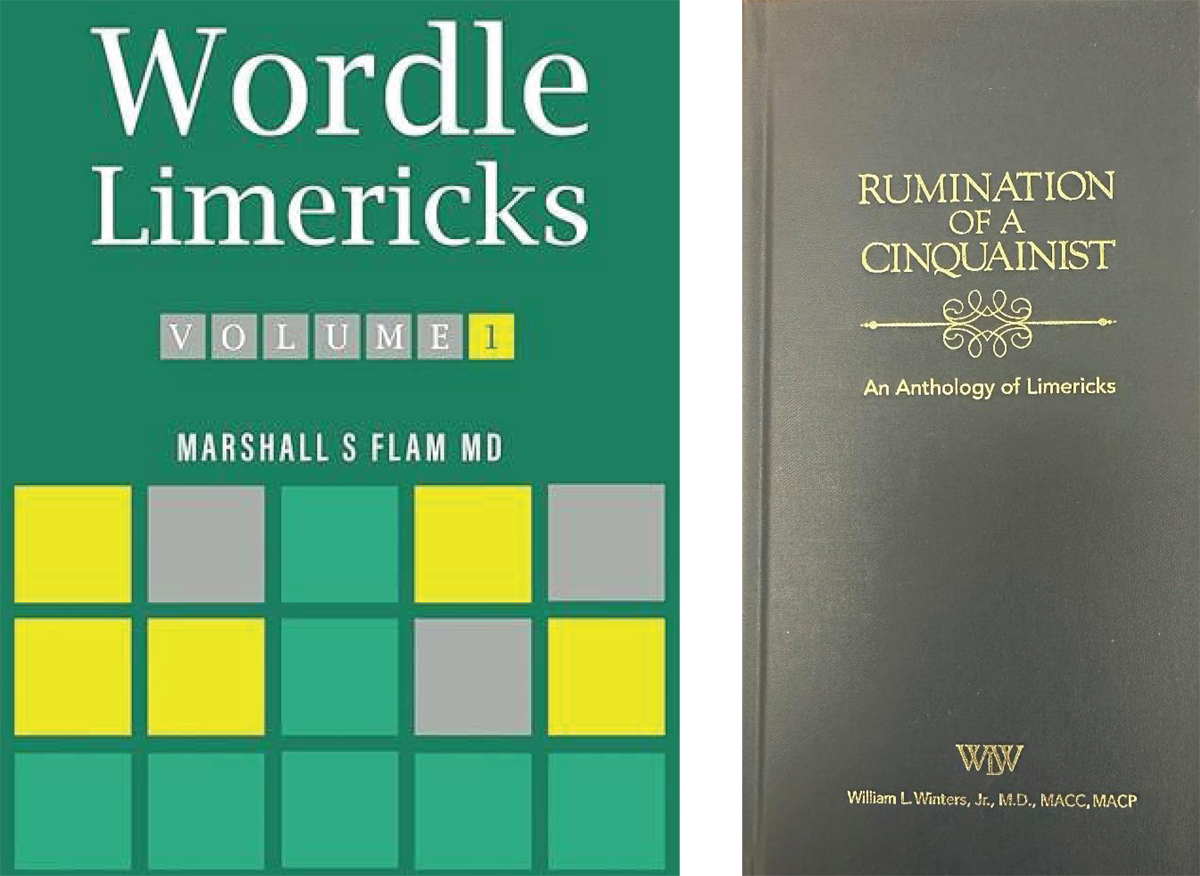
Two books on limericks compiled by physicians: Worldle Limericks by Marshall S. Flam, and Ruminations of a Cinquanist by William L. Winters, Jr.
Competing Interests
The authors have no competing interests to declare.