
Introduction
Myocardial recovery, where there are demonstrable changes in left ventricular (LV) structure and systolic function on imaging, is often thought of as the holy grail of the subspecialty of advanced heart failure (HF). The term has commonly been associated with reversal of HF syndrome and normalization of ventricular function with mechanical unloading from LV assist devices (LVADs). The sometimes-controversial debate of “recovery versus remission” has become less relevant in recent clinical settings, and the notion of plotting a trajectory in a particular patient’s myocardial recovery (recently redefined as improvement) course has become more useful. Here we discuss the concepts of myocardial recovery and remission as they relate to HF with improved ejection fraction (HFimpEF). Additionally, we explore the prevalence of myocardial improvement in various clinical scenarios and the significance of delineating responders from nonresponders as it relates to patient care and potential future research endeavors.
Historical Perspectives and Definitions
The observation of myocardial recovery was historically associated with spontaneous LV recovery after transient severe LV dysfunction due to an acute neurohormonal insult, tachyarrhythmia (with resolution of systolic dysfunction with sinus rhythm restoration), or hyperthyroidism.1, 2 The thought, at that time, was that following these short-lived insults, the cardiac structure returned to normal, both intrinsically at the level of the myocyte and extrinsically regarding LV volumes and global function. In a seminal paper over a decade ago, Mann and Burkhoff put forth the idea that partial recovery of the HF with reduced EF (HFrEF) phenotype consisted of EF improvement between 40% and 50% with residual abnormalities at the (1) myocyte, (2) extracellular matrix, and (3) ventricular structure and performance levels, but true cardiomyopathy recovery included normalization of all three components and a resultant EF > 50%.3
However, contrary to this theory, subsequent evidence demonstrated that the previously determined “fully-recovered” cardiomyopathies indeed were not normal. A classic example is the case of Takotsubo cardiomyopathy; Scally and others have shown that, despite a return to normal LVEF and normalization of serum biomarkers, there are persistent abnormalities in apical circumferential and global longitudinal strain (GLS) in those patients considered to be “recovered.” Increased native T1 mapping values on cardiac magnetic resonance (CMR) imaging persist as well, reinforcing the concept of myocardial remission as a distinct clinical and pathobiological entity.4
Since then, numerous studies have examined the underlying basis of remission, frequently termed LV reverse remodeling (LVRR). While this topic is outside the scope of this article, the current understanding of LVRR is not simply a “replica in reverse” of the molecular and cellular pathways that become dysregulated during forward/maladaptive LV remodeling. Rather, LVRR represents a distinct, multilevel process that leads to a less pathological myocardial steady state.5, 6
The experience with the acute cardiomyopathies paved the way for expanded clinical scenarios of recovery/remission, most notably with regard to chronic LV unloading with durable LVADs. After years of studying LV unloading and strategies for recovery, the dedicated Remission from Stage D Heart Failure (RESTAGE-HF) trial added intensive neurohormonal therapy for HF plus LV unloading and demonstrated a 40% recovery rate sufficient to meet the primary outcome, defined as sufficient improvement of myocardial function; this allowed for LVAD explantation within 18 months with sustained remission from death/mechanical circulatory support/heart transplantation at 12 months.7 This was a culmination of sorts of over a decade of clinical experience and discovery by Birks and colleagues with LV unloading with durable LVADs.
In addition, it is now widely recognized that, when exposed to highly effective neurohormonal therapies (collectively termed guideline-directed medical therapy [GDMT]), a subset of HFrEF patients undergo LVRR and functional improvement.8, 9 Further, LVRR has been observed in patients who have received guideline-indicated implantable devices, especially cardiac resynchronization therapy (CRT).10, 11 In clinical trials, CRT receipt is associated with significant reduction in LV volumes and improvement in LVEF.12, 13 This subset of GDMT and device “responders” is now referred to as HFimpEF, previously known as recovered EF (HFrecEF),14 and has recently been recognized as a distinct clinical entity in the American Heart Association/American College of Cardiology/Heart Failure Society of America’s (AHA/ACC/HFSA) clinical guideline.15
Despite our knowledge of the phenomenon of myocardial recovery/improvement in clinical practice, it was only recently that a consensus statement definition was put forth for HFrecEF, which included: (1) a documented history of HFrEF with LVEF ≤ 40%, (2) ≥ 10% absolute increase in LVEF, and (3) resultant LVEF > 40% with an accompanied reduction in LV volumes.14 This delineation has garnered support from a recent consensus statement on the universal definition of HF from the HFSA/European Society of Cardiology/Japanese Heart Failure Society, with an iteration in terminology from HFrecEF to HFimpEF. This change was based on totality of the evidence that there is a persistent HF risk in this population, and remission/improvement is the more accurate description.16 A now contemporary term, the HFimpEF classification, is also supported by the most recent AHA/ACC/HFSA HF guidelines.15 Notably, these guidelines do not specify a criterion for an absolute increase in LVEF.
Current Understanding of Improvement
Prevalence
A potential reason for HFimpEF only recently becoming incorporated into the guidelines is the varying estimates of the proportion of patients with improved LVEF. Due to the heterogeneity in clinical populations and variable definitions in both observational and clinical trial datasets, improvement rates range widely (Table 1).9, 17, 18, 19, 20, 21, 22, 23, 24, 25, 26, 27, 28, 29, 30, 31, 32, 33, 34, 35, 36 Over a decade ago, work from the IMPROVE-HF study—a large observational cohort of outpatients with HFrEF enrolled in a performance measure intervention—demonstrated that partial improvement was possible with current available pharmacotherapies, which at the time included only angiotensin-converting enzyme inhibitors and beta blockers. However, despite not being exposed to either angiotensin receptor/neprilysin inhibitor (ARNI), mineralocorticoid receptor antagonist, or sodium-glucose cotransporter 2 inhibitor (SGLT2i) therapies, almost one-third of patients experienced meaningful improvement of myocardial function, with nearly a doubling of LVEF function (from 25% to 46%).21 In a meta-analysis, when multiple definitions of myocardial recovery/improvement are combined, the prevalence estimate was lower at 22.6% at a mean follow-up of 3.8 years.30 The prevalence of HFimpEF is likely somewhere between currently available estimates. Further, multicentered, diverse analyses are necessary to refine these estimates by duration of HF, cardiomyopathy type, and type and duration of HF therapies.
Table 1
Prevalence of improvement from observational cohorts and subgroup analyses of clinical trials.* Modified from Gulati and Udelson.17 EF: left ventricular ejection fraction; HFrEF: heart failure with reduced ejection fraction; DCM: dilated cardiomyopathy; ACE: angiotensin-converting enzyme inhibitor; BB: beta blocker; ARB: angiotensin receptor blocker; MRA: mineralocorticoid receptor antagonist; ARNI: angiotensin receptor/neprilysin inhibitor.
| FIRST AUTHOR | PUBLICATION YEAR | STUDY SIZE (N) | POPULATION | BASELINE THERAPIES (> 70%) | IMPROVEMENT EF CUTOFF | FREQUENCY OF IMPROVEMENT (%) |
|---|---|---|---|---|---|---|
| Cioffi18 | 2004 | 110 | Chronic HFrEF (EF < 40%) | Digoxin, diuretics | > 51% | 18% |
| McNamara19 | 2011 | 373 | Recent onset DCM & myocarditis (EF ≤ 40%) | ACE, BB | ≥ 50% | 25% |
| Merlo20 | 2011 | 242 | Chronic DCM | ACE, BB, digoxin | Increase ≥ 10% or ≥ 50% | 37% |
| Wilcox21 | 2012 | 3,994 | Chronic HFrEF (EF ≤ 35%) | ACE, BB | Increase > 10% | 29% |
| Dunlay22 | 2012 | 674 | Chronic HF (EF < 50%) | Not given | ≥ 50% | 39% |
| Merlo24 | 2015 | 408 | DCM (EF < 50%) | ACE/ARB, BB | ≥ 50% | 15% |
| Florea9 | 2016 | 4,410 | Chronic HFrEF (EF < 35%) | ACE, diuretics | > 40% | 9% |
| Kalogeropoulos25 | 2016 | 2,166 | Chronic HFrEF (EF ≤ 40%) | ACE/ARB, BB | > 40% | 16% |
| Lupon26 | 2017 | 940 | Chronic HF (EF < 45%) | ACE/ARB, BB, diuretics | ≥ 45% | 25% |
| Agra Bermejo27 | 2018 | 242 | Chronic HFrEF (EF ≤ 40%) | ACE/ARB, BB, diuretics | > 40% | 52% |
| Chang28 | 2018 | 318 | African-American, Chronic HFrEF (EF < 35%) | ACE/ARB, BB, diuretics | > 40% | 19% |
| Ghimire29 | 2019 | 3,124 | Chronic HFrEF (EF ≤ 40%) | ACE, BB | Increase ≥ 10% | 38% |
| He30 | 2021 | 9,491 | Meta-analysis Chronic HFrEF | Varied | Varied | 23% |
| Zhang31 | 2021 | 1,160 | Chronic HFrEF (EF < 40%) | ACE/ARB, BB, MRA† | > 40% & increase ≥ 10% | 25% |
| Yang32 | 2022 | 262 | Chronic HFrEF (EF ≤ 40%) | BB, MRA | > 40% & increase ≥ 10% | 46% |
| Goh33 | 2023 | 407 | Chronic HFrEF (NICM; EF ≤ 40%) | ACE/ARB, BB | > 40% & increase ≥ 10% | 34% |
| Liu34 | 2023 | 573 | Chronic HFrEF (EF ≤ 40%) | ACE/ARB/ARNI, BB | > 40% & increase ≥ 10% | 37% |
| Mohebi36 | 2023 | 416 | Chronic HFrEF (EF < 35%) | ARNI, BB | ≥ 35% | 61% |
| Romero35 | 2024 | 1,307 | Chronic HFrEF (EF ≤ 40%) | ACE/ARB/ARNI | > 40% & increase ≥ 10% | 39% |
[i] *Select studies presented and not intended to be an exhaustive list.
†MRA only > 70% in persistent HFrEF patients
Importance of Underlying Etiology and Clinical Predictors
Determining the etiology of myocardial dysfunction is crucial to estimating the probability of achieving myocardial remission or HFimpEF status. Simply stated, the “etiology of the cardiomyopathy matters,” and the nature and duration of the myocardial insult modulate improvement status. In reality, it is often challenging in clinical practice to determine the exact inciting myocardial insult, which results in many patients being labeled as idiopathic nonischemic cadiomyopathy. Figure 1 shows many of the toxin, inflammation, and abnormal energetic insults that, when removed, frequently result in spontaneous improvement in LV function and LVRR.1
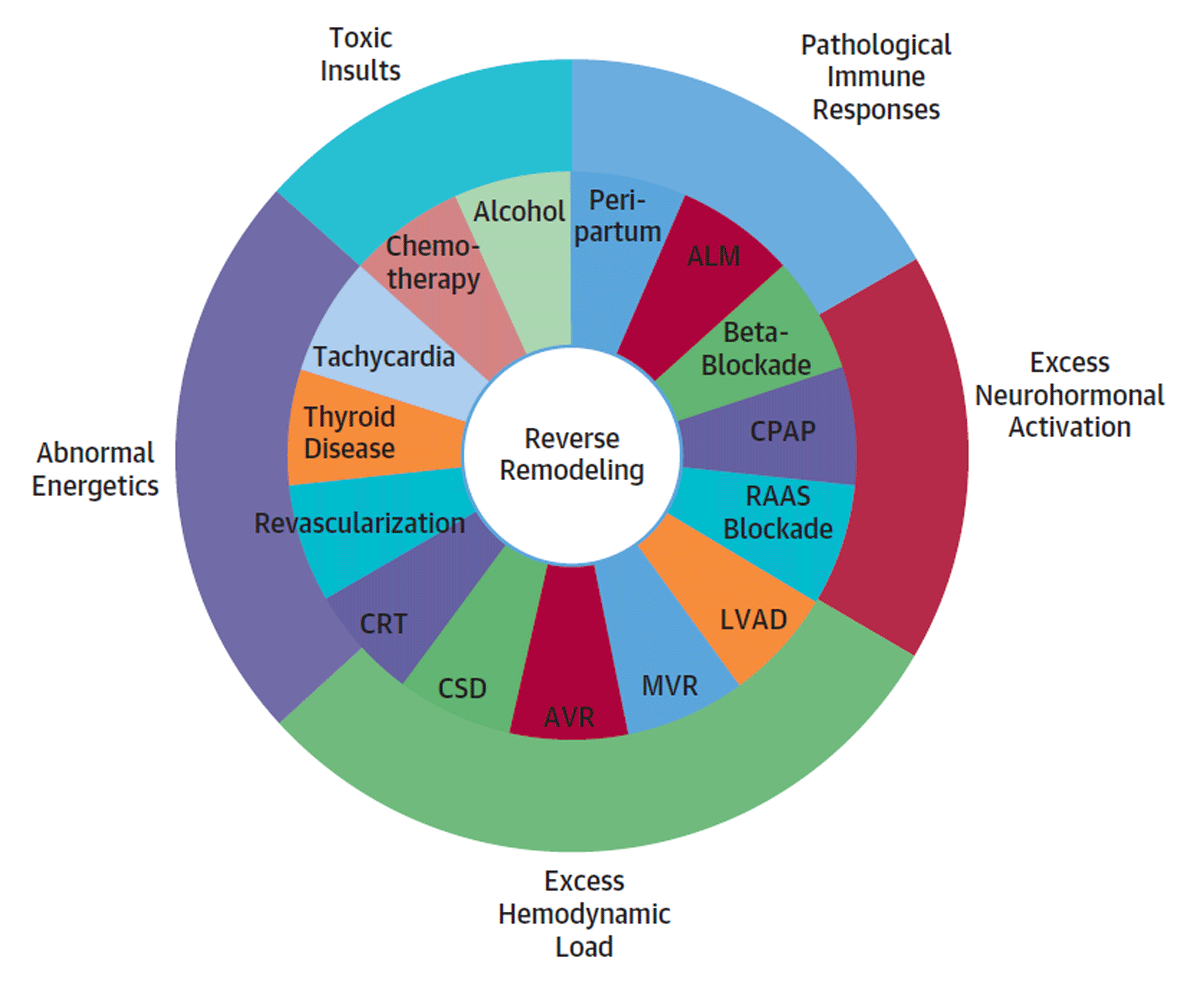
Figure 1
Categorization of frequently encountered myocardial insults in clinical practice. The outer ring represents pathobiologic insults that can result in left ventricular ejection fraction reduction. The middle ring represents either treatments that can result in left ventricular reverse remodeling (LVRR) or scenarios where LVRR can occur if the insult is removed. Used with permission from Hellawell and Marguiles.1 ALM: acute lymphocytic myocarditis; CPAP: continuous positive airway pressure; RAAS: renin-angiotensin-aldosterone system; LVAD: left ventricular assist device; MVR: mitral valve repair/replacement; AVR: aortic valve replacement; CSD: cardiac support device; CRT: cardiac resynchronization therapy
In clinical practice, the improvement in ventricular function is often highest in cases of adverse metabolic or energetic milieu, such as the case of tachycardia-mediated and abnormal thyroid-associated (both hyperthyroidism and hypothyroidism) LV dysfunction. Cardiomyopathies due to abnormal immune responses, such as peripartum cardiomyopathy (PPCM), also have higher rates of improvement compared to idiopathic dilated cardiomyopathy (DCM). In one large European-based registry analysis, 46.5% of 465 patients with PPCM had myocardial recovery, defined as baseline LVEF ≤ 45% and follow-up LVEF ≥ 50% at 6 months.37 Similarly, in their analysis of the IMAC2 registry, Cooper et al. demonstrated that 48% of PPCM patients achieve an LVEF ≥ 50% from a baseline of ≤ 40%, which was significantly higher at 6 months than rates in other groups (19% in men; 34% in non-PPCM women, P = .002).38 Improvement in LV function also can be seen after the discontinuation of cardiotoxic agents, including alcohol39 and monoclonal antibodies.40 For example, in one small Spanish analysis, > 40% of patients with alcohol-associated cardiomyopathy developed LVEF recovery (defined as follow-up LVEF ≥ 40% and increase in absolute LVEF by ≥ 10%) with a reduction in or abstinence of alcohol intake.41 In addition to etiology, a number of other clinical, imaging, and biochemical markers are linked to varying degrees of LVRR (Table 2), although their description is outside the scope of this review.
Table 2
Clinical predictors of myocardial recovery. Used with permission from Wilcox et al.14 LV: left ventricular; HF: heart failure; LBBB: left bundle branch block; Echo: echocardiography; CRT: cardiac resynchronization therapy; CMR: cardiac MRI; LGE: late gadolinium enhancement; NT-proBNP: N-terminal pro-b-type natriuretic peptide; sST2: solute suppression of tumorigenicity 2
| PREDICTOR CATEGORY | PREDICTORS OF REVERSE LV REMODELING |
|---|---|
| Clinical parameters | Nonischemic etiology |
| Shorter duration of HF | |
| Female sex | |
| No LBBB | |
| LBBB in CRT | |
| Genetic factors | Pathogenic gene variants not involving structural cytoskeletal proteins or Z-disk proteins |
| Echo/CMR imaging | Greater contractility on strain imaging LGE absence |
| Biomarkers | Lower NT-proBNP |
| Lower troponin | |
| Lower sST2 | |
| Galectin-3, emerging biomarkers (mimecan, miRNAs, orexin) |
Clinical Relevance
Why Do We Care About Myocardial Recovery/Improvement in Clinical Practice?
Regardless of the specific criteria or thresholds used to categorize HFimpEF, the trend remains consistent: LVRR leads to favorable clinical outcomes compared with persistently reduced LVEF.26, 27, 35 Myocardial improvement is associated with substantially improved clinical outcomes, including reduction in hospitalization rates and death, when compared with persistent HFrEF. For example, compared to patients with myocardial improvement defined as LVEF < 40% to > 40% with an absolute increase in LVEF of ≥ 10%, those with persistent HFrEF have a near two-fold increased risk of all-cause mortality (HR 1.973; 95% CI, 1.206-3.226, P = .007) and of all-cause hospitalization (HR 1.740; 95% CI, 1.336-2.267, P = .000).31 Hence, myocardial improvement is an important target for therapy and is a defined, shared goal for the clinician and their patient. The inability to achieve LVRR or persistent HF symptoms offers the clinician the ability to identify patients at risk for progressive, or ACC/AHA stage D, HFrEF and thereby who may be candidates for advanced therapies.
Why is the Distinction of Clinical Myocardial Remission Important?
The concept of recovery versus remission from HF in DCM led to the seminal Therapy withdrawal in REcovered Dilated cardiomyopathy-Heart Failure (TRED-HF) trial, arguably the only dedicated clinical trial that was performed in what was thought to be a truly “recovered” patient population at the time. In this small but well-powered study, 51 patients with prior DCM and LVEF ≤ 40% who had recovered LVEF to ≥ 50%, were asymptomatic, on GDMT, had normal LV end-diastolic volume (LVEDV) index by CMR imaging, and normal biomarker profiles (normal N-terminal pro-B-type natriuretic peptide [NT-proBNP]) were randomized to GDMT withdrawal. Importantly, within 6 months of GDMT withdrawal, 40% of patients met the primary outcome of relapsing HF (defined as either reduction in LVEF > 10% to < 50%, increase in LVEDV > 10% to higher than the normal range, two-fold rise in NT-proBNP, or clinical evidence of HF). Notably, 13 of the 20 individuals who met the primary study end point did so within 16 weeks of treatment withdrawal.42 Given this high relapse rate of LV dysfunction, the field of myocardial recovery could have paused, but most clinicians in the field leaned into the idea of remission as a laudable goal for patients as the primary lesson of TRED-HF and remain steadfast in trying to understand the biology of remission/recovery.
As previously mentioned, an example of this commitment to remission from HF was the combination of LV unloading with LVAD support and high-dose GDMT utilized in the RESTAGE-HF trial. In this prospective multicenter study, 36 of 40 randomized patients with advanced HF secondary to nonischemic cadiomyopathy, age < 60 years, with starting LVEF < 25%, and short duration of HF (≤ 5 years) underwent protocolized LVAD speed optimization with the goal of maximal LV unloading. Subjects simultaneously underwent aggressive, protocolized titration of multiple pharmacological agents (lisinopril, carvedilol, spironolactone, digoxin, and losartan) to maximally tolerated doses. Within 18 months, 50% (n = 18/36) of patients who completed the study protocol met criteria for LVAD explantation, including an LVEF > 45% and reduction in LV dimensions, with an additional patient meeting criteria after 18 months.7 Through this analysis, Birks and colleagues demonstrated that when remission is a clinical target and the population is enriched, remission is achievable. Learnings from TRED-HF reinforce the concept that GDMT must be continued among LVAD explant patients in addition to close monitoring with biomarkers and serial echocardiography imaging.
Another recent area of clinical inquiry relates to the timing of LVEF improvement, which is likely very different based on the individual patient, and most patients do not demonstrate improvement at the same rate.43 Especially within the first year of de novo diagnosis of HFrEF, there is heterogeneity in response to GDMT, potential for spontaneous improvement in LVEF, and the possibility of early versus later improvement. Additionally, it has been observed that a substantial proportion of patients develop LVEF improvement beyond 1 year, with some demonstrating improvement after 2 years.44
Building on this observation that the timing of improvement can be highly variable is a subgroup analysis from the Effects of Sacubitril/Valsartan Therapy on Biomarkers, Myocardial Remodeling and Outcomes (PROVE-HF) trial.36 In the original PROVE-HF trial, patients exposed to sacubitril/valsartan (ARNI) demonstrated improvement in LVEF at 6 months and further improvement at 12 months.45 In a subgroup analysis of 416 patients, 61.3% of those eligible for implantable cardioverter-defibrillator (ICD) implantation (LVEF < 35%) at trial inclusion improved their LVEF to ≥ 35% after 12 months of ARNI exposure. In their model, the most significant factors that predicted lack of LVEF improvement were lower baseline LVEF, higher LV mass index, longer duration of HF, younger age, lower baseline, and 14-day change in NT-proBNP (area under the curve [AUC] for predicting lack of LVEF improvement of 0.92 and 0.86 in the training and validation cohorts, respectively).36 Current guidelines suggest ICD implantation if LVEF remains < 35% after 90 days of maximally tolerated GDMT, but this subgroup analysis is an important reminder that LVRR is highly variable, and many patients may still experience remodeling and LVEF improvement even out to 12 months from new therapy introduction.
From this arises a major clinical unmet need: lack of available models to predict an individual patient’s disease trajectory, and, if they have LVEF improvement, the time necessary to achieve improvement. Based on current available data and our clinical experience, we have previously proposed that there are at least three trajectories for systolic progression in the HFimpEF population: continued LVEF improvement, LVEF stability/remission, and LVEF decline.46 However, the factors associated with these trajectories are not well-delineated. There is some evidence that imaging markers, specifically GLS, may be useful in predicting eventual LVEF deterioration and adverse cardiovascular outcomes.47 It remains to be determined if these factors are clinically modifiable to improve outcomes. Additionally, further analysis is necessary to elucidate the time course to achieving these trajectories and to determine if different subclasses of patients may experience these trajectories at different time points.
Should We Manage Patients with Some Degree of Remission Any Differently?
The real question may be: Should we escalate therapy? (For instance, we may ask, “Do you add an SGLT2i in HFimpEF?”) While the TRED-HF trial solidified that most patients who experience improvement from HFrEF after exposure to GDMT should remain on lifelong therapies, the DELIVER (Dapagliflozin Evaluation to Improve the Lives of Patients with Preserved Ejection Fraction Heart Failure) trial48 demonstrated that addition of the SGLT2i dapagliflozin is beneficial even in the HFimpEF population. In this trial, patients with an LVEF > 40% were randomized to dapagliflozin or placebo. Importantly, the inclusion criteria encompassed patients with LVEF improvement by the ACC/AHA/HFSA guidelines (defined as prior LVEF ≤ 40% and improved to > 40%).15
In a secondary analysis of the trial, patients with LVEF improvement demonstrated substantial benefit from dapagliflozin compared with placebo with lower risk of the primary composite outcome of cardiovascular death and worsening HF requiring admission or urgent HF evaluation (HR 0.74; 95% CI, 0.56-0.97). Additionally, these patients experienced improved HF-related symptom burden while on dapagliflozin.49 There was also an observed reduction in cardiovascular death compared to placebo (HR 0.62; 95% CI, 0.41-0.96), which was attributed to decreased rates of sudden cardiac death.50 Despite these promising findings, it is not currently known if SGLT2i therapy will result in further improvements in LVEF in this group or if it may mitigate risk of future LVEF decline among the HFimpEF population. Irrespective, the DELIVER trial represents a step toward targeted therapy in HFimpEF.
To this notion, subclinical effects of SGLT2i in addition to the HFimpEF GDMT regimen on myocardial structure and mechanics are unknown. Additionally, in one small prospective trial of SGLT2i (in this case empagliflozin) in patients with diabetes mellitus and no known cardiovascular disease, SGLT2i prescription was associated with improvements in GLS at 1- and 6-month intervals in those with baseline abnormal GLS (< 16.5%).51 It is feasible that the benefits of SGLT2i use in the HFimpEF population observed in the DELIVER trial may be partly related to similar reverse remodeling mechanisms. However, further endeavors into this concept are needed before definitive conclusions can be drawn.
Conclusion
Myocardial improvement remains a highly relevant target for therapy. Although the prevalence varies widely and is influenced by underlying etiology of cardiomyopathy, understanding the predictors and mechanisms of systolic improvement can aid in better patient selection for future clinical studies. Recent clinical trials have given clinicians insight into initial management strategies for the HFimpEF population. Future endeavors must now be aimed at understanding long-term remission in HFimpEF, categorizing LVEF trajectory, and preventing recurrent systolic decline and, thereby, adverse outcomes in this population.
Key Points
The current understanding of myocardial improvement has come a long way in the past few decades, but further analyses are needed to understand the factors driving different trajectories in heart failure with improved ejection fraction (HFimpEF).
Rigorous use of the accepted definition of HFimpEF is required to help streamline future knowledge acquisition of this condition.
Patients with HFimpEF should be continued on their guideline-directed medical therapy regimens indefinitely, and the addition of an SGLT2i should be considered in this patient population.
CME Credit Opportunity
Houston Methodist is accredited by the Accreditation Council for Continuing Medical Education (ACCME) to provide continuing medical education for physicians.
Houston Methodist designates this Journal-based CME activity for a maximum of 1 AMA PRA Category 1 Credit™. Physicians should claim only the credit commensurate with the extent of their participation in the activity.
Click to earn CME credit: learn.houstonmethodist.org/MDCVJ-20.4.
Competing Interests
Dr. Wilcox is a consultant for Abbott, Abiomed, Astra Zeneca, and Boehringer Ingelheim. The other authors have no competing interests to declare.