
Table 1
Unique and unmet challenges associated with pulmonary embolism.
|
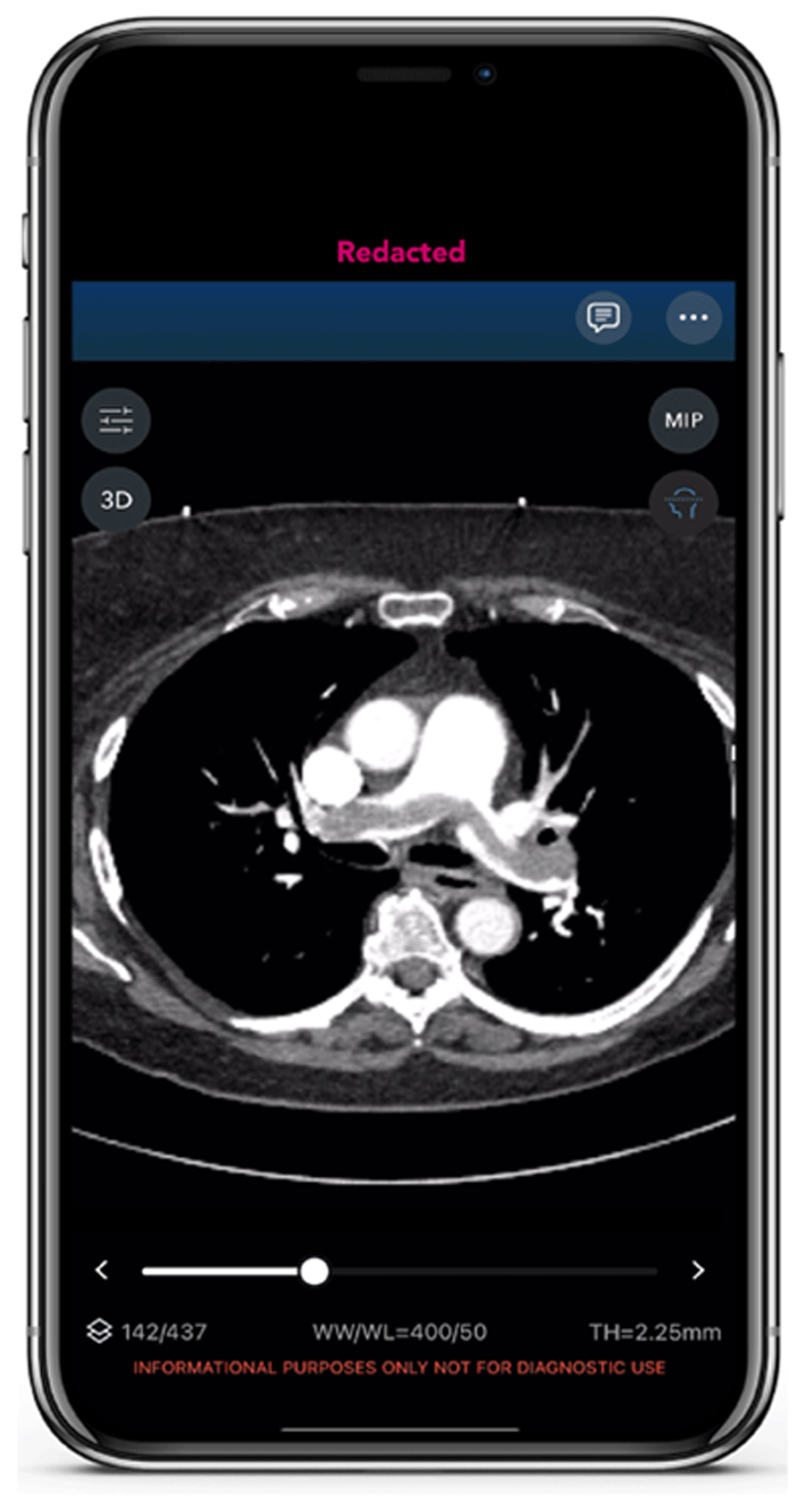
Figure 1
Saddle embolism in Viz.ai app.
Table 2
Time to triage. AI: artificial intelligence; PERT: pulmonary embolism response team
| COHORT | PRE-AI (n = 22) | POST-AI (n = 29) | POST-AI NON-PERT (n = 20) | POST-AI PERT ACTIVATION (n = 9) |
|---|---|---|---|---|
| Time-to-consult | 240.45 min (SD = 320.248) | 6.72 min (SD 2.671) | – | – |
| Time-to-rad | 30.45 min (SD = 22.211) | 105.34 min (SD = 109.841) | 139.30 min (SD = 116.9) | 29.89 min (SD = 21.038) |
Table 3
Patient and pulmonary embolism characteristics. artificial intelligence; BMI: body mass index; VTE: venous thromboembolism; PE: pulmonary embolism; RV/LV: right ventricular/left ventricular
| CHARACTERISTIC | PRE-AI (n = 22) | POST-AI (n = 29) |
|---|---|---|
| Sex (% female) | 45.4% (10/22) | 55.2% (16/29) |
| Mean age (years) | 57.55 | 67.76 |
| Sedentary lifestyle | 54.5% (12/22) | 51.7% (15/29) |
| Recent long-distance travel | 13.6% (3/22) | 17.2% (5/29) |
| History of obesity(BMI > 30) | 63.6% (14/22) | 44.8% (13/29) |
| Prior VTE | 36.4% (8/22) | 20.7% (6/29) |
| Prior cancer diagnosis | 13.6% (3/22) | 20.7% (6/29) |
| Recent surgery | 22.7% (5/22) | 17.2% (5/29) |
| Prior thrombophilia | 9% (2/22) | 0% (0/29) |
| Use of hormone replacement | 4.5% (1/22) | 6.9% (2/29) |
| Centrally located PE | 86.4% (19/22) | 72.4% (21/29) |
| RV/LV ratio ≥ 1.5 | 59% (13/22) | 48.3% (14/29) |
| Intervention performed | 100% (22/22) | 41.4% (12/29) |
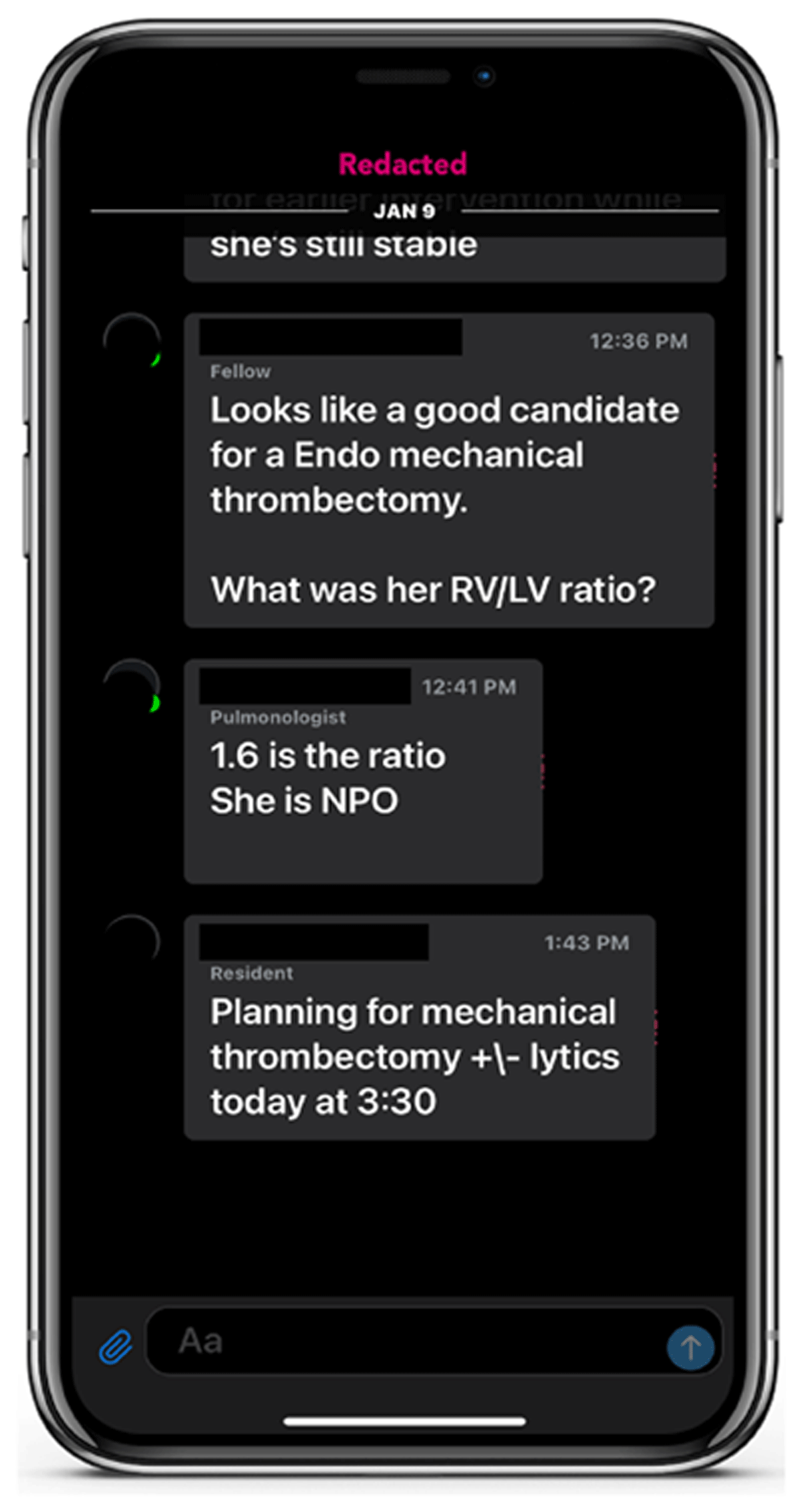
Figure 2
Specialist communication platform.
Table 4
Patient characteristics. AI: artificial intelligence; BMI: body mass index; VTE: venous thromboembolism; PE: pulmonary embolism; RV/LV: right ventricular/left ventricular
| CHARACTERISTIC | PRE-AI (N = 113) | POST-AI (N = 45) |
|---|---|---|
| Sex (% female) | 61 (53.9%) | 25 (55.5%) |
| Mean age (years) | 60.1 | 65.3 |
| Sedentary lifestyle | 48 (42.4%) | 24 (53.3%) |
| Recent long distance travel | 14 (12.3%) | 9 (20%) |
| History of obesity(BMI > 30) | 66 (58.4%) | 25 (55.5%) |
| Prior VTE | 28 (24.7%) | 8 (17.7%) |
| Prior cancer diagnosis | 19 (16.8%) | 9 (20%) |
| Recent surgery | 28 (24.7%) | 8 (17.7%) |
| Prior thrombophilia | 8 (7.1%) | 0 (0%) |
| Use of hormone replacement | 16 (14.1%) | 4 (8.8%) |
| Centrally located PE | 96 (86.7%) | 35 (77.7%) |
| RV/LV ratio ≥ 1.5 | 73 (64.6%) | 26 (57.7%) |
Table 5
Pre-AI versus post-AI time to assessment. AI: artificial intelligence; PERT: pulmonary embolism response team
| PRE-AI | POST-AI | P VALUE | |
|---|---|---|---|
| Time-to-assessment | 318.42 min (SD 339.99) | 5.47 min (SD 2.67) | P < .001 |
| In-hospital mortalities | 10 (8.8%) | 1 (2.2%) | |
| With PERT | Without PERT | ||
| Time-to-anticoagulation | 83.17 min (SD 61.32) | 164.96 min (SD 82.88) | P = .005 |
| In-hospital mortalities | 10 | 1 |