
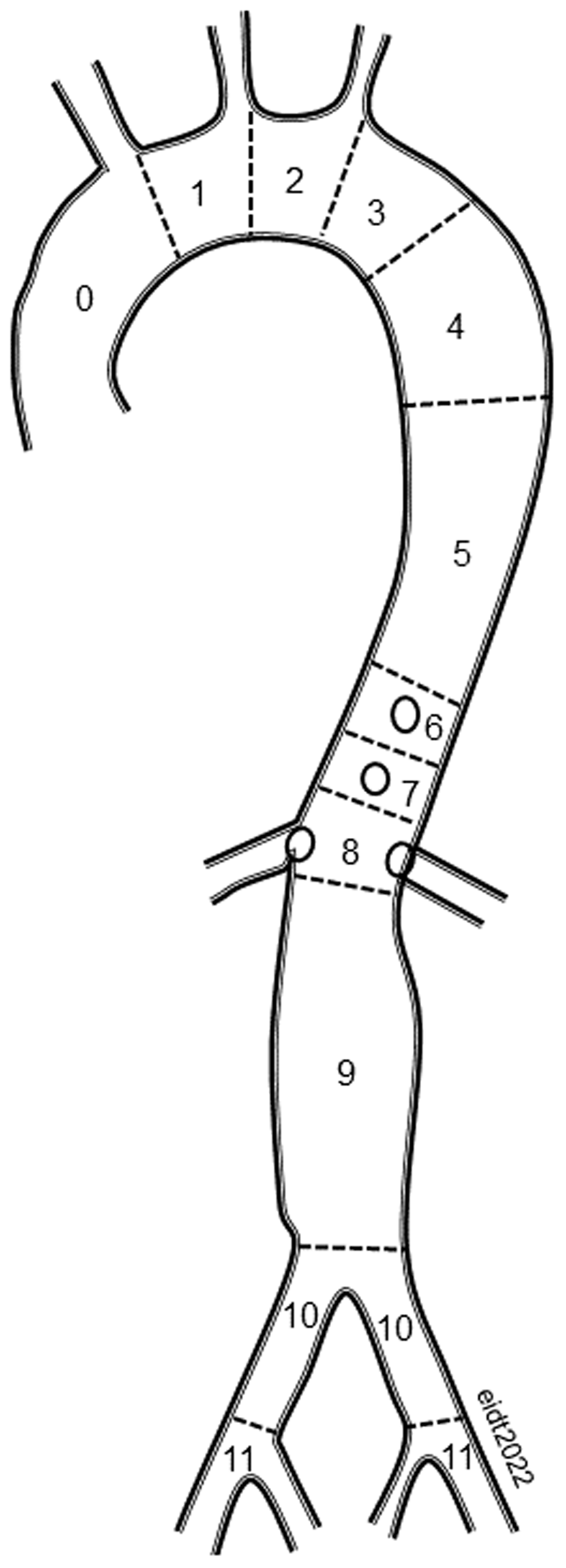
Figure 1
The thoracoabdominal aorta and the bifurcation are divided into 11 zones starting at the aortic valve and extending into the external iliac arteries. Acute dissections that involve the ascending aorta (zone 0) are designated type A. It is noteworthy that dissections involving zone 0 are predominantly intrapericardial, which can lead to the lethal triad of aortic insufficiency, pericardial tamponade, and coronary malperfusion. All dissections involving zones 1-11 are classified as type B (extrapericardial).
Table 1
Features of complicated, uncomplicated, and high-risk acute type B aortic dissection.3
| UNCOMPLICATED | COMPLICATED | HIGH RISK |
|---|---|---|
| True lumen diameter > 22 mm | ||
| No high-risk features | Malperfusion | Total aortic diameter > 40 mm |
| No malperfusion | Rupture | Radiographic malperfusion |
| No rupture | Refractory pain Hemothorax Refractory hypertension Readmission |
Table 2
Predictors of mortality in acute type B dissection.2
| PREDICTORS | MORTALITY ODDS RATIO |
|---|---|
| Increasing age per decade | 1.3 |
| Female sex | 1.4 |
| Extremity ischemia | 3.0 |
| Periaortic hematoma | 3.0 |
| Aortic diameter > 5.5 cm | 3.0 |
| Acute renal failure | 3.6 |
| Hypotension/shock | 6.4 |
| Mesenteric ischemia | 9.0 |
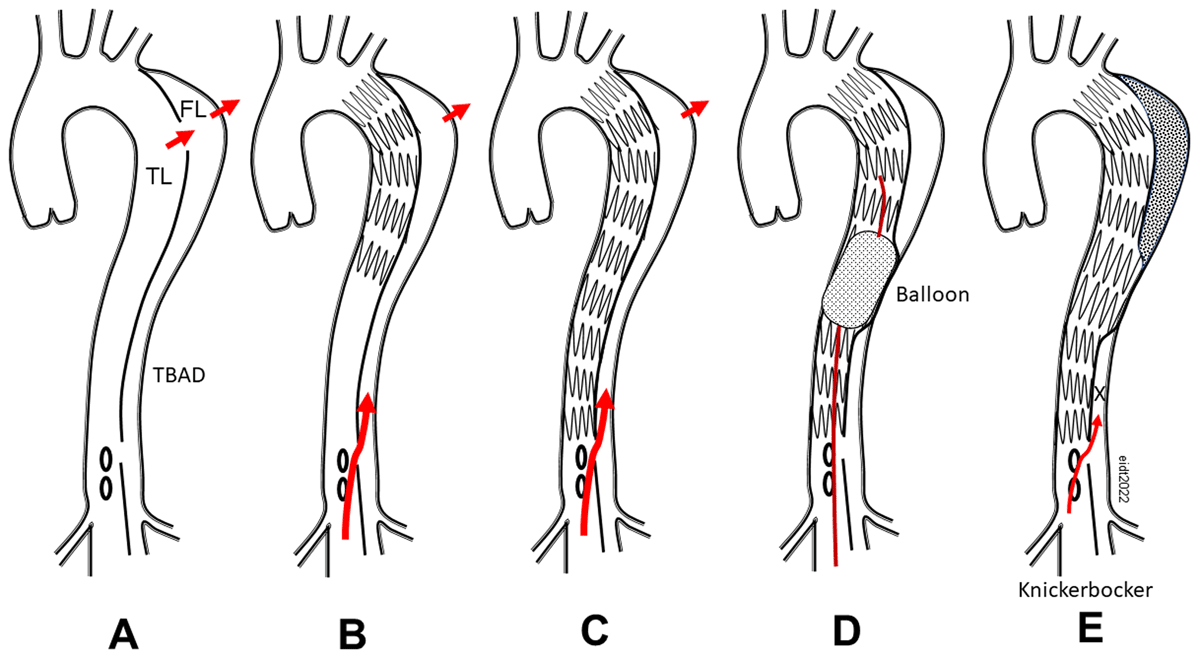
Figure 2
Illustration of the Knickerbocker technique. (A) Type B aortic dissection with a large proximal entry tear leading to bleeding in the chest. (B) After TEVAR, the proximal entry tear is covered but distal false lumen backflow persists. (C) Despite covering the entire length of the descending thoracic aorta, there is persistent bleeding via false lumen filling. (D) Inflating a compliant balloon within the endograft intentionally ruptures the dissection membrane. (E) The expanded endograft prevents backflow into the false lumen aneurysm and eliminates the source of intrathoracic hemorrhage (X). TEVAR: thoracic endovascular aortic repair; TL: true lumen; FL: false lumen; TBAD: type B aortic dissection
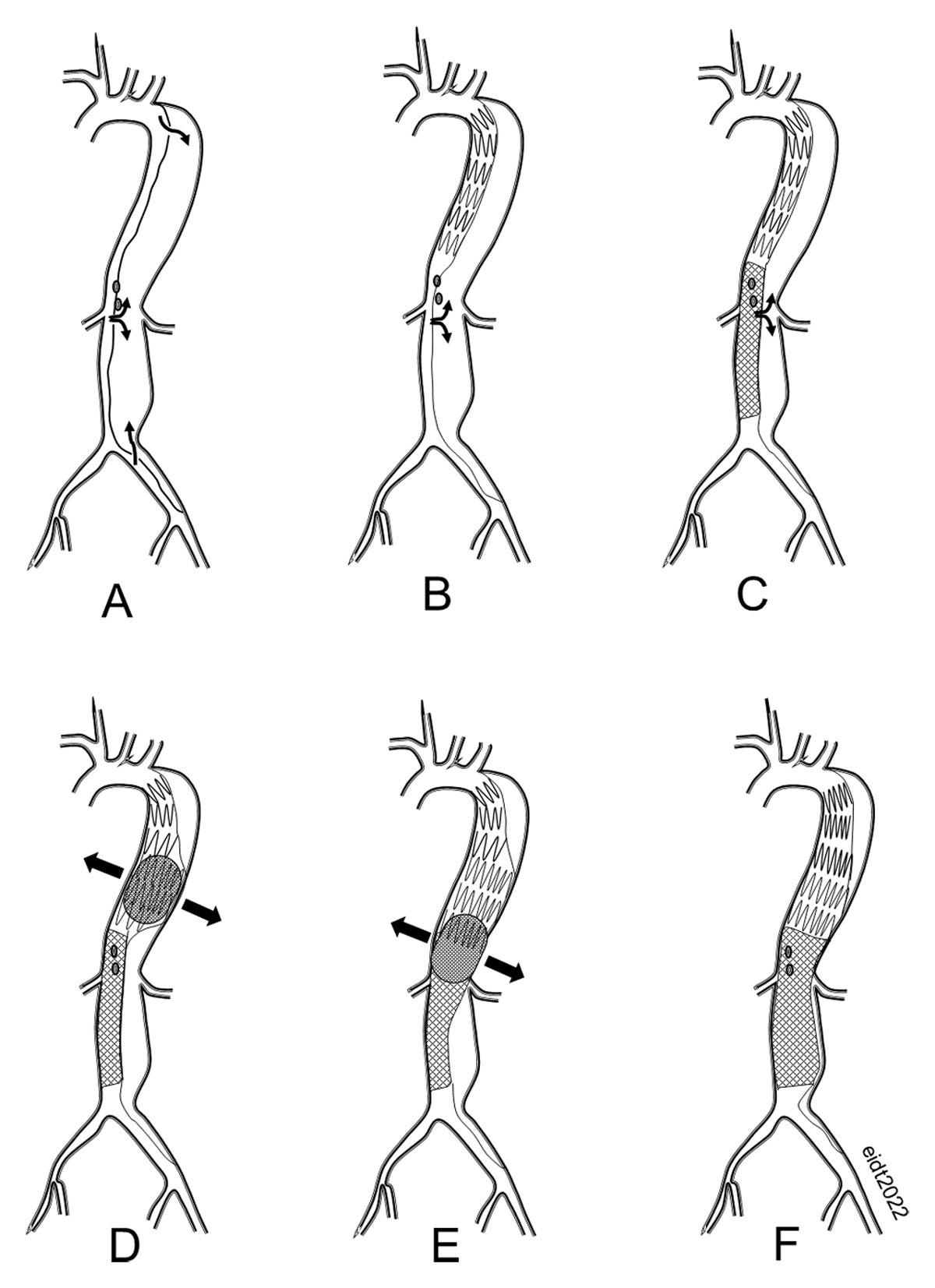
Figure 3
(A) Acute type B aortic dissection. (B) Following proximal thoracic endografting, there is persistent retrograde flow in the false lumen. (C) Bare metal PETTICOAT self-expanding stent improves true lumen blood flow but does not prevent false lumen filling. (D) Intentional rupture of the dissection membrane with a compliant balloon results in obliteration of the false lumen. (E) The balloon is sequentially inflated throughout the entire thoracic and abdominal aorta. (F) The false lumen is completely eliminated by intentional rupture of the dissection membrane.