
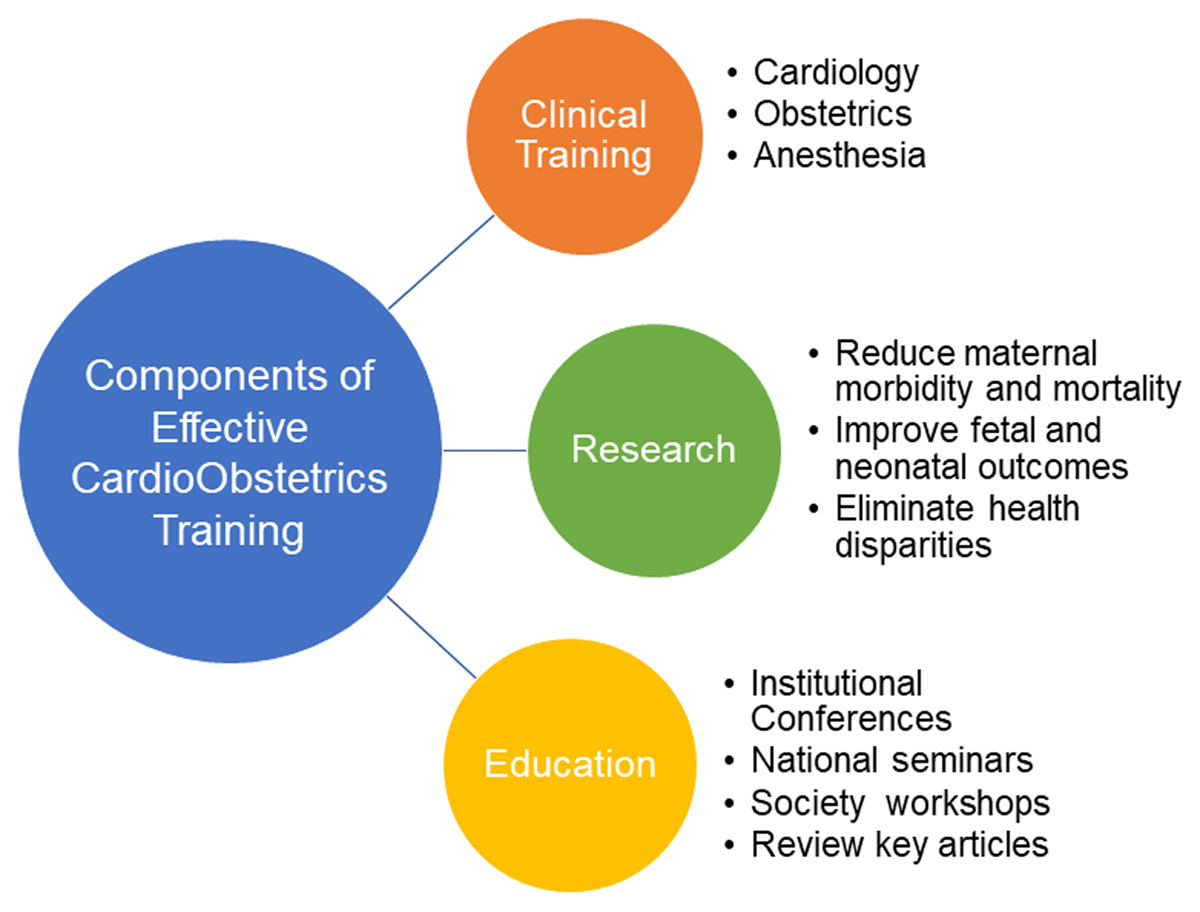
Figure 1
Components of effective cardio-obstetrics training.
Table 1
Conditions expected to be encountered during cardio-obstetrics training.
| ADULT CARDIOLOGY CONDITIONS DURING PREGNANCY | |
|---|---|
| General cardiology | Normal cardiovascular physiology of pregnancy |
| Hypertensive disorders in pregnancy | |
| Cardiovascular risks associated with contraception | |
| Valvular heart disease | |
| Coronary artery disease (including spontaneous coronary artery dissection) | |
| Aortopathies | |
| Pulmonary hypertension | |
| Heart failure | Peripartum cardiomyopathy |
| Dilated cardiomyopathy | |
| Restrictive cardiomyopathy | |
| Hypertrophic cardiomyopathy | |
| Ischemic cardiomyopathy | |
| Electrophysiology | Benign ectopy |
| Ventricular arrhythmias | |
| Supraventricular arrhythmias | |
| Genetic disorders | |
| Imaging | Normal cardiac structural/functional of pregnancy |
| Limitations and risks of cardiovascular imaging during pregnancy | |
| ADULT CONGENITAL HEART DISEASE DURING PREGNANCY* | |
| Simple complexity | Small unrepaired secundum atrial septal defect |
| Small unrepaired perimembranous ventricular septal defect | |
| Mild isolated congenital pulmonic stenosis | |
| Repaired patent ductus arteriosus | |
| Repaired atrial or ventricular septal defect | |
| Moderate complexity | Partial or total anomalous pulmonary venous return |
| Anomalous coronary artery | |
| Atrioventricular septal defect | |
| Congenital aortic or mitral valve stenosis | |
| Coarctation of the aorta | |
| Ebstein anomaly | |
| Ostium primum atrial septal defect | |
| Moderate or large unrepaired secundum atrial septal defect, patent ductus arteriosus or ventricular septal defect | |
| Tetralogy of Fallot | |
| Severe complexity | Cyanotic congenital heart defect |
| Fontan circulation/single ventricle physiology | |
| Eisenmenger physiology | |
| Transposition of the great arteries | |
| Truncus arteriosus | |
[i] *Based on American College of Cardiology/American Heart Association anatomic classification system.
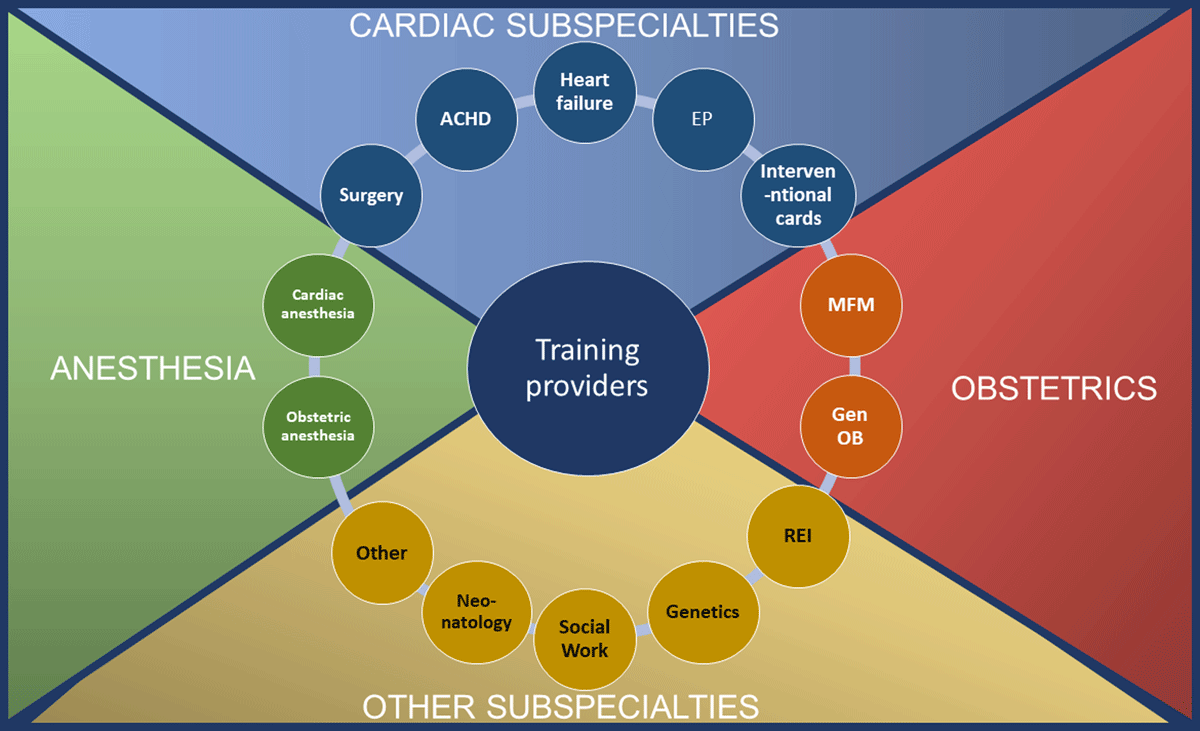
Figure 2
Team-based learning across medical specialties.
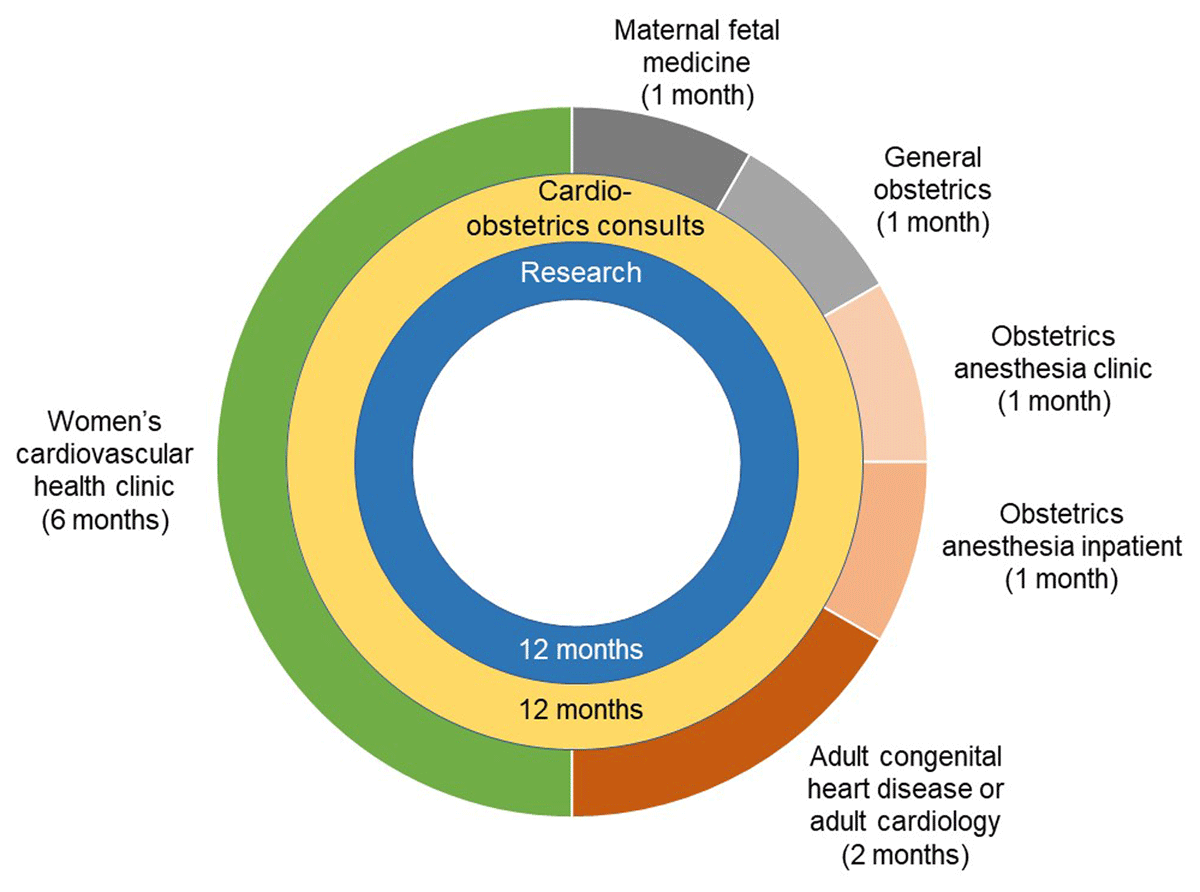
Figure 3
Suggested curriculum for cardio-obstetrics training through general adult and adult congenital heart disease pathways.