
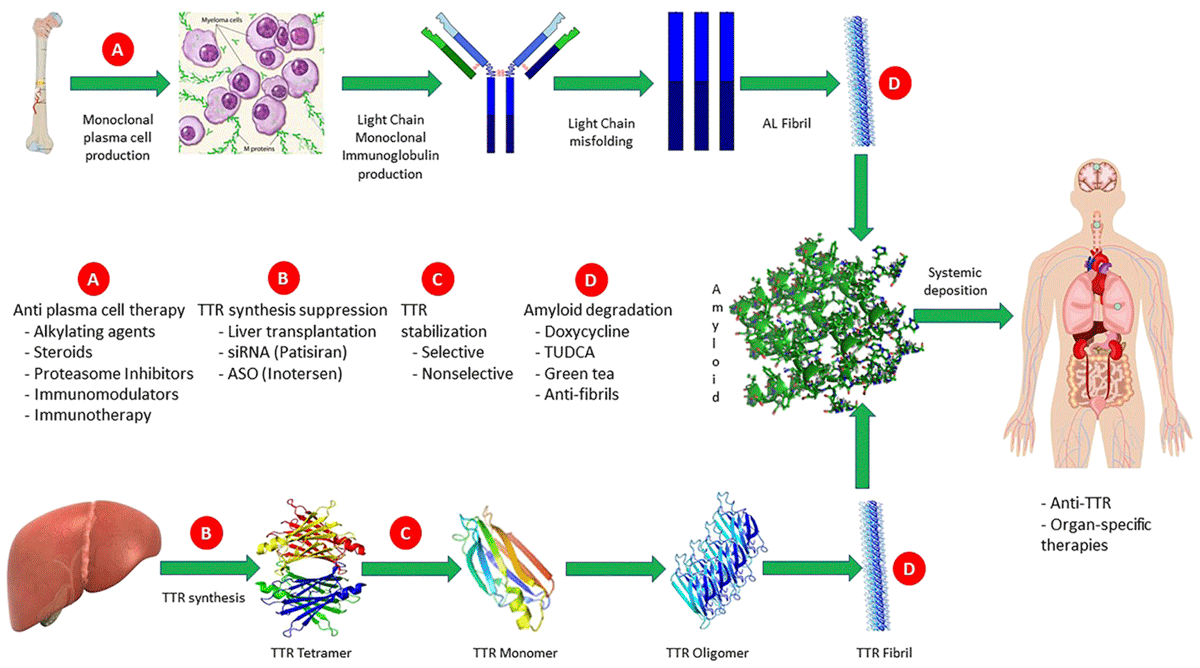
Figure 1
Targets of treatment along the light chain and transthyretin amyloidogenic pathway. Reproduced with permission from @John Wiley & Sons Ltd on behalf of European Society of Cardiology, Adam et al.1 AL: amyloid light chain; TTR: transthyretin; siRNA: small interfering ribonucleic acid; ASO: antisense oligonucleotide; TUDCA: tauroursodeoxycholic acid
Table 1
General treatment strategies for cardiac amyloidosis subtypes. Adapted from @Springer Science + Business Media LLC, Stern and Kittleson.2 GDMT: guideline-directed medical treatment *with ace-inhibitors, angiotensin receptor blockers, angiotensin receptor blocker-neprilysin inhibitor, beta-blockers, aldosterone antagonists, sodium glucose cotransporter-2 inhibitors; AF: atrial fibrillation or atrial flutter; DOAC: direct oral anticoagulant; VKA: vitamin-K antagonist; PPM: permanent pacemaker; ICD: implantable cardioverter defibrillator; VT: ventricular tachycardia; SCD: aborted sudden cardiac death; HRS: Heart Rhythm Society; AL: light chain amyloidosis; ATTRv: hereditary transthyretin amyloidosis; ATTRwt: wild-type ATTR amyloidosis; CM: cardiomyopathy; PN: polyneuropathy; PO: per oral administration; SQ: subcutaneous administration; IV: intravenous administration; FDA: Food and Drug Administration; CyBorD: cyclophosphamide-bortezomib-dexamethasone; BMD: bortezomib-melphalan-dexamethasone; ASCT: autologous stem cell transplant
| TREATMENT CATEGORY | TREATMENT | COMMENTS AND CAVEATS |
|---|---|---|
| Heart failure | Loop diuretics | Favor bioavailable (bumetanide, torsemide) |
| GDMT* if tolerated | Clinical benefit not established May be poorly tolerated due to restrictive physiology and renal dysfunction | |
| Autonomic dysfunction | (1) Midodrine (2) Droxidopa (3) Pyridostigmine (4) Compression stockings | (1–3) Usually AL-CA and ATTRv-CA (3) Not formally studied in CA (4) For orthostasis and mobilization of peripheral edema for all types of CA |
| Arrhythmias | ||
| Medical | Amiodarone (AF) | Usually tolerated over nodal blocking agents due to tendency for conduction disease and heart rate dependence; no difference for rate or rhythm control |
| Anticoagulation (AF) | DOAC or VKA Prescribed regardless of CHA2DS2-VASc score | |
| Device | PPM (Heart block) | CRT may be considered in select PPM-dependent patients |
| ICD (VT/SCD) | Heart Rhythm Society recommendation75: Primary prevention: AL-CA with NSVT with > 1 yr life expectancy (IIb) Secondary: > 1 yr life expectancy (Ic) | |
| Advanced therapies | Heart transplant | AL-CM: select patients with good response to chemotherapy/immunotherapy and minimal extracardiac involvement ATTR-CM: Select patients with minimal extracardiac symptoms |
| Heart-liver transplant | ATTRv-CM + PN: liver transplant may be unnecessary in the future with advances in silencer therapy | |
| Currently available disease-modifying therapy | ||
| ATTR-CA | ||
| ATTRwt-CM | (1) Tafamidis (2) Diflunisal | TTR stabilizers: halts disease progression PO tablets (1) FDA approved (2) Off-label, NSAID: contraindicated for renal failure and thrombocytopenia; used cautiously with anticoagulation and gastrointestinal bleed |
| ATTRv-CM | (1) Tafamidis (2) Diflunisal | |
| ATTRv-CM + PN | (1) Tafamidis (2) Inotersen (3) Patisiran (4) Diflunisal | TTR stabilizers: (1) FDA approved (4) off-label TTR silencers: prevent amyloid formation (2) SQ, risk of thrombocytopenia and glomerulonephritis (3) IV, fewer reported side effects |
| ATTRv-PN | (1) Inotersen (2) Patisiran (3) Diflunisal | TTR silencers (1,2) TTR stabilizer (3) off label |
| AL-CA | ||
| Chemotherapy | CyBorD/BMD | Most common chemotherapy regimens in patients who are not candidates for ASCT and as up-front therapy with daratumumab Corticosteroids/volume of therapy may precipitate decompensated heart failure |
| Immunotherapy | Daratumumab | Anti-CD38 monoclonal antibody Only FDA-approved therapy for AL amyloidosis Up-front therapy combined with bortezomib-based chemotherapy regimens |
| (1) Lenalidomide (2) Pomalidomide (3) Thalidomide | Thalidomide analogs (1–3): Generally reserved for relapsed disease Potential cardiac and renal toxicity | |
| Transplant | High-dose melphalan + ASCT | Preferred approach but rarely offered if significant cardiac and/or other organ involvement May be performed after heart transplantation |
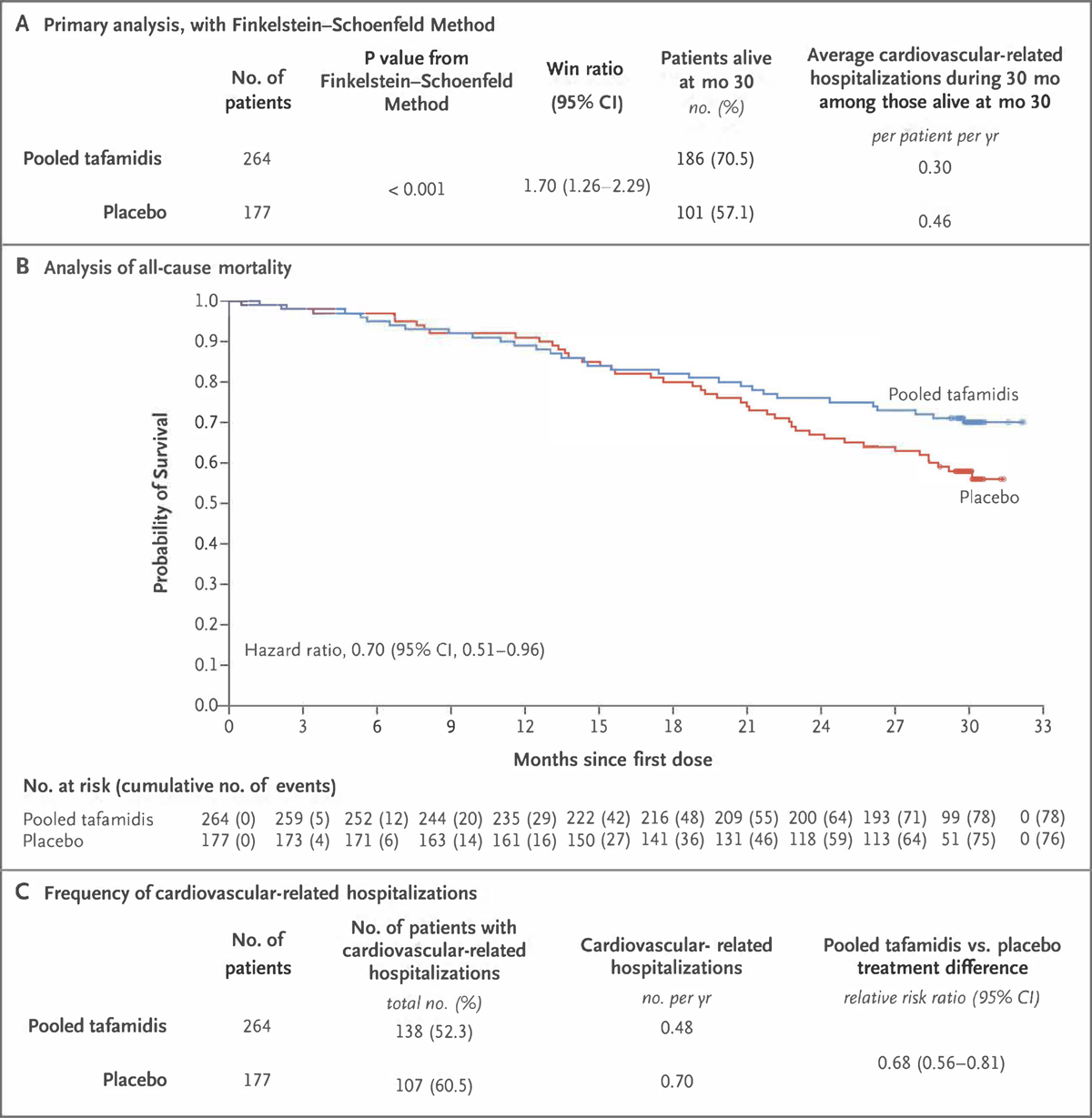
Figure 2
Primary and secondary outcomes of the ATTR-ACT (Safety and Efficacy of Tafamidis in Patients With Transthyretin Cardiomyopathy) Study investigation of pooled tafamidis (80 mg and 20 mg daily dosing) versus placebo. Panel A demonstrates the superiority of pooled tafamidis compared with placebo for the primary analysis using the Finkelstein-Schoenfeld method to hierarchically assess all-cause mortality and cardiovascular-related hospitalization. Panel B shows the Kaplan Meier survival curves demonstrating a reduction in all-cause mortality for pooled tafamidis compared to placebo, with curves diverting at 18-month follow-up (secondary outcome). Panel C shows the frequency of cardiovascular-related hospitalizations (secondary outcome). Reproduced with permission from the @Massachusetts Medical Society, Maurer et al.51