Have a personal or library account? Click to login
Acute Circulatory Collapse and Advanced Therapies in Patients with COVID-19 Infection Cover

Acute Circulatory Collapse and Advanced Therapies in Patients with COVID-19 Infection

Open Access
|Dec 2021

Figures & Tables

Figure 1

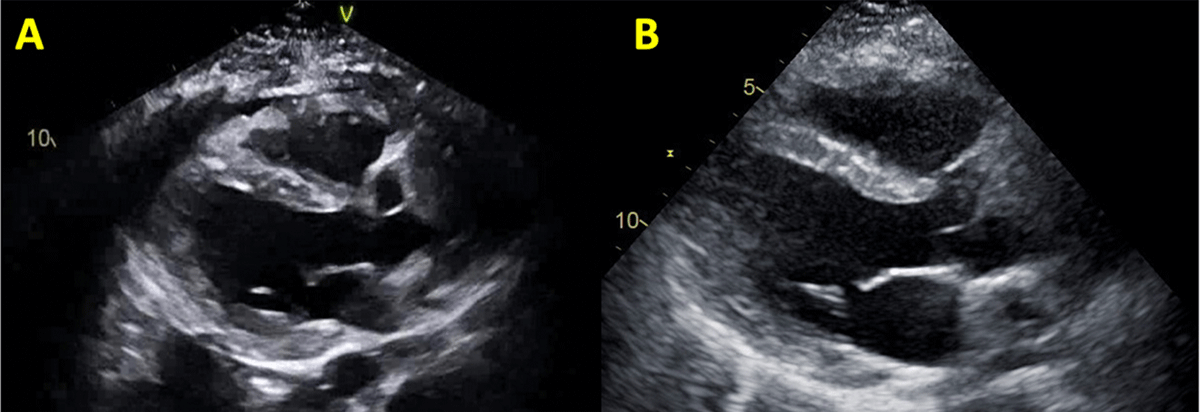
(A) Pretreatment echocardiogram (echo) with pericardial effusion, myocardial edema, and depressed left ventricular (LV) and right ventricular (RV) function. (B) Post-treatment echo with LV and RV recovery.
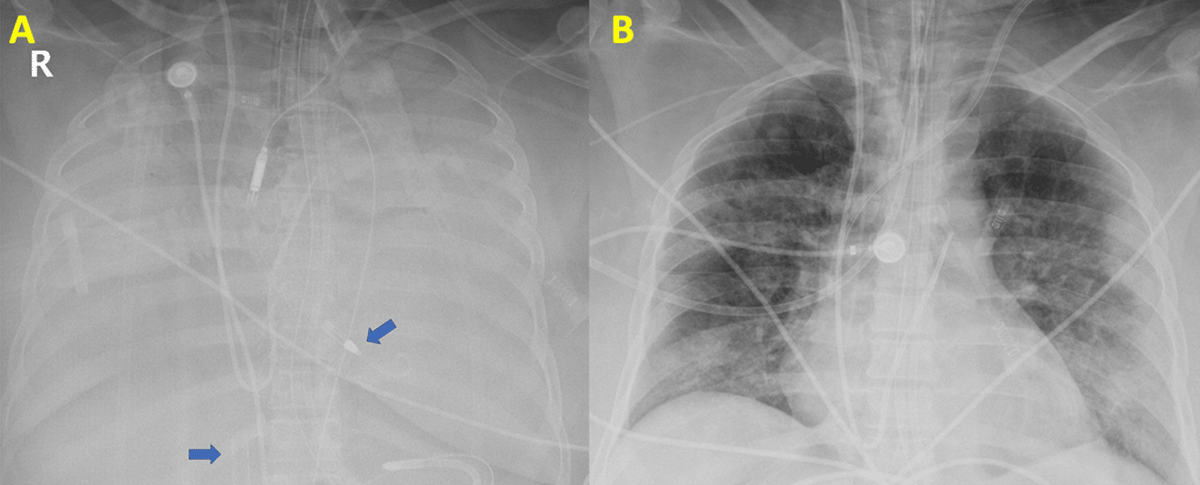
Figure 2

(A) Chest x-ray demonstrating severe COVID-19 pneumonia with extracorporeal membrane oxygenation (ECMO) cannula and Impella (arrows). (B) Post-decannulation chest x-ray after ECMO and Impella removal.

Table 1

General considerations for intensive care management of patients in acute circulatory collapse. MCS: mechanical circulatory support; RV: right ventricle; LV: left ventricle; CRRT: continuous renal replacement therapy; ARDS: acute respiratory distress syndrome; CO: cardiac output

Hemodynamic assessment
  • Hemodynamic assessment with Swan-Ganz catheter is at the core of cardiogenic shock management.

  • A Swan-Ganz catheter should be used, particularly if MCS is considered.

  • A central line can assess volume status and mixed venous oxygen saturation.

  • Echocardiography is essential for assessing RV/LV function, CO, and filling pressures.

Fluid management
  • Avoid hyper- or hypovolemia.

  • In ARDS, hypervolemia may worsen respiratory status.

  • In hyperinflammation with severe cytokine response, functional hypovolemia due to capillary leak and intravascular volume depletion may lead to poor organ perfusion.

  • CRRT may be required to optimize fluid status.

Blood pressure maintenance
  • Maintain perfusion with vasopressors.

  • Norepinephrine is considered first line.

  • Vasopressin is considered second line.

Adequate cardiac output maintenance
  • Dobutamine or milrinone may be used to maintain CO.

  • When inotropes fail, early escalation to MCS may be considered as outlined.

Table 2

Overview of mechanical circulatory support (MCS) strategies. VA ECMO: veno-venous extracorporeal membrane oxygenation; RVAD: right ventricular assist device; VV ECMO: veno-venous extracorporeal membrane oxygenation; IABP: intra-aortic balloon pump; LV: left ventricle; RV: right ventricle; BiV: biventricular

MCS STRATEGYCANNULATION SITECONSIDERATIONS
INLETOUTLET
Cardiopulmonary supportVA ECMO
  • Femoral/jugular veins (peripheral)

  • Right atrium (central)

  • Femoral artery (peripheral)

  • Aorta (central)

  • LV or BiV failure

  • May need LV venting strategy

RVAD
  • Right atrium

  • Internal jugular vein

  • Pulmonary artery

  • Predominant RV failure

  • Oxygenator for pulmonary support

Pulmonary supportVV ECMO
  • Right atrium

  • Internal jugular vein

  • Right atrium

  • Internal jugular vein

  • Isolated respiratory failure

Cardiac supportImpellaLV
  • Proximal aorta

  • Direct LV support

IABPN/AN/A
  • Indirect LV support via decreased afterload and improved coronary blood flow

Figure 3

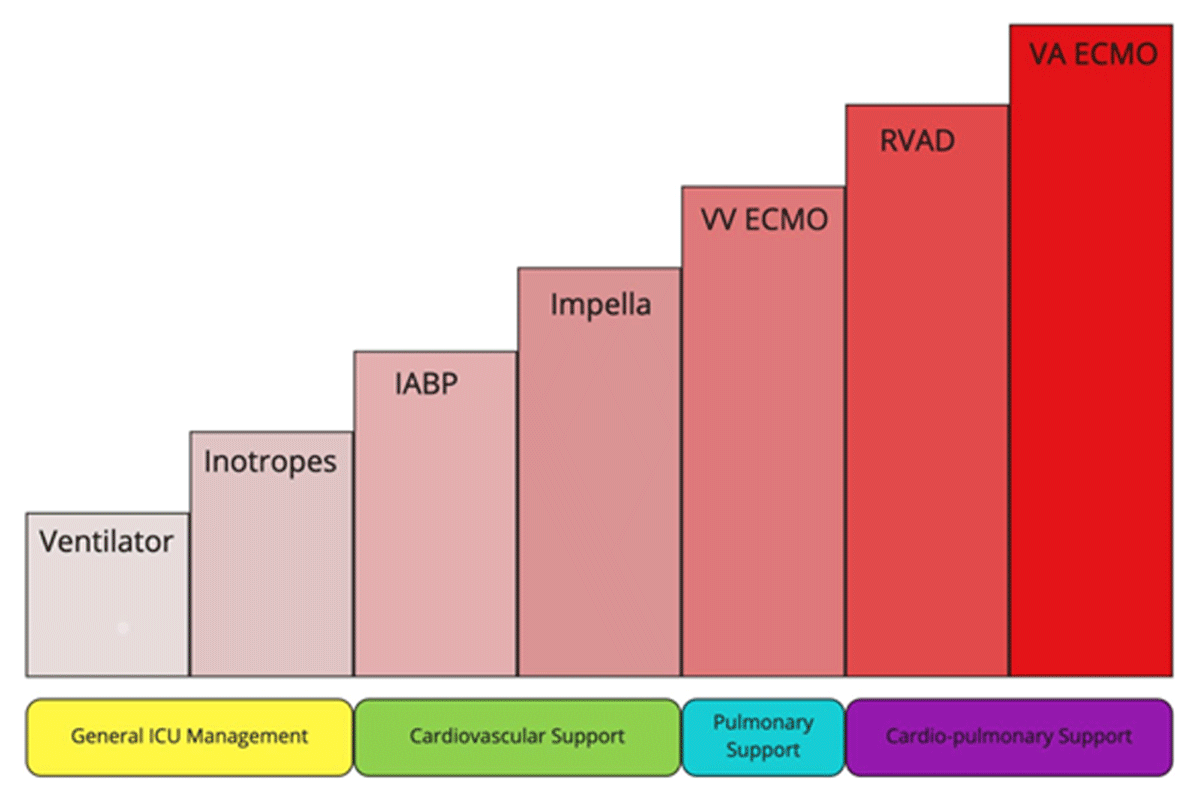
Spectrum of care in COVID-19 and Acute Circulatory Collapse. IABP: intra-aortic balloon pump; VV ECMO: veno-venous extracorporeal membrane oxygenation; RVAD: right ventricular assist device; VA ECMO: veno-arterial extracorporeal membrane oxygenation

Table 3

Absolute and relative contraindications to extracorporeal membrane oxygenation. SOFA: Sequential Organ Failure Assessment; VAD: ventricular assist device; DVT: deep vein thrombosis

ABSOLUTE CONTRAINDICATIONSRELATIVE CONTRAINDICATIONS
  • Age > 80 years

  • Irreversible multisystem organ failure

  • SOFA Score > 11

  • Contraindication to anticoagulation

  • Unrecoverable cardiac condition, not a candidate for VAD/transplant

  • Active life-limiting condition such as disseminated malignancy

  • Cardiac arrest with asystole persisting for over 30 minutes

  • Skin infection at the site of cannulation

  • Evidence of DVT in bilateral femoral veins

  • Severe peripheral vascular disease (risk of limb ischemia)

  • Intracerebral hemorrhage or severe brain damage

  • Intubated > 7 days

  • Obesity

DOI: https://doi.org/10.14797/mdcvj.1048 | Journal eISSN: 1947-6108
Language: English
Page range: 43 - 52
Submitted on: Oct 7, 2021
Accepted on: Oct 18, 2021
Published on: Dec 15, 2021
Published by: Houston Methodist DeBakey Heart & Vascular Center
In partnership with: Paradigm Publishing Services

© 2021 Rishi Thaker, Aayush Shah, Ju Kim, Mahwash Kassi, published by Houston Methodist DeBakey Heart & Vascular Center
This work is licensed under the Creative Commons Attribution-NonCommercial 4.0 License.