
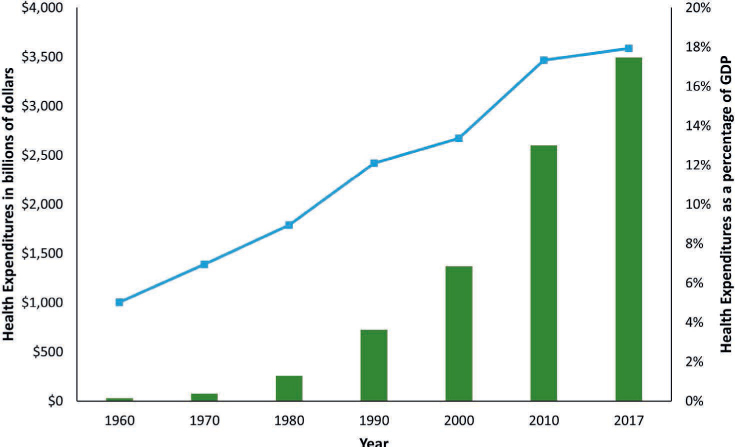
Figure 1.
Trends in United States Health Expenditures in selected years between 1960 and 2017. National health expenditures in billions of dollars (green bars and left-sided axis) and as a percentage of United States gross domestic product (GDP) (blue lines and right-sided axis). Publically available data was obtained from the National Center for Health Statistics.2
Table 1.
Common acronyms used in health care reform.
| ACRONYM | DEFINITION |
|---|---|
| ACA | Affordable Care Act |
| ACO | Patient Protection and Accountable Care Organization |
| AMI | Acute myocardial infarction |
| BPCI | Bundled Payment for Care Improvement |
| CMS | Centers for Medicare and Medicaid Services |
| DRG | Diagnosis-related group |
| HF | Heart failure |
| HRRP | Hospital Readmissions Reduction Program |
| HVBP | Hospital Value-Based Purchasing |
| MACRA | Medicare Access and Children’s Health Insurance Program Reauthorization Act |
| QPP | Quality Payment Program |
Table 2.
Summary of Medicare Value-Based Payment Reforms in Cardiovascular Care. AMI: acute myocardial infarction; CV: cardiovascular; DRG: diagnosis-related group; HF: heart failure; CABG: coronary artery bypass graft
| CHARACTERISTIC | HOSPITAL READMISSIONS REDUCTION PROGRAM (HRRP) | HOSPITAL VALUE-BASED PURCHASING (HVBP) | ACCOUNTABLE CARE ORGANIZATION (ACO) | BUNDLED PAYMENT FOR CARE IMPROVEMENT (BPCI) |
|---|---|---|---|---|
| Implementation date | 2012 | 2012 | 2012 | BPCI: 2013 BPCI Advanced: 2018 |
| Mandatory vs voluntary participation | Mandatory | Mandatory | Voluntary | Voluntary |
| Summary of policy design | Hospitals with higher-than-expected readmission rates for targeted conditions were penalized in the form of reduced Medicare reimbursements for all DRG payments. | Hospital Medicare DRG payments are tied to hospital performance on a variety of quality metrics. | Groups of health care entities voluntarily assume responsibility for the spending and outcomes of a group of patients. ACOs that reduce spending and meet certain quality benchmarks can share in the savings. Some ACOs are in two-sided risk arrangements where they share in savings and also bear financial risk if spending is above targets. | Effectively pay hospitals a fixed amount for delivering quality care over a period of time (usually 90 days) after a qualifying event. |
| How does it involve cardiovascular care? | Targeted conditions include AMI, HF, and CABG. | Risk-standardized mortality rates for AMI and HF are included in the hospital performance measures. | CV conditions are not specifically targeted by ACOs. Many patients with CV disease are cared for by ACOs, and ACO quality benchmarks include CVconditions. | BPCI Advanced includes many CV episodes in which hospitals and physician groups may participate. |
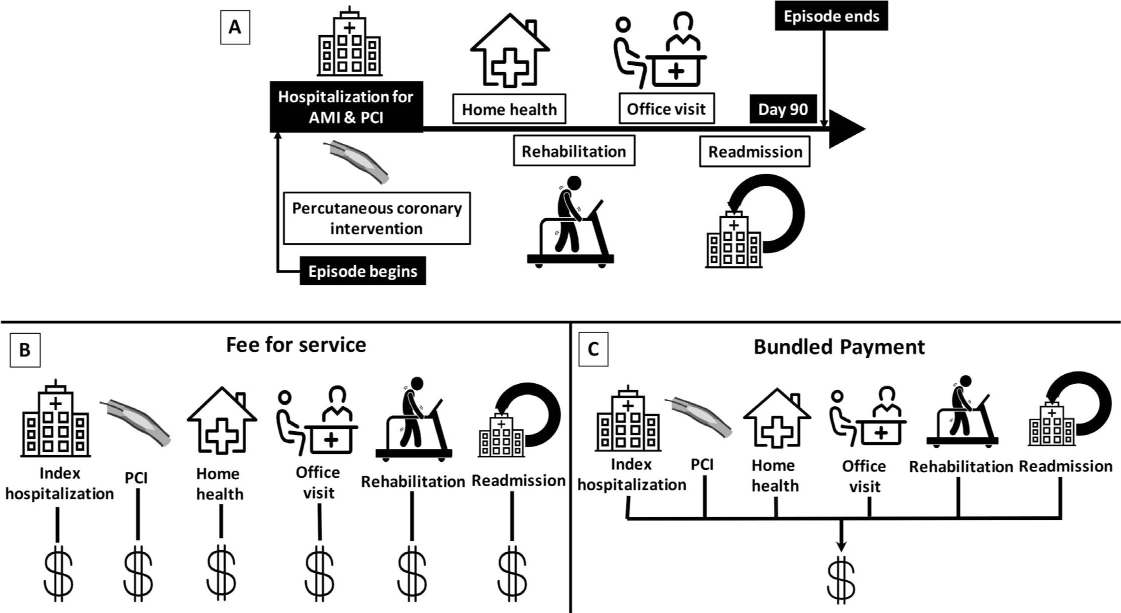
Figure 2.
Graphical representation of bundled payment versus traditional fee-for-service payment for an episode of care. (A) An example of an episode of care that begins with hospitalization for treatment of an acute myocardial infarction (AMI) with percutaneous coronary intervention (PCI) and includes related health care services through 90 days after discharge, including services such as home health care, outpatient rehab, and readmissions. (B) Traditional fee-for-service payment models reimburse hospitals and providers for each service delivered during the course of that 90-day episode of care. (C) In bundled payment models, hospitals are held accountable to a single benchmarked payment for the care delivered, regardless of the quantity of services provided.
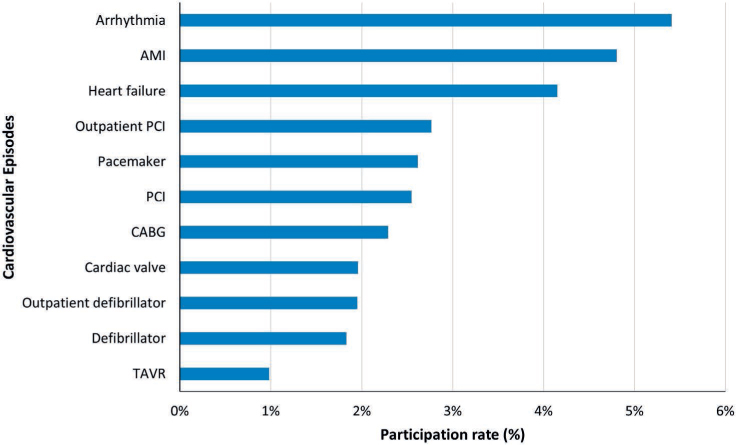
Figure 3.
Participation in specific cardiovascular episodes as a percentage of all episodes that participants (ie, hospitals and physician groups) volunteered for in Model Year 3 of BPCI Advanced (N = 12,717). All episodes are initiated as inpatient clinical episodes except for outpatient PCI and outpatient defibrillator. Data were obtained from the publically available BPCI Advanced model year 3 participant file.33 BPCI: Bundled Payment for Care Improvement; AMI: acute myocardial infarction; PCI: percutaneous coronary intervention; CABG: coronary artery bypass graft; TAVR: transcatheter aortic valve replacement