
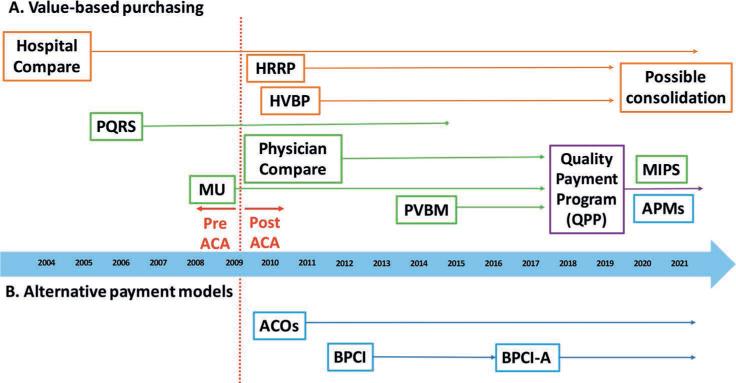
Figure 1.
Timeline of federal efforts to improve quality of cardiovascular care. (A) Timeline for various value-based purchasing (VBP) programs divided by hospital-level (orange) and physician-level programs (green). The HRRP and HVBP were created after the ACA and will potentially be consolidated, with other federal hospital programs, into a single program in 2022. Prior physician-level programs such as PQRS, MU, and PVBM were consolidated into the QPP in 2019. The QPP has two main components, MIPS and APMs. (B) The two main APMs for cardiovascular care include ACOs and BPCI-A. ACA: Affordable Care Act; ACO: Accountable Care Organization; APM: Alternative Payment Model; BPCI: Bundled Payments for Care Improvement; BPCI-A: Bundled Payments for Care Improvement-Advanced; HRRP: Hospital Readmissions Reduction Program; HVBP: Hospital Value-Based Purchasing Program; MIPS: Merit-based Incentive Payment System; MU: Meaningful Use Program; PQRS: Physician Quality Reporting System; PVBM: Physician Value-Based Modifier Program; QPP: Quality Payment Program
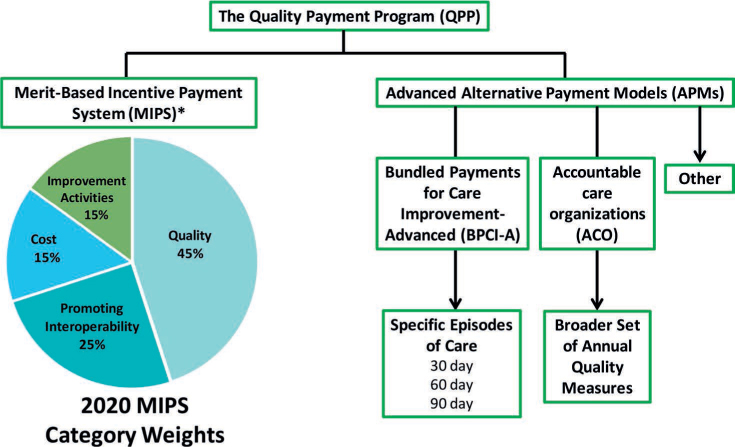
Figure 2.
Diagram of the components within the Quality Payment Program (QPP). The QPP is composed of the Merit-Based Incentive Program (MIPS) and Alternative Payment Models (APMs). MIPS is the default program for clinicians and is composed of the following four elements (2020 weights reported): Quality 45%, Promoting Interoperability 25%, Cost 15%, Improvement Activities 15%. Clinicians can opt out of MIPs if they are enrolled in a qualifying APM; within cardiovascular care, this could mean either participating in an accountable care organization or being part of an organization that is participating in the Bundled Payments for Care Improvement-Advanced program.
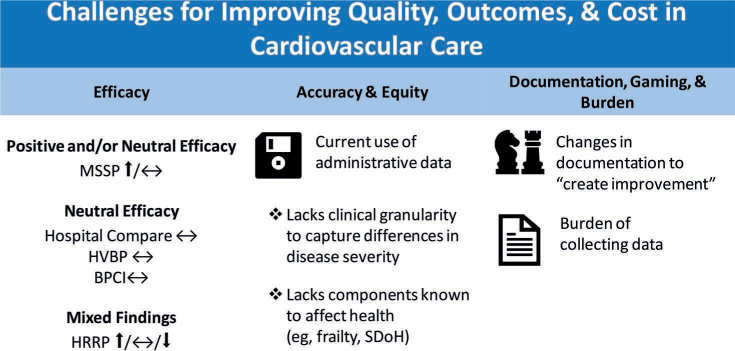
Figure 3.
Challenges for improving quality, outcomes, and cost in cardiovascular care. The challenges facing the successful implementation of value-based, high-quality cardiovascular care include program efficacy, accuracy and equity, administrative burden, and data manipulation. BPCI: Bundled Payments for Care Improvement; HRRP: Hospital Readmissions Reduction Program; HVBP: Hospital Value-Based Purchasing Program; MSSP: Medicare Shared Savings Program; SDoH: social determinants of health
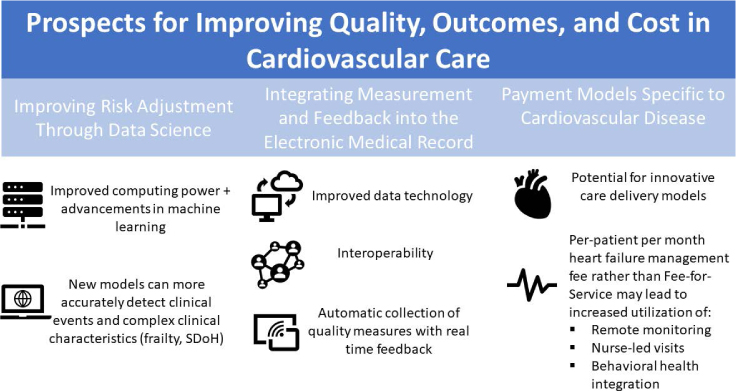
Figure 4.
Prospects for improving quality, outcomes, and cost in cardiovascular care. Encouraging prospects for the successful implementation of value-based, high-quality cardiovascular care include the incorporation of improved data science for improved risk adjustment, decreased administrative burden, and potential innovative care delivery models. SDoH: social determinants of health