
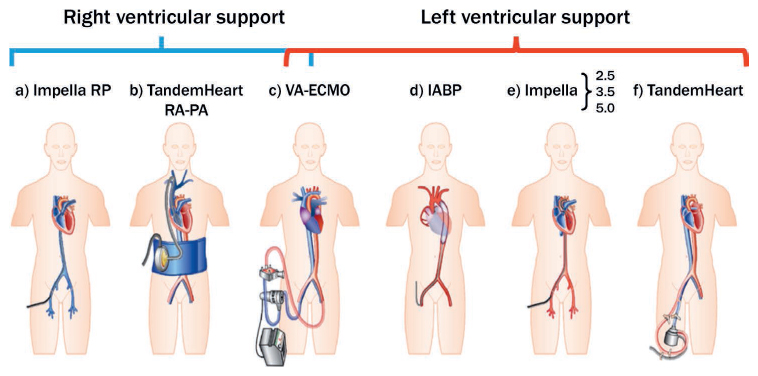
Figure 1.
Schematic drawing of current commercially available percutaneous mechanical support devices for cardiogenic shock. On the left are devices for right ventricular support, and on the right are those for left ventricular support. (a) Impella® RP, (b) TandemHeart™ RA-PA (right atrium–pulmonary artery), (c) venoarterial (VA) extracorporeal membrane oxygenation (ECMO), (d) intra-aortic balloon pump, (e) Impella, (f) TandemHeart. Adapted from H. Thiele et al. with permission from Oxford University Press.5
Table 1.
Short-term mechanical circulatory support options divided by side of support (left side, right side, biventricular) and whether they are inserted percutaneously or surgically. IABP: intra-aortic balloon pump; VA ECMO: venoarterial extracorporeal membrane oxygenation; LV-Ao: left ventricle-aorta; RA-PA: right atrium–pulmonary artery; LA-Ao: left atrium-aorta; RV: right ventricle; LV: left ventricle
| SHORT-TERM MECHANICAL CIRCULATORY SUPPORT | PERCUTANEOUS OPTIONS | SURGICAL OPTIONS |
|---|---|---|
| Left-sided |
|
|
| Right-sided |
|
|
| Biventricular |
|
|
Table 2.
Suggested indications for short-term mechanical circulatory support. Adapted from Rihal et al. with permission from Elsevier.6 AMI: acute myocardial infarction; MCS: mechanical circulatory support; PCI: percutaneous coronary intervention; LV: left ventricular; RV: right ventricular; VAD: ventricular assist device; INTERMACS: interagency registry for mechanically assisted circulatory support; ECMO: extracorporeal membrane oxygenation; EF: ejection fraction; VT: ventricular tachycardia
| INDICATION | COMMENTS |
|---|---|
| Complications of AMI | Ischemic mitral regurgitation is particularly well suited to these devices because the hemodynamic disturbance is usually acute and substantial. Acutely depressed LV function from large AMIs during and after primary PCI is an increasing indication for temporary MCS use. Cariogenic shock from RV infarction can be treated with percutaneous RV support. |
| Severe heart failure in the setting of nonischemic cardiomyopathy | Examples include severe exacerbations of chronic systolic heart failure as well as acutely reversible cardiomyopathies such as fulminant myocarditis, stress cardiomyopathy, or peripartum cardiomyopathy. In patients presenting in INTERMACS profiles 1 or 2, MCS can be used as a bridge to destination VAD placement or as a bridge to recovery if the ejection fraction rapidly improves. |
| Acute cardiac allograft failure | Primary allograft failure (adult or pediatric) may be caused by acute cellular- or antibody-mediated rejection, prolonged ischemic time, or inadequate organ preservation. |
| Post-transplant RV failure | Acute RV failure has several potential causes, including recipient pulmonary hypertension, intraoperative injury/ischemia, and excess volume/blood product resuscitation. MCS support provides time for the donor right ventricle to recover function, often with the assistance of inotropic and pulmonary vasodilator therapy. |
| Patients slow to wean from cardiopulmonary bypass following heart surgery | Although selected patients may be transitioned to a percutaneous system for additional weaning, this is rarely done. |
| Refractory arrhythmias | Patients can be treated with a percutaneous system that is somewhat independent of the cardiac rhythm. For recurrent, refractory ventricular arrhythmias, ECMO may be required for biventricular failure. |
| Prophylactic use for high-risk PCI | Seen particularly in patients with severe LV dysfunction (EF < 20%–30%) and complex coronary artery disease involving a large territory (sole remaining vessel, left main or three-vessel disease). |
| High-risk or complex ablation of VT | Similar to high-risk PCI, complex VT ablation can be made feasible with percutaneous support. MCS use allows the patient to remain in VT longer during arrhythmia mapping without as much concern about systemic hypoperfusion. |
| High-risk percutaneous valve interventions | These evolving procedures may be aided by MCS. |
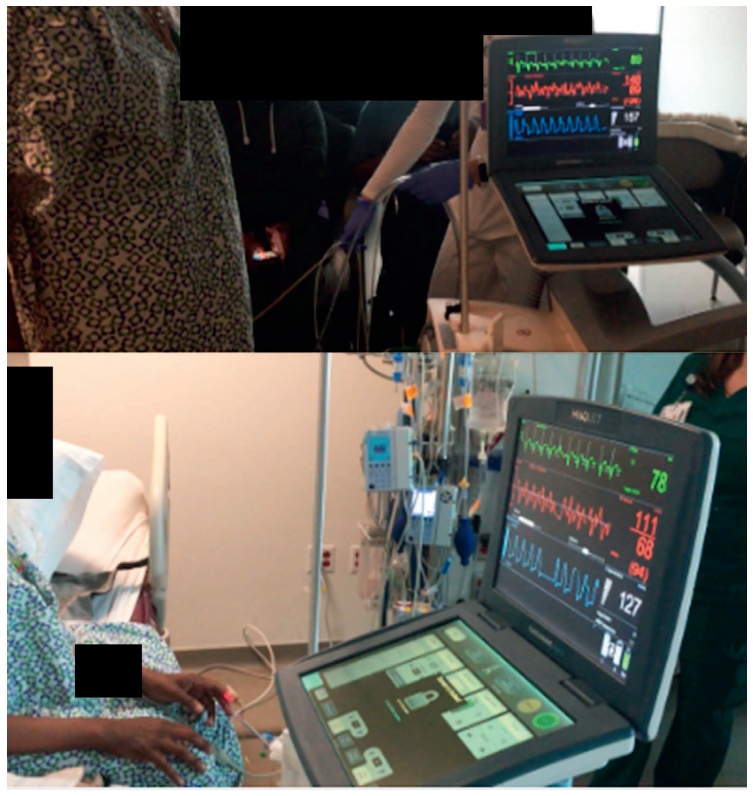
Figure 2.
Percutaneous intra-aortic balloon pump in axillary/subclavian position permits ambulation.
Table 3.
Comparison of commercially available devices for short-term mechanical circulatory support. Modified from Guglin et al. with permission from Elsevier.5,16 CO2: carbon dioxide; FDA: US Food and Drug Administration; IABP: intra-aortic balloon pump; LV: left ventricle/ventricular; RV: right ventricle; VA-ECMO: venoarterial extracorporeal membrane oxygenation
| DEVICE | IABP | IMPELLA (2.5, CP, RP) | TANDEMHEART | VA-ECMO |
|---|---|---|---|---|
| Flow, L/min | 0.5–1 | 2.5–5 | 4–6 | 4–6 |
| Cannula size, F | 7–8 | 12–23 | Inflow 21 Outflow 15–19 | Inflow 18–23 Outflow 15–29 |
| Duration of support, FDA approved | 9 days | 4 days (2.5, CP) 14 days (5.0) 14 days (RP) | 21 days | 6 hours (limited by oxygenator durability) |
| Ventricles supported | LV | LV or RV | LV or RV | LV and RV |
| Additional requirements | Surgical cutdown for Impella 5 | Transseptal puncture | Potential need for LV venting, possible cutdown | |
| Advantages | Easy to place Good safety profile Fewer side effects, especially vascular | Multiple device options | Highest cardiac output Comparable to VA-ECMO No LV distension | Highest cardiac output Complete cardiopulmonary support (including oxygenation and CO2 removal) |
| Disadvantages | Limited hemodynamic support Contraindicated in severe aortic regurgitation | More invasive and complex to implant than the IAPB Unstable position Frequent hemolysis Vascular complications | Need tertiary or quaternary specialized care center Necessitates atrial transseptal puncture with its potential complications Vascular complications Retrograde blood flow | Requires more resources and support staff than other devices Retrograde blood flow with worsening of afterload (LV distention) Vascular complications Thrombocytopenia |