
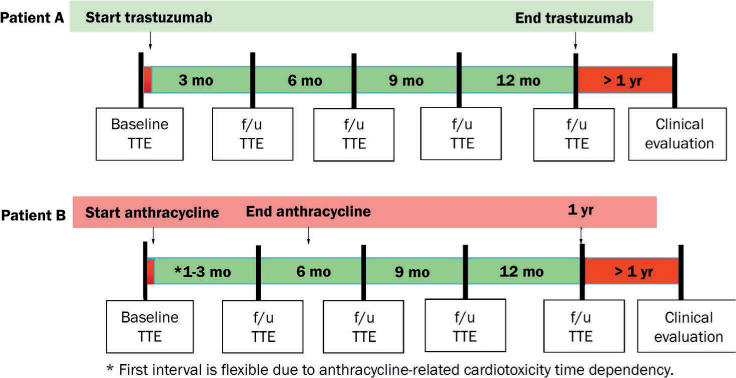
Figure 1.
Proposed timing of cardiotoxicity monitoring with transthoracic echocardiogram for anthracyclines and anti-HER2 therapies in patients with breast cancer without heart failure symptoms. TTE: transthoracic echocardiogram
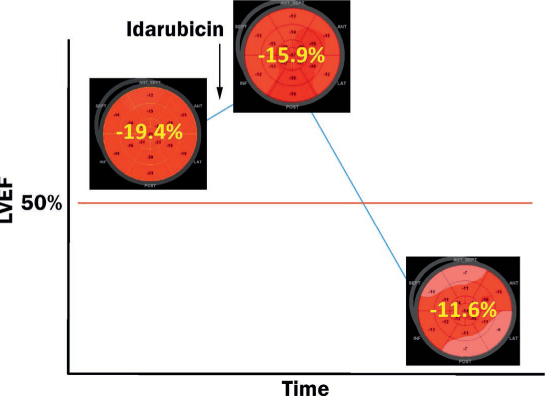
Figure 2.
An example of subclinical cardiotoxicity related to anthracycline detected by global longitudinal strain before a decrease in left ventricular ejection fraction (LVEF).
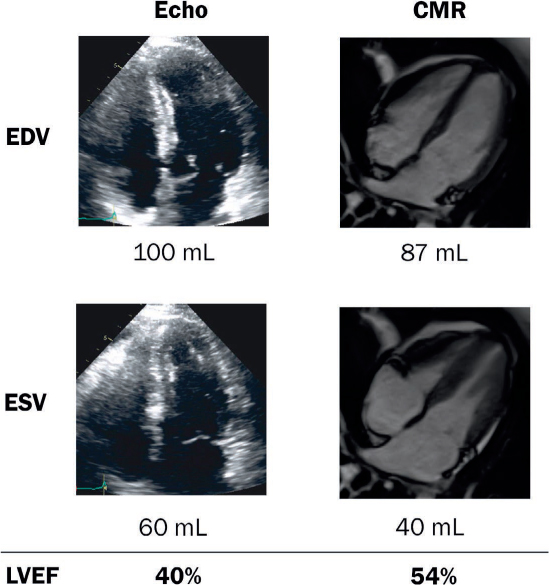
Figure 3.
Illustrative case of a 37-year-old woman with lymphoma undergoing chemotherapy. She had a decrease in left ventricular (LV) systolic function by echocardiogram (echo) biplane LV ejection fraction (LVEF) quantification, which was verified by cardiac magnetic resonance imaging, and LVEF > 50%. Treatment with anthracycline was resumed without any consequences in LV systolic function. CMR: cardiac magnetic resonance; EDV: end diastolic volume; ESV: end systolic volume
Table 1.
Summary of studies assessing the role of biomarkers for predicting cardiotoxicity.28,30,32–34,36,37,39
| SERUM BIOMARKER | AUTHORS | SAMPLE SIZE (N) | RESULT |
|---|---|---|---|
| hs troponin I | Putt et al.33 | 78 | Not predictive of cardiotoxicity |
| hs troponin T | Pourier et al.34 | 64 | Not predictive of late cardiotoxicity in survivors |
| Troponin I | Cardinale et al.28 | 703 | Predictive of adverse cardiac events |
| Troponin T | Fallah-Rad et al.32 | 42 | Not predictive of cardiotoxicity |
| BNP | Okumura et al.36 | 13 | May predict cardiotoxicity |
| NT-proBNP | Dodos et al.37 | 100 | Not predictive of cardiotoxicity |
| ST-2 | Sawaya et al.30 | 81 | Not predictive of cardiotoxicity |
| Galectin-3 | Ky et al.39 | 78 | Not predictive of cardiotoxicity |
| MPO | Ky et al.39 | 78 | May predict cardiotoxicity |
[i] hs: high sensitivity; NT-proBNP: N-terminal pro b-type natriuretic peptide; MPO: myeloperoxidase
Table 2.
| POSITION PAPER/GUIDELINE | BASELINE TTE (YES/NO) | FREQUENCY OF MONITORING (AC) | FREQUENCY OF MONITORING (T) | FOLLOW-UP AFTER TREATMENT |
|---|---|---|---|---|
| MUGA18 (1987) | No, MUGA instead | At baseline, at the end of treatment, when cumulative dose reaches 250–500 mg/m2, and at 450 mg/m2 (and each subsequent dose) | N/A | N/A |
| ASE/EACVI1 (2014) | Yes | At baseline, at the end of treatment, when cumulative dose reaches 240 mg/m2, and each additional 50 mg/m2 dose thereafter | At baseline and every 3 months | 6 months after completion of chemotherapy |
| ESC41 (2016) | Yes | At baseline, at the end of treatment, when cumulative dose reaches 240 mg/m2 | At baseline and every 3 months | Long-term surveillance |
| ASCO42 (2017) | Yes | N/A | N/A | 6–12 months after completion |
[i] TTE: transthoracic echocardiography; MUGA: multiple-gated acquisition scan; AC: anthracycline; T: trastuzumab; N/A: not available or not commented; ASE: American Society of Echocardiography; EACVI: European Association of Cardiovascular Imaging; ESC: European Society of Cardiology; ASCO: American Society of Clinical Oncology
Table 3.
Summary of cardiotoxicity from chemotherapeutic agents.
| CANCER THERAPY | TOXICITY | TREATMENT |
|---|---|---|
| Anthracyclines (doxorubicin, idarubicin) | Cardiomyopathy | Dexrazoxane, dose limitation, prolonged infusion, early initiation of guideline-directed medical therapy for heart failure |
| Anti-HER2 therapies (trastuzumab) | Cardiomyopathy | Guideline-directed medical therapy for heart failure, rechallenge (while on heart failure therapy) if ejection fraction recovers to > 50% |
| Immune checkpoint inhibitors | Myocarditis | High-dose intravenous corticosteroids, plasmapheresis, immunoglobulins, other immunomodulators |