
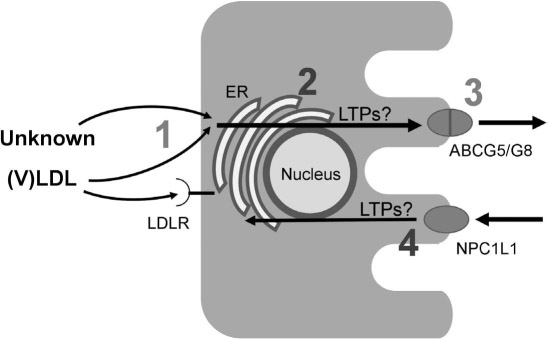
Figure 1.
Schematic representation of the pathways in transintestinal cholesterol excretion (TICE) in the enterocyte. (1) Cholesterol uptake by the basolateral membrane of the enterocyte. Cholesterol from very low-density lipoprotein (VLDL) and/or a yet unknown source is taken up by the low-density lipoprotein receptor (LDLR) and/or another pathway. (2) Translocation of cholesterol from the basolateral to the apical side of the enterocyte. The mechanisms behind this translocation are not known; however, we hypothesize that lipid-transfer proteins (LTPs) form tethers between different membranes, such as that of the endoplasmic reticulum (ER), allowing transfer of cholesterol between these membranes. (3) Excretion over the apical membrane into the intestinal lumen, a process that is mainly mediated by the ATP-binding cassettes G5/G8 (ABCG5/G8) transporter. (4) Absorption of cholesterol by the cholesterol influx transporter NPC1L1 followed by translocation, a process presumably also involving the actions of LTPs. NPC1L1: Niemann-Pick C1-Like 1, a protein that mediates extracellular sterol transport
Table 1.
Expression of lipid-transfer proteins in the small intestine of mice and humans. The higher the expression, the higher the value for messenger RNA expression.31,32 ND: not detected; GRAMD1: GRAM domain-containing protein 1; OSBP: oxysterol-binding protein; ORP1L: OSBP-related protein 1 long form; StAR: steroidogenic acute regulatory protein; STARD3: StAR-related lipid transfer (START) domain containing 3; TEX2: testis-expressed protein 2
| LIPID-TRANSFER PROTEIN | MOUSE | HUMAN | |
|---|---|---|---|
| MRNA | MRNA | PROTEIN | |
| GRAMD1a | 92 | 6 | Medium |
| GRAMD1b | 68/89* | 88 | Medium |
| GRAMD1c | 514 | 8 | ND |
| OSBP | 3493 | 14/146 | High |
| ORP1L | 30/94 | 36/176 | Medium |
| StAR | 5/5/11 | 5 | ND |
| STARD3 | 228 | 7 | High |
| TEX2 | 5/595 | 36 | Medium |