
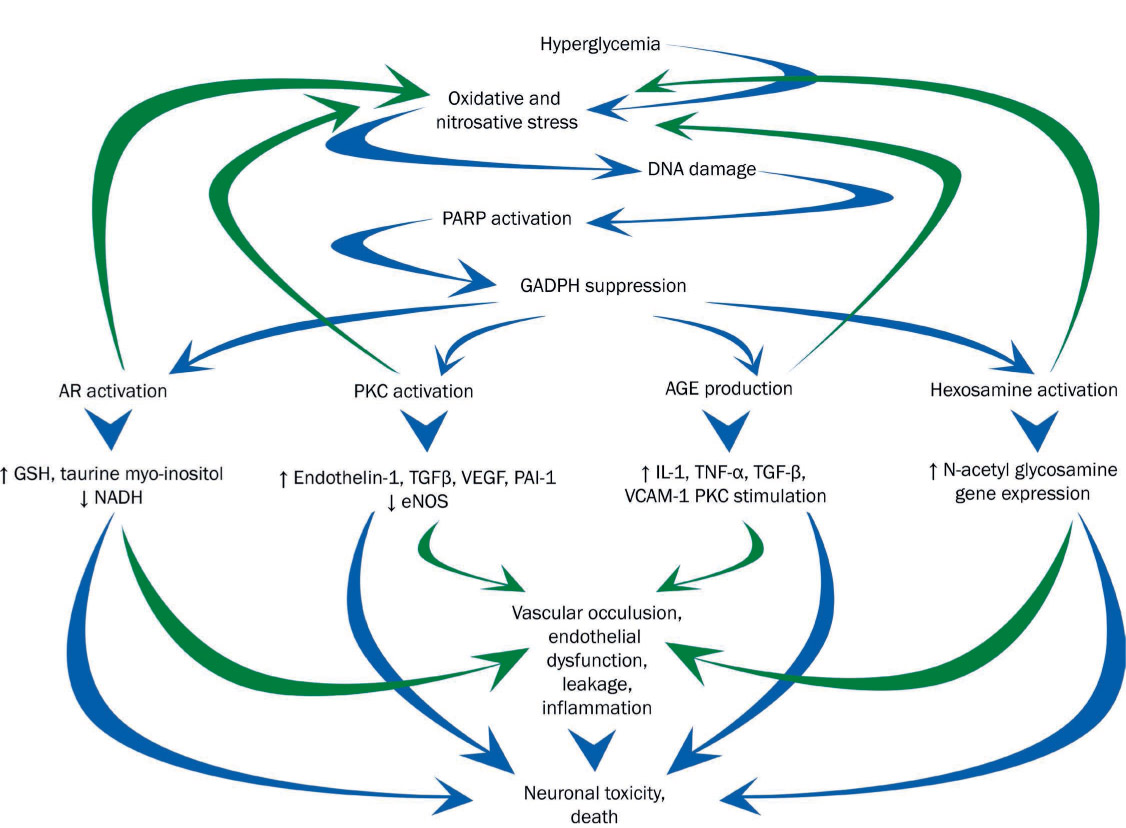
Figure 1.
Summary of the mechanisms that relate hyperglycemia to microvascular complications such as neuropathy in patients with diabetes.1 PKC: protein kinase C; AGE: advanced glycation end-products; PARP: poly ADP-ribose polymerase; GAPDH: glyceraldehyde-3 phosphate dehydrogenase; GSH: glutathione; NADH: nicotinamide adenine dinucleotide; TGF-β: transforming growth factor beta; VEGF: vascular endothelial growth factor; PAI-1: plasminogen activator inhibitor-1; eNOS: endothelial nitric oxide synthase; IL-1: interleukin 1; TNF-α: tumor necrosis factor alpha; VCAM-1: vascular cell adhesion molecule 1
Table 1.
Standard cardiovascular autonomic reflex tests (CARTS).2 HRV: heart rate variability; ECG: electrocardiogram; bpm: beats per minute
| TEST | TECHNIQUE | NORMAL RESPONSE AND VALUES |
|---|---|---|
| Beat-to-beat HRV | With the patient at rest and supine, heart rate is monitored by ECG while the patient breathes in and out at 6 breaths/min, paced by a metronome or similar device. | A difference in heart rate of > 15 bpm is normal and < 10 bpm is abnormal. The lowest normal value for the expiration-inspiration ratio of the R-R interval is 1.17 in patients aged 20–24; this value decreases with age. |
| Heart rate response to standing | During continuous ECG monitoring, the R-R interval is measured at beats 15 and 30 after standing. | Typically, a tachycardia is followed by reflex bradycardia. The 30:15 ratio should be > 1.03. |
| Heart rate response to Valsalva maneuver | The subject forcibly exhales into the mouthpiece of a manometer to 40 mm Hg for 15 s during ECG monitoring. | Healthy subjects develop tachycardia and peripheral vasoconstriction during strain and an overshoot bradycardia and rise in blood pressure with release. The normal ratio of longest to shortest R-R is > 1.2. |
| Systolic blood pressure response to standing | Systolic blood pressure is measured in the supine subject. The patient stands, and the systolic blood pressure is measured after 2 min. | Normal response is a fall of < 10 mm Hg; borderline is a fall of 10–29 mm Hg; abnormal is a fall of > 30 mm Hg with symptoms. |
| Diastolic blood pressure response to isometric exercise | The subject squeezes a handgrip dynamometer to establish a maximum. Grip is then squeezed at 30% maximum for 5 min. | A normal response for diastolic blood pressure is a rise of > 16 mm Hg in the opposite arm. |