
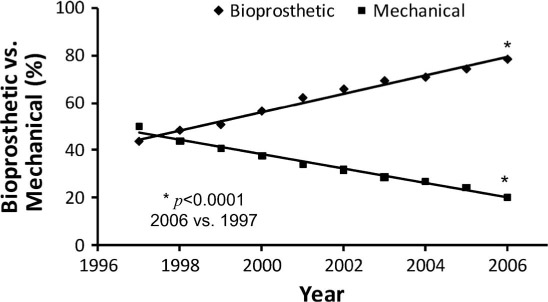
Figure 1.
Percentage use of bioprosthetic valves vs mechanical valves from 1997 through 2006. Bioprosthetic valve use increased progressively during 10 years. Asterisk indicatesP < .0001. Reprinted with permission.1
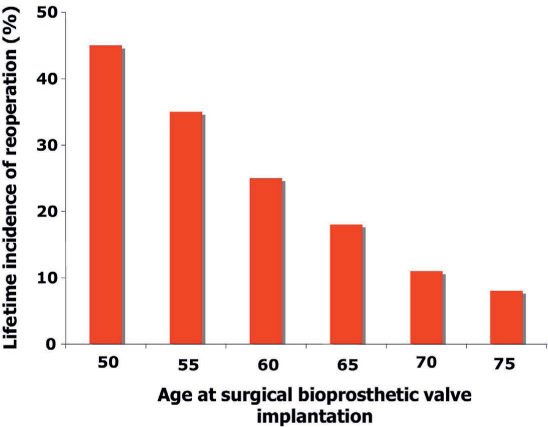
Figure 2.
Lifetime risk of reoperation as a function of age at surgical aortic valve replacement. Reprinted with permission.13
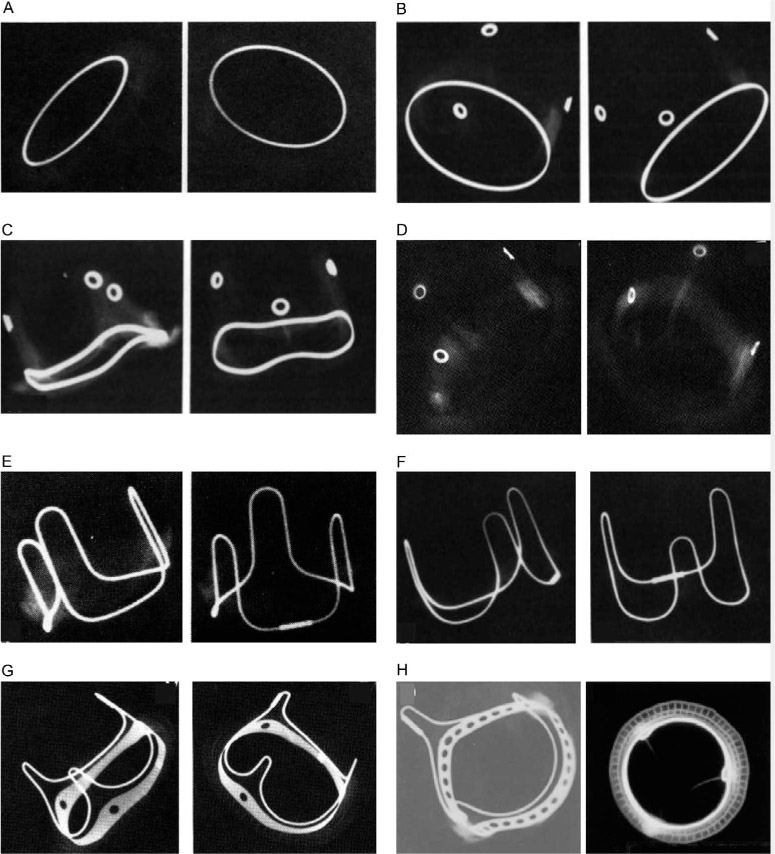
Figure 3.
Radiographic appearances of various stented bioprosthetic valves. (A) The Hancock standard valve has a radiopaque Haynes alloy flat base ring. (B) The Hancock Modified Orifice valve has a radiopaque flat base ring (Haynes alloy) and metal eyelets (Haynes alloy) located at the apices of each stent post. (C) The Medtronic Hancock II valve has a radiopaque saddle-shaped base ring (Haynes alloy) and metal eyelets (Haynes alloy) located at the apices of each stent post. (D) The Medtronic Mosaic valve has radiopaque metal eyelets only. (E) The Carpentier-Edwards (CE) Porcine Standard valve has a radiopaque continuous wire form (Elgiloy Specialty Metals) that outlines the stent posts (U-shaped loops) and the base ring between the stent posts. The base ring is otherwise radiolucent. (F) The CE Porcine Supra-Annular Valve (SAV) is similar to the CE Porcine Standard valve (E) except that the CE porcine SAV has “less sharp” transition angles between base ring and stent posts. (G) The CE Pericardial valve has a flattened radiopaque base ring with three holes. A narrow wire form outlines the three stent posts and the base ring in between. (H) The CE Perimount standard has a radiopaque base ring that contains multiple holes and a separate narrow wire form that outlines the stent posts and the base ring in between. Reprinted with permission.13