Have a personal or library account? Click to login
Evaluation and Management of Pulmonary Arterial Hypertension in Congenital Heart Disease Cover

Evaluation and Management of Pulmonary Arterial Hypertension in Congenital Heart Disease

Open Access
|Jul 2021

Figures & Tables

Table 1

2013 clinical classification of pulmonary arterial hypertension associated with congenital heart disease. This classification remained unchanged in the 6th World symposium of Pulmonary Hypertension. Reprinted with permission from Elsevier.7 PVR: pulmonary vascular resistance; PAH: pulmonary arterial hypertension; HCV: hepatitis C virus

EISENMENGER SYNDROME
  • Includes all large intra- and extracardiac defects, which begin as systemic-to-pulmonary shunts and progress with time to severe elevation of PVR and to reversal (pulmonary-to-systemic) or bidirectional shunting. Cyanosis, secondary erythrocytosis, and multiple organ involvement are usually present.

PAH ASSOCIATED WITH PREVALENT SYSTEMIC-TO-PULMONARY SHUNTS
  • Correctable

  • Noncorrectable

    • Includes moderate to large defects; PVR is mildly to moderately increased, systemic-to-pulmonary shunting is still prevalent. Cyanosis at rest is not a feature.

PAH WITH SMALL/COINCIDENTAL DEFECTS
  • Marked elevation in PVR in the presence of small cardiac defects (usually ventricular septal defects < 1 cm and atrial septal defects < 2 cm of effective diameter assessed by echo), which themselves do not account for development of elevated PVR; the clinical picture is very similar to idiopathic PAH. Closing the defects is contraindicated.

PAH AFTER DEFECT CORRECTION
  • Congenital heart disease is repaired, but PAH either persists immediately after correction or recurs/develops months or years after surgery in the absence of significant postoperative hemodynamic lesions.

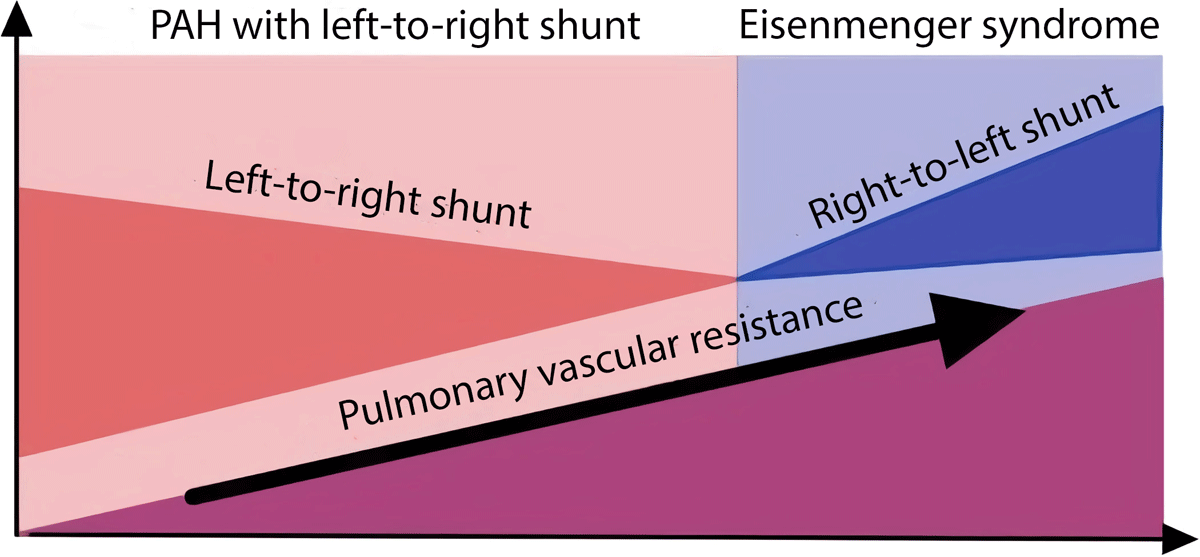
Figure 1

Pathophysiology of pulmonary arterial hypertension in a patient born with a hemodynamically significant septal defect. Pressure and volume overload of the pulmonary circulation increases the severity of pulmonary vascular resistance, leading to an initial fall and eventual reversal of the shunt.

Figure 2

Trials specific to pulmonary arterial hypertension therapy done in patients with congenital heart disease, specifically in those with Eisenmenger syndrome (ES) and with single ventricle physiology and Fontan operation.28,29,35,36,37,38

DOI: https://doi.org/10.14797/UFEJ2329 | Journal eISSN: 1947-6108
Language: English
Page range: 145 - 151
Accepted on: Apr 28, 2021
Published on: Jul 1, 2021
Published by: Houston Methodist DeBakey Heart & Vascular Center
In partnership with: Paradigm Publishing Services

© 2021 Hassaan B Arshad, Valeria E Duarte, published by Houston Methodist DeBakey Heart & Vascular Center
This work is licensed under the Creative Commons Attribution-NonCommercial 4.0 License.