
Introduction
Only a few large dune areas occur on the several 100-km-long coast of Catalonia (Marqués et al. 2011). All significant dune fields are associated with river deltas, mainly the Ebro and Llobregat, and in Alt and Baix Empordà with the alluvial plains of the Muga, Fluvià, Ter and Daró rivers. Coastal dunes of the mentioned areas are the subject of multifaceted studies, ranging from geomorphological, sedimentological, through biogeographical, landscape, to historical, economic and others (Cros 1987, Marques, Julia 1988, Cros, Serra 1993, Curcó 1996, Marques et al. 2001, Rodríguez-Santalla et al. 2009, Roig-Munar et al. 2009, 2020, Pipió 2013, Pintó et al. 2014, 2023, Barrio-Parra, Rodríguez-Santalla 2016, Garcia-Lozano, Pintó 2018, Perelló et al. 2019, Calafat et al. 2021, Lluis 2021 and others).
Catalan dunes cover an area of <25 km2 and are mostly (>74%) stabilised by vegetation (Garcia-Lozano 2019). Inland dunes predominate (Hills of Begur, Montgri), while coastal dunes are a secondary landscape element, occurring on only 15% of Catalan beaches. Pintó and Garcia-Lozano (2016) report that the largest coastal dune systems cover an area of slightly over 2 km2, while Garcia-Lozano (2019), comparing the 20 largest coastal dunes, determines their area at 7.5 km2. Most dunes are very small, with an area of <0.5 ha.
In the past, dunes were a much more characteristic element of the coastal landscape of Catalonia than they are today. However, due to the progressive urbanisation of the coast, the expansion of tourist and recreational infrastructure, transport, etc., has been built up, degraded or disappeared. Garcia-Lozano (2019) reports that since 1960, 90% of dune landscapes on the Catalan coast have been degraded. The problem of dune disappearance and the loss of their natural and landscape values, changes in the functioning of the beach–dune system, and the protection of initial aeolian forms and dune habitats are the subject of numerous studies (e.g. Santana Cordero et al. 2015, Pintó, Garcia-Lozano 2016, Garcia-Lozano 2019, Perelló et al. 2019, Garcia-Lozano et al. 2018, 2024).
Pintó and Garcia-Lozano (2016) documented the former occurrence of dune systems in many locations on the Catalan coast based on a thorough analysis of archival, cartographic and photographic materials. The tabular summary included in the paper (pp. 90–91) shows that out of 33 dune areas visible in archival photographs, 7 were not identified in aerial photographs from the mid-20th century (1947 or 1957), and another 20 areas have completely disappeared, mainly due to urbanisation, and the area of the remaining 6 areas has been significantly reduced. It reflects the scale of anthropogenic pressure on the dune environment (Pipió 2008, Garcia-Lozano et al. 2018, 2024). Recent decades have brought positive changes in coastal management, including protecting areas with initial aeolian forms and growing vegetation (e.g. Pla et al. 2018, Calafat et al. 2021, Fig. 1).
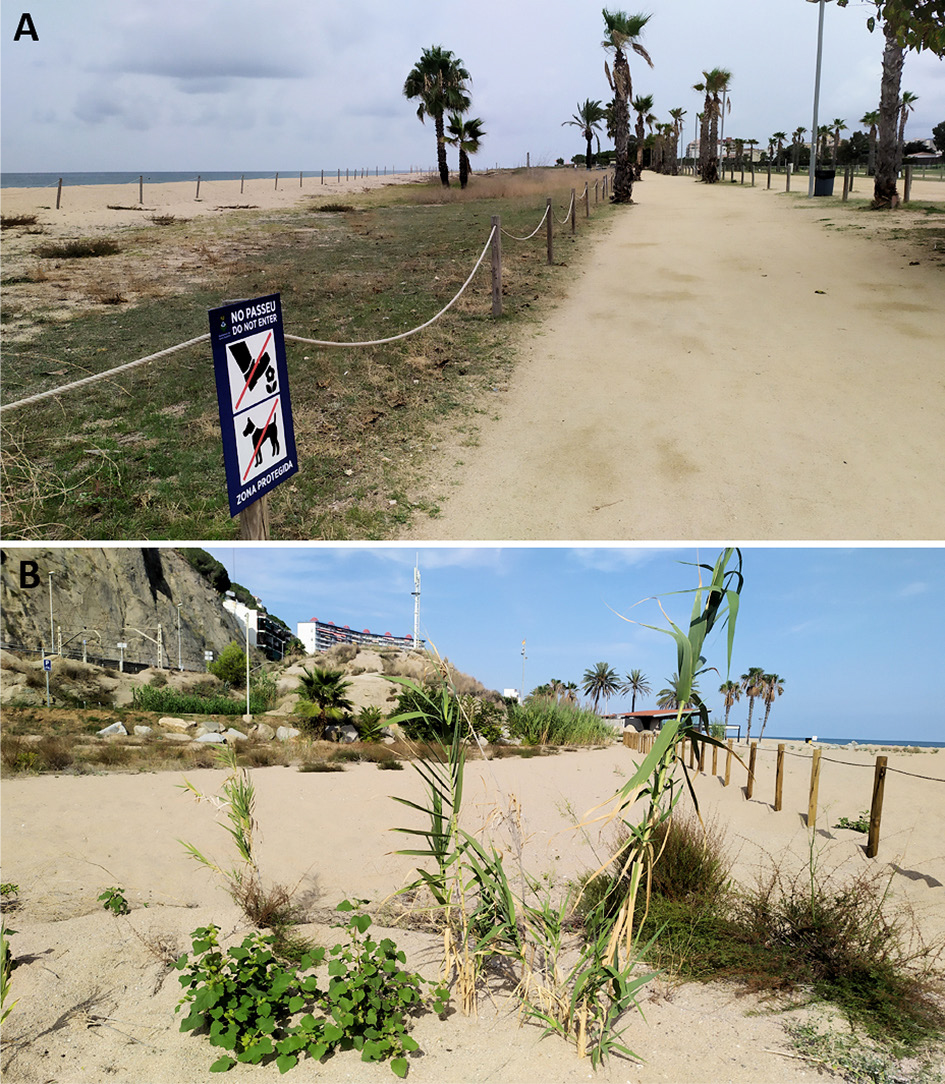
Fig. 1.
Examples of the protection of initial aeolian forms and the vegetation growing on them: A – Dunes Beach, Santa Susanna, B – Canet Beach, Canet de Mar (Photo R. Dulias 2023).
From a geomorphological point of view, how the coast transformed from dune to duneless in a short period is interesting. The coasts on which, in the movement of deposits, it was possible to distinguish in a simplifed way, the water transport zone, the transition zone between water and wind transport, and the wind transport zone have been narrowed to such an extent that in most, they are only in the range of waves. The coastal strip has been limited and narrowed in many sections both on the landside and at the seaside. In the frst case, this is a result of the occupancy of former dunes by expanding towns and tourist resorts and then the approach of the building line directly to the beaches (e.g. Marti, Pintó 2012, Cuadrado-Ciuraneta et al. 2017, Sagristà 2020), and in the second case, with coastal erosion and receding of the coastline. In recent decades, these processes have affected many Catalan beaches (e.g. Marqués, Julià 2005, Ballesteros et al. 2018, Jiménez, Valdemoro 2019, Panareda 2020), as in other regions of Spain (Molina et al. 2019, Pardo-Pascual et al. 2021), or the world (Pilkey, Cooper 2014, Luijendijk et al. 2018). About 70% beaches of Costa Brava are subject to erosion in recent decades (Jiménez et al. 2016, Roig-Munar 2020). An example of dynamic coastline changes is Fenals Beach in Lloret de Mar, where in the years 2020–2024, one part of the beach was heavily eroded, and the other was within the range of accumulation processes (Fig. 2). The rate of coastal erosion is estimated differently. For the north-eastern coast of Catalonia, an average rate of beach erosion has been estimated at 1 m per year (Jiménez et al. 2016). However, Jiménez and Valdemoro (2019) reported that >60% of Catalan beaches are currently experiencing erosion, with an average shoreline retreat of approximately 0.5 m · a−1.
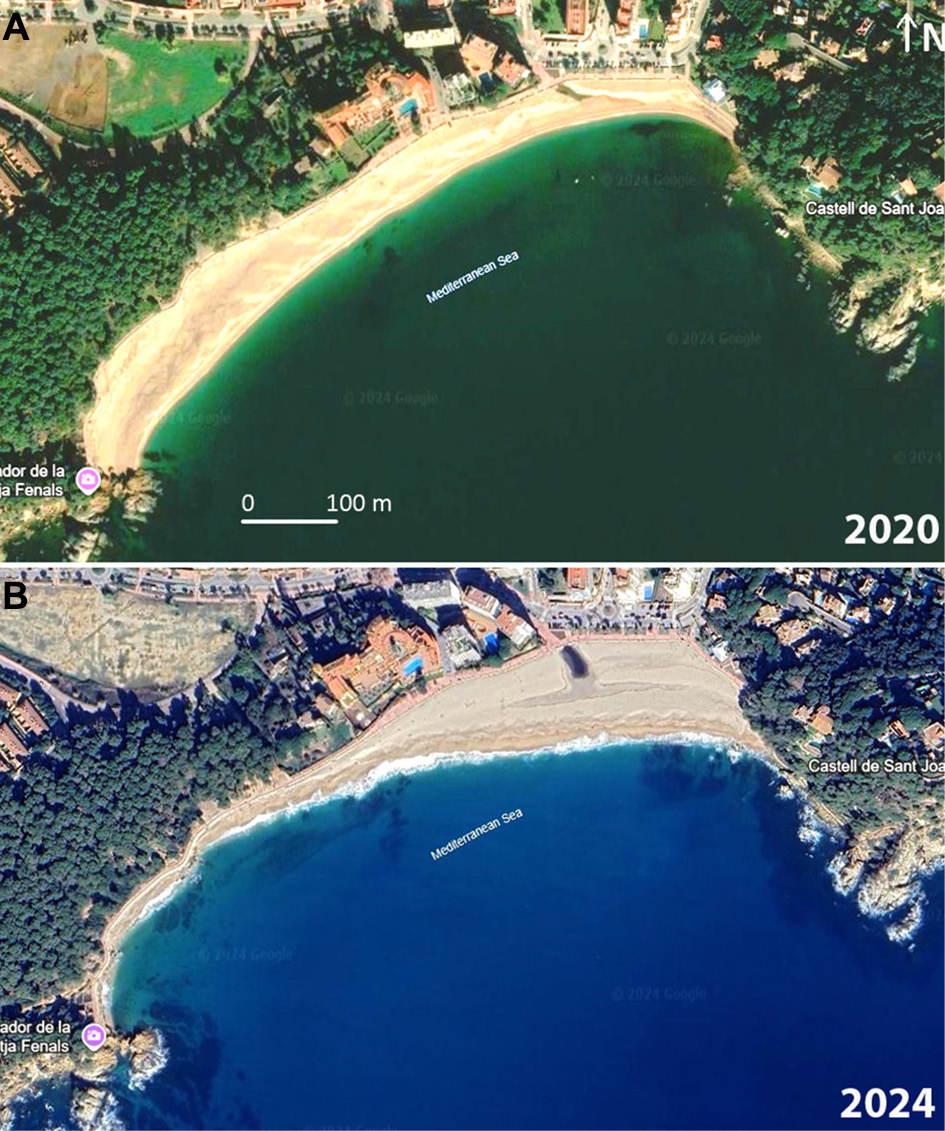
Fig. 2.
Changes to the Fenals Beach coastline in Lloret de Mar, Costa Brava in 2020 and 2024 (acc. to Google Earth).
Storms have a substantial impact on the reduction of beach areas and the volume of their deposits (Mendoza et al. 2011, Duran et al. 2016, Jiménez et al. 2018, Sanuy et al. 2018, Amores et al. 2020, Pintó et al. 2020). The Mediterranean Sea is listed among the world’s basins that has a high rate of cyclogenesis (Sartini et al. 2015, Toomey et al. 2022). In recent decades, the coast of Catalonia has been subject to many extreme storms, with record-breaking strong winds and wave heights. Jiménez et al. (2012) analyses storms on the Catalan coast from 1958 to 2008, concluding that they were more frequent in the late 1990s and 2001–2004. Particularly destructive impacts on coastal geomorphology, and urban and transport infrastructure, were the storm Sant Esteve in 2008, with wind speeds of up to 20 m · s−1 and waves up to 8 m (Sanchez-Vidal et al. 2012) and the storm Gloria in January 2020 (Amores et al. 2020, Pintó et al. 2020). Extreme weather conditions occur mainly in winter when strong E–NE winds generate high waves on the continental shelf, which in turn cause overwash, flooding and erosion of the beaches (Sanchez-Vidal et al. 2012).
The erosion of the Catalan coast associated with storms caused the coastline to retreat by several dozen or even more than a 100 m (Ballesteros et al. 2018, Jiménez et al. 2018, Perelló et al. 2019, Martín-Vide et al. 2020) and, as a result, brought it closer to the foreland of former foredunes. Some of the beaches currently flooded by storm waves were beyond their reach in the past, so in favourable conditions, the deposits that built them could participate in the aeolian transport process and be a source of material for foredunes. The favourable conditions for aeolian processes, apart from the dryness of deposits, lack of vegetation and strong winds, also include space – an area where the accumulation of blown-out deposits can occur, and foredunes can be formed. On many sections of the Catalan coast, this space no longer exists – it has been built up.
The Catalan coast is, therefore, an example of very dynamic changes in environmental conditions due to natural and anthropogenic causes on a short-term scale over the past few dozen 100–200 years. One such significant change is the disappearance of coastal dunes. The lack of morphological effects of wind activity is not equivalent to the lack of aeolian deposits, as these may be a part of contemporary beach deposits, especially in their upper parts, formerly the foreland of foredunes. The deposit features confrming their presence in an aeolian environment include the rounding of quartz grains and, above all, the matting of their surfaces. Both features are acquired as a result of mechanical abrasion during wind transport, which is used to identify aeolian deposits from deposits of other origins (Krumbein 1941, Cailleux 1942, Powers 1953, Kuenen 1960, Seppälä 1969, Krinsley, Doornkamp 1973, Goździk, Mycielska-Dowgiałlo 1982, Woronko 2012, Dulias 2023a and many others).
In this paper, an attempt was made to answer two questions: (1) whether the textural features of contemporary beach deposits in Catalonia contain a record of past aeolian processes, and (2) whether this record is clear enough to be a basis for indicating coasts where dunes occurred in the past. A section of the coast currently without dunes was selected for the study, apart from a few very small initial forms of the nebkha type.
Study area
The study area is located in northeastern Spain in the Catalonia region (Fig. 3) and belongs to the Serralada Litoral Range. These are relatively low (about 500 m above sea level, maximum 763 m above sea level), significantly eroded mountains, which end with steep, rocky cliffs to the sea in some sections. This area mainly comprises igneous rocks – granodiorites, granites, leucogranites and tonalites (Carboniferous-Permian). Details of the geological structure are presented in Figure 4.
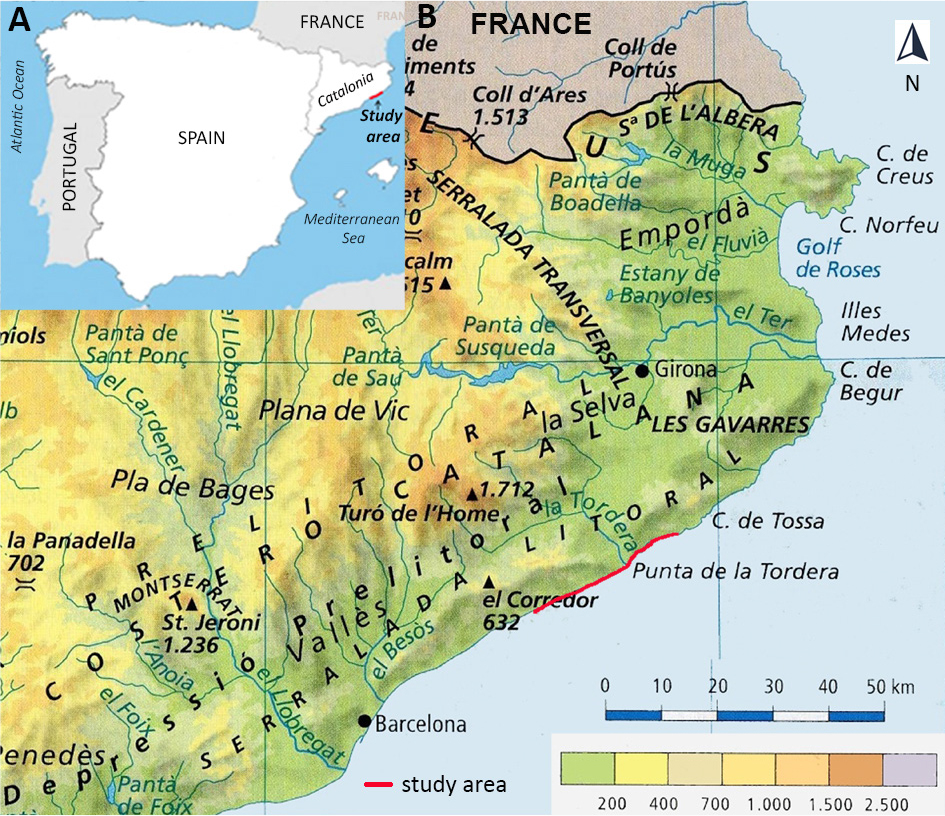
Fig. 3.
Location of the study area on the Iberian Peninsula – A and in northeastern Catalonia, Spain – B (acc. to ontheworldmap.com, changed).
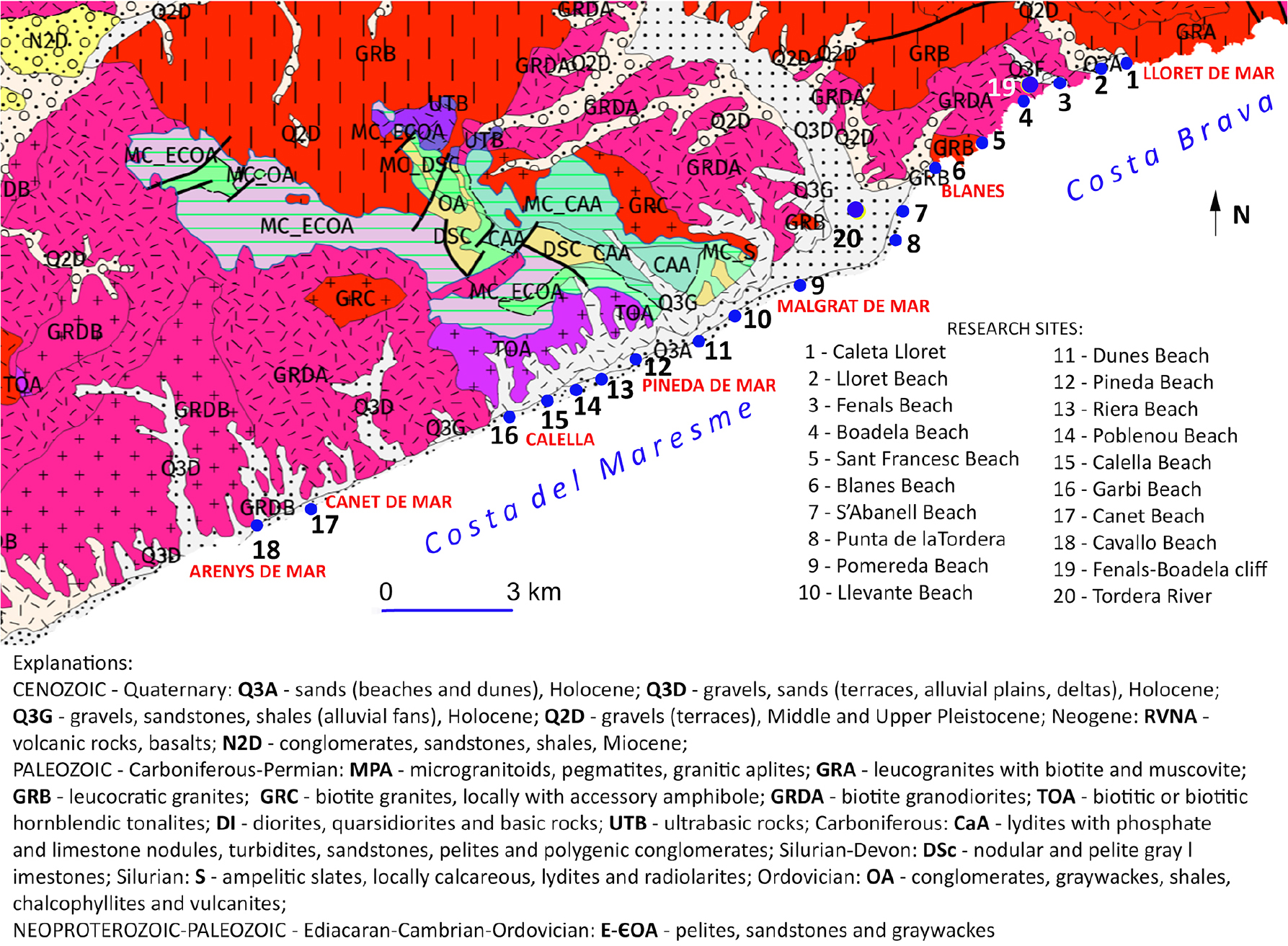
Fig. 4.
Location of research sites (1–20) against the geology of the Costa del Maresme and Costa Brava (acc. to Mapa geològic de Catalunya 1: 300 000 2024).
A Mediterranean climate characterises the study area. The average annual temperature is about 16°C (summer – 23°C, winter – 10°C) (meteotecadecatalunya.cat). Annual precipitation is about 600 mm, predominating in autumn and spring. A strong Tramontana wind blows in the cold season, generally from the north and northwest. Llevantades winds from the east are less frequent but are associated with strong storms. The tidal regime is microtidal, and the longshore drift is from north to south.
The study covered a strip of the Mediterranean coastline approximately 30 km long, located between Lloret de Mar and Arenys de Mar (Fig. 4). The mouth of the Tordera River divides it into two parts belonging to two provinces – the area located north of La Palomera in Blanes is called Costa Brava (province of Girona), while the coast situated to the south is called Costa del Maresme (province of Barcelona). The coast is generally oriented from the north-east to the south-west. It includes both a rocky coastline with cliffs, sandy-gravel pocket beaches, as well as large open sandy or sandy-gravel beaches (Caracterització del litoral Català 2018) (Fig. 5). South of the Tordera River, the continental shelf is wide (up to 12 km); it is a zone of high deposits transfer dynamics (Pla de Ports de Catalunya 2007–2015). North of the Tordera River, the continental shelf is narrower (up to 5 km). At Arenys de Mar and Blanes, the shelf is fragmented by canyons, named Arenys and Blanes, respectively (Sanchez-Vidal et al. 2012).
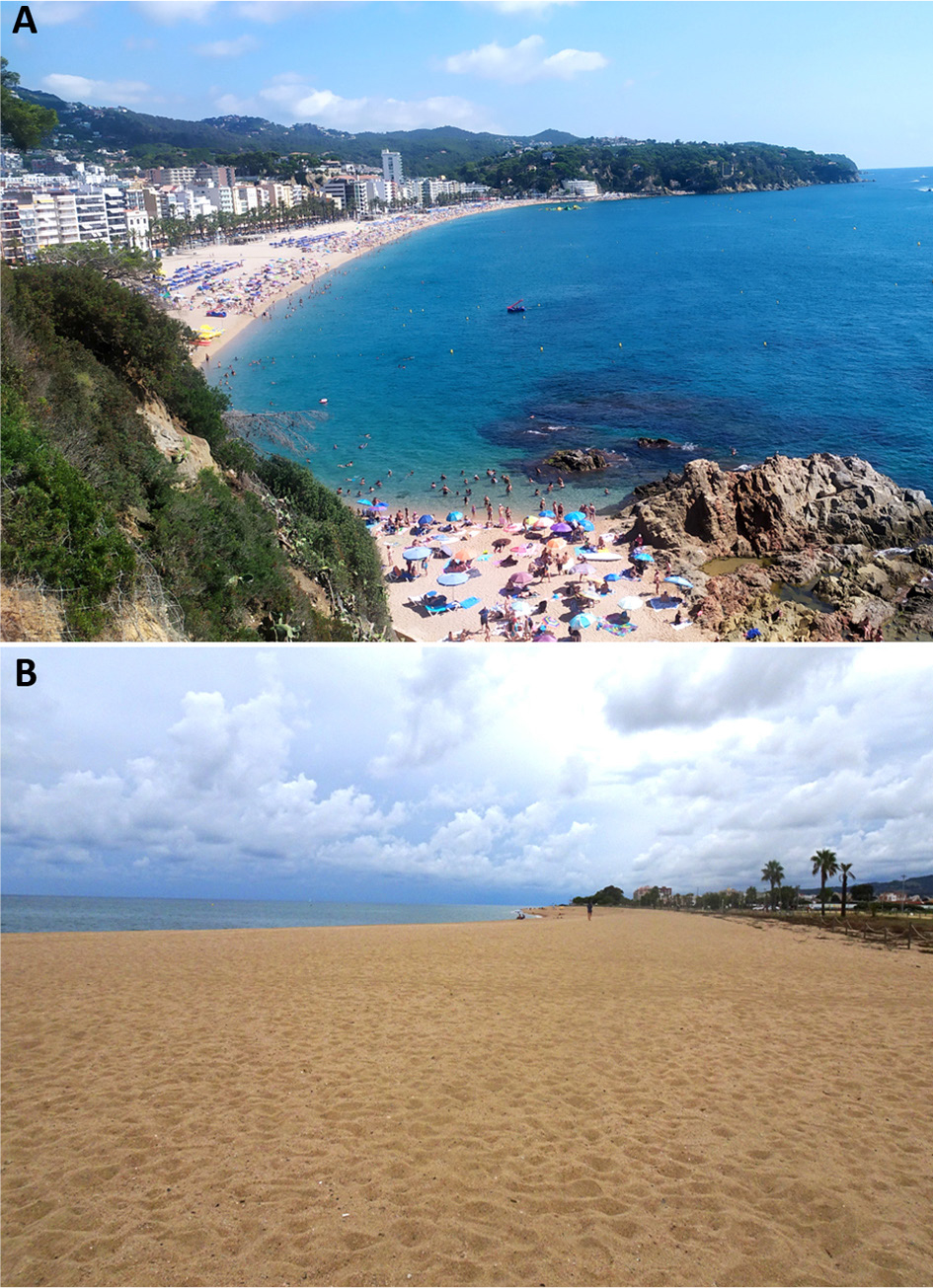
Fig. 5.
Lloret Beach in Lloret de Mar A – as an example of a sandy-gravel pocket beach on the Costa Brava and Dunes Beach in Santa Susanna B – as an example of a large open sandy-gravel beach on the Costa del Maresme (Photo R. Dulias 2023). Textural features of the deposits are presented in Tables 2 and 3.
On the Catalan coast, the primary sources of deposits are rivers and streams, especially during intense rainfall, coastal erosion and longshore transport. However, natural and anthropogenic factors have significantly modified the deposit budget in recent years. The negative balance is related to the decrease in river-supplied deposits, coastal erosion and disruption of longshore transport, among others, due to the presence of marinas (Ballesteros et al. 2018, Garcia-Lozano 2019, Panareda 2020). Coastal municipalities take different actions to manage beach deposits, such as beach nourishment or redistribution of deposits (Sardá et al. 2005, Sagristà, Sardà 2020), but the effects of these actions are not permanent (Pla et al. 2018).
The Tordera Delta has high geomorphological dynamics and is sensitive to storms, floods and anthropogenic pressure. The coastline here is exposed to high-energy storm waves from the E–NE direction and secondary directions from the southern sector (Mendoza et al. 2011, Jiménez et al. 2018). From the 1940s to the present, the Tordera Delta has retreated by 250–300 m, among others, due to the lack of deposit supply caused by excessive groundwater exploitation and aggregate extraction from the channel (Sagristà et al. 2017). In the last few kilometres, the Tordera channel has been dry for years, except for periods of heavy rainfall (Farguell 2019). In January 2020, the flood after the Gloria storm (peak discharge of about 550 m3 · s−1) caused a huge influx of deposits and the formation of a spit in the open sea and a lagoon (Batalla et al. 2020). In 2023, during the study period, the estuary section of the Tordera channel was dry, and there was no trace of the delta from 3 years ago. It should be added that the Tordera delta stands out from other deltas in the Mediterranean basin for the coarse grain of the deposits. Their source is granitoid and metamorphic rocks of the pre-littoral mountains (Vila, Serra 2015).
Materials and methods
In the study area, 20 research sites were established, including 18 on beaches, 1 in the Tordera riverbed and 1 on the cliff top between the Fenals and Boadela beaches (Fig. 4). On beaches, samples were taken from their inner and outer parts, as follows: 18 samples from the upper part of the backshore, limited by the cliff, dense vegetation, promenade, fence or other development and 15 samples from the upper part of the swash zone (beach face) (samples from the swash zone were not collected on two very narrow beaches and from one beach due to high wave activity during the fieldwork). To simplify the description, the terms backshore and swash zone were used for their upper parts. For sampling, places with natural morphology, least changed by human activity, were selected, and artificially created embankments and forms with regular, unnatural contours were avoided.
Samples weighing 200 g were collected from a depth of 0–10 cm. Basic grain size indices were determined for all samples according to the Folk and Ward formulas (1957), using mainly the mean grain diameter Mz and δ sorting in this analysis. Two teaspoons of deposits were collected from fractions of 0.8–1.0 mm and 0.5–0.8 mm to analyse the mineral composition and abrasion of quartz grains. The following were isolated: resistant quartz, less resistant shells and carbonate minerals, and non-quartz minerals of various resistances. It was assumed that the larger the share of quartz grains, the longer the aeolian process lasts (Mycielska-Dowgiałło, Woronko 1998, Woronko 2012). The number of grains counted for the study ranged from 100 to 200.
The abrasion of quartz grains was studied using the Cailleux morphoscopic method (1942), modified by Mycielska-Dowgiałło and Woronko (1998), using an optical microscope. The types of grains and their characteristics are summarised in Table 1. Shiny grains indicate abrasion in water environments, and matt grains in aeolian environments. Following Woronko (2012) and other authors, it was assumed that the measure of the duration of the aeolian process is the ratio of RM and EM/RM grains. If the former predominates, the aeolian processes last longer and vice versa. It should be noted that quartz grains are also subjected to chemical etching, and as a result of this process, grain matting may occur (Margolis 1968, Krinsley, Doornkamp 1973, Setlow 1978, Mycielska-Dowgiałło 1988, Mahaney 2002, Vos et al. 2014). The cause of matting can be identified under a scanning electron microscope (SEM). Grains from high-energy beaches, such as the beaches on the studied coast of Catalonia, show mainly mechanical abrasion features (Krinsley, Takahashi 1962).
Table 1.
Quartz grain types according to the morphoscopic analysis of Cailleux (1942), modified by Myciels-ka-Dowgiałlo, Woronko (1998).
| Name | Features | Krumbein (1941) roundness scale | Environment |
|---|---|---|---|
| C | Broken (cracked) | Mainly glacial, periglacial, but also in other environments | |
| NU | Fresh, angular grains with sharp edges (not abraded) | 0.1–0.2 | Weathered in situ and/or from crushing grains formed in all environments |
| EL | Very well-rounded, shiny | 0.7–0.9 | Long-term water transport – fluvial, high-energy beach |
| EM/EL | Moderately rounded, shiny | 0.3–0.6 | Short-term water transport – fluvial, high-energy beach |
| RM | Very well-rounded, matt | 0.7–0.9 | Long-term (several 1000 years), intensive aeolian transport |
| EM/RM | Moderately rounded, matt only of the edges | 0.3–0.6 | Short-term aeolian transport (several 100 years) or low transport intensity |
Results
Grain size
The beaches of the study area are sandy, sandy-gravelly and gravelly. Typically, gravel beaches are those in bays surrounded by high cliffs, for example, Sant Francesc Beach in Blanes, where the gravel fraction in the swash zone is 95.7%, or the beaches of Fenals and Boadela in Lloret de Mar with a share of gravel in the backshore, 86.5% and 91.2% respectively. Another gravel beach is Cavallo Beach in Arenys de Mar (located in the southernmost part of the study area), with >62% of the gravel share in both zones.
Sandy beaches occur mainly in the central and southern parts of the studied coast, for example, Riera Beach (97.3% of sand fraction in the backshore), Poblenou Beach (94.9%) or Calella Beach (92.0%). However, they are composed of very coarse-grained sand (1.0–2.0 mm) and coarse-grained sand (0.5–1.0 mm). The analysis of the Mz values presented in Table 2 shows that on most beaches without cliffs (e.g. Levante Beach, Dunes Beach, Riera Beach, Poblenou Beach, Calella Beach), deposits become finer from the swash zone towards the backshore (Fig. 6). An example of the opposite relationship is Pomereda Beach in Malgrat de Mar, where the backshore is composed of much coarser material (Mz – 1.444 mm) than the deposits in the swash zone (Mz – 0.933 mm) (Table 2).
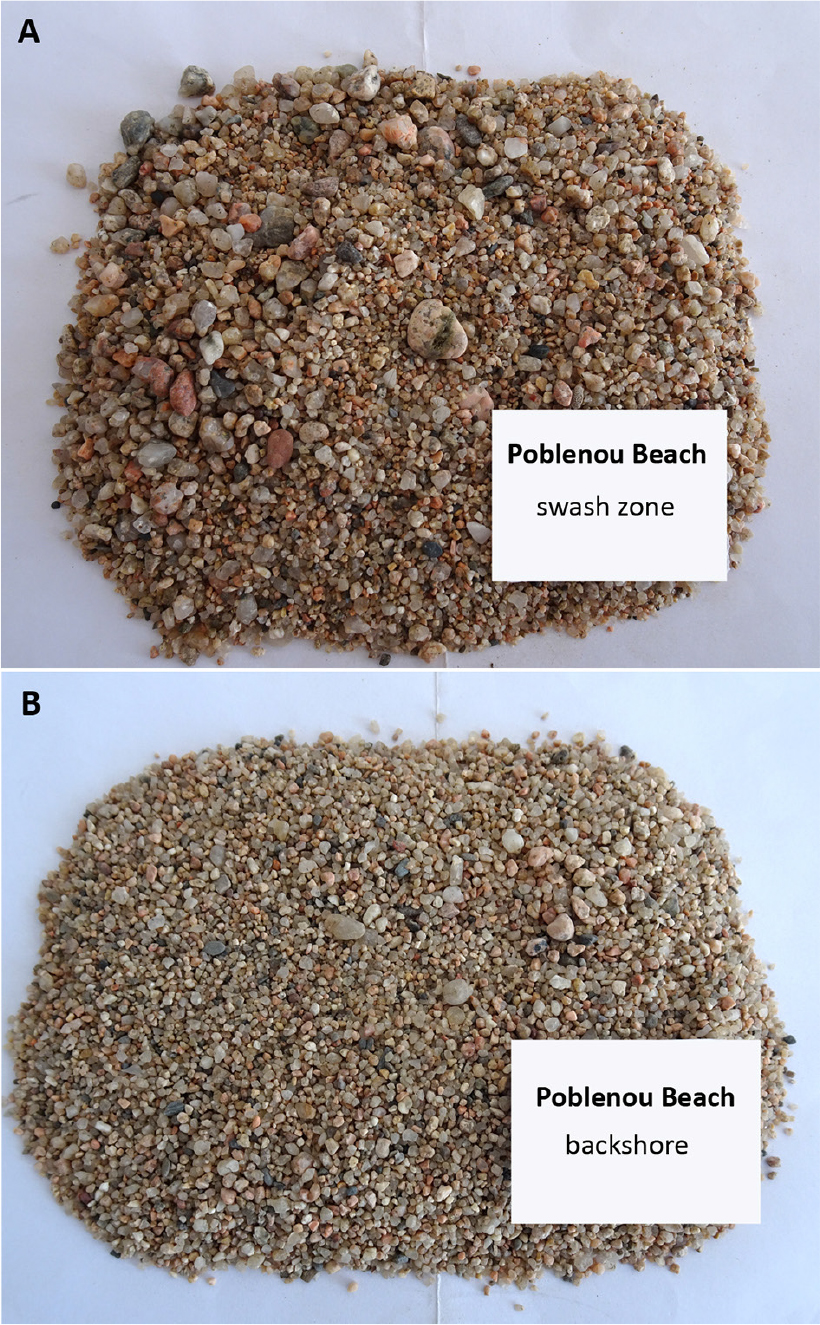
Fig. 6.
Macroscopically visible differences in grain size of deposits between the swash zone – A and the backshore – B, Poblenou Beach in Pineda de Mar (Photo R. Dulias 2023). Textural features of the deposits are presented in Tables 2 and 3.
Table 2.
Mean grain size (Mz) and sorting (δ) (a – no sample taken).
| No. | Site | Municipality | Mean Mz [mm] | Sorting δ [phi] | ||
|---|---|---|---|---|---|---|
| Swash zone | Backshore | Swash zone | Backshore | |||
| 1 | Caleta Lloret | Lloret de Mar | a | 1.729 | a | 0.64 |
| 2 | Lloret Beach | 2.250 | 2.129 | 0.56 | 0.64 | |
| 3 | Fenals Beach | 2.330 | 3.095 | 0.42 | 0.60 | |
| 4 | Boadela Beach | a | 2.969 | a | 0.49 | |
| 5 | Sant Francesc Beach | Blanes | 3.031 | 2.694 | 0.42 | 0.63 |
| 6 | Blanes Beach | 1.647 | 1.932 | 0.45 | 0.63 | |
| 7 | S’Abanell Beach | 1.670 | 1.516 | 0.70 | 0.70 | |
| 8 | Punta de la Tordera | 1.021 | 1.366 | 0.42 | 0.63 | |
| 9 | Pomereda Beach | Malgrat de Mar | 0.933 | 1.444 | 0.52 | 0.52 |
| 10 | Llevante Beach | Santa Susanna | 1.320 | 0.927 | 0.58 | 0.55 |
| 11 | Dunes Beach | 1.790 | 1.424 | 0.47 | 0.68 | |
| 12 | Pineda Beach | Pineda de Mar | a | 1.778 | a | 0.61 |
| 13 | Riera Beach | 1.537 | 1.149 | 0.53 | 0.37 | |
| 14 | Poblenou Beach | 1.537 | 1.231 | 0.65 | 0.36 | |
| 15 | Calella Beach | Calella | 1.395 | 1.283 | 0.44 | 0.43 |
| 16 | Garbi Beach | 1.366 | 1.602 | 0.53 | 0.53 | |
| 17 | Canet Beach | Canet de Mar | 1.516 | 1.526 | 0.48 | 0.57 |
| 18 | Cavallo Beach | Arenys de Mar | 2.412 | 2.313 | 0.70 | 0.62 |
| 19 | Fenals–Boadela cliff | Lloret de Mar | 1.087 | 0.37 | ||
| 20 | Tordera River | Blanes | 1.670 | 0.77 | ||
Beach deposits are well and moderately sorted in both the swash zone (δ values ranging from 0.42 to 0.70) and the backshore (0.36–0.70) (Table 2). The mean sorting in both zones is similar and amounts to 0.52 and 0.57, respectively.
Mineral composition
Quartz dominates the mineral composition of the studied beach deposits. In the 0.8–1.0 mm fraction, its share is very high and ranges from 82% to 97% in the swash zone (average 91.1%) and from 82% to 99% in the backshore (average 90.6%) (Table 3). In the 0.5–0.8 mm fraction, the average quartz content is lower but also high and almost identical in both zones, 80.6% and 80.2%, respectively. The residual deposits on the cliff between Fenals and Boadela beaches contain only quartz (100%), while the least quartz is in the deposits from Riera Beach in Pineda de Mar – 62% in the 0.5–0.8 mm fraction (Table 3). Shells and carbonate minerals were not found in any of the samples. Apart from quartz, the tested fractions also contained light non-quartz minerals (gray, pink-beige), which were not determined.
Table 3.
Percentage of quartz in fractions of 0.8–1.0 mm and 0.5–0.8 mm (a – no sample taken; b – no fraction).
| No. | Site | Municipality | Swash zone | Backshore | ||
|---|---|---|---|---|---|---|
| 0.8–1.0 mm | 0.5–0.8 mm | 0.8–1.0 mm | 0.5–0.8 mm | |||
| 1 | Caleta Lloret | Lloret de Mar | a | a | 96 | 86 |
| 2 | Lloret Beach | 94 | b | 97 | 86 | |
| 3 | Fenals Beach | 96 | b | 99 | 86 | |
| 4 | Boadela Beach | a | a | 96 | b | |
| 5 | Sant Francesc Beach | Blanes | 86 | b | 96 | 84 |
| 6 | Blanes Beach | 96 | 86 | 94 | 94 | |
| 7 | S’Abanell Beach | 89 | 86 | 88 | 81 | |
| 8 | Punta de la Tordera | 94 | 86 | 90 | 83 | |
| 9 | Pomereda Beach | Malgrat de Mar | 93 | 81 | 95 | 78 |
| 10 | Llevante Beach | Santa Susanna | 88 | 88 | 88 | 82 |
| 11 | Dunes Beach | 89 | 77 | 82 | 71 | |
| 12 | Pineda Beach | Pineda de Mar | a | a | 84 | 76 |
| 13 | Riera Beach | 82 | 70 | 84 | 62 | |
| 14 | Poblenou Beach | 89 | 79 | 84 | 74 | |
| 15 | Calella Beach | Calella | 90 | 68 | 85 | 76 |
| 16 | Garbi Beach | 91 | 74 | 88 | 71 | |
| 17 | Canet Beach | Canet de Mar | 97 | 96 | 89 | 86 |
| 18 | Cavallo Beach | Arenys de Mar | 92 | 76 | 96 | 87 |
| 19 | Fenals–Boadela cliff | Lloret de Mar | 100 | 72 | ||
| 20 | Tordera River | Blanes | 90 | 83 | ||
Quartz grain abrasion
A distinctive feature of the investigated deposits is the high proportion of fresh and angular NU grains. In the 0.8–1.0 mm fraction, their share in both zones is similar, averaging 43.1% in the swash zone and 44.1% in the backshore. The highest content of NU grains was recorded in the swash zone of beaches located on both sides of the Tordera delta – S’Abanell Beach (62%) and Punta de la Tordera (70%) in Blanes and Pomereda Beach in Malgrat de Mar (52%). For the same beaches, a high proportion of NU grains was also found in the backshore (Table 4, Fig. 7). The share of these grains in the backshore in rocky bays is equally high – Sant Francesc Beach (67%), Caleta Lloret (52%) and Boadela Beach (50%). In the 0.5–0.8 mm fraction, the share of NU grains is even higher than in the 0.8–1.0 mm fraction, especially in the swash zone – an average of 52.1%, with a maximum of 87% at S’Abanell Beach (Table 5).
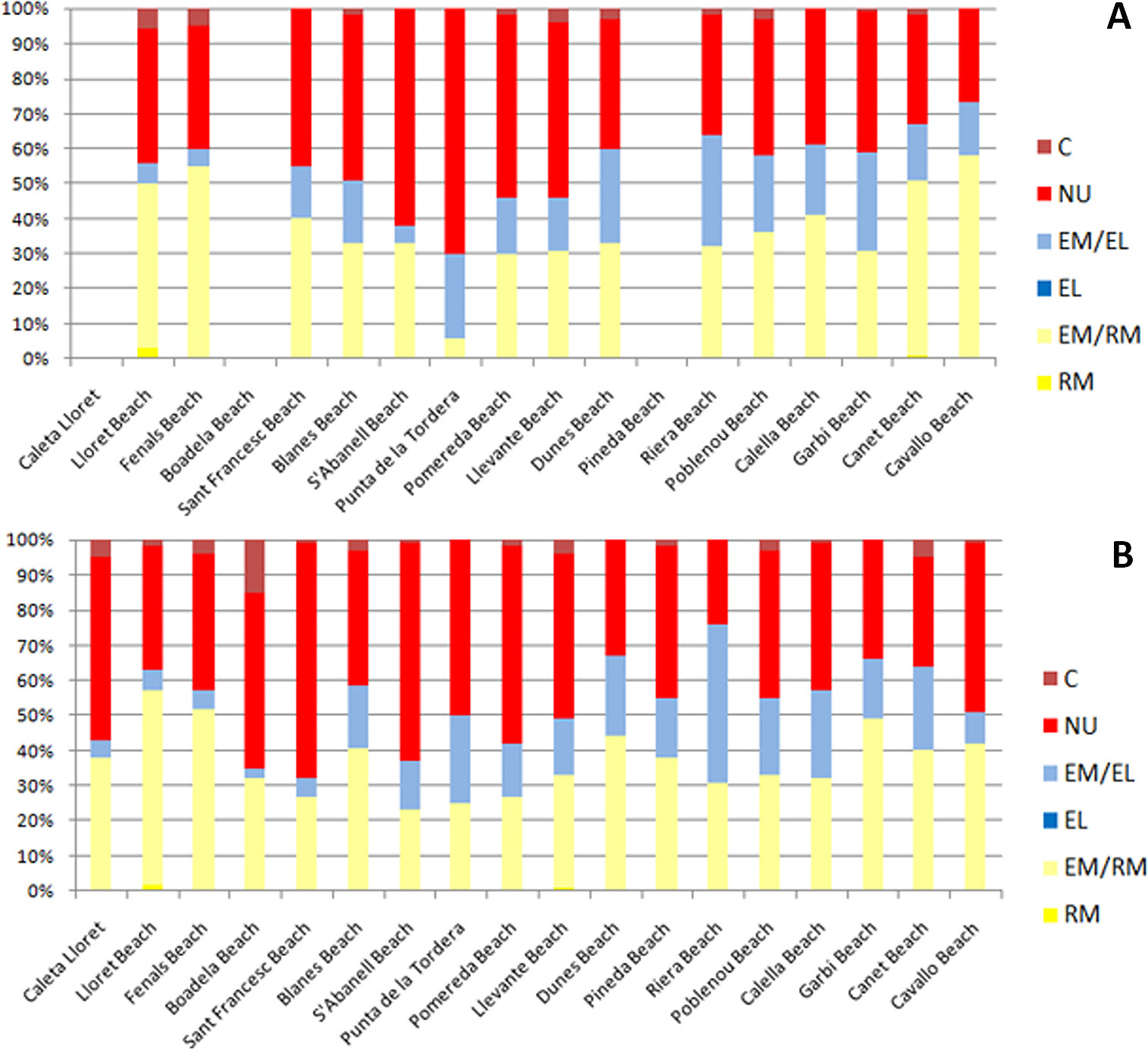
Fig. 7.
Quartz grain abrasion in the fraction 0.8–1.0 mm in the swash zone – A and backshore – B.
Table 4.
Quartz grain abrasion in the fraction 0.8–1.0 mm (S – swash zone; B – backshore; a – no sample taken).
| No. | Site | Municipality | Quartz grain abrasion [%] | |||||||||||
|---|---|---|---|---|---|---|---|---|---|---|---|---|---|---|
| C | NU | EL | EM/EL | RM | EM/RM | |||||||||
| S | B | S | B | S | B | S | B | S | B | S | B | |||
| 1 | Caleta Lloret | Lloret de Mar | a | 5 | a | 52 | a | 0 | a | 5 | a | 0 | a | 38 |
| 2 | Lloret Beach | 6 | 2 | 38 | 35 | 0 | 0 | 6 | 6 | 3 | 2 | 47 | 55 | |
| 3 | Fenals Beach | 5 | 4 | 35 | 39 | 0 | 0 | 5 | 5 | 0 | 0 | 55 | 52 | |
| 4 | Boadela Beach | a | 15 | a | 50 | a | 0 | a | 3 | a | 0 | a | 32 | |
| 5 | Sant Francesc Beach | Blanes | 0 | 1 | 45 | 67 | 0 | 0 | 15 | 5 | 0 | 0 | 40 | 27 |
| 6 | Blanes Beach | 2 | 3 | 47 | 39 | 0 | 0 | 18 | 18 | 0 | 0 | 33 | 41 | |
| 7 | S’Abanell Beach | 0 | 1 | 62 | 62 | 0 | 0 | 5 | 14 | 0 | 0 | 33 | 23 | |
| 8 | Punta de la Tordera | 0 | 0 | 70 | 50 | 0 | 0 | 24 | 25 | 0 | 0 | 6 | 25 | |
| 9 | Pomereda Beach | Malgrat de Mar | 2 | 2 | 52 | 56 | 0 | 0 | 16 | 15 | 0 | 0 | 30 | 27 |
| 10 | Llevante Beach | Santa Susanna | 4 | 4 | 50 | 47 | 0 | 0 | 15 | 16 | 0 | 1 | 31 | 32 |
| 11 | Dunes Beach | 3 | 0 | 37 | 33 | 0 | 0 | 27 | 23 | 0 | 0 | 33 | 44 | |
| 12 | Pineda Beach | Pineda de Mar | a | 2 | a | 43 | a | 0 | a | 17 | a | 0 | a | 38 |
| 13 | Riera Beach | 2 | 0 | 34 | 24 | 0 | 0 | 32 | 45 | 0 | 0 | 32 | 31 | |
| 14 | Poblenou Beach | 3 | 3 | 39 | 42 | 0 | 0 | 22 | 22 | 0 | 0 | 36 | 33 | |
| 15 | Calella Beach | Calella | 0 | 1 | 39 | 42 | 0 | 0 | 20 | 25 | 0 | 0 | 41 | 32 |
| 16 | Garbi Beach | 1 | 0 | 40 | 34 | 0 | 0 | 28 | 17 | 0 | 0 | 31 | 49 | |
| 17 | Canet Beach | Canet de Mar | 2 | 5 | 31 | 31 | 0 | 0 | 16 | 24 | 1 | 0 | 50 | 40 |
| 18 | Cavallo Beach | Arenys de Mar | 0 | 1 | 27 | 48 | 0 | 0 | 15 | 9 | 0 | 0 | 58 | 42 |
| 19 | Fenals–Boadela cliff | Lloret de Mar | 0 | 100 | 0 | 0 | 0 | 0 | ||||||
| 20 | Tordera River | Blanes | 0 | 65 | 0 | 14 | 0 | 21 | ||||||
Table 5.
Quartz grain abrasion in the fraction 0.5–0.8 mm (S – swash zone; B – backshore; a – no sample taken; b – no fraction).
| No. | Site | Municipality | Quartz grain abrasion [%] | |||||||||||
|---|---|---|---|---|---|---|---|---|---|---|---|---|---|---|
| C | NU | EL | EM/EL | RM | EM/RM | |||||||||
| S | B | S | B | S | B | S | B | S | B | S | B | |||
| 1 | Caleta Lloret | Lloret de Mar | a | 3 | a | 64 | a | 0 | a | 2 | a | 2 | a | 29 |
| 2 | Lloret Beach | b | 5 | b | 40 | b | 0 | b | 6 | b | 9 | b | 40 | |
| 3 | Fenals Beach | b | 4 | b | 44 | b | 2 | b | 6 | b | 6 | b | 38 | |
| 4 | Boadela Beach | a | b | a | b | a | b | a | b | a | b | a | b | |
| 5 | Sant Francesc Beach | Blanes | b | 2 | b | 67 | b | 0 | b | 4 | b | 0 | b | 27 |
| 6 | Blanes Beach | 5 | 2 | 57 | 32 | 0 | 0 | 13 | 16 | 0 | 0 | 25 | 50 | |
| 7 | S’Abanell Beach | 0 | 1 | 87 | 42 | 0 | 2 | 4 | 10 | 0 | 1 | 9 | 44 | |
| 8 | Punta de la Tordera | 0 | 4 | 55 | 49 | 0 | 0 | 22 | 12 | 0 | 2 | 23 | 33 | |
| 9 | Pomereda Beach | Malgrat de Mar | 3 | 1 | 42 | 59 | 0 | 0 | 19 | 21 | 0 | 0 | 36 | 19 |
| 10 | Llevante Beach | Santa Susanna | 2 | 2 | 41 | 39 | 1 | 0 | 22 | 18 | 0 | 0 | 34 | 41 |
| 11 | Dunes Beach | 1 | 3 | 37 | 53 | 0 | 0 | 31 | 19 | 0 | 0 | 31 | 25 | |
| 12 | Pineda Beach | Pineda de Mar | a | 0 | a | 35 | a | 3 | a | 13 | a | 0 | a | 49 |
| 13 | Riera Beach | 0 | 3 | 45 | 43 | 3 | 0 | 22 | 35 | 1 | 0 | 29 | 19 | |
| 14 | Poblenou Beach | 1 | 4 | 51 | 35 | 0 | 1 | 15 | 15 | 0 | 1 | 33 | 44 | |
| 15 | Calella Beach | Calella | 5 | 2 | 45 | 46 | 0 | 1 | 13 | 8 | 0 | 0 | 37 | 43 |
| 16 | Garbi Beach | 5 | 3 | 71 | 56 | 0 | 2 | 7 | 9 | 0 | 0 | 17 | 30 | |
| 17 | Canet Beach | Canet de Mar | 10 | 3 | 48 | 38 | 0 | 1 | 10 | 15 | 0 | 0 | 34 | 43 |
| 18 | Cavallo Beach | Arenys de Mar | 0 | 1 | 46 | 37 | 0 | 0 | 18 | 13 | 0 | 1 | 36 | 48 |
| 19 | Fenals–Boadela cliff | Lloret de Mar | 0 | 100 | 0 | 0 | 0 | 0 | ||||||
| 20 | Tordera River | Blanes | 6 | 60 | 0 | 20 | 0 | 14 | ||||||
There are a few broken (cracked) C grains. In the 0.8–1.0 mm fraction, an average of 2%, except Boadela Beach, with a 15% share of C grains in the backshore (Fig. 7B). In the 0.5–0.8 mm fraction, the share of broken grains in both zones is similar and averages 2.7% in the swash zone and 2.5% in the backshore.
No very well-rounded and shiny EL grains were found in any site in the 0.8–1.0 mm fraction. In the 0.5–0.8 mm fraction, the share of EL grains is negligible in the swash zone (average 0.3%) and backshore (average 0.7%).
In each fraction studied, the share of moderately rounded and shiny EM/EL grains, both in the swash zone and backshore, averages a dozen or so percent (Tables 4 and 5). Among all sites, the largest share of these grains (45%) was found in the deposits of Riera Beach in Pineda de Mar (backshore). The most minor shares of grains of this type (2–6%) are characterised by beach deposits in Lloret de Mar.
Very well rounded and matt RM grains are almost absent. The averages for individual zones and fractions are 0.1–1.3%. The largest share of RM grains was found in the 0.5–0.8 mm fraction on the backshore of Lloret and Fenals beaches, at 9% and 6%, respectively.
Moderately rounded and matt only on the edges, EM/RM grains are well represented in the studied deposits. In the 0.8–1.0 mm fraction, both in the swash zone and backshore, their average share is similar, at 37.1% and 36.7%, respectively. The most significant number of grains of this type (above 50%) is on Fenals Beach, but also on the beaches of Lloret, Cavallo and Canet, which are above average (Table 4, Fig. 7). In the 0.5–0.8 mm fraction, EM/RM grains constitute an average of 28.7% in the swash zone and 36.6% in the backshore. The highest share of this type of grain is in the backshore of beaches Blanes, Pineda and Cavallo (48–50%), and the lowest is in the swash zone of S’Abanell Beach (9%) (Table 5).
Discussion
The presence of dunes in the past in the study area is confrmed by the results of the research by Pintó and Garcia-Lozano (2016), who identified dunes between Lloret de Mar and Arenys de Mar on the beaches of Lloret, Santa Cristina, Blanes, Gran Calella, Garbi, El Pla, Canet, El Cavalo and Primera. Pintό and Serra (2005), presenting the landscape of the Tordera delta in the mid-19th century, mention scrub growing in the driest areas, where extensive cattle grazing was carried out. These wastelands can likely be associated with overgrown small dunes and aeolian coversands. Panareda (2020) states that in the 19th century, moving sand masses penetrated felds, ditches and roads, so the stabilisation/immobilisation of aeolian landforms with pine trees began. Also, on the 1888 plan of Blanes (Castells et al. 1994) south of La Palomera, between the current S’Abanell beach and the agricultural fields, there is an area marked with an unexplained hachure, which most likely indicates a strip of dunes (Fig. 8). According to Garcia-Lozano (2019, p. 131–132), in the past, there were broad zones of initial dunes on the beaches of Maresme. As an example, the author gives Dunes Beach in Santa Susanna, where in the mid-20th century (1948), Montserrat (1955) found numerous plants characteristic of the dune environment in a vast aeolian feld.
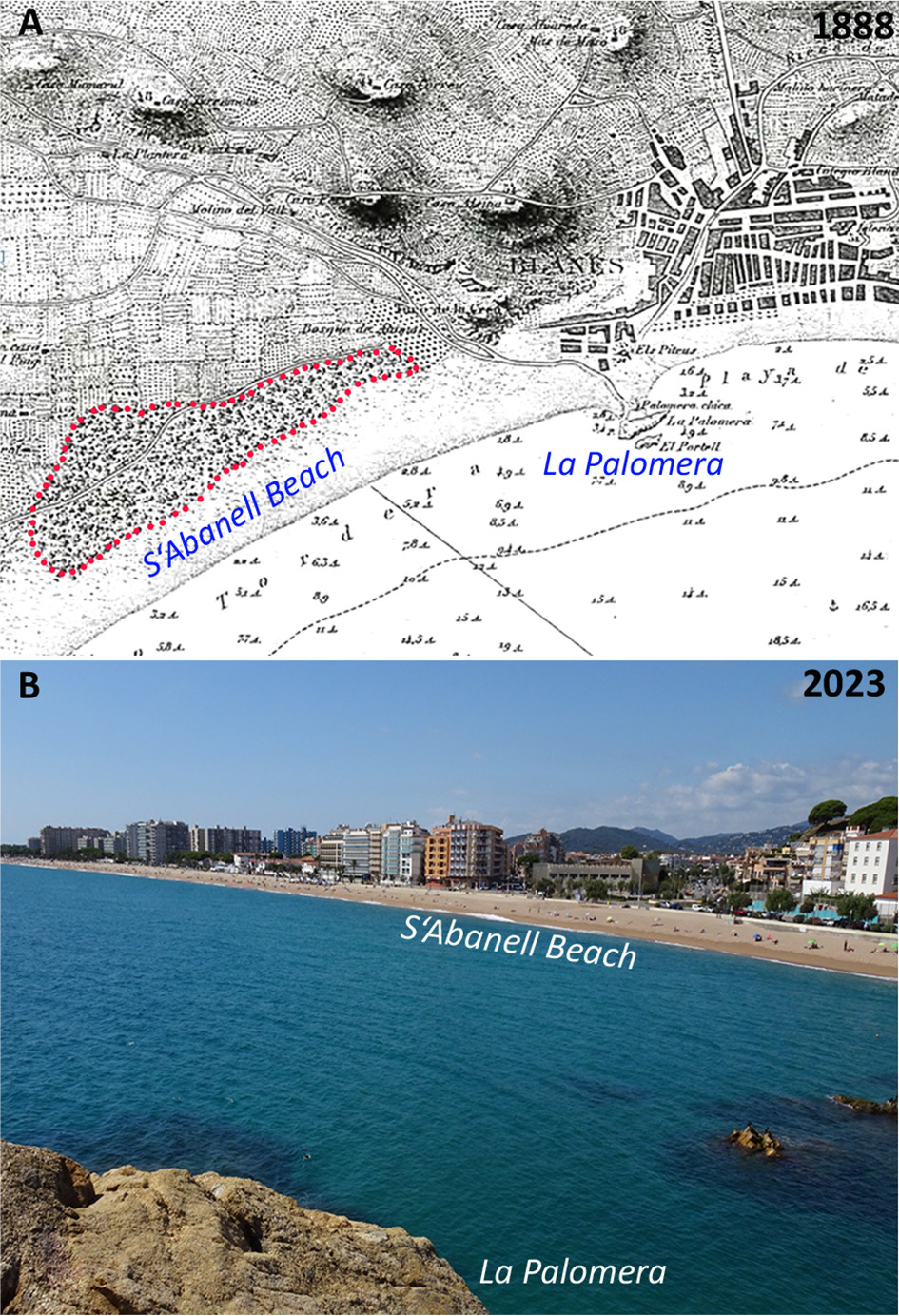
Fig. 8.
S’Abanell Beach: A – On the 1888 plan of Blanes (Source: Castells et al. 1994, modified) – In the southwestern part of the area, most probably checked dune fields or vegetation growing on aeolian forms (outlined in red); B – Contemporary view of the beach from La Palomera, with a strip of buildings in the area of the former dune fields (Photo R. Dulias 2023).
The studied coastal strip is currently 99% duneless. All forms existing in the mid-20th century have disappeared, except for one area (El Pla), where they were significantly reduced (Pintó, Garcia-Lozano 2016). Maps from the website dedicated to the beaches and dunes of Catalonia (platgesonline.cat) indicate only four initial aeolian forms of the nebkha type (on the beaches of Cavallo in Arenys de Mar, Pomereda in Malgrat de Mar and Santa Cristina in LLoret de Mar) and two dune ridges (cordó dunar in Catalan) on the Pla beach in Canet de Mar and on the Dunes Beach in Santa Susanna. The second of the mentioned dunes, however, is artificial, which is confirmed by the analysis of historical Google Earth images, which shows that in 2006, the area was flat, and a year later, there was already a large dune fenced in and standing out unnaturally against the background of the wide, flat and long beach.
The grain size of beach deposits may vary in time and space (Moreira 1988, Davidson-Arnott, Law 1990, Aleman et al. 2011, Prodger et al. 2016, Lamy et al. 2024). According to data included in (ICGC 2010), Mz values for deposits from the swash zone of the same 15 beaches studied in this work ranged from 0.881 mm to 1680 mm, with an average of 1.365 mm. The contemporary average Mz value is 1.717 mm (0.933–3.031 mm), so these are deposits with clearly coarser grain size – very coarse sands or fine gravels. In this respect, they do not differ from other beach deposits on the Costa del Maresme. For example, in the deposits of five beaches in Badalona, the share of the gravel fraction is, on average, 13.1%, and of coarse sand – 33% (Ruiz Torrent 2018).
Therefore, the grain size of the study area’s deposits is not typical for aeolian deposits, which generally consist of fine- and medium-grained sands (Bagnold 1941, Kuenen 1960 and many others). There are no known dunes composed exclusively of coarse-grained sand, but in many aeolian deposits, there is an admixture of a coarser fraction or lamina of very coarse-grained sand, and even gravel as a record of higher wind speed and thus its greater lift force (Szczypek 1988, Waga 1994, Dulias 2023a). On the coast of Catalonia, in Baix Empordà (NE of the study area), in some samples of aeolian deposits, a larger share of the gravel fraction (above 2 mm) was also found (Cros 1987).
The coarse grain of deposits limits but does not exclude aeolian transport. In the small bay of Sa Riera, surrounded by cliffs >40 m high, there is a small beach (50–95 m wide, 186 m long) composed of coarse-grained deposits with an average grain size of 1770 mm (Duran et al. 2016). Meanwhile, the archival photograph published in the work of Pintó and Garcia-Lozano (2016) shows ramp dunes. A few contemporary initial aeolian forms in the study area also develop on coarse-grained beaches, for example, Cavallo Beach (Garcia-Lozano 2019).
Studies by various authors show that wind can transport coarser grains, including gravel. For example, we can cite the results of research by Szczypek (1988) in the polar zone, which showed the presence of gravel in aeolian deposits blown away from the coastal ridge in the Gulf of Gås (southern Spitsbergen) as a result of winds with speeds from a dozen to 25–30 m · s−1, or the results of research by Waga (1994), who found the occurrence of gravel laminae with diameters of 5 mm and more in Late Glacial inland dunes in the Koźle Basin (Central Europe).
The threshold wind speeds that can move grains of specific diameters are defined differently. For example, Bagnold (1941) states that the limiting wind speed necessary to initiate saltation is 4.7 m ∙ s−1, while Nowaczyk (1986), based on experiments in a wind tunnel, determined the threshold wind speed for grains of 1 mm diameter to be 11.9 ∙ m ∙s−1 (i.e. six on the Beaufort scale). Generally, a wind speed of about 10 m ∙ s−1 causes the movement of grains of up to 1 mm in diameter; at a wind speed of 15 m ∙ s−1, grains of 3 mm in diameter, a hurricane can lift even larger grains. Therefore, considering the anemological conditions on the coast of Catalonia, the coarse-grained material of the studied beaches can theoretically participate in the aeolian transport process during strong winds, in conditions of lack of vegetation, dry deposits and a suitably wide beach. However, it seems that the wind’s activity is and will be limited only to creating small dunes. First, because of the coarse grain of the source material, and second, because of the development of the space onto which the finer grains could have been blown. It can be assumed, however, that the dunes that formed in the past in the undeveloped, open space behind the beaches were composed of fine- and medium-grained sands blown out of coarse-grained beach deposits.
While the grain size characteristics of the studied deposits do not indicate their extensive participation in aeolian transport, their mineral composition partly does. They are characterised by a high content of resistant quartz (>90% on average, 99% at most), one of the determinants of their presence in a high-energy beach and/or wind environment. In such environments, the less resistant components are removed first, so the deposits are enriched with resistant minerals, mainly quartz. A high proportion of resistant minerals in the deposits generally indicates their maturity, reflecting longer water or aeolian transport. However, in areas composed of crystalline rocks, which is the case of the studied coast of Catalonia, fresh residual deposits are also characterised by a high content of resistant quartz, and these deposits are certainly not mature.
The degree of maturity of the deposits studied can be partly inferred from the composition of heavy minerals. No such studies were conducted in this work, but Duboul-Razavet and Monaco (1966), in a mineralogical study of the sands of the Catalan coast, give percentages of heavy minerals, among others, for the study area. Minerals of low resistance hold a significant share – mica (from 25% at the mouth of the Tordera to 75% at Lloret de Mar) and chlorite (from 4% at the mouth of the Tordera to 20% at Calella Beach). The content of moderately resistant epidote is 2–20%, and opaque minerals is 8–33%. The share of more resistant andalusite is 2–3%, except at the mouth of the Tordera – 15%. The contents of very resistant minerals – zircon, tourmaline and rutile are negligible (0–2%). As mentioned above, the high proportion of weakly resistant mica in the Lloret de Mar deposits (75%) near the rocky cliffs indicates a constant supply of fresh weathered material. In other words, removing low-resistant minerals is constantly compensated for by a new supply. The low maturity of the aeolian deposits in the Baix Empordà area is reported by Cros (1987), who, while emphasising the clear predominance of resistant quartz, also points out the significant proportion of weakly resistant minerals, feldspars and mica. He found a particularly large amount of mica in the inland dunes at Sant Llorenc de les Arenes.
The feature of the investigated deposits indicating their participation in aeolian transport is the abrasion of quartz grains. In all the analysed samples, except for the residual deposits from the clifftop, there are grains with matt edges, which they obtained due to mechanical abrasion of grains during wind transport. However, the aeolisation of grains did not last long because these grains are moderately rounded and belong to the EM/RM type. The share of these grains is significant; on average, it constitutes over one-third of all grains, which is twice as much as shiny grains, typical of the high-energy beach environment. The latter represent only moderately rounded EM/EL grains. The most characteristic feature of the studied deposits is the high share of fresh and angular NU grains, amounting on average, depending on the zone and fraction, to 43.1–52.1%. The study results indicate that we are dealing with deposits subjected to both aeolian and water transport and are constantly supplied with fresh grain from weathering and erosion of the coast. These findings confirm the low maturity of the deposits resulting from the composition of heavy minerals. It is worth emphasising that the abrasion of quartz grains, despite obvious differences in individual sites, is generally similar along the entire 30-km stretch of the coast.
The abrasion degree of quartz grains from beach deposits on the Catalan coast can be compared with the results of other authors. Cros (1987) investigated the degree of rounding of quartz grains of fraction 0.–1.0 mm from aeolian deposits in Baix Empordà using the Shepard and Young (1961) method, in which the degree of rounding is defined by letters from A to F, that is, from the smallest to the largest. Most samples were classified into group C – subangular, group B – angular and only some D – subrounded. The latter referred to deposits from the Hills of Begur. Analysis using electron microscopy also indicated better abrasion of deposits from this area. The author emphasises, however, that although the grains show clear traces of aeolisation, it cannot be generally assumed that the deposits from the Hills of Begur are strongly eolised. Similar results are obtained from the studies of the degree of rounding of quartz grains from the beaches in Badalona, made using the Powers method (1953) by Ruiz Torrent (2018) – most of the grains belong to the subangular and angular classes, and to a lesser extent to the subrounded ones. Dunes on the Baix Empordà plain are young; they started to form after the Roman era, to a greater extent several 100 years ago, and on the coast about 200 years ago (Cros 1987, Marqués, Julià 2005, Duran et al. 2016). It can be assumed that the dunes that once existed in the study area were also young, and their history was several 100 years old.
Sanjume (1974) carried out sedimentological studies on the coast of Valencia (Albufera lagoon), including grain size and morphoscopy of deposits and their mineral composition. In the morphoscopic analysis, only three types of grains were distinguished according to the Cailleux and Tricart (1959) method: fresh angular, rounded shiny and rounded matt. The analysis was carried out for four fractions (in mm): 0.21–0.29, 0.29–0.35, 0.35–0.59 and 0.59–1.19. It was shown that in each of the studied zones (beach, dune, lagoon barrier), the share of fresh, angular grains increases with grain refinement, while the share of rounded, shiny grains decreases. In the studied samples (41), rounded matt grains are the least represented – in the fraction 0.21–0.29 mm, they constitute, on average, 11%, and in the fraction 0.35–0.59 mm, slightly over 18% (own calculations). Only in the fraction 0.59–1.19 mm is the average share of these grains higher (30.6%), but they occur only in 6 samples out of 11 studied.
Beach and dune deposits on the Mediterranean coast of Andalusia are characterised by a low abrasion degree of quartz grains (Dulias 2024). Fresh NU grains predominate in them, and the share of EM/RM grains is generally about twice as low as in the beach deposits of Catalonia. In addition, these are fine-grained deposits (medium-grained sands) and contain much less quartz, as well as many shells/carbonate minerals and non-quartz minerals. The formation of dunes in this area was facilitated by the fine grain of the source (beach) deposits, but these are young forms built from deposits with poor abrasion. In turn, deposits from the coast of western Crete (eastern Mediterranean) are characterised by a very low quartz content (average 18%), but they are characterised by a better abrasion degree than beach deposits from Catalonia and Andalusia, as the content of EM/RM grains is on average 79% (Dulias 2023b).
The coast of Catalonia is changing very dynamically. The coastline, beach width and deposit budget change almost every year, most significantly due to storms. About the studied area, even a cursory analysis of historical satellite images from the past 20 years indicates significant changes in the course of the coastline and, thus, a constant redistribution of deposits. In answering the research questions posed in this paper, it should be emphasised that all the studied deposits have recorded in their features their presence in the aeolian environment. To the least extent, this applies to grain size, while to a significant, unquestionable extent – to abrasion of quartz grains. Moderately rounded grains occur on Catalonia’s studied coast in both analysed fractions. These are grains from the local environment and, as can be assumed, brought by the longshore current from the Empordà coast. The abrasion of deposits study results obtained do not allow for the determination of coastal zones where larger dune systems occurred in the past, primarily due to the relatively similar abrasion degree in most of the studied sites but also due to dynamic natural and anthropogenic changes in the morphology of the Catalan coast.
Conclusions
The Catalan coast has been subject to significant anthropogenic pressure and above-average, often extreme natural phenomena associated with climate change in the past century. In the studied section, all coastal dunes disappeared in a short time, both due to intensive development and intense erosion. The space for recreating the beach-dune system is very narrow on a large part of the coastline, so even the smallest, initial aeolian microforms would require protection to maintain/strengthen aeolian processes. They are already protected in several places with rope fences and appropriate information boards, mainly due to plant species growing on the dry beach/aeolian deposits.
The gravel beaches are located in bays surrounded by high cliffs. Sandy beaches occur mainly in the central and southern parts of the studied coast, composed of very coarse-grained sand. Most often, deposits become finer from the swash zone towards the backshore. Beach deposits are well and moderately sorted. Quartz dominates the mineral composition of the studied deposits. Its share is very high in the larger fraction, on average, >90%. In the finer fraction, the average quartz content is lower, on average, >80%.
Despite the lack of dunes in the study area, analysis of abrasion of quartz grains from beach deposits has shown that they are partly aeolian. This is because the coastline has moved landward and now the foreland of former foredunes is being included in water transport – deposits in this zone have recorded effects of earlier aeolian processes, such as rounding quartz grains and their matting at the edges. EM/RM grains are well represented in the studied deposits. In the 0.8-1.0 mm fraction, both in the swash zone and backshore, their average share is similar and is approximately 37%. Due to the intensive coastal development, there is currently a lack of space for the free development of aeolian processes and the formation of dunes from finer material blown out of the generally coarse-grained beach deposits.
This study also confirms the usefulness of a relatively simple morphoscopic analysis in identifying deposits of various origins. Depending on the research goals, the results obtained using the method allow a decision to be made on whether or not to perform analyses under a SEM.
Acknowledgements
The co-author, Renata Dulias, thanks Professor Xavier Úbeda from the Department of Geography, University of Barcelona, Spain, for the invitation to the 2-month research internship and for all the help he provided.
The authors thank the anonymous reviewers for their pertinent comments on the article.
Notes
[1] Contributed by Author’s contribution
R.D.: Conceptualization, Investigation, Methodology, Writing – original draft, Writing – Review and Editing, Visualization; J.F.: Writing – original draft, Writing – Review and Editing.