
Introduction
Forest fires (and more broadly – wildfires) are extensively studied globally due to their far-reaching consequences on nature (e.g., Ward et al. 2020), society (e.g., Kountouris, Remoundou 2011, Paudel 2023), the economy (e.g., Sadowska et al. 2021, Poduška, Stajić 2024), and human life (e.g., Kalogiannidis et al. 2023). Countryman (1972) stated that fire behaviour is determined by the environment in which it occurs, highlighting topography, fuel, and meteorological conditions in this context. Subsequent studies conducted, among others, in temperate-zone forests have confirmed the relationship between fires and both topographic conditions (e.g., Adámek et al. 2015, Ciesielski et al. 2022) and meteorological factors (e.g., Krikken et al. 2019, Sutanto et al. 2020, Venäläinen et al. 2020, Mandal et al. 2021). Regarding fuel, Countryman (1972) emphasised the significant influence of human activity, such as roads and settlements near forests – a finding later corroborated by the literature review of Costafreda-Aumedes et al. (2017) and, in the context of Polish forests, by Kolanek et al. (2021) and Milanović et al. (2023). Countryman (1972) also mentioned forest management as a factor potentially affecting forest fires. Lee et al. (2009) demonstrate that forest stand type, tree composition and the spatial arrangement of forest cover patches influence fire spread intensity in Samchuck, South Korea. Research on the forest structure in relation to fire behaviour has yielded significant results, regardless of the region in which it was conducted. For example, some research found that fires are more likely in homogeneous woody areas (Lloret et al. 2002) and tend to be lower in forests with high patch density and diverse tree cover (Lee et al. 2009, Román-Cuesta et al. 2009). Greater variability in forest structure may enhance resistance to external factors, including fire (Koontz et al. 2020). Fire resistance may stem from the interaction between fire behaviour and forest structure, although Koontz et al. (2020) note that the scale of this effect is local, evident in the smallest tested area (90 m × 90 m). In studies broadly examining the influence of the spatial structure of landscape on wildfires, other factors have also been considered in addition to stand type, such as tree age (Zhu et al. 2006) or humidity (Davies et al. 2016).
The landscape context in forest studies has been analysed in terms of the impact of wildfires on landscape structure (Hudak et al. 2004, James et al. 2007, Hanberry 2020, Bountzouklis et al. 2022, Donager et al. 2022) and vice versa. Gonzalez et al. (2005) noted that it is reasonable to assume a relationship between the spatial distribution of different forest stands and fire risk; therefore, the spatial distribution of more or less susceptible to fires forest stands should be considered. Beverly et al. (2021) mentioned that the proximity of land cover elements to one another can either facilitate or limit fire spread. Lloret et al. (2002) and Gonçalves et al. (2012) demonstrated that the landscape-level structure of vegetation and its changes affect the spatial patterns of wildfire frequency and size. However, in these studies, forest habitats were grouped only into general categories (e.g., dense forest/open forest), without analysing the more detailed structure of stands (e.g., in terms of humidity, age, or dominant tree species).
Landscape metrics, which are algorithms that quantify specific spatial characteristics of patches, classes of patches, or entire landscape mosaics (McGarigal, Marks 1995), have been used to study forest environments, typically analysing changes in the cover or structure of individual habitat types (Southworth et al. 2002, Rutledge 2003, Żmihorski et al. 2010, Kayiranga et al. 2016, Ersoy Mirici et al. 2020, Netzel et al. 2024). Geri et al. (2010) quantified changes in forest patterns based on three forest classes (broad-leaved, conifer, and mixed) in a Mediterranean area by comparing historical and recent forest maps. del Castillo et al. (2015) used landscape metrics to relate forest management to nature conservation, with analyses based on nine classes (forest stand type and species composition). Hardy et al. (2023) applied landscape analyses to investigate the share of old forests and forest fragmentation regarding forest management. Landscape metrics have also been utilised to study forest fires. Costafreda-Aumedes et al. (2013) sought to predict human-caused fire occurrence in Spain for >5 years using landscape ecology metrics across 10 km × 10 km grids based on the Forest Map of Spain. Additionally, Viedma (2008) assessed the relative influence of topography and fire on landscape patterns within a large forest in Spain. Alexandre et al. (2016) categorised forest areas into three flammability categories, subsequently employing landscape metrics. Dutt and Kunz (2024) used landscape metrics to monitor changes in forest cover post-disasters, aiding in recovery assessments and management decisions.
In Polish forests, a mosaic of trophic types and humidity types of forest habitats exists, which may directly influence their susceptibility to fire. Coniferous species dominate 68.7% of Poland’s forest area (partly due to the preference of these trees by the timber industry) and Scots pine (Pinus sylvestris L.) occupies 58.1% of the forest area (Report on the State of Forests in Poland 2018). However, does the forest structure itself affect the incidence of fires? Aszalós et al. (2022), through analysing the diversity of stands in selected European countries, discovered that the forest structure impacts sensitivity to disturbances like the bark beetle. Even straightforward diagrams from Poland in 2007–2017 illustrate differences between the features of stands in all forest areas and those where fires occurred (Fig. 1). Based on this, herein we verify a research hypothesis that the spatial structure of forests (understood as the spatial differentiation of forest stands’ characteristics within forests) significantly influences the occurrence of fires. In other words, we aim to check whether increased spatial fragmentation of forest stands causes the occurrence of fires to rise.
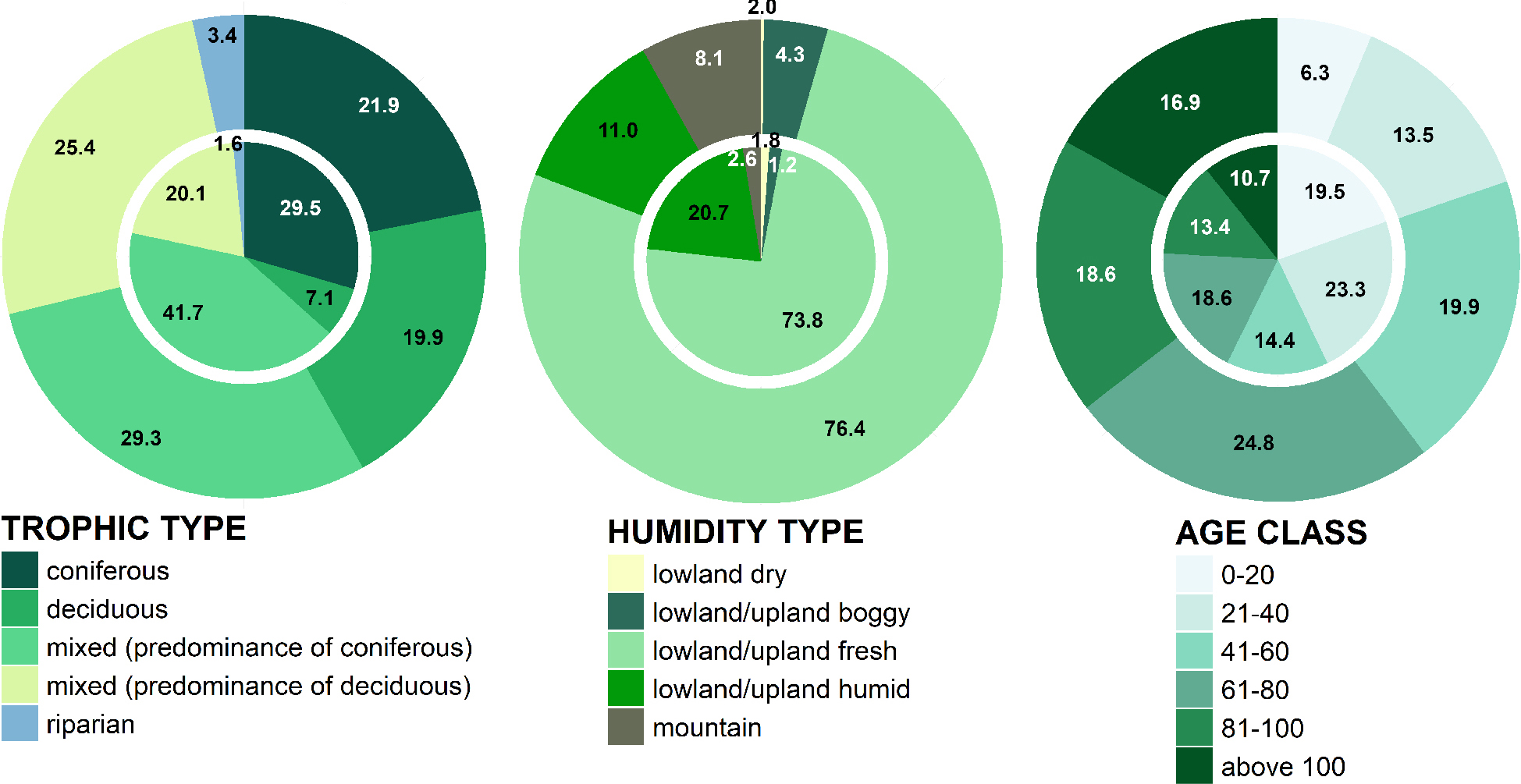
Fig. 1.
Differences between the structure of forest stands in general forest areas (outer ring) and in stands where fires broke out (inner ring); data from the entire territory of Poland, 2007–2017. Units are given in percentages.
Materials and methods
Study area
The present study focused on forests at both the national scale across Poland and at the regional scale within the Lubelskie Voivodeship (Fig. 2). In the first step, the Lubelskie Voivodeship and a single reference year (2015) were selected for the analysis based on a relatively high share of forest area and a considerable number of forest fire incidents. In the second step, the analyses were expanded to encompass forests throughout the entire country.
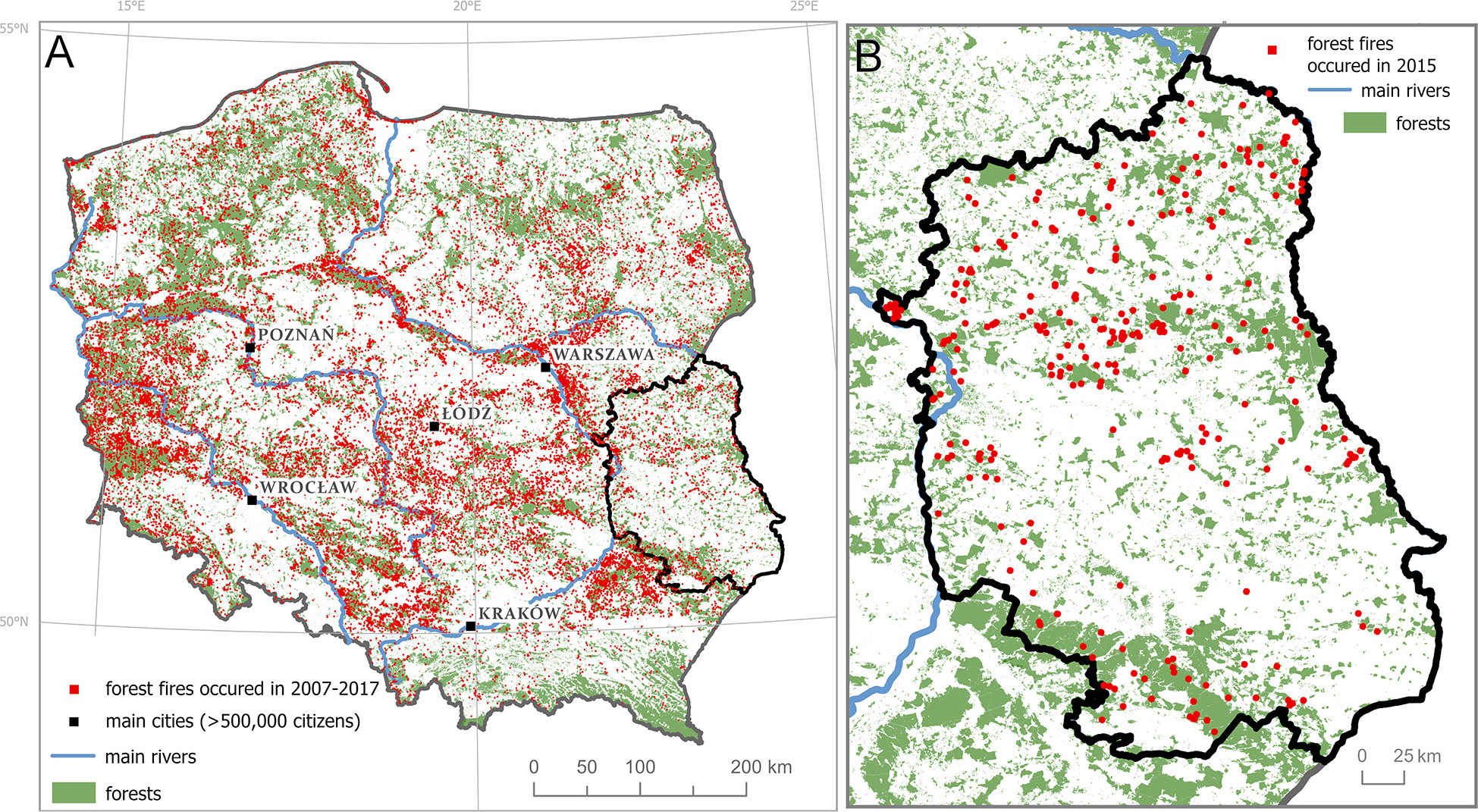
Fig. 2.
Forest fires occurred in 2007–2017 in Poland (A) and in 2015 in Lubelskie Voivodeship (B).
According to the National Forest Fire Information System (NFFIS 2018), approximately 38,700 forest fires occurred in Poland between 2007 and 2017, of which >41% were caused by arson. Negligence accounted for 25% of the fires, and accidents for >12%. Only about 1% of fires were triggered by natural causes, while the remaining cases remained undetermined. A similar distribution of causes was observed in the Lubelskie Voivodeship in 2015, where arson and negligence were the predominant drivers (NFFIS 2018). Forest fires in Poland exhibit seasonality: during 2007–2017, the majority of fires occurred in the second (1 April–30 June) and third (1 July–30 September) quarters of the year (57% and 29%, respectively). A somewhat different pattern is observed in terms of the total burned area: while the largest share of burned area (51%) occurred in the second quarter, the early autumn and winter months (first and fourth quarters, i.e. 1 January–31 March and 1 October–31 December) accounted for as much as 29% of the total burned forest area (Kolanek et al. 2023). In the same decade, nearly 80% of forest fires were <0.5 ha, whereas fires >5 ha accounted for <1.4% of cases (Kolanek et al. 2023). According to the European Forest Fire Information System, although the annual number of forest fires in Poland is more than twice the European average, the total burned area is approximately 10 times smaller (San-Miguel-Ayanz et al. 2018).
Polish forests are predominantly (approximately 80%) managed by the State Forests, through 429 so-called Forest Districts, which are the fundamental, independent administrative units responsible for forest management and silvicultural practices within their territories. The average area of a Forest District is about 17,500 ha (ranging from ~5200 ha to ~36,500 ha). Forests within each district (as well as non-State Forest areas) are subdivided into forest subareas, which represent the smallest, homogeneous forest units delineated during field inventory. These subareas are distinguished based on key silvicultural attributes (e.g. tree stand age, species composition), requiring uniform management practices (State Forests 2012b). The size of subareas is variable and depends on local site conditions and survey requirements, with no universally fixed standard. In the Lubelskie Voivodeship, the average compartment size is 2.06 ha (ranging from 0.1 ha to 79.5 ha, with a standard deviation of 3.22 ha).
Each subarea is assigned a specific forest site type, reflecting both humidity characteristics (dry, fresh, humid, boggy) and trophic conditions (coniferous, mixed with predominance of coniferous or deciduous, deciduous), as well as the age of the tree stand (grouped by us into classes). Overall, habitat types of stands and their age structure are diverse in Poland (Report on the State of Forests in Poland 2018) and vary across different regions (Mandal et al. 2021). The share of forest subareas in which fires break out differs from the share of subareas in the total forest area in Poland (Fig. 1). Differences also occur on a regional scale (Table 1), in the Lubelskie Voivodeship.
Table 1.
Share of forest where fires occured in 2015 in relation to share of total forest area in Lubelskie Voivodeship in 2015. Prepared based on the Forest Data Bank (2018) and the National Forest Inventory (2011–2015) (https://www.bdl.lasy.gov.pl/portal/wisl-en).
| Tree stand characteristic | share [%] of total forest area | share [%] of forests, where fires occured | |
|---|---|---|---|
| trophic type | coniferous | 17.8 | 48.13 |
| mixed (conifer–dominated) | 28.0 | 27.5 | |
| mixed (deciduous–dominated) | 27.9 | 20.0 | |
| deciduous | 26.3 | 4.0 | |
| humidity type | fresh | 80.0 | 86.3 |
| humid | 14.8 | 9.4 | |
| other | 5.2 | 4.3 | |
| age class (in years) | 0–20 | 9.2 | 14.9 |
| 21–40 | 15.6 | 13.13 | |
| 41–60 | 26.6 | 24.7 | |
| 61–80 | 25.9 | 36.4 | |
| 81–100 | 13.2 | 8.4 | |
| more than 100 | 5.0 | 1.9 | |
Data collection
The forest fire data spanning the time interval from 2007 to 2017 used in this study were obtained from the National Forest Fires Information System (NFFIS 2018). It includes information on the precise locations of fires along with their attributes, derived directly from firefighters’ reports, stored as fire ignition points saved in the shapefile format. The period 2007–2017 was chosen due to the availability of fire data collected in the NFFIS database. Information regarding the structure of tree stands was collected from the Forest Data Bank (2018), abbreviated hereinafter as FDB, the primary resource of State Forest Poland, which features a digital forest map (Fig. 3) based on data gathered during fieldwork and supplemented with aerial and satellite imagery. The FDB comprises polygons in the shapefile format that represent forest subareas with attributes related to forest stands, such as tree age, dominant species in the subarea, moisture type (ranging from dry to boggy), and trophic type (which depends on tree composition – coniferous, deciduous, or mixed – and regionalisation, including lowland, upland, and mountain). For the analyses of fires from 2007 to 2017, we used FDB data updated to 2018, which represents one of the methodological limitations of the study. For analyses of fires in the Lubelskie Voivodeship in 2015, the database version updated to 2015 was used.
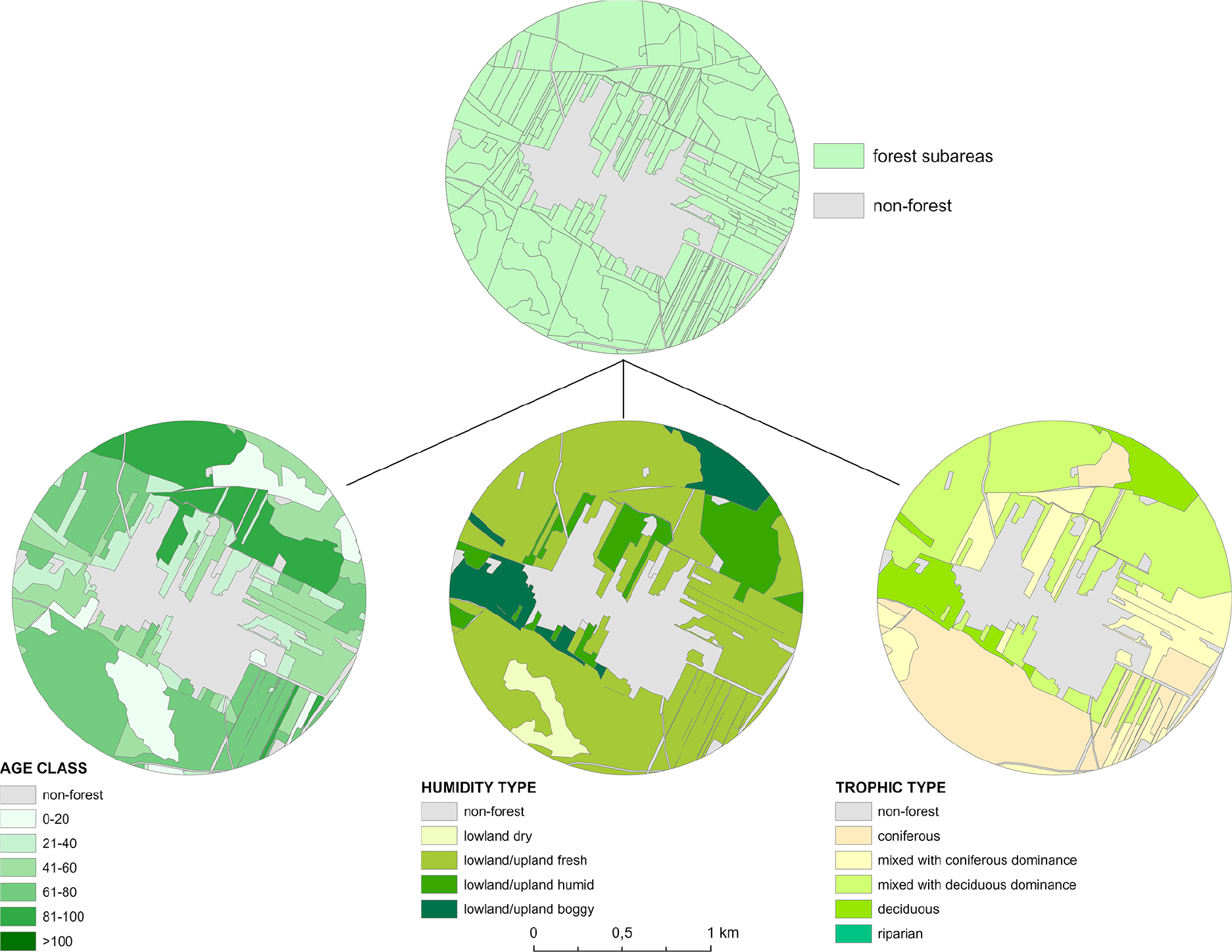
Fig. 3.
Examples of patch distribution in buffer zones belonging to individual classes for the three analysed stand features. Data source: Forest Data Bank (2018). Each forest subarea has specific attributes (top row). Adjacent subareas with the same attributes were merged to forest patches (bottom row).
Fire and data preparation
For this study, we extracted exclusively those fire events recorded within forest areas from the complete NFFIS database. Buffer zones with a radius of 1000 m were established around points indicative of fire occurrences (test sets) and around points randomly distributed in the study area (control sets). The radius was selected on the basis of the study by Diaz-Varela et al. (2009), but we are aware that the decision was arbitrary and is a potential methodological limitation.
We employed two approaches to create the test and control sets. In the first approach, the test set (coded as A1) includes buffer zones around 133 fires that occurred in 2015 in the Lubelskie Voivodeship. The control sets contain buffer zones around randomly selected points that allow (coded as B) and do not allow (coded as C) overlapping with the test set. The points were randomly selected using the Create Random Points tool from the Data Management toolbox in ArcMap software (ESRI 2011).
In the second approach, the test set (coded as A2) encompasses buffer zones around 38,700 fires that occurred between 2007 and 2017 across Poland, while the control set (coded as D) consists of buffer zones around randomly placed points selected through stratified random sampling. Here, we also used the Create Random Points tool, but indicated how many points should be created in each forest type, reflecting the proportions of habitats where fires occurred.
The first approach aimed to assess whether there is any potential for using landscape metrics in analysing the relationship between forest structure and fire occurrence. Therefore, a voivodeship with a relatively high proportion of forested areas and a considerable number of fire incidents was selected to ensure adequate sampling. In this preliminary approach, random sampling was applied without considering the proportional representation of different habitat types within the area of analysis. In the second approach, if landscape metrics revealed statistically significant results, the analysis was extended to the entire available forest fire dataset. To enhance the methodological rigour, stratified sampling was employed, accounting for the proportional distribution of each habitat type.
The FDB layer was clipped using the buffer zones, and then adjacent patches with the same attributes were merged for age, moisture, and trophic attributes (Fig. 3). Non-forest areas were also merged into one class.
The division into classes was based entirely on the classification of State Forests due to the possibility of using the results to plan further activities within the framework of forest management and fire protection measures. Trophic (coniferous, mixed with coniferous dominance, mixed with deciduous dominance, deciduous, riparian) and humidity (lowland/upland boggy, lowland/upland humid, lowland/upland fresh, lowland dry, mountain) types were directly obtained from the classification of State Forests, and age classes (0–20, 21–40, 41–60, 61–80, 81–100, >100) were categorised to align with reporting standards recognised by State Forest.
Calculation of landscape metrics
There are three levels in a landscape: a single element (patch), classes of elements (patches), and the landscape (Lausch, Herzog 2002, Gökyer 2013). The landscape level is understood as the set of all patches; metrics are calculated for all patches in total. The class level, in turn, concerns patches grouped according to a given feature; metrics are calculated separately for each class.
Most previous studies on landscape analysis relied on raster data and the FRAGSTAT software (McGarigal et al. 2012) to calculate the metrics. However, due to the availability of high-quality spatial data, metric calculations would be performed using vector data to ensure greater spatial accuracy – raster resolution often being significantly lower than the size of the smallest individual Polish forest subareas (0.1 ha), so the use of polygons ensures higher accuracy. Consequently, the PatchAnalyst plugin in the ArcGIS software was selected for the study. PatchAnalyst is an extension of ArcGIS dedicated to habitat and biodiversity studies in which data are gathered in patches, and its manufacturer recognises forest management as a field of its application.
Basic landscape metrics were calculated, reflecting the characteristics of the structure of forest areas in Poland (number of patches, average and median area of patches, length and density of patch edges, patch shape index). Metrics were determined at the landscape level for both approaches and, in approach 2, at the class level (for those classes that may potentially influence forest fires, such as older stands and dry stands).
To verify the research hypothesis, several landscape metrics were used (from McGarigal, Marks 1995), related to the number, size, edges, and complexity of forest patches (Table 2). Similar metrics were used in previous studies of fire analysis (e.g., Gonçalves et al. 2012, Costafreda-Aumedes et al. 2013). All metrics were calculated in meters or square meters.
Table 2.
Landscape metrics used in this study.
| patches feature | Metric name and acronym | explanation |
|---|---|---|
| number of forest patches | Number of patches (NumP) |
|
| size of forest patches | Mean patch size (MPS) |
|
| Median patch size (MedPS) |
| |
| Patch Size Standard Deviation (PSSD) |
| |
| Patch Size Coefficient of Variance (PSCoV) |
| |
| edges of forest patches | Edge density (ED) | The amount of patch edges relative to the patch area:
|
| Mean patch edge (MPE) | The average amount of edge per patch
| |
| forest patches complexity | Mean shape index (MSI) | Takes values equal to or greater than 1, when patches are circular, then MSI = 1
|
| Area-weighted mean shape index (AWMSI) | MSI related to patch size
| |
| Mean perimeter-area ratio (MPAR) | Perimeter of patches related to patch area:
|
Statistical analysis
The statistical analysis was conducted in two stages. First, we assessed the independence of data within each group (A1, B, C – for each forest feature and metric) using the Ljung–Box test (box.test), with the significance level set at 0.01. Subsequently, we applied the Mann–Whitney U test (wilcox.test) to internally independent samples (corresponding to specific groups) in order to evaluate whether their theoretical means are identical at the significance level of 0.05. All statistical analyses were performed using R software (R Core Team 2017).
Results
Approach 1
At the landscape level, for all considered forest stand characteristics (age class, trophic type, humidity type), the mean values of patch size-related metrics (MPS or MedPS) were lower in the test group A1 compared with the control groups B and C. A similar pattern was observed for the mean patch edge (MPE) metric, which reflects the total edge length of patches, regardless of the forest stand attribute analysed. By contrast, the values of the AWMSI index, which indicates the complexity of patch shapes, were higher in group A1 relative to either group B or both B and C across all forest stand characteristics (Table 3). Other significant landscape-level results were found only for trophic and humidity-related characteristics. Patch size variability (PSCoV) was higher in group A1 compared with group B (group C did not meet the independence assumption of the Ljung–Box test). The NumP in group A1 was higher than in group B for trophic characteristics (group C failed to meet the independence assumption), and higher than in group C for humidity characteristics (no significant differences were observed in relation to group B) (Table 3).
Table 3.
U Mann-Whitney test of significance of differences between test (A1) and control (B and C) groups for a landscape level in the Lubelskie province (with significance level of 0.05); * – statistically significant difference; – – non-significance; × – no fulfillment of the Ljung-Box test assumptions (with significance level of 0.01).
| forest feature | metric | mean values | significance of difference | direction of difference (group A1 compared to other(s)) | |||
|---|---|---|---|---|---|---|---|
| group A1 | group B | group C | A1 vs B | A1 vs C | |||
| age class | MedPS | 8,728.06 | 11,059.75 | × | * | × | ↓ |
| MPE | 1,003.29 | 1,061.11 | 1,065.97 | * | * | ↓ | |
| AWMSI | 3.04 | 2.87 | × | * | × | ↑ | |
| trophic type | NumP | 56.30 | 43.60 | × | * | × | ↑ |
| MPS | 98,897.47 | 133,178.45 | 142,389.22 | * | * | ↓ | |
| PSCoV | 355.83 | 319.81 | × | * | × | ↑ | |
| MPE | 1,299.43 | 1,470.54 | 1,507.99 | * | * | ↓ | |
| AWMSI | 3.06 | 2.91 | × | * | × | ↑ | |
| humidity type | NumP | 49.26 | 38.29 | 39.93 | – | * | ↑ |
| MPS | 107,686.13 | 144,325.46 | 159,496.67 | – | * | ↓ | |
| PSCoV | 344.65 | 314.08 | × | * | × | ↑ | |
| MPE | 1,386.21 | 1,542.72 | 1,575.72 | * | * | ↓ | |
| AWMSI | 3.13 | 2.97 | 2.81 | * | * | ↑ | |
At the class level, for each of the analysed stand characteristics (trophic type, humidity type, age class), certain differences in metric values were observed between the test group A1 (fire surroundings) and the control groups (B, C). Only some metrics did not meet the assumptions of the Ljung–Box test for data independence (Table 4).
Table 4.
U Mann-Whitney test of significance of differences between test (A1) and control (B and C) groups for a class level in the Lubelskie province (with significance level of 0.05); * _ statistically significant difference; – – non-significance; × – no fulfillment of the Ljung-Box test assumptions (with significance level of 0.01).
| forest feature | class | metric | mean values | significance of difference | direction of difference (group A1 compared to other(s)) | |||
|---|---|---|---|---|---|---|---|---|
| group A1 | group B | group C | A1 vs B | A1 vs C | ||||
| age class | 0–20 | NumP | 10.74 | 9.62 | 10.08 | * | – | ↑ |
| MPS | 15,843.95 | 18,852.84 | 22,300.089 | – | * | ↓ | ||
| MPE | 598.63 | 643.17 | 699.68 | – | * | ↓ | ||
| 21–40 | NumP | 14.58 | 11.70 | × | * | × | ↑ | |
| MPS | 16,007.82 | × | 23,208.13 | × | * | ↓ | ||
| PSSD | 18,196.26 | × | 24,523.71 | × | * | ↓ | ||
| MPE | 572.97 | × | 699.26 | × | * | ↓ | ||
| 41–60 | MedPS | 10,261.88 | 16,281.81 | 22,505.81 | * | * | ↓ | |
| MPE | 716.95 | 869.33 | 838.83 | * | * | ↓ | ||
| MPAR | 0.16 | 0.14 | 0.13 | – | * | ↑ | ||
| above 100 | MPS | 48,430.89 | 82,508.20 | 90,334.95 | * | * | ↓ | |
| MedPS | 34,246.01 | 59,932.55 | 64,983.52 | * | * | ↓ | ||
| PSSD | 36,922.72 | 63,068.51 | 74,370.46 | – | * | ↓ | ||
| TE | 3,902.17 | 5,077.76 | 5,848.49 | – | * | ↓ | ||
| ED | 0.0012 | 0.0016 | 0.0019 | – | * | ↓ | ||
| MPE | 940.87 | 1,313.20 | 1,328.98 | * | * | ↓ | ||
| trophic type | coniferous | MPAR | 0.13 | 0.11 | 0.23 | * | – | ↑ |
| mixed (coniferous dominance) | MPS | 50,221.79 | 97,672.72 | 76,815.13 | * | * | ↓ | |
| PSSD | 76,474.80 | 135,536.72 | 109,243.81 | * | * | ↓ | ||
| TE | 13,611.17 | 14,224.80 | 14,768.00 | * | – | ↓ | ||
| ED | 0.0043 | 0.0045 | 0.0047 | * | – | ↓ | ||
| MPE | 965.20 | 1,351.90 | 1,202.55 | * | * | ↓ | ||
| AWMSI | 1.8767 | 2.0293 | 2.0349 | * | – | ↓ | ||
| mixed (deciduous dominance) | MPS | 65,612.30 | 125,744.80 | 129,248.48 | * | * | ↓ | |
| TE | 8,056.01 | 11,467.22 | 10,461.48 | * | * | ↓ | ||
| ED | 0.0026 | 0.0036 | 0.0033 | * | * | ↓ | ||
| MPE | 1,044.97 | 1,397.51 | 1,425.78 | * | * | ↓ | ||
| AWMSI | 1.74 | 1.91 | 1.88 | * | * | ↓ | ||
| trophic type | deciduous | MedPS | 32,883.01 | × | 151,401.46 | × | * | ↓ |
| PSCoV | 74.46 | 98.49 | 104.39 | * | * | ↓ | ||
| TE | 3,752.86 | 8,102.72 | 7,812.92 | * | * | ↓ | ||
| ED | 0.0012 | 0.0026 | 0.0025 | * | * | ↓ | ||
| MPE | 901.56 | 1,615.18 | 1,786.23 | * | * | ↓ | ||
| MPFD | 1.41 | 1.38 | 1.39 | – | * | ↑ | ||
| AWMPFD | 1.36 | 1.34 | 1.33 | * | * | ↑ | ||
| riparian | PSSD | 1,018.44 | 28,118.00 | 8,191.14 | * | – | ↓ | |
| humidity type | lowland/upland boggy | MPS | 32,655.46 | 45,032.88 | 47,329.74 | * | * | ↓ |
| MedPS | 26,755.34 | 26,933.49 | 33,966.39 | * | * | ↓ | ||
| PSSD | 27,515.54 | 48,934.72 | 34,810.27 | * | * | ↓ | ||
| TE | 3,565.16 | 5,044.87 | 4,777.90 | * | – | ↓ | ||
| ED | 0.0011 | 0.0016 | 0.0015 | * | – | ↓ | ||
| MPE | 795.19 | 1,008.65 | 1,025.47 | * | * | ↓ | ||
| AWMPFD | 1.37 | 1.36 | 1.36 | – | * | ↑ | ||
| lowland/upland humid | MPS | 49,006.54 | 64,442.65 | 66,420.40 | * | * | ↓ | |
| MedPS | 18,806.61 | 23,624.03 | 36,780.94 | * | * | ↓ | ||
| MSI | 1.70 | 1.76 | 1.73 | * | – | ↓ | ||
| AWMSI | 1.86 | 2.05 | 1.94 | * | * | ↓ | ||
| lowland/upland fresh | NumP | 20.31 | 15.40 | × | * | × | ↑ | |
| MPS | 11,4533.22 | 277,913.46 | 278,704.02 | * | * | ↓ | ||
| PSSD | 18,3262.98 | 257,122.58 | × | * | × | ↓ | ||
| MPE | 1,441.72 | 1,929.30 | 1,977.48 | * | * | ↓ | ||
| AWMPFD | 1.32 | 1.31 | × | * | × | ↑ | ||
| lowland dry | MPS | 59,539.82 | 19,212.09 | 22,153.63 | * | * | ↑ | |
| MedPS | 54,795.90 | 16,524.39 | 14,166.96 | – | * | ↑ | ||
| MPE | 1229.21 | 633.41 | 598.16 | * | * | ↑ | ||
| MPAR | 0.0410 | 0.0509 | 0.0591 | – | * | ↓ | ||
For the age classes 0–20 and 21–40, metrics related to patch size (MPS, MedPS) were significantly lower in group A1 compared with group C. For classes 41–60 and >100, these metrics were significantly lower in group A1 compared with both control groups B and C. In nearly all age classes (except for 61–80 and 81–100), the MPE length was significantly lower in group A1 than in groups B and C. As with the MPS and MedPS metrics, for the 0–20 class, the difference in the MPE metric was significant only between groups A1 and C. The NumP in group A1 was significantly higher than in group B only for the 0–20 and 21–40 age classes. The remaining significant differences in metrics were observed only for selected age classes. In the 21–40 class, patch size variability (PSSD) was significantly lower in group A1 compared with group C. In the 41–60 class, patch compactness (MPAR) was significantly higher in group A1 than in group C. In the age class >100 years, patch size variability and edge length and edge density (PSSD, TE, and ED) were significantly lower in group A1 compared with group C.
For mixed stands (both conifer-dominated and broadleaf-dominated) as well as broadleaf stands, metrics related to mean patch size (MPS, MedPS) and edge characteristics (TE, ED, MPE) were significantly lower in group A1 compared with at least one of the control groups. In coniferous stands, shape complexity (MPAR) was significantly higher in group A1 than in group B. Patch size and shape complexity (AWMSI or PSSD) in both types of mixed stands were significantly lower in group A1 compared with groups B and C. In broadleaf stands, patch size variability (PSCoV) and shape complexity (MPFD, AWMPFD) were lower in group A1 compared with groups B and C, although not all metrics showed the same pattern of significance. In riparian stands, in contrast to coniferous stands, shape complexity (MPAR) was significantly lower in group A1 compared with group B, similarly to the pattern observed in coniferous stands (Table 4).Within humidity types, patch size (MPS, MedPS) in dry stands was significantly higher in group A1 compared with groups B and C, whereas in the remaining, more humid stand types, the relationship was reversed – patch size was significantly lower in group A1 relative to groups B and C. In fresh and boggy stands, the MPE length was significantly higher in group A1 than in both control groups. Patch shape variability (PSSD) in fresh and boggy stands was significantly lower in group A1 compared with at least one of the groups B or C. Conversely, patch shape complexity (AWMPFD) in fresh and boggy stands showed the opposite trend – it was higher in group A1 than in group B (fresh) or group C (boggy) (Table 4).
In boggy stands, patch edge length and edge density (TE, ED) were significantly lower in group A1 compared with group B. In humid stands, patch shape complexity (MSI, AWMSI) was significantly lower in group A1 relative to the control groups. In fresh stands, the NumP was significantly higher in group A1 compared with group. In dry stands, patch compactness (MPAR) was significantly lower in group A1 compared with group C, while the difference between A1 and B was not statistically significant (Table 4).
Approach 2
The results of the Ljung-Box test showed autocorrelation of data within each data set analysed. Therefore, further statistical analyses were not performed because assumptions of the U Mann-Whitney test were not fulfilled.
Discussion
Landscape metrics may play an important role in forest management by providing quantitative measures that describe the structure of forest ecosystems. Gonçalves et al. (2012) tested several landscape metrics (e.g., mean, dominant, relative patch richness, area weighted mean shape index, mean perimeter-area ratio, mean patch fractal dimension, edge density, median patch size, patch density) as potentially useful to conduct a fire risk analysis. Their results pointed to the usefulness of these metrics to assess the role of landscape characteristics on fire size distribution, which was the reason for us to take up the topic. Our research aimed to verify the hypothesis that the spatial differentiation of tree stand structures (precisely, State Forests division subareas) is related to the occurrence of forest fires. The hypothesis is formulated on the basis of two elements:
differences between the structure of forest characteristics in all forest subdivisions in Poland and in subdivisions where fires were noted (Fig. 1);
the fact that the spatial structure of forest habitats in Poland largely reflects human forest management, making it possible to conduct modelling of forest structure in ways that enhance fire prevention.
Forest structure is influenced by the origin, history and manner of forest management. Żmihorski et al. (2010) suggest that forest management and economic interests may be related to the share of forest characteristics in central Poland. For over 100 years (since 1924), forests in Poland have been managed by State Forests. Since 1991, the Forest Act (1991) has been regulating the management of stands in individual forest districts, which are the basic management units of the State Forests administration. In accordance with the provisions of this Act, after every 10 years, a document (called forest management plan [FMP]) is created for each forest district that specifies the scope, objectives, and methods for conducting economic activities in individual forest subareas, which are the smallest units of forest, distinguished by trophic, humidity, and age types of trees. Therefore, the results of the above studies may provide valuable information that will help in planning future activities to significantly reduce the number of fires breaking out in forest districts. Especially, given that landscape metrics are already being utilised in the management of areas affected by various hazards (e.g., Buchholtz et al. 2023).
Our findings confirm the research hypothesis and suggest that some of the characteristics of forest patches in the vicinity of fire outbreaks differ from those in randomly selected areas. At the landscape level, regardless of the habitat feature under consideration – whether age class, trophic type, or humidity type – forest patches surrounding fire ignition points were generally smaller and exhibited longer edge lengths. This suggests that areas where forest fires occurred exhibit higher landscape fragmentation compared with randomly chosen locations. This may imply that such areas are more susceptible to external disturbances because greater forest fragmentation is associated with a higher density of roads running through forest areas, which may affect the density of forest fires (Kolanek et al. 2021). These results are similar to those of Bonner et al. (2024), who suggest that the complexity of forest structures enhances the overall damage caused by fires. Also, Noble et al. (2025) showed that fire density was the greatest in small, complex forest patches.
Moreover, patches in fire-affected zones displayed greater shape complexity, indicating more irregular and non-standard contours. It is a result similar to the findings of Hébert-Dufresne et al. (2018), who demonstrated that patches with more irregular boundaries are more susceptible to the effects of edge fire.
For trophic and humidity-related characteristics, patch size variability and the NumP were higher in the vicinity of fire sites than in one of the randomly selected groups. However, some of these differences were statistically insignificant, potentially indicating a lesser relevance of these metrics. Overall, at the landscape level, areas surrounding forest fires appear to be more highly fragmented than randomly selected areas, particularly in relation to habitat features associated with trophic and humidity characteristics. These findings are consistent with research from the Amazon forests (Armenteras et al. 2013, Silva-Junior et al. 2018, Silva-Junior et al. 2022, Noble et al. 2025), which has demonstrated that the majority of forest fires – and the most severe ones – tend to occur within the first kilometre of forest edges, underscoring the increased vulnerability of fragmented forests to fire. In Poland, where the vast majority of forest fires are caused by human activity (NFFIS 2018), forest edges are more vulnerable to human penetration than areas deeper in the forest (Kolanek et al. 2021).
Landscape-level conclusions are supported by the analysis of differences observed within individual classes of forest habitat characteristics. For most age classes (0–20, 21–40, 41–60, and >100 years), forest patches in the areas surrounding fire sites were smaller and had shorter perimeters compared with at least one control group. A higher NumP indicates greater fragmentation of younger (<60 years) and the oldest forest stands in the vicinity of fire outbreaks. This pattern may be explained by forest management practices implemented by the State Forests of Poland, which involve relatively small-scale final felling of the oldest stands, followed by regeneration activities (State Forests 2012a).
The absence of significant differences in the 61–80 and 81–100-year age classes may indicate a higher degree of landscape stability during this successional phase. This could be associated with the fact that for most forest habitat types in Poland, the rotation age (i.e. the minimum age at which a stand can be harvested to achieve an optimal balance between costs and benefits; State Forests 2023) is typically >100 years (for the pine, which is the most dominant species in Poland; Report on the State Forests in Poland 2018). Therefore, forest stands within the 61–100-year age range are generally not subject to active large-scale management interventions that can change the forest site type.
In Central Europe, the highest fire risk was observed in young and middle-aged pine stands, whereas no increased fire risk was reported for maturing, mature or old-growth forests (Slavskiy et al. 2023). It is well established that the most significant risk of fire occurs in the most disturbed and transformed habitats – whether due to natural disturbances such as droughts, wind events, or bark beetle outbreaks (Berčák et al. 2023), as a consequence of forest management practices (Zald, Dunn 2018), or high density of roads (Kolanek et al. 2021). These factors may help explain the observed results.
Other significant differences observed within individual age classes – such as lower patch size variability in the 21–40 age class, higher patch compactness in the 41–60 age class, and more homogeneous patches in the >100 age class in the vicinity of fires – may result from the specific forest management practices applied within individual forest districts. Without considering FMPs, it is challenging to draw reliable conclusions about the underlying causes of these patterns.
For the mixed and deciduous forest stands that dominate in Poland (Report on the State Forests in Poland 2018) and dominate within sub-areas where fires occurred, patch size, as well as edge length and edge density, were lower in the A1 group, suggesting a more fragmented spatial structure in areas surrounding fire events. Lower variability in patch size and shape in A1 within mixed and deciduous stands indicates greater homogeneity of patches in the forest landscape in the surroundings of fire sites. This may be attributed to the relatively uniform size of final fellings and regeneration areas in intensively managed forests. By contrast, greater patch complexity was observed in group A1 subareas of pine-dominated stands, which are known to be more fire-prone (Krawchuk et al. 2006).
At the class level, the most crucial differences in the context of forest fire occurrence appear to be associated with humidity classes, given that one of the primary factors contributing to fire susceptibility is the nature of the fuel material (Davies et al. 2016, Shi et al. 2024). In dry forest stands, patches in the vicinity of fire locations were larger and less compact compared with those in other areas. Conversely, in more humid stands (fresh and boggy), patches were generally smaller. This is a significant finding, as dry stands are more susceptible to fire ignition and subsequent spread. In certain stands (e.g., fresh and boggy), the shape variability of patches was lower in areas surrounding fire sites, while the overall shape complexity was higher. Taken together, at the habitat class level, the landscape structure in fire-affected areas (group A1) is characterised by higher fragmentation, smaller patch sizes, and, depending on the habitat type, variable shape complexity. Similar patterns have been discovered by other researchers (Armenteras et al. 2013, Numata et al. 2017). These effects are particularly evident in young, mixed, and moist forest stands, where the landscape is more fragmented, and patches are either more irregular or more homogeneous, depending on the metric analysed. The observed characteristics of fragmentation, patch size, and patch number may serve as a basis for identifying areas more susceptible to fire outbreaks, thereby enabling more effective prevention strategies and faster firefighting response.
While landscape-level analysis provides a broad overview of structural instability, class-level analysis helps to pinpoint which forest types and developmental stages are susceptible to these effects. Both approaches demonstrate that landscapes surrounding fire occurrences are more fragmented and more complex in shape. However, the class-level results reveal that this effect is not uniform; somewhat, it varies depending on stand age, habitat type, and dominant tree species composition. Our conclusions emphasise the potential utility of landscape metrics in identifying areas that may be particularly susceptible to forest fires, without attempting an in-depth analysis of the underlying drivers shaping landscape structure. Such an analysis would require more comprehensive research, including detailed assessments of individual forest districts and their forest management strategies as outlined in operational planning documents.
The findings of this study demonstrate that landscape analysis can be integrated into forest management planning, particularly in anticipating and mitigating fire risk, especially since the research review conducted by Uuemaa et al. (2012) also showed that landscape metrics can be a tool for fire control. Further research is planned to explore the predictive potential of landscape metrics for assessing forest fire risk in a more detailed and systematic manner.
Limitations of research and possible solutions for the future
Our study entails certain methodological limitations, stemming from the pioneering approach undertaken in exploring the relationship between Polish forest subareas and fire occurrence.
We are fully aware that the decision about the buffer radius we used for our analyses is arbitrary. However, we have not encountered any studies in the literature that address the issue of determining the optimal buffer size for this type of analysis, except for a single work by Diaz-Varela et al. (2009). In that paper, among the three tested buffer sizes (500 m, 1000 m, and 1500 m radius), the landscape analysis results exhibited the highest significance of correlations for metrics that interest us, specifically for the 1000 m distance. Despite this, future studies should focus on a comparative analysis of landscape metrics calculated for various buffer sizes surrounding fire ignition points.
The second limitation pertains to potential changes in forest structure during the period 2007–2017. The Forest Data Bank (2018) is updated based on FMP for individual forest districts, prepared on a 10-year cycle, with each forest district potentially having a different year of FMP update. Although the Forest Data Bank is updated annually, it does not necessarily reflect the current structure of forest compartments in real-time, which may explain why, in approach 2, the data did not meet the assumptions of the Ljung–Box test.
Furthermore, these compartments (and our classification) are based on forest site types. A forest site type is a fundamental unit in the classification of forest habitats, encompassing all forest areas with similar site conditions and exhibiting comparable productive capacities (State Forests 2012b), considered as relatively stable units, and any changes occur only with proper justification and are implemented following applicable forestry regulations and procedures (State Forests 2012a, b).
This limitation can be eliminated by focusing on analyses conducted at the level of individual forest districts, that is, within the framework of specific FMPs.
Conclusions
At both the landscape and class levels, the results were consistent: whenever a metric showed higher (or lower) values in areas where forest fires occurred compared with randomly chosen locations at one level, the same trend was observed at the other. They indicate that areas in the vicinity of fire occurrences exhibit greater forest structural fragmentation compared with the control groups, as reflected by smaller, more numerous, and more irregularly shaped forest patches. Specifically, the following patterns were observed:
– At the landscape scale, regardless of the analysed forest habitat attribute, patches surrounding fire sites were consistently smaller and more irregular, suggesting increased fragmentation, particularly in relation to trophic and moisture-related characteristics.
– At the level of individual habitat classes, similar patterns were observed in greater detail.
Young stands (0–40 years) and mixed and fresh to boggy habitats were especially affected. In these classes, patches were smaller, more fragmented, and more numerous, indicating heightened landscape fragmentation.
These findings underscore the potential significance of forest structure in shaping fire risk. The implications could be significant, particularly in the context of Poland, where a single, state-owned organisation (State Forests) is responsible for managing nearly all forested areas. These results could inform national forest management strategies and be incorporated into fire risk forecasting systems.
Strategically planned forest management can help mitigate forest fire risk or, at a minimum, identify areas more vulnerable to fire, thereby enhancing the effectiveness of prevention measures and emergency response planning.
In memoriam
This article was prepared in collaboration with my Mentor, Mariusz Szymanowski, who passed away in April 2024. Despite his absence, we would like to emphasize his contribution to the development of the concepts and the process of creating this article. His dedication, wisdom, and support were invaluable to our work. We are deeply grateful for his contribution, and the memory of his presence will remain with us forever.
Acknowledgements
We would like to thank the two anonymous reviewers for their valuable comments and suggestions, which helped us to improve the quality and clarity of this manuscript.
Notes
[1] Licencing
Spatial forest data managed by the State Forests were obtained from the Forest Data Bank’s open resources (https://www.bdl.lasy.gov.pl/, access date: 20/09/2018). Other spatial forest data (managed by national parks and district offices) were obtained from the Forest Data Bank (access date: 19/02/2019) by decision of the General Directorate of the State Forests (signature ZU.0172.3.2018).
[2] Contributed by Author’s contribution
AK: Conceptualization, Data curation, Formal analysis, Funding acquisition, Investigation, Methodology, Visualization, Writing – original draft, Writing – review & editing. MS: Conceptualization, Methodology. TN: Formal analysis, Writing – review & editing.