
Introduction
Boreal forests, also known as the taiga, are among the most extensive and ecologically vital terrestrial biomes on Earth, spanning approximately 1.89 billion ha globally and representing nearly one-third of the world’s forest cover (UNECE 2024). These forests play a central role in regulating the global climate by storing vast amounts of carbon, influencing hydrological cycles and providing critical habitats for a wide range of flora and fauna adapted to high-latitude, cold environments (Keenan 2015, Senez-Gagnon et al. 2018).
Geographically, boreal forests form a belt across the northern hemisphere, extending from Alaska through Canada, northern Europe, Russia and into parts of northern Mongolia and northeastern China. In Mongolia, these forests primarily occur in the northern and northeastern provinces, such as Selenge, Khentii, Khuvsgul, Bulgan and Zavkhan, covering around 7.37 Mha, that is approximately 8% of the entire country (Ecological Connectivity of Forest Ecosystems 2025, Global forest watch 2024). The Mongolian northern forests are dominated by species such as Siberian larch (SBL) (Larix sibirica Ledeb.) (74.3%), Scotch pine (SP) (Pinus sylvestris L.) (5.1%), Siberian pine (SBP) (Pinus sibirica Ledeb.) (6.2%) and Manchurian birch (MB) (Betula platyphylla Sukaczev) (12.1%), which form coniferous, deciduous and mixed-forest stands (Dulamsuren et al. 2010a, b, Ochirbat et al. 2022).
These forests safeguard soil and water, store carbon, conserve biodiversity and sustain livelihoods. In the last decades, Mongolia’s boreal forests have faced increasing degradation due to both anthropogenic pressures and natural disasters. Between 2001 and 2024, Mongolia lost around 439,000 ha of forest, which equates to a 11% decrease in wooded areas since 2000. Wildfires were the primary driver (95.9%), followed by logging (2.5%) and other forest disturbances. Since 2000, the Selenge Province, a key forested area, have experienced the highest forest loss (141,000 ha) but at the same time the largest gains (37,100 ha) due to reforestation and natural regeneration, where observed (Global forest watch 2024).
Discrepancies in national and international forest statistics complicate efforts to track and manage forest changes. Global forest watch (2024) estimates Mongolia’s forested area at 7.37 Mha, whereas FAO’s Global Forest Resources Assessment (2021) reports 14.1 Mha and the National Statistics Office of Mongolia (2025) reports only 12.1 Mha. Mongolia’s remaining forest resources, including the arid and semi-arid sago saxaul (Haloxylon ammodendron C. A. Mey.), are composed of drought-tolerant species and are almost entirely state-owned, with approximately 100% of Mongolia’s forests classified as State Forests (Ministry of Environment and Green Development of Mongolia 2015).
Significant discrepancies in forest cover in Mongolia result from differing definitions (e.g. canopy cover and tree height), methodological approaches (satellite vs. field surveys) and reporting intervals (Hansen et al. 2013, National Statistic office of Mongolia 2025, United Nations 2015). In Mongolia, the recent systematic adoption of advanced remote sensing techniques further challenges data comparability (Silva et al. 2022). This underscores the urgent need for a standardised, transparent monitoring framework to establish a consistent baseline to monitor forest resources in Mongolia.
In addition, over the past two decades, Mongolia’s mean annual temperature has increased by approximately 2.1°C, contributing to a rise in environmental hazards such as wildfires, with more than 1400 incidents reported annually. In response to this crisis, the Mongolian government launched the ‘One Billion Tree’ campaign in 2021 to mitigate climate change through large-scale reforestation (Galtbayar et al. 2022, Ministry of Environment and Tourism 2021).
Addressing these data inconsistencies and improving forest monitoring capabilities are crucial, and recent advances in remote sensing and machine learning (ML) have emerged as vital tools, offering promising solutions for more accurate and large-scale forest classification and management. Advances in satellite imaging technology, particularly the European Space Agency’s (ESA) Sentinel-2 (A, B and C) mission, offer relatively high-resolution (HR) multispectral data capable of capturing and monitoring forest phenology and species-level differences. Globally, ML algorithms such as random forest (RF), support vector machines (SVM) and convolutional neural networks (CNN) have demonstrated high accuracy in forest mapping (Grabska-Szwagrzyk and Tymińska-Czabańska 2024, Immitzer et al. 2016, Persson et al. 2018). For example, studies in Germany and Poland have successfully used multi-temporal Sentinel-2 (ESA) imageries combined with national forest inventories to classify more than 10 main tree species with accuracies >80% (Blickensdörfer et al. 2024).
In the past, Amarsaikhan et al. (2012) utilised Landsat (NASA) and ALOS PALSAR data to classify forest areas in northern Mongolia, achieving classification accuracy of 90.78%. Erdenebaatar and Damdinsuren (2020) used object-based classification (GEOBIA) on Sentinel-2 imagery in Bogdkhan Mountain, reporting 90.87% accuracy. Norovsuren et al. (2023) developed the Spectral Forest Index (SFI) from Sentinel-2, aligning well with ground inventory data. Based on these principles, this study aims to develop and rigorously test a classification framework using multi-temporal Sentinel-2 (ESA) imageries with a RF classifier of the forest cover in the Mandal, Yruu, Khuder (sub-province of Selenge), Khongor, Shariin gol (sub-province of Darkhan-Uul), a key region for both events, such as forest loss and forest recovery in Mongolia.
In this study, we address the primary research questions as follows:
– What is the classification accuracy of dominant tree species in the northern part of Mongolia using multi-temporal Sentinel-2 (ESA) series of satellite imageries and a RF classifer?
– Is it possible to detect changes in the forest tree species composition based on the classifcation performed on the multi-temporal Sentinel-2 imagery?
– What are the limitations of the remote sensing based on tree species classifcation approach?
Study area
The study focuses on a sub-province, Mandal, Bayangol, Javkhlant, Yruu, Khuder in Selenge Province and Khongor, Shariin gol sub-province in Darkhan-Uul Province, and Erdene sub-province in Tuv Province, northern Mongolia (48°51'14"N; 106°27'31"E), approximately 300 km north of Ulaanbaatar (Fig. 1). The test area lies at 7386.27 km2 within the southern extent of the Siberian boreal taiga forest biome, forming a transitional ecotone between forest and steppe. It is characterised by high ecological heterogeneity due to complex topography, continental climate and varied types of vegetation (Dulamsuren et al. 2010a, b).
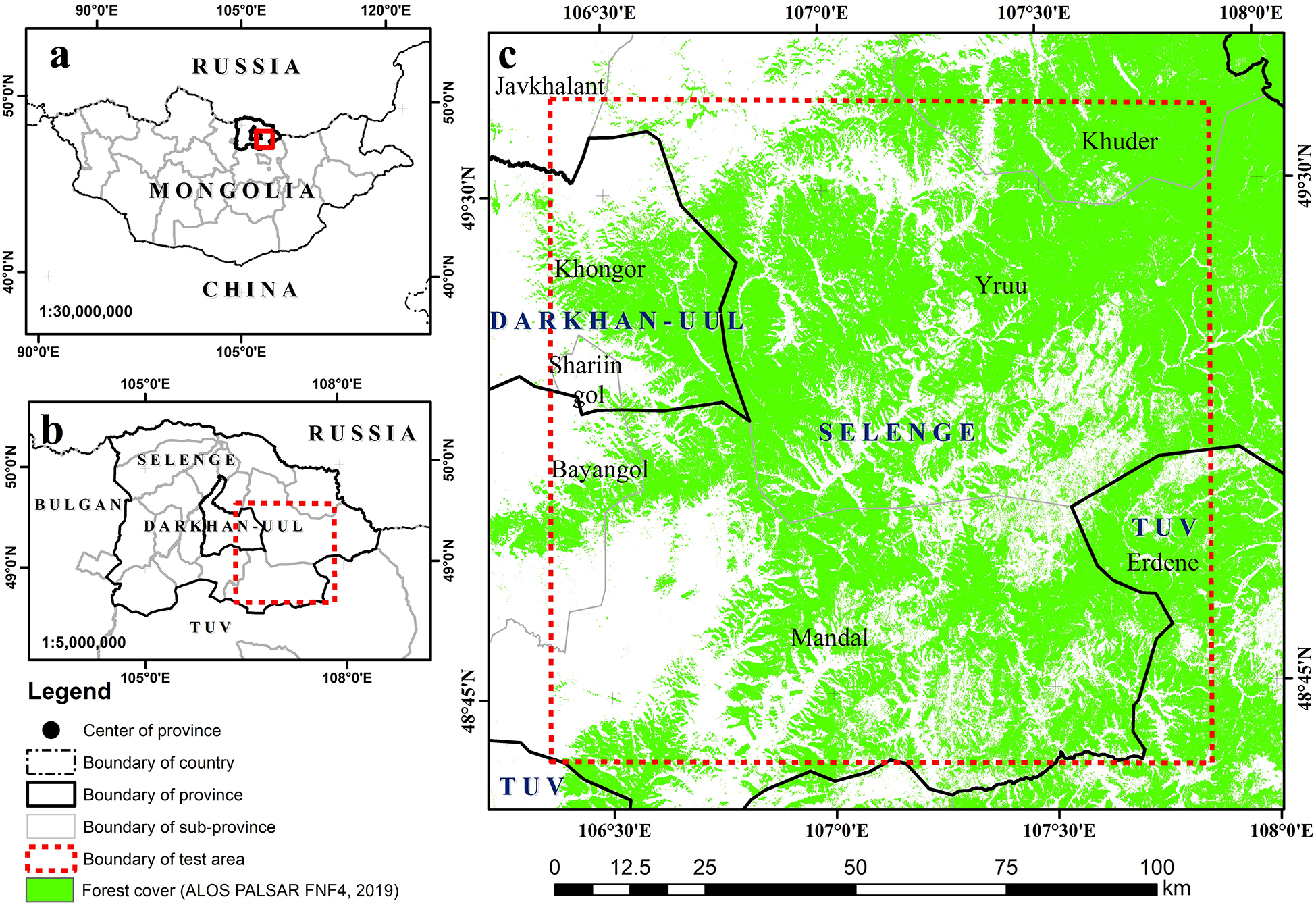
Fig. 1.
Study area: (A) Overview map; (B) Provinces in test area: Selenge, Darkhan-Uul and Tuv; (C) Test area over sub-provinces: Mandal, Bayangol, Javkhlant, Yruu, Khuder, Khongor, Shariin gol and Erdene (Mongolian Environmental Database, 2025).
The Selenge, Darkhan-Uul and Tuv Provinces span 11.6 Mha, of which 13.4% is forested (Global forest watch 2024). Dominant tree species includes SP (P. sylvestris, share of 28.9%), birch (Betula spp., 27%), SBL (L. sibirica, 25.9%), SBP (P. sibirica, 15.2%) and Siberian spruce (SBS) (Picea obovata, 0.7%; Environmental Information Center 2025) (Fig. 2). The dominant forest soils in the study area are Podzols, Kastanozems-Chernozems-Phaeozems and Cambisols type (Jugder et al. 2018).
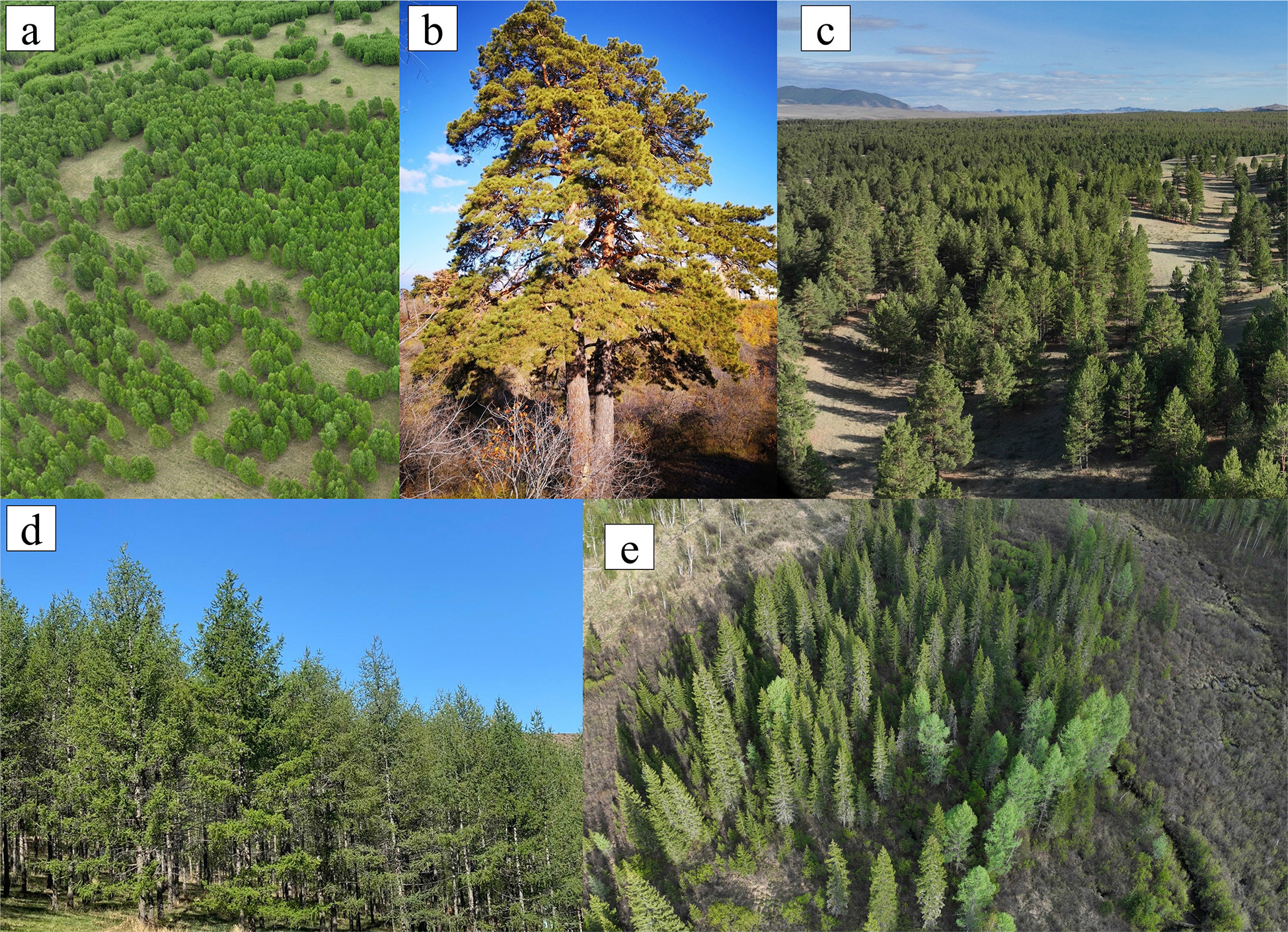
Fig. 2.
Examples of dominant tree species in northern Mongolia: (A) MB; (B) SBL; (C) SP; (D) SBP; (E) SBS. MB, Manchurian birch; SBL, Siberian larch; SBP, Siberian pine; SBS, Siberian spruce; SP, Scotch pine.
The elevation range is from 700 m to 1600 m above sea level (a.s.l.). It experiences a continental climate with mean annual temperatures from –4°C to +2°C and annual precipitation of 250–400 mm, most common between June and August (Dulamsuren et al. 2010a, b). In Selenge Darkhan-Uul and Tuv provinces between 2001 and 2024, wildfires were responsible for 96% of tree cover loss in the region (Fig. 3), making them the dominant disturbance factor (Global forest watch 2024). In contrast, between 2000 and 2020, the province experienced a 40,018 ha increase in forested area, accounting for 51% of Mongolia’s total forest restoration during that period.
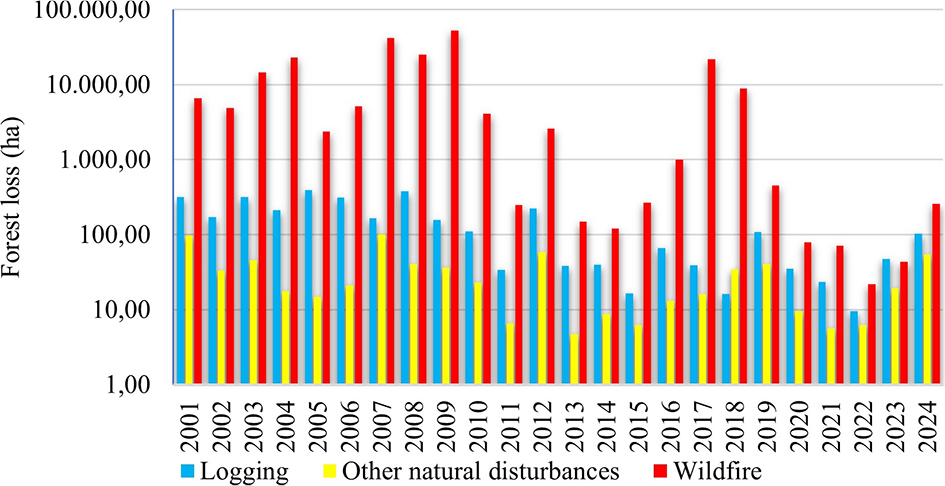
Fig. 3.
Main drivers of forest loss in Selenge, Darkhan-Uul and Tuv provinces (2001–2024).
Materials and methods
The methodological concept of this study is based on a supervised ML framework integrating multi-temporal Sentinel-2 imagery and the RF classifier for forest tree species discrimination (Fig. 4). The workflow was designed to ensure reproducibility, scalability and statistical robustness of species mapping across heterogeneous boreal landscapes in northern Mongolia. The RF algorithm was chosen for its demonstrated reliability and accuracy in remote sensing-based ecological classification tasks (Belgiu and Drăgu 2016, Grabska-Szwagrzyk and Tymińska-Czabańska 2024, Maxwell et al. 2018).
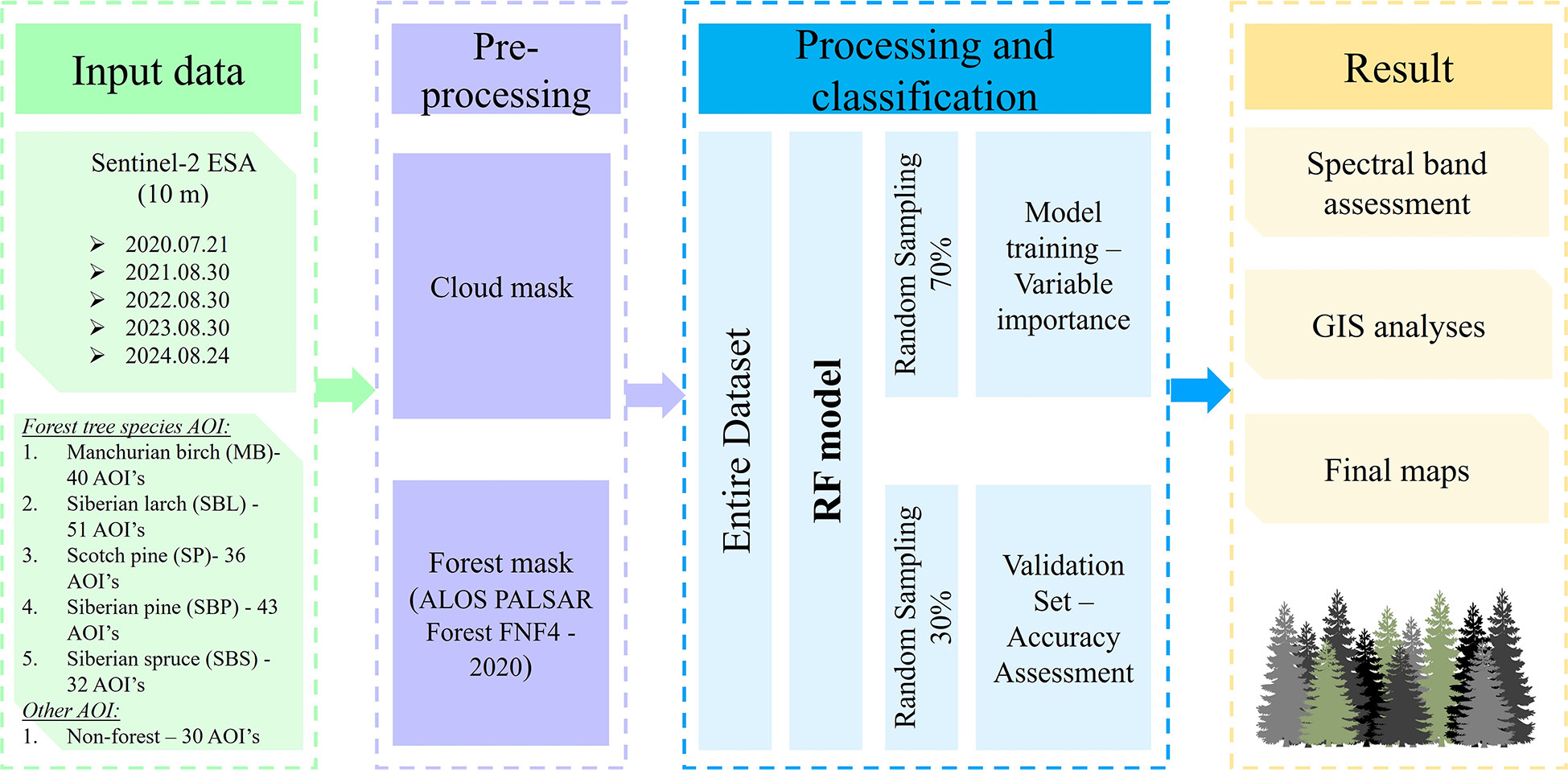
Fig. 4.
Flow chart of data processing.
Data
This study utilised satellite-based data sources to develop and validate the forest tree species classification framework. These datasets were selected to ensure comprehensive spatial, spectral and temporal coverage, as well as high-quality reference information.
Satellite imagery – Sentinel 2 ESA
We utilised five Sentinel-2 (Level 2A; ESA) surface reflectance imageries acquired between 2020 and 2024. The Sentinel-2 constellation (S-2A, S-2B and S-2C) offers 13 spectral bands at 10–60 m GSD (Ground Sampling Distance) with a 5-day revisit cycle (Drusch et al. 2012). A total of nine Sentinel-2 (S-2) cloud-free scenes (<10% cloud cover) were selected across five growing seasons (i.e. July–August): 21 July 2020; 30 August 2021; 30 August 2022; 30 August 2023 and 24 August 2024. These HR satellite images were used to build a consistent dataset covering the 7386.27 km2 study area (ESA 2024) (Fig. 5).
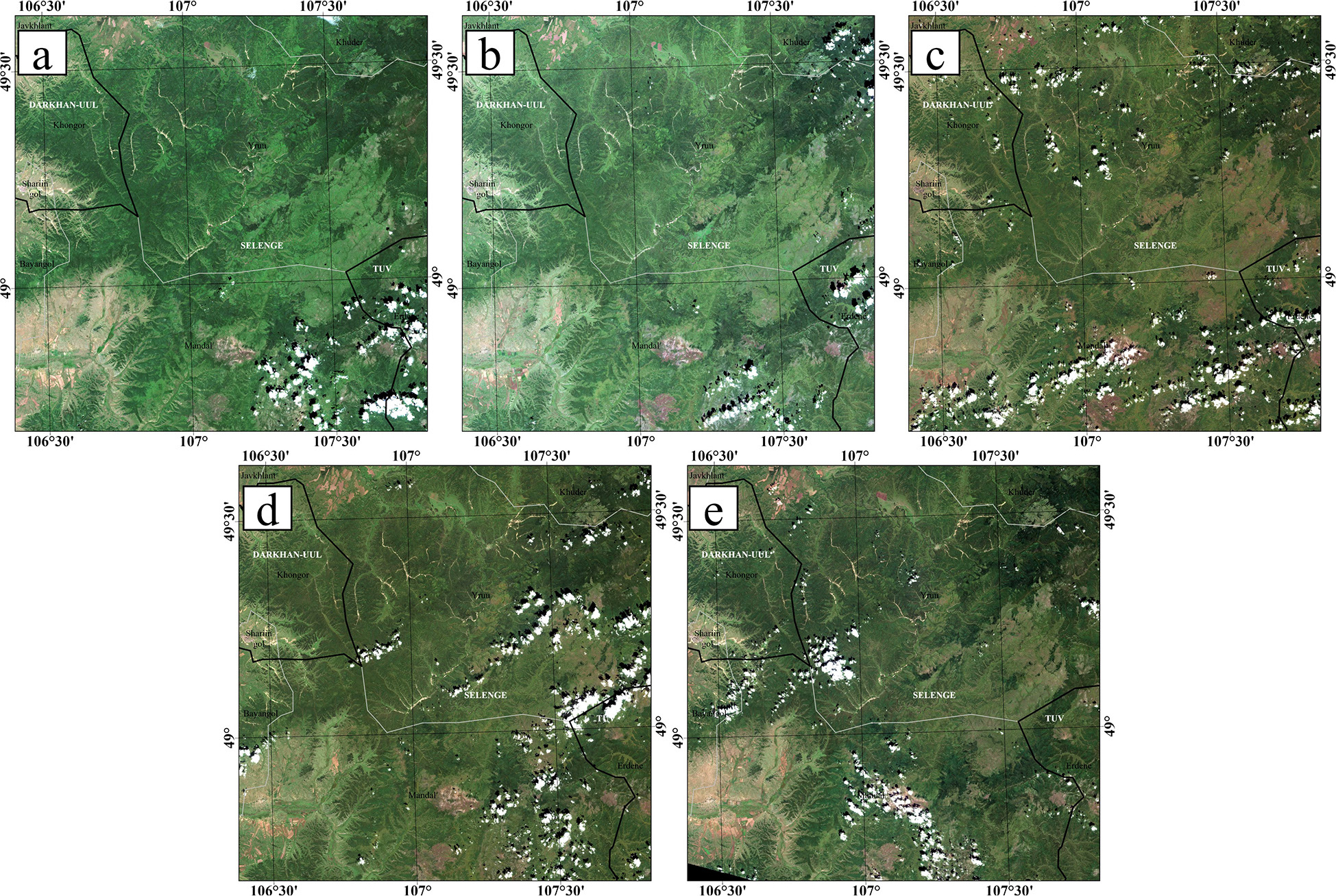
Fig. 5.
The Sentinel-2A (ESA) imageries during LEAF-ON (Leaf-on growing season) period used in the study: (A) 21.07.2020; (B) 30.08.2021; (C) 30.08.2022; (D) 30.08.2023; (E) 24.08.2024. ESA, European Space Agency.
The analysed periods (July–August) were strategically chosen to coincide with the peak of the growing season in the boreal forests of northern Mongolia. These periods are characterised by maximal leaf-area development and photosynthetic activity, which maximises the spectral separability between coniferous and deciduous species (e.g. the high reflectance of MB in the near-infrared [NIR] spectrum). Furthermore, this time frame typically experiences minimal cloud cover, a critical practical consideration for obtaining a cloud-free, multi-temporal satellite image.
Reference data
For the S-2 (ESA) RF image classification, we planned to use polygons (area of interest [AOI]) derived from the Mongolian Forest Inventory (2019), provided by the General Authority for Forestry and the Environment in Mongolia (Fig. 6). This dataset included compartment-level attributes such as dominant tree species, forest stand age, canopy cover and disturbance history. Only homogeneous, single-species forest stands were selected and used in this study. The AOIs represented five dominant boreal species: MB (B. platyphylla Sukaczev; MB), SBL (L. sibirica Ledeb.; SBL), SP (P. sylvestris L.; SP), SBP (P. sibirica Ledeb.; SBP) and SBS (P. obovata Ledeb.; SBS), stratified to ensure ecological representativeness.
The AOIs were initially extracted from the Mongolian digital forest inventory map. Their boundaries were then manually refined through on-screen digitisation using a S-2 false-colour infrared (CIR) composite generated from the Red, Green, and NIR bands (10 m GSD). This specific band combination maximises the spectral contrast between forested and non-forested areas, enabling precise manual delineation (Table 1).
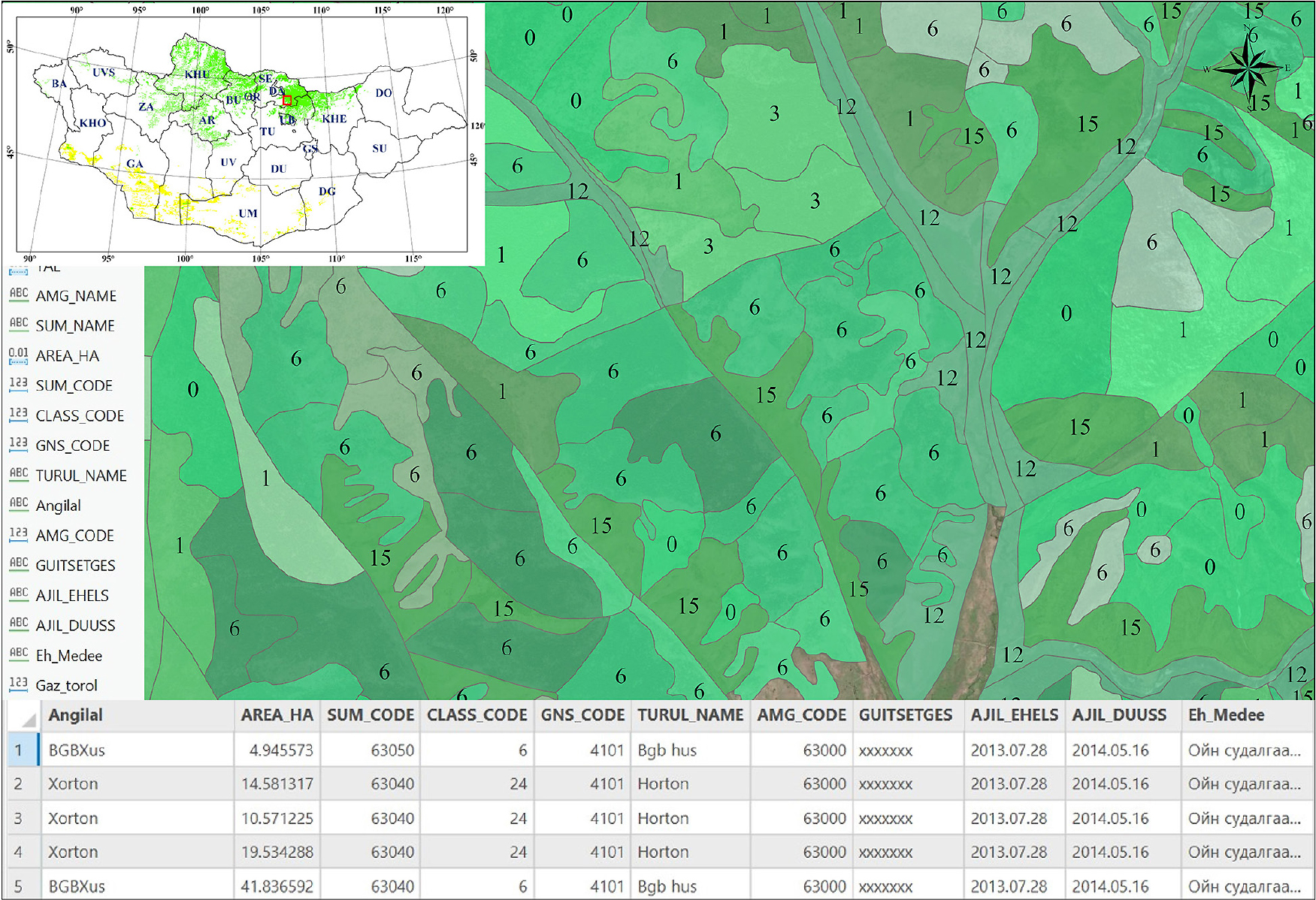
Fig. 6.
Example of the Mongolian forest digital forest map containing data form field inventory visualised in ArcGIS Pro software (Esri, Redlands, CA, USA) (Data source: Mongolian Agency of Forestry 2019).
Table 1.
Basic statistic for area of interest (AOI).
| No. | Class | Number of AOI (pcs) | Min AOI area (ha) | Mean AOI area (ha) | Max AOI area (ha) | Total AOI area (ha) | Percentage of total samples (%) |
|---|---|---|---|---|---|---|---|
| Land use and land cover forest: Tree species | |||||||
| 1 | Manchurian birch (B. platyphylla Sukaczev) | 40 | 0.3 | 12 | 47.6 | 494 | 17.2 |
| 2 | Siberian larch (L. sibirica Ledeb.) | 51 | 0.3 | 8 | 49.5 | 388 | 22.0 |
| 3 | Scotch pine (P. sylvestris L.) | 36 | 2.7 | 14 | 57.1 | 514 | 15.5 |
| 4 | Siberian pine (P. sibirica Ledeb.) | 43 | 0.3 | 16 | 84.6 | 667 | 18.5 |
| 5 | Siberian spruce (P. obovata Ledeb.) | 32 | 0.7 | 5 | 28.3 | 168 | 13.8 |
| Other land use and land cover classes | |||||||
| 1 | Non-forest | 30 | 0.1 | 9 | 59.4 | 314 | 12.9 |
The statistical characteristics of the finalised AOIs are summarised in Table 1. A total of 202 forested AOIs were utilised, spanning a combined area of 2231.0 ha. The number of samples per species ranged from 32 (P. obovata Ledeb.) to 51 (L. sibirica Ledeb.), reflecting both the relative abundance of species in the region and the need to ensure a minimum sample size for minority classes. The mean area of individual AOIs was 11.04 ha, with species-specific means ranging from 5.25 ha (P. obovata Ledeb.) to 15.51 ha (P. sibirica Ledeb.). This variation is attributable to the natural patch size distribution of the species and the challenge of delineating large, homogeneous stands for less common species like spruce.
The AOIs were split into training (70%) and validation (30%) subsets using spatial stratified sampling to minimise spatial autocorrelation (Lechner et al. 2020). This resulted in a robust dataset for model training and a statistically independent set for accuracy assessment.
Mean NDVI (Normalized Difference Vegetation Index) values for the analysed tree species AOIs are presented in Figure 7, where the graph aims to demonstrate the spectral-temporal differences between the five tree species. MB (B. platyphylla Sukaczev) consistently had the highest mean NDVI values (0.50–0.57) across 2020–2024 compared to the other tree species. In contrast, SBL (L. sibirica Ledeb.), SBP (P. sibirica Ledeb.) and SBS (P. obovata Ledeb.) maintained lower and relatively stable NDVI values around 0.39–0.46 throughout the study period.
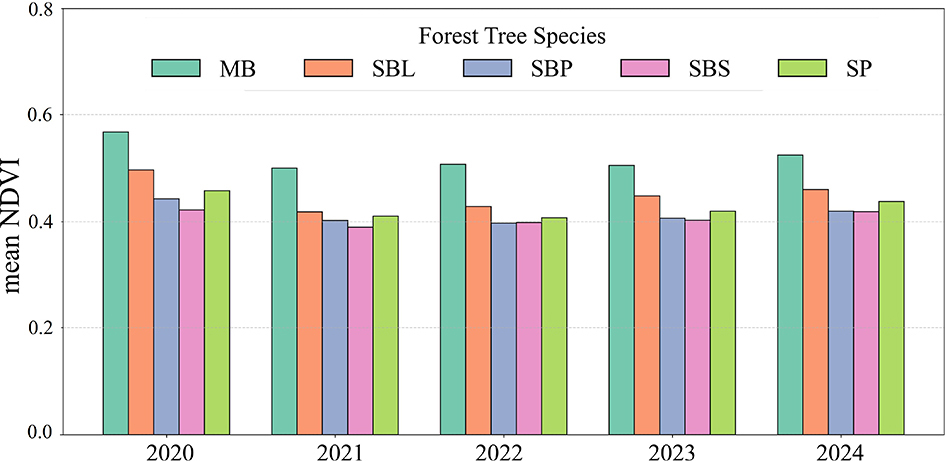
Fig. 7.
Mean NDVI values of AOIs of analysed tree species in test site. AOIs, area of interest.
While the consistent NDVI difference between deciduous and coniferous species demonstrates the potential for further species classification, the minimal contrast between conifers, particularly between SBP (P. sibirica Ledeb.) and SBS (P. obovata Ledeb.), may pose a challenge for accurate classification.
Data processing
Satellite data acquisition and pre-processing
Atmospherically corrected Sentinel-2 (Level 2A) imageries were selected based on seasonal vegetation phenology and low percentage of cloud cover. Only S-2 11 bands with 10, 20 and 60 m GSD were retained. The 20 m and 60 m GSD bands were resampled to 10 m GSD using bilinear interpolation to ensure consistency for pixel-based classification. S-2 spectral bands were scaled by dividing Digital Numbers (DNs) by 10,000 to obtain top-of-canopy reflectance, following ESA standards (Drusch et al. 2012). The final band stack included B1 (Coastal), B2 (Blue), B3 (Green) and B4 (Red); B5 (Red Edge 1), B6 (Red Edge 2) and B7 (Red Edge 3); B8 (NIR), B8A (Red Edge 4), B11 (SWIR 2) and B12 (SWIR 3).
Initially, all pixels affected by clouds and cloud shadows within the S-2 imagery were identified and delineated. A corresponding vector mask was generated and applied to remove these areas. Subsequently, a forest cover mask was derived from the Global 4-class PALSAR-2/PALSAR Forest/Non-Forest (FNF4) dataset, accessed via Google Earth Engine (GEE). Each S-2 raster was first corrected using the cloud-free mask and then spatially constrained using the forest cover mask, thereby isolating exclusively forested regions. This sequential masking approach ensured the derivation of a spatially coherent dataset, comprising only cloud-free forested areas, suitable for subsequent classification and remote sensing analyses.
Feature extraction
Vector-based training data sets (AOIs) were rasterised to ensure spatial congruence with S-2 imagery at a 10 m GSD, thereby facilitating compatibility with pixel-based classification methods. From these rasterised AOIs, representative samples were extracted to obtain per-pixel spectral reflectance values across all used spectral bands. This process yielded a structured dataset comprising spectral bands as predictor variables and corresponding forest tree species classes as response labels, suitable for supervised classification. This methodological workflow is consistent with established remote sensing practices for generating image-aligned training datasets (Lechner et al. 2020) (Fig. 4).
In total, 222,870 samples were extracted, comprising 156,012 training (70%) and 66,858 testing (30%) samples. Forest classes represented 94.9% of all samples, while non-forest areas accounted for 5.1% (Table 2).
Table 2.
Number of S2 rasters (10 m GSD) used for training and testing in random forest classification (bold values represent the total area and overall percentage across all classes).
| Classification | Training samples (train) | Testing samples (test) | Total | Overall percentage (%) | |
|---|---|---|---|---|---|
| LULC forest: Tree species | |||||
| 1 | Manchurian birch | 34,132 | 14,627 | 48,759 | 21.9 |
| 2 | Siberian larch | 26,313 | 11,277 | 37,590 | 16.9 |
| 3 | Scotch pine | 35,723 | 15,309 | 51,032 | 22.9 |
| 4 | Siberian pine | 40,829 | 17,497 | 58,326 | 26.2 |
| 5 | Siberian spruce | 11,066 | 4742 | 15,808 | 7.1 |
| Other LULC classes | |||||
| 1 | Non-forest | 7949 | 3406 | 11,355 | 5.1 |
| Total | 156,012 | 66,858 | 22,287 | 100.0 | |
RF classification
The RF algorithm (Breiman 2001) was used to classify forest cover and identify the dominant forest tree species in the test area. The RF algorithm was selected due to its proven effectiveness in handling high-dimensional and heterogeneous remote sensing data, as well as its reliability against overfitting (Belgiu and Drăgu 2016). The model’s performance was assessed using the out-of-bag (OOB) error estimate, which provides an unbiased measure of generalisation error by evaluating each tree on the data not included in its bootstrap sample. Additionally, the number of variables considered at each split (mtry) was optimised using 10-fold k-value cross-validation, selecting the optimal mtry value from [2, 4, 6, 8, 10, 12] to enhance classification accuracy (Ming et al. 2016). The number of trees parameter was held at a constant value of 500.
Although mean NDVI values were calculated and analysed to illustrate the spectral-temporal variability between tree species (Fig. 7), NDVI was not included as an input feature in the RF classification model. The RF algorithm utilised only Sentinel-2 spectral bands (B1–B12) as predictor variables. This decision aimed to evaluate the model’s capacity to distinguish tree species directly from spectral reflectance data without vegetation indices.
Field validation and accuracy assessment
The training set AOIs were proportionally distributed across all defined classes to ensure adequate representation of their variability.
For the accuracy assessment of S-2 classification performance, an error matrix (confusion matrix) was computed based on the predicted and reference class labels from the test AOI set. From this matrix, standard accuracy metrics were derived, including OA, which quantifies the proportion of correctly classified pixels across all categories. Additional metrics, such as the Cohen’s kappa coefficient, were also calculated to provide a more comprehensive evaluation of class-specific performance and overall agreement beyond chance.
OA:
where:
–nii is the number of correct predictions for class i.
These are the diagonal elements of the confusion matrix, representing where the predicted class matches the true class and N is the total number of samples (Congalton 2019):
Cohen’s kappa (κ):
where:
–Po is observed agreement,
–Pe is expected by chance.
Statistics derived from the confusion matrix were used to assess the reliability of the classification model.
Results
Temporal dynamics of forest tree species classification (2020–2024)
The results of forest tree species classification based on S-2 satellite imagery from 2020 to 2024 in individual tree species within the study area (Fig. 8).
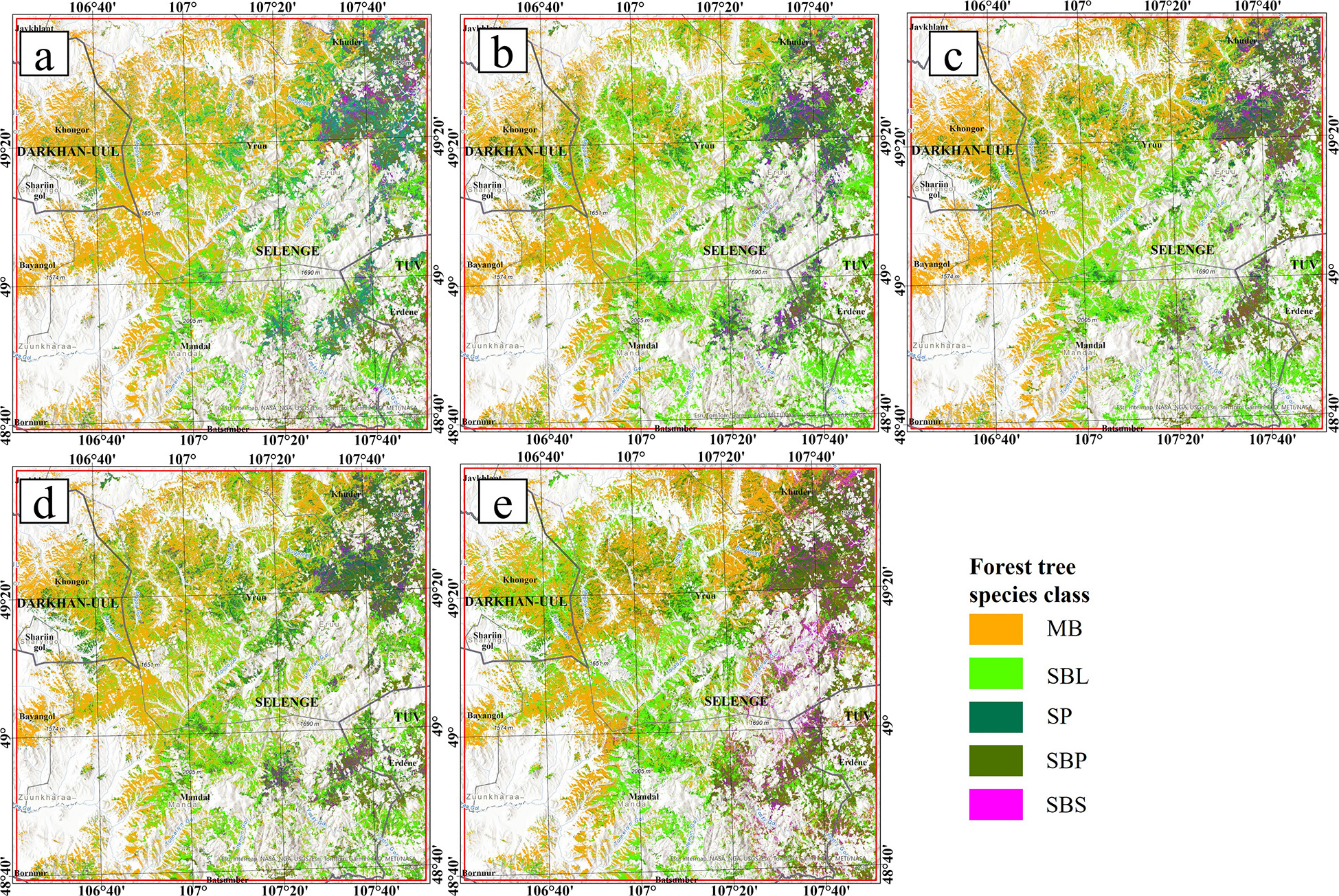
Fig. 8.
Forest tree species classification maps for analysed periods: (A) 21.08.2020; (B) 30.08.2021; (C) 30.08.2022; (D) 30.08.2023; (E) 24.08.2024.
The classification maps illustrating annual changes in forest tree species revealed that the alterations were spatially dispersed and did not encompass large contiguous areas (Fig. 9).
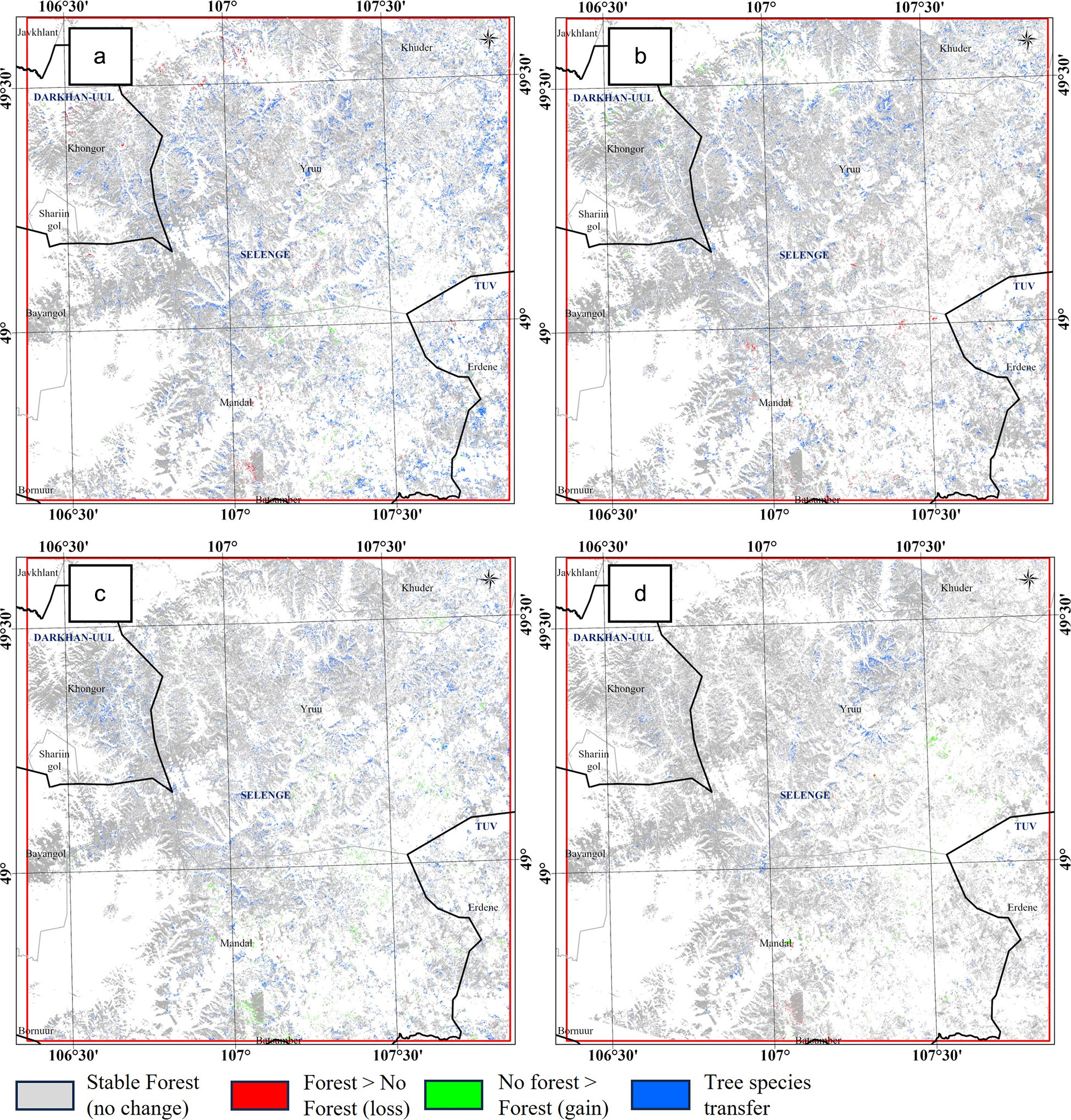
Fig. 9.
Change detection map of forest tree species classification: (A) From 2020 to 2021; (B) From 2021 to 2022; (C) From 2022 to 2023; (D) From 2023 to 2024.
Based on the RF classification, MB (B. platyphylla Sukaczev) was the dominant tree species in the whole period, consistently covering between 1900 km2 and 2188 km2, indicating a relatively stable and mature forest presence (Fig. 10, Table 3).
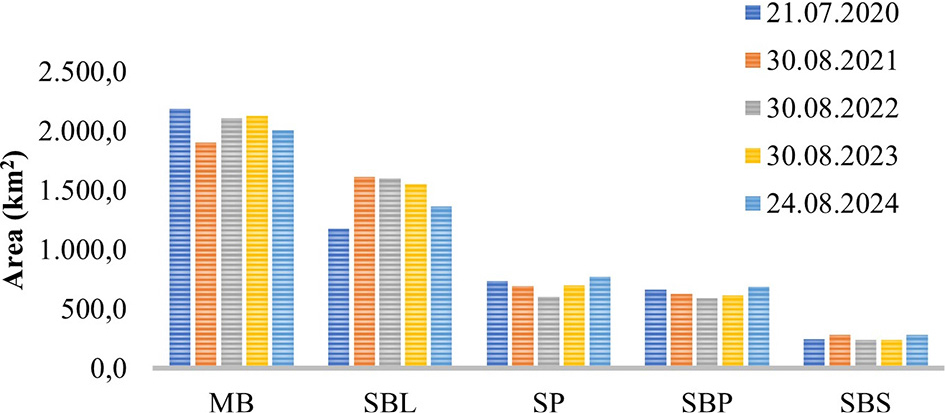
Fig. 10.
Dynamic of classified (random forest) forest main tree species classes (single species/total area; km2) on S-2 image (European Space Agency).
Table 3.
Classification results using RF approach (bold values represent the total area and overall percentage across all classes).
| Class name | Manchurian birch | Siberian larch | Scotch pine | Siberian pine | Siberian spruce | Sum of forest mask | Nonforest | Other | Total (km2) | |
|---|---|---|---|---|---|---|---|---|---|---|
| Sentinel 2 21.07.2020 | Area (km2) | 2188.5 | 1178.1 | 736.0 | 664.1 | 243.4 | 5010.0 | 1142.3 | 1233.9 | 7386.3 |
| Percentage (%) | 29.6 | 15.9 | 10.0 | 9.0 | 3.3 | 67.8 | 15.5 | 16.7 | 100.0 | |
| Sentinel 2 30.08.2021 | Area (km2) | 1900.7 | 1614.3 | 692.5 | 626.5 | 280.8 | 5114.7 | 1037.6 | 1233.9 | 7386.3 |
| Percentage (%) | 25.7 | 21.9 | 9.4 | 8.5 | 3.8 | 69.2 | 14.0 | 16.7 | 100.0 | |
| Sentinel 2 30.08.2022 | Area (km2) | 2107.1 | 1600.3 | 602.4 | 589.7 | 243.0 | 5142.4 | 1009.9 | 1233.9 | 7386.3 |
| Percentage (%) | 28.5 | 21.7 | 8.2 | 8.0 | 3.3 | 69.6 | 13.7 | 16.7 | 100.0 | |
| Sentinel 2 30.08.2023 | Area (km2) | 2127.3 | 1555.1 | 699.0 | 612.5 | 241.7 | 5235.5 | 9168 | 1233.9 | 7386.3 |
| Percentage (%) | 28.8 | 21.1 | 9.5 | 8.3 | 3.3 | 70.9 | 12.4 | 16.7 | 100.0 | |
| Sentinel 2 24.08.2024 | Area (km2) | 2008.0 | 1367.6 | 769.6 | 685.1 | 281.0 | 5111.3 | 1041.1 | 1233.9 | 7386.3 |
| Percentage (%) | 27.2 | 18.5 | 10.4 | 9.3 | 3.8 | 69.2 | 14.1 | 16.7 | 100.0 | |
SBL (L. sibirica Ledeb.) ranked as second, with its area fluctuating significantly, from 1178.1 km2 (in July 2020), peaking at 1614.3 km2 (August 2021), then declining to 1367.6 km2 (August 2024). These fluctuations may be related to the seasonal phenological changes of larch, particularly its distinctive needle coloration.
SBP (P. sibirica Ledeb.) exhibited minor fluctuations, from 664.1 km2 (9.0%) in 2020 to 626.5 km2 (8.5%) in 2021, then 589.7 km2 (8.0%) in 2022, 612.5 km2 (8.3%) in 2023 and 685.1 km2 (9.3%) in 2024.
The area of SP (P. sylvestris L.) fluctuated over the 5 years. It covered 736.0 km2 (10.0%) in 2020, decreased to 692.5 km2 (9.4%) in 2021 and 602.4 km2 (8.2%) in 2022, then increased to 699.0 km2 (9.5%) in 2023 and 769.6 km2 (10.4%) in 2024.
SBS (P. obovata Ledeb.) maintained relatively stable coverage, ranging from 243.4 km2 (3.3%) in 2020 to 280.8 km2 (3.8%) in 2021, decreasing slightly to 243.0 km2 (3.3%) in 2022, 241.7 km2 (3.3%) in 2023 and increasing again to 281.0 km2 (3.8%) in 2024 (Table 2). These fluctuations may have been influenced by the mixed forest structure, interspecific competition, and the specific characteristics of natural regeneration in coniferous stands. Furthermore, the temporal difference in data collection – carried out in July 2020 and in August during 2021–2024 – may have contributed to the observed changes due to differences in growth stages, crown density of deciduous species and spectral variations in remote sensing data.
Classification validation
The comprehensive validation of forest tree species classification demonstrates consistently exceptional performance across all evaluated metrics (Table 4). OA remained remarkably high throughout the study period (2020–2024), ranging from 0.939 to a high 0.962, with peak performance observed in the S-2 (July 21, 2021) dataset, achieving near-perfect accuracy and κ = 0.962.
Table 4.
Classification validation metrics.
| Metric | Range | Interpretation |
|---|---|---|
| Accuracy | 0.939–0.962 | All pixels were classified correctly, showing that the overall performance of the model is very reliable. |
| Kappa | 0.924–0.949 | Demonstrates very strong agreement beyond chance, which confirms the consistency and reliability of the classification results |
| P-value | < 2.2e-16 | The findings are extremely statistically significant. |
| Sensitivity (high class) | 0.963–0.980 | The model is highly effective in detecting the actual presence of species in these categories. |
| Sensitivity (low class) | 0.867–0.917 | Slightly lower sensitivity for species like Spruce, meaning it’s harder to correctly identify them. |
| Specificity | 0.975–0.997 | Very high species are rarely misclassified as each other. |
| Fl-score | 0.935–0.952 | Demonstrating excellent performance and a strong balance between precision and recall. |
MB (B. platyphylla Sukaczev) consistently shows excellent and stable performance, with sensitivity and specificity generally >0.991 and a slight dip in specificity to 0.984 in 2024, reflecting its distinct canopy and leaf morphology (Thenkabail et al. 2010). SBL (L. sibirica Ledeb.) exhibits improving sensitivity from 0.914 in 2020 to 0.942 in 2022 but lower specificity, which dropped in 2021 and remained at lower values, suggesting better detection at the expense of occasional misclassification likely due to needle senescence (Saarinen et al. 2018). SP (P. sylvestris L.) maintains consistently high sensitivity and specificity, with specificity reaching a perfect 1.000 in 2021, indicating zero false positives, reflecting the robustness of the RF classifier. SBP (P. sibirica Ledeb.) demonstrates high sensitivity and specificity throughout, with a small drop in specificity from 2020 to 2023, followed by its increase in 2024, likely influenced by environmental factors such as canopy shadow or moisture variation (Fassnacht et al. 2016). SBS (P. obovata Ledeb.) shows the highest specificity but the lowest and most variable sensitivity, falling to 0.867 in 2023, indicating a conservative model that avoids false positives but frequently misses true Spruce stands due to spectral similarity with other conifers (Maxwell et al. 2018).
Based on the data from 2020 to 2022, the classification model demonstrate strong performance for non-forest areas and SBS (P. obovata Ledeb.), with consistently high accuracy scores. However, it demonstrates significant confusion between SP (P. sylvestris L.), SBP (P. sibirica Ledeb.) and SBL (L. sibirica Ledeb.) classes across all years. The model shows improvement in MB (B. platyphylla Sukaczev) classification over time, with misclassification rates decreasing from 501 in 2020 to 264 in 2022 when confused with SBS (P. obovata Ledeb.) (Fig. 11).
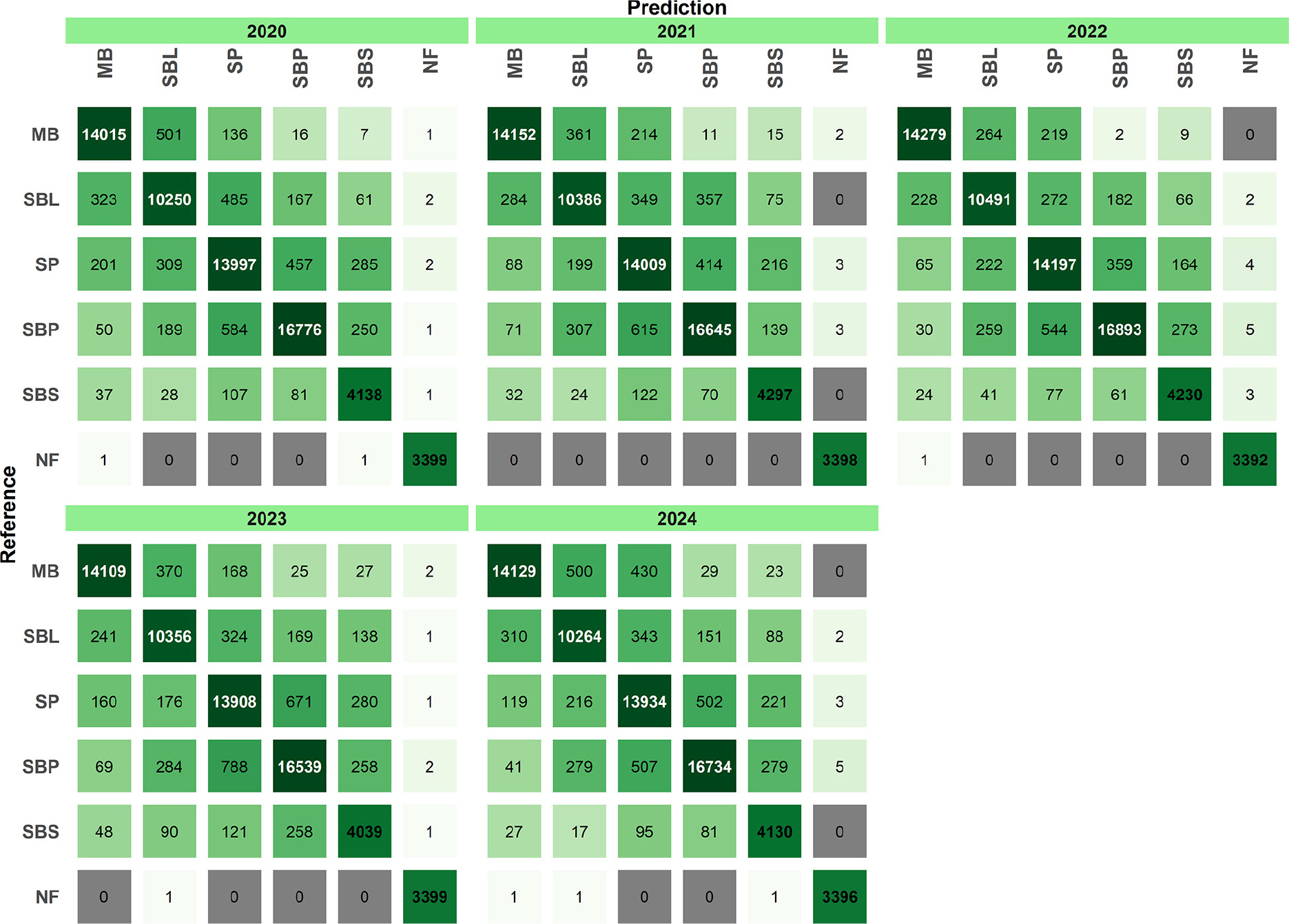
Fig. 11.
Confusion matrices for forest type classification (2020–2024).
Comparison of S-2 classification results with the traditional forest inventory from 2019
A comparative analysis of the 2019 forest inventory and S-2 classifications from July 2020 and August 2024 reveals substantial shifts in forest composition more than 5 years (Table 5). MB (B. platyphylla Sukaczev) declined from 2773.9 km2 (53.8%) in 2019 to 2188.5 km2 (43.7%) in 2020 and 2008 km2 (39.3%) in 2024, a total loss of 765.9 km2 (27.6%). SBL (L. sibirica Ledeb.) increased from 912.3 km2 (17.7%) to 1178.1 km2 (23.5%) in 2020 and 1367.6 km2 (26.8%) in 2024 (>49.9%), while SBP (P. sibirica Ledeb.) grew from 517.4 km2 (10.0%) to 685.1 km2 (13.4%), a 32.4% increase. SP (P. sylvestris L.) remained relatively stable, with minor fluctuations from 902.7 km2 (17.5%) to 769.6 km2 (15.1%). The most difference occurred in SBS (P. obovata Ledeb.), rising from 50.9 km2 (1.0%) to 281.0 km2 (5.5%), a 452.1% increase, likely reflecting underestimation in the 2019 inventory or classifier confusion. Overall, this considerable discrepancy may be attributable to differences between forest inventory mapping methodologies and remote sensing approaches, as well as to deficiencies in the updating of forest inventory maps.
Table 5.
Results of S-2 classification vs. forest inventory data (bold values represent the total area and overall percentage across all classes).
| Class | Forest inventory map (2019) | S-2 | Difference | S-2 | Difference | |||||
|---|---|---|---|---|---|---|---|---|---|---|
| 21/07/2020 | 24/08/2024 | |||||||||
| km2 | % | km2 | % | km2 | % | km2 | % | km2 | % | |
| Manchurian birch | 2773.9 | 53.8 | 2188.5 | 43.7 | –585.4 | –21.1 | 2008.0 | 39.3 | –765.9 | –27.6 |
| Siberian larch | 912.3 | 17.7 | 1178.1 | 23.5 | 265.8 | 29.1 | 1367.6 | 26.8 | 455.3 | 49.9 |
| Scotch pine | 902.7 | 17.5 | 735.9 | 14.7 | –166.8 | –18.5 | 769.6 | 15.1 | –133.1 | –14.7 |
| Siberian pine | 517.4 | 10.0 | 664.1 | 13.3 | 146.7 | 28.4 | 685.1 | 13.4 | 167.7 | 32.4 |
| Siberian spruce | 50.9 | 1.0 | 243.4 | 4.9 | 192.5 | 378.2 | 281.0 | 5.5 | 230.1 | 452.1 |
| Total | 5157.2 | 100.0 | 5010.0 | 100.0 | 5111.3 | 100.0 | ||||
Discussion
This study highlights the efficacy of using multi-temporal Sentinel-2 (S-2) imagery with the RF algorithm for precise forest tree species classification in Mongolia’s boreal regions. The achieved OA of 96.19% and a kappa coefficient of 0.949 align with recent findings using S-2 time series in complex forest environments (Liu et al. 2024). However, discrepancies with the 2019 Forest Inventory data – such as overestimation of SBS (P. obovata Ledeb.) and SBL (L. sibirica Ledeb.), and underestimation of MB (B. platyphylla Sukaczev) – highlight limitations inherent to both field-based mapping and satellite image classification. These inconsistencies likely result from spectral similarity among coniferous species, mixed forest compositions and the absence of ecological or morphometric variables (Dulamsuren et al. 2010a, b, Karthigesu et al. 2025).
The findings corroborate earlier studies in Mongolia (Amarsaikhan et al. 2012, Munkh-Erdene et al. 2018), where classification accuracies of 90–91% were reported using Landsat and ALOS PALSAR data. The higher accuracy in the current study can be attributed to the richer multi-temporal dataset, optimised sampling strategies and the application of ML algorithms (Grabska-Szwagrzyk et al. 2024).
Spectral confusion among coniferous species, particularly between SBS (P. obovata Ledeb.) and other evergreen conifers, remains a significant challenge due to overlapping canopy reflectance (Ban et al. 2020, Franklin et al. 2003). The current classification framework did not incorporate morphometric or ecological variables, such as altitude, slope or aspect, which are known to influence species distribution in Mongolia’s forest landscapes. Incorporating these variables could further enhance classification accuracy (Erdenebaatar and Damdinsuren 2020).
The conventional forest inventory methodology in Mongolia remains outdated relative to international standards, relying heavily on labour-intensive, time-consuming field measurements (FAO 2005). Insufficient integration of remote sensing, such as Sentinel-2 imagery, limits the detection of forest dynamics, degradation and regeneration (Hansen et al. 2013, Reiche et al. 2016). The combination of multi-temporal S-2 imagery, RF classification and potential integration of NDVI-based phenology (Grabska-Szwagrzyk et al. 2024) provides a scalable and replicable framework for modernising Mongolia’s forest inventory system. Such approaches can enhance the detection of mixed forest compositions, improve classification of spectrally similar species, and support sustainable forest management under changing environmental conditions.
While preparing the manuscript, authors calculated the NDVI index and used it as an explanatory variable. However, it transpired that the RF algorithm produced OA values that were lower (OA = 0.921) than those obtained without using the NDVI index in the predictive model (OA = 0.995). The authors were therefore discouraged from using the NDVI index, which is commonly used in studies. Furthermore, calculating and implementing it as an additional variable in the model prolonged the data processing time.
To improve classification, particularly for SBS (P. obovata Ledeb.), future research should integrate airborne laser scanning (ALS) LiDAR or UAV (Unmanned Aerial Vehicle)-based data (Zhong et al. 2022), and very-HR commercial satellite imagery, such as Planet SuperDove or Aleph Satellogic (WV-3/Legion Maxar) (Duncanson et al. 2021). Multi-temporal Sentinel-2 time series, combined with vegetation indices such as NDVI, EVI (Enhanced Vegetation Index), or MTCI (MERIS Terrestrial Chlorophyll Index), provide valuable insights into phenological patterns and could improve species-level discrimination (Grabska-Szwagrzyk et al. 2024).
High accuracy and kappa scores were achieved; however, uncertainties remain due to limited HR reference data and the selection of homogeneous test areas, which may inflate results (Lechner et al. 2020). Yearly variations in species estimates further reflect the challenges of spectral and temporal variability (Lu, Weng 2007). Expanding and diversifying ground-truth datasets will improve model robustness and reliability.
Conclusions
This study confirms that ML, particularly the RF algorithm, applied to Sentinel-2 imageries, enables rapid and accurate forest species classification in boreal regions such as northern Mongolia. Across the five dominant species, the approach achieved an OA of up to 96.19% and kappa values approaching 0.949.
Nonetheless, these performance metrics likely represent an upper bound of true accuracy. Validation data were deliberately selected from homogeneous, representative forest stands – conditions that inherently reduce classification difficulty. The lack of comprehensive, HR reference datasets across more heterogeneous forest mosaics introduces uncertainty, which is reflected in the substantial interannual variability observed in classified areas. Despite these caveats, the approach represents a significant advancement over earlier Mongolian studies, which typically reported accuracies near 90%.
In practical terms, this research offers a scalable and cost-effective tool for operational forest monitoring in Mongolia, supporting management, restoration and climate policy initiatives. However, further improvements are essential. These include incorporating morphometric and ecological layers, using higher-resolution commercial imagery where feasible, expanding field data collection using GNSS (Global Navigation Satellite Systems) or UAV platforms, and exploring more advanced classification methods such as deep learning. This study represents a significant advancement in remote sensing-based forest classification and provides well-defined avenues for further methodological improvement.
Acknowledgements
The research was financially supported by the Rector’s grant under the research at the Doctoral School of University of Agriculture in Krakow. We would also like to thank the Editor and the reviewers for their valuable comments and suggestions, which helped improve this paper.
Notes
[1] Contributed by Author’s contribution
E.B.: conceptualisation, validation, formal analysis, investigation, data curation, writing – original draft, writing – review & editing, visualisation; P.W.: supervision, conceptualisation, writing – review & editing, investigation, project administration; W.K.: conceptualisation, writing – review & editing, investigation, data curation.
[2] Conflicts of interest Conflict of interest statement
The authors declare that they have no known competing financial interests or personal relationships that could have appeared to influence the work reported in this paper.