
Introduction
Lake islands are inextricably linked to the genesis of the lake basin and simultaneously indicate its evolution. All Polish lake islands were formed during the last glaciation, with their evolution taking place during the Holocene. One possibility of their formation is that flowing glacial waters left ‘inselbergs’ in the eroded bowls, which, when filled with water bowls, protruded above their surface and formed islands. Another possibility was the formation of fragments of the bottom protruding above the water surface, resulting from chaotic melting of blocks of dead ice, e.g. in the bottom moraine zones. Some islands were formed as a result of lowering the water level, which resulted in the emergence of, for example, shallows, which formed islands. The changes could be the result of both climatic fluctuations and anthropogenic pressure. In turn, some of the islands may have been created as a result of rising water levels, as a result of which the peninsulas may have become islands. Changes in area and number may result from intense bioaccumulation in shallow waters, which may result in the creation of a new island or the merger of several islands.
To date, no study has been published that covers all the lake islands within a single country. There are works that contain the total number of islands in a country, but without distinguishing between sea, lake or river islands, e.g. in the USA or Finland (Sarjakoski 1996). In the case of legal protection of lake islands, there are only scientific publications concerning selected regions, without taking into account the protection of lake islands across the entire country. Even in these cases, there is no detailed numerical data (cf. The Conservation of Biological Diversity in the Great Lakes Ecosystem 1994, State of the Greatlakes Islands 1999). There are many works devoted to selected aspects of lake islands, e.g. geology, flora and fauna (among other Krefting 1969, McEachern, Towle 1974, Corin 1976, Peterson 1977, Nilsson, Nilsson 1978, Francis et al. 1979, Crispin et al. 1985, Case, McCullough 1987, Soule 1993, Roden 1998, Alenius et al. 2004, Francis 2012, Shipunov, Abramova 2014, Jusik, Macioł 2014, Sapelko et al. 2020).
Due to their location and features, lake islands have been and continue to be refuges for flora and fauna. In the early stages of civilisational development, they served as human settlements (e.g., Biskupin, which is now a peninsula). During the formation of the Polish statehood, some of them became sites for fortresses (e.g., Ostrów Lednicki, Giecz, Ostrów Tumski). More information on the role and cultural signifcance of lake islands in the early Middle Ages can be found in Tietz’s (2022) work. Despite their importance and natural values, lake islands in Poland have not been the subject of a comprehensive, collective study, with the exception of an unpublished monograph by Żygulska (1992), which includes an analysis (mainly statistical) of all such features in our country. Nonetheless, mentions of lake islands and islandness can be found in the works of Choiński (2000, 2007). The literature indicates that in the evolution of lakes, especially in recent decades, and consequently of islands, significant two-way changes have been observed. On the one hand, they involve a reduction in area or the disappearance of islands (as a result of rising water levels); on the other hand, the increase in surface area and the emergence of new islands (as a result of lowering water levels). In extreme cases, islands can merge with one another or turn into peninsulas (Kaniecki 1997, Choiński, Macias 2002, Choiński 2006, Kunz et al. 2010). Therefore, the main aim of this study was to determine the evolution of lake islands. This term should be understood as referring to changes in their number, area and natural or anthropogenic transformations. It was developed based in topographic maps (ca 1975) and orthophotomaps (2010-2011). This period seems sufficient to capture changes in the area of lake islands. Another primary goal of this study was to show the percentage of islands under legal protection within the system of protected areas, as well as to highlight their most valuable natural and landscape features. So far, in Polish or world literature, there have been no collective works devoted exclusively to lake islands.
The issues related to islands on lakes are quite complex, particularly those concerning their origins and evolution. This is evident in the current place names. For instance, many present names of peninsulas, such as Ostrów, were once islands that became peninsulas only after the water level in the lake dropped. Conversely, there have been situations where the rising water levels in a lake caused peninsulas to lose their connection to the mainland, thereby becoming islands. Underwater thresholds and various shallows can also become peninsulas, islands or shallow areas, depending on water level changes, and vegetation may begin to grow on them. This is very clearly seen in the comparative analysis of topographic maps edited in different periods, often more than 100 years apart. Examples of the above changes can be found on maps and they are presented, among others, in engravings in the works of Choiński (2009, 2014) and Choiński et al. (2012).
Unfortunately, there is limited information on lake islands in the literature. Most existing works are either occasional studies or brief mentions that describe an island or a group of islands on a single lake, which possess specific characteristics, such as a strict floral reserve or an archaeological site. The most comprehensive work in this regard is by Żygulska (1992), which provides a synthesis of the statistical analysis on Polish lake islands. A significant number of compilations concerning islands on lakes worldwide are included in Choiński (2000) work. It should be noted that data on the number and area of lake islands can also be obtained from unpublished bathymetric plans of the Inland Fisheries Institute in Olsztyn. This pertains to only about 30% of the number of lakes compared to the number of lakes identified on topographic maps at a scale of 1:50,000. Additionally, in the case involving multiple islands on a single lake, only their total area is provided.
There remain many unanswered questions regarding lake islands. Future studies on islands should include information on topics such as:
– changes in water levels over long observation periods in selected lakes, in relation to changes in island surfaces as determined from detailed topographic maps or aerial photographs,
– identification of those islands that are suitable for development due to their tourism potential,
– conducting geomorphological and geological studies aimed at determining the geological structure of the islands and their genetic origins,
– identification of islands and peninsulas that have the potential to become peninsulas, islands, or contribute to the division of lakes (as exemplified by Lake Wicko).
Study area
In the latest physiogeographic division of Poland (Solon et al. 2018, Richling et al. 2021), the study area is included in 4 subprovinces: South Baltic Coastland (313), East Baltic Coastland (841), South Baltic Lakeland (314–316) and East Baltic Lakeland (842). Its total area is 116,005 km2, which constitutes 37.25% of Poland’s total area. It is a young-glacial area, with altitude differences ranging from 0 m a.s.l. to 329 m a.s.l. The relief of this area has a predominantly plain character. The annual rainfall, according to Woś (2010), ranges from 480 mm to 750 mm, with 500–750 mm in the Pomeranian Lake District, 500–700 mm in the Masurian Lake District, and 480–580 mm in the Greater Poland-Kuyavian Lake District. In total, in the analysed area, there are 6789 lakes with an area of over 1 ha, including 644 with islands. There are 3381 lakes in the Pomeranian Lake District, including 271 with islands, in the Masurian Lake District – 2061 lakes, including 268 with islands, and in the Greater Poland-Kuyavian Lake District – 1347 lakes, including 105 with islands. The greatest changes in water levels and the highest volumes of lake waters occur in March and April, while the lowest – between August and October. In the Pomeranian Lake District, the highest situated lake is the unnamed lake (no. 33 on the Kartuzy sheet according to Choiński 2006) with an area of 4 ha, located at an altitude of 245 m a.s.l., while the lowest situated lakes are the coastal lakes located at an average altitude of 0.1 m a.s.l. The average altitude of the lakes in this lake district is 105.5 m a.s.l. In the Masurian Lake District, the highest situated lake – and also the highest situated lake in northern Poland within the lake district range (range of the Vistula glaciation) – is an unnamed lake with an area of 3 ha (no. 17 on the Przerośl-Osada sheet according to Choiński 2006), located at an altitude of 254 m a.s.l. The average altitude of the lakes within this lake district is 120 m a.s.l. Finally, in the Greater Poland-Kuyavian Lakeland, the highest situated lake is an unnamed lake with an area of 1 ha (no. 41 on the Sulęcin sheet), situated at an altitude of 143 m a.s.l. However, the average altitude of the lakes is only 74.3 m a.s.l.
Materials and methods
The areas of larger islands were calculated using a planimeter, while those of smaller islands were measured using graph paper with an accuracy to half a grid square, which equates to an area of 0.125 ha. The obtained data regarding the number of islands and their areas were derived from calculations made on topographic maps at a scale of 1:50,000. This edition (comprising 203 sheets covering the lake zone) was released around 1975. This provided a uniform material for analysis, both in terms of the time of publication and the accuracy of the map scale. Nevertheless, the obtained data may differ from the actual state. This discrepancy arises from the fact that some islands, depending on the level of their surface at the time of mapping, could be close to the water surface, i.e., either slightly above and below it. Consequently, some may be classified as islands, while others might be overlooked. This depends on the local and regional conditions affecting the fluctuations of the water level in the given lakes. For lakes that have islands, a so-called island index was determined, expressed as a percentage. This index represents the ratio of the island(s) surface area to the total lake surface area (Choiński, Skowron 2022a, b).
The study utilised the ArcGIS graphic software, which allows for the vectorisation of a raster base through the Web Map Service (WMS) tool. The foundation was the creation of vector files (shp), to which identifiers – in the form of thematic layer areas – were manually added in the attribute table using the ‘Calculate Geometry¼’ function (Gotlib et al. 2007, Hildebrandt-Radke, Przybycin 2011). The raster base on which the measurements were made (enlarged to a scale no smaller than 1:800) was created by combining aerial images, typically with a pixel accuracy of 0.5 m. The orthophotomap, at a scale equivalent to 1:10,000, was current for the years 2010–2011. Special attention was paid to the coastal zone during vectorisation, which was distinguishable on the orthophotomaps and depicted the extent of macrophyte vegetation in the lakes (Kunz et al. 2010, Choiński, Skowron 2022a, b). However, the extent of reed vegetation on the orthophotomaps made it difficult and problematic to determine the island shores, especially for islands with a low elevation above the lake water level. Consequently, much depended on the interpretation of the structure and type of vegetation, and the results obtained may differ from the actual state (Choiński, Kijowski 2015). Additionally, as with topographic maps, the number and area of islands on orthophotomaps depend on the water level in the lakes at the time the aerial photographs were taken. The time difference between the edition of topographic maps and the year of creation of the orthophotomap is 35 years.
The analysis of lake islands in the context of Poland’s legal nature conservation system was based on digital databases using QGIS software version 3.18 (Open Source Geospatial). and the ‘Catalogue of Lakes in Poland’ by Choiński (2006). The sources included: work by Żygulska (1992), digital databases in the form of shape layers such as water bodies in Poland encompassing lakes and artificial reservoirs, the National Register of Geographical Names – physiographic features, shape layers of various legally protected areas in Poland from the Central Register of Nature Protection Forms of the General Directorate for Environmental Protection as of 31 March 2024, and the WMS plugin from the Geoportal enabling the use of raster topographic maps of Poland at scales from 1:10,000 to 1:50,000. The description of selected islands was based on data from the Central Register of Nature Protection Forms of the General Directorate for Environmental Protection (crfop.gdos.gov.pl), legal acts establishing the forms of nature protection, and the books of Walczak et al. (2001), Wilk et al. (2020), and Przybysz (1997).
Analysis of lake islandness according to topographic maps
The analysis of topographic maps revealed that out of 7081 Polish lakes with areas exceeding 1 ha, 556 lakes have islands, totalling 1115 islands (Fig. 1). Based on this assumption, the following results were obtained from the analysis of islands on lakes with areas greater than 1 ha:
– 556 lakes feature islands, whereas the number of such lakes is as follows: 239 in the Pomeranian Lakeland, 215 in the Masurian Lakeland and 102 in the Greater Poland-Kuyavian Lakeland (including those south of the maximum extent of the last glaciation),
– the highest number of islands is found on the lakes of the Masurian Lakeland (541), in the Pomeranian Lakeland (410), and the Greater Poland-Kuyavian Lakeland and south of the maximum extent of the last glaciation (only 164),
– the total area of islands in the Masurian Lakeland is 1342.5 ha, in the Pomeranian Lakeland 822.0 ha, and in the Greater Poland-Kuyavian Lakeland 231.3 ha,
– with a total area of islands amounting to 2395.8 ha, this yields the following average island density: for the Masurian Lakeland 1.01%, for the Pomeranian Lakeland 0.78%, and for the Greater Poland-Kuyavian Lakeland 0.52%,
– lakes with islands make up 7.8% of all Polish lakes, meaning that, on average, every 13th lake contains an island. Table 1 provides statistics on the occurrence of islands categorised by their size.
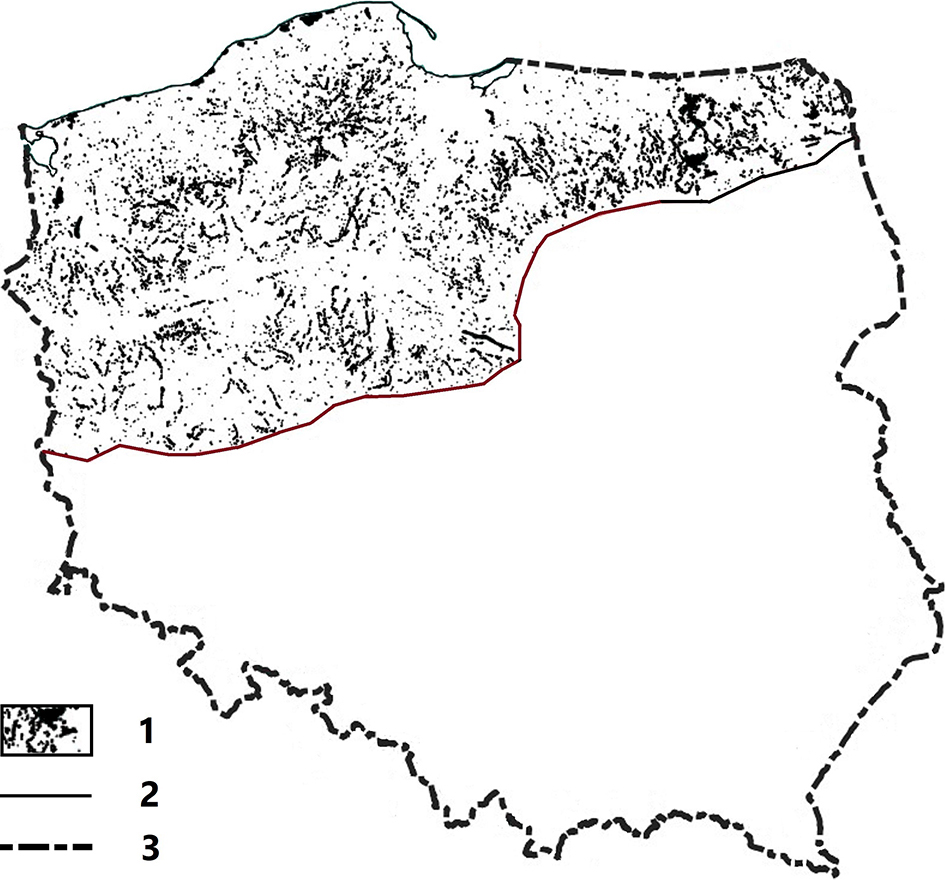
Fig. 1.
Location of the study area.
Explanations: 1 – lakes, 2 – scope of the study area, 3 – country border.
Table 1.
Numerical and areal variation of islands (according to Choiński 2007).
| Size class | Number of islands | Total area of islands | ||
|---|---|---|---|---|
| [ha] | [–] | [%] | [ha] | [%] |
| <1 | 783 | 70.22 | 314.3 | 13.12 |
| 1–5 | 253 | 22.69 | 560.4 | 23.40 |
| 5–10 | 38 | 3.41 | 251.8 | 10.51 |
| 10–20 | 18 | 1.61 | 265.0 | 11.06 |
| 20–50 | 15 | 1.35 | 393.4 | 16.42 |
| >50 | 8 | 0.72 | 610.7 | 25.49 |
| Total | 1115 | 100.00 | 2395.8 | 100.00 |
The large majority of the islands are small, i.e., less than 1 ha in size, with 783 islands accounting for 70.22% of the total. They also occupy a small percentage of the total island area, only 13.12%. In contrast, the small group of the largest islands, i.e., those over 20 ha, numbers 23 (just 2.07% of the total) but has a combined area of 1004.1 ha, which constitutes 41.91% of the total area of all islands.
The largest lake island in Poland is Ostrów, covering 99.5 ha on Lake Jeziorak. Among other large islands are: Ostrów Wielki, covering 95.0 ha on Lake Wdzydze; Wielimska, covering 94.5 ha on Lake Wielimie; Bielawa, covering 75.0 ha on Lake Drawsko; Duży Ostrów, covering 73.5 ha, and Upałty, covering 66.5 ha, both on Lake Mamry; and Czaplak, covering 54.2 ha on Lake Jeziorak. In terms of the number of islands on a lake, Lake Mamry leads with 35 islands. The next largest numbers of islands are found on the following lakes: Narie with 20, Druglin Duży with 17, Jeziorak with 15, and Drawsko, Wigry, Dadaj and Karaś, each with 13. As evident from this list, the lakes of the Masurian Lake District have the largest concentrations of islands. It should be noted that in the Pomeranian Lake District, only Lake Drawsko has more than 10 islands, while the Greater Poland-Kuyavian Lake District is the poorest in this regard, with the highest number of islands being only 6 on Lake Skorzęcińskie. Considering only lakes that have islands, the average number of islands per lake has been determined. For the Masurian Lake District, this average is 2.5 islands per lake; for the Pomeranian Lake District, it is 1.7; and for the Greater Poland-Kuyavian Lake District, it is 1.6 islands. The island index exceeds 10% in several cases. Figure 2 presents examples of lakes with the highest island indexes in the analysed lake districts (Choiński 2007). Interestingly, some lakes with islands also have significant depths, such as Drawsko (82.2 m), Wdzydze (69.5 m), Siecino (44.2 m) and Lubie (46.2 m) (Choiński 2006). There are also cases where islands have considerable maximum elevations above the water level of these lakes. The highest elevation in this regard is achieved by the island Ostrów on Lake Siecino, where its peak rises 27.7 m above the water level. When considering islands as integral parts of lake basins, the relative heights in these cases – that is, the difference between the greatest depth and the island’s peak – reach substantial values. For the four lakes mentioned above, these differences are 92.7, 84.2, 71.9 and 63.2 m, respectively.
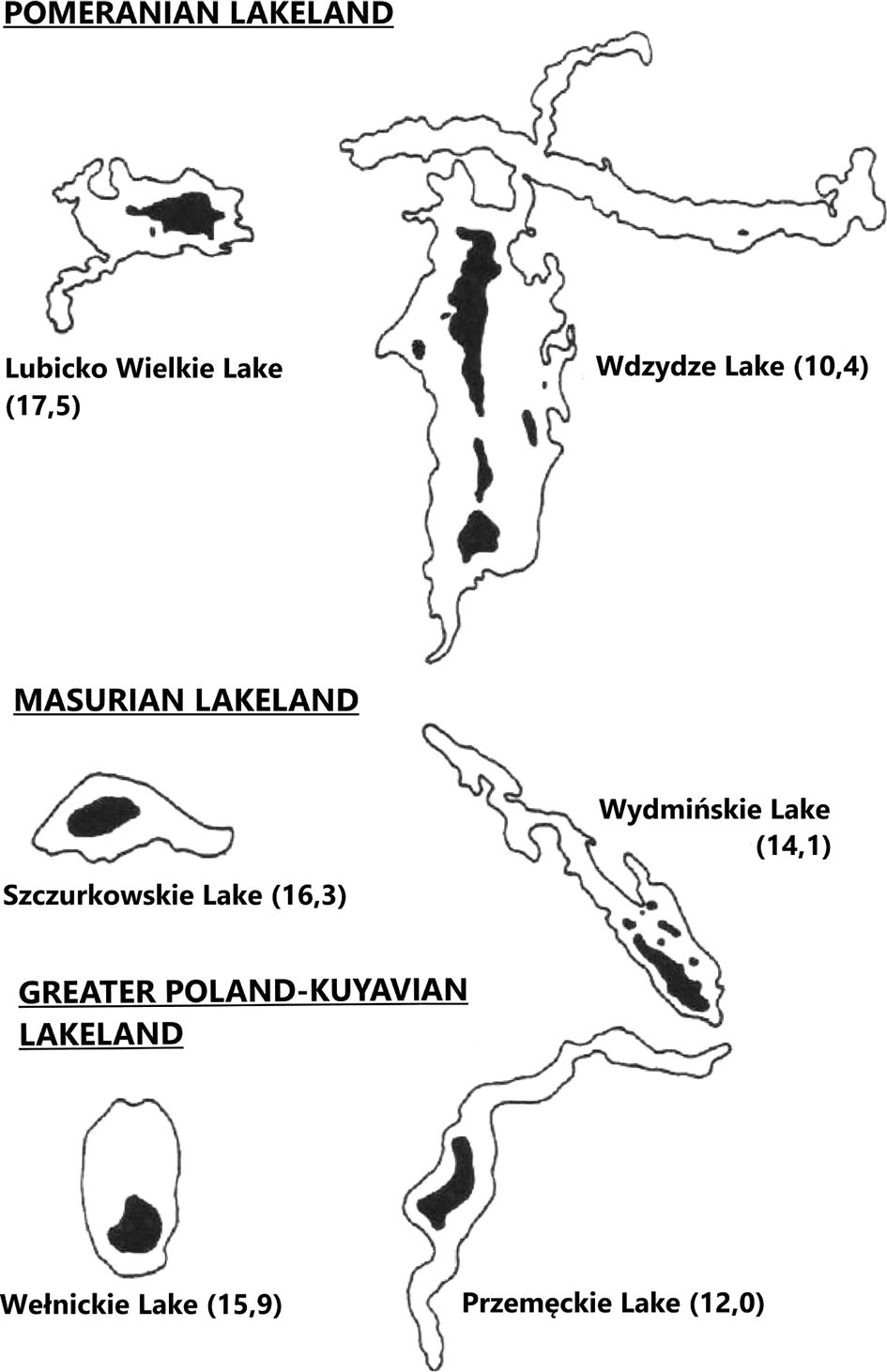
Fig. 2.
Examples of lakes (presented in different scales) with the highest island index (%) (Choiński 2007, changed).
Both the surfaces of the islands and their shores can be extremely attractive for various forms of tourism. Moreover, not only the islands themselves but also their surroundings can provide a wind shadow zone during strong winds, offering shelter to sailors and kayakers. Of course, it is difficult to estimate, for example, what percentage of the shores are suitable for tourists, partly due to the often-dense vegetation surrounding them. Nevertheless, the total length of the lake island shores within the lake districts is as follows: Masurian Lake District – 268 km, Pomeranian Lake District – 144 km and Greater Poland-Kuyavian Lake District – 58 km. Altogether, the total length of island shores amounts to approximately 470 km, which is close to the length of Poland’s Baltic Sea coastline. Statistically, this means that each resident of Poland corresponds to only 2 cm of both seacoast and lake island shore. It is worth noting that the total length of the lake shorelines is about 13,500 km, which is nearly 30 times longer than the total length of the island shores.
Analysis of lake islandness based on orthophotomaps
In this section of the work, the starting source is aerial photographs in the form of orthophotos taken in the years 2010-2011. During the desk study, the outlines of lake shorelines, the extent of emergent vegetation and the contours of the islands were delineated at a scale of 1:800.
The analysis of the orthophotomap revealed that the lakes differ both in number and area from the data provided by Choiński (2006), which were based on topographic maps. The area of islands in the Masurian Lake District is 1231.77 ha, in the Pomeranian Lake District is 714.6 ha, and in the Greater Poland-Kuyavian Lake District is 215.2 ha, totalling almost 2161.57 ha (Table 2).
Table 2.
Number of lakes and their surface areas on individual lakes based on the orthophotomaps.
| Lake district | Number of lakes | Total area of lakes | Number of lakes with islands | Number of islands | Total area of islands |
|---|---|---|---|---|---|
| [-] | [ha] | [-] | [-] | [ha] | |
| Pomeranian | 3214 | 106,622.6 | 234 | 407 | 714.60 |
| Masurian | 2019 | 135,138.0 | 236 | 572 | 1231.77 |
| Great Poland-Kuyavian | 1298 | 45,375.7 | 80 | 136 | 215.20 |
| Total | 6531 | 286,136.3 | 550 | 1115 | 2161.57 |
In the area covered by the Baltic glaciation, according to the orthophotomap, there are 6531 lakes. Of these, 3214 lakes are in the Pomeranian Lake District, 2019 lakes are in the Masurian Lake District, and 1298 lakes are in the Greater Poland-Kuyavian Lake District.
The orthophotomaps from aerial images revealed that in the Polish Lowlands, there are 550 lakes with 1115 islands (Table 2). The largest number of lakes with islands is found in the Masurian Lake District – 236 lakes – while the fewest are in the Greater Poland-Kuyavian Lake District – 80 lakes. The total area of the islands is 2161.57 ha. The majority of the islands fall within the size range of up to 1 ha (819 islands), which accounts for 73.4% of all islands (Table 3). The next largest category is islands ranging from 1 ha to 5 ha – 223 islands (20.0%). The smallest proportion is of islands with the largest areas: 10–20 ha – 1.3% and 20–100 ha – 2.2%.
Table 3.
Share of islands in area ranges.
| Area range | Number of islands | Share |
|---|---|---|
| [ha] | [–] | [%] |
| 20–100 | 24 | 2.2 |
| 10–20 | 14 | 1.3 |
| 5–10 | 35 | 3.1 |
| 1–5 | 223 | 20.0 |
| Below 1 | 819 | 73.4 |
| Total | 1115 | 100.0 |
According to the orthophotomap, the largest islands are found on lakes within all the lake districts. The largest of these is Wielimska Island on Lake Wielimie, with an area of 94.6 ha, followed by Ostrów Wielki on Lake Wdzydze – 92.5 ha – and Ostrów Island on Lake Jeziorak – 85.1 ha. Seven islands have an area exceeding 50 ha (Table 4).
Table 4.
Surface areas of the largest islands on Polish lakes.
| Name of island | Name of lake | Area of islands based on orthophotomap [ha] |
|---|---|---|
| Wielimska | Wielimie | 94.6 |
| Ostrów Wielki | Wdzydze | 92.5 |
| Ostrów | Jeziorak | 85.1 |
| Duży Ostrów | Mamry | 79.8 |
| Bielawa | Drawsko | 75.0 |
| Upałty | Mamry | 68.3 |
| Róż | Orzysz | 56.4 |
Out of the 550 lakes with islands, the highest number of islands is found on the following lakes: Mamry with 32 islands, Narie with 17, Dadaj and Jeziorak each with 16 and Wigry with 13 (Table 5). There are 39 lakes with at least five islands and 115 lakes with at least three islands.
Table 5.
Lakes with the highest number of islands (based on the orthophotomap).
| Lake | Number of lakes in the catalogue of Poland (Choiński 2006) | Area of the islands | Number of islands | Altitude |
|---|---|---|---|---|
| [ha] | [–] | [m a.s.l.] | ||
| Mamry | II-16-2 | 302.8 | 32 | 115.8 |
| Narie | II-23-32 | 26.99 | 17 | 104.6 |
| Jeziorak | II-32-41 | 192.2 | 16 | 99.2 |
| Dadaj | II-25-16 | 22.71 | 16 | 122.5 |
| Wigry | II-19-01 | 63.49 | 13 | 131.9 |
| Drawsko | I-44-36 | 86.57 | 12 | 128.3 |
| Kisajno | II-16-02 | 156.55 | 11 | 115.8 |
| Wielimie | I-45-53 | 124.32 | 11 | 132.6 |
| Wdzydze (whole) | I-28-47 | 140.96 | 9 | 134.1 |
| Orzysz | II-37-18 | 72.76 | 9 | 119.7–120.0 |
| Wulpińskie | II-34-32 | 22.76 | 7 | 105.8 |
| Bytyńskie | III-19-10 | 26.67 | 6 | 84.8 |
| Gopło | III-23-01 | 26.49 | 5 | 76.8–77.2 |
Islandness of lakes provides information not only about the genesis of the lake basin but also about the process of lake overgrowth (Żygulska 1992, Kowalczyk 1993, Dorożyński, Skowron 2002). For 12 lakes, the island index exceeds 10%, with two lakes located in the Pomeranian Lake District reaching even 15% (Table 6).
Table 6.
Lakes with the highest island index (more than 10%) (based on the orthophotomap).
| Lake | Number of lakes in the catalogue of Poland (Choiński 2006) | Area of the lake | Area of the islands | Number of islands | Island index |
|---|---|---|---|---|---|
| [ha] | [ha] | [–] | [%] | ||
| No name | I-28-51 | 2.0 | 0.36 | 1 | 180.0 |
| No name | I-76-01 | 1.2 | 0.20 | 1 | 16.8 |
| No name | I-19-92 | 1.5 | 0.22 | 1 | 14.9 |
| No name | I-27-98 | 3.4 | 0.51 | 9 | 14.8 |
| Szczurkowskie | II-53-06 | 31.2 | 4.37 | 1 | 14.0 |
| No name | II-05-05 | 16.2 | 2.21 | 1 | 13.6 |
| Lubicko Wielkie | I-45-07 | 195.0 | 25.98 | 2 | 13.3 |
| Wdzydze (whole) | I-28-47 | 1 078.6 | 140.96 | 9 | 13.1 |
| Przemęckie I | III-49-17 | 233.8 | 27.31 | 2 | 11.7 |
| Gordyjskie | II-17-48 | 30.0 | 3.40 | 1 | 11.3 |
| Ostrowieckie | I-83-20 | 123.8 | 13.79 | 2 | 11.1 |
| Ostrowite | I-18-104 | 10.5 | 1.15 | 1 | 11.0 |
Legal protection of lake islands
Lake islands, due to their conditions, often form ecosystems with limited human access. Historically, they were used to build settlements (e.g., Ostrów Lednicki on Lake Lednica, Wyspa Komorowska on Lake Bytyń), castles (e.g., Wyspa Starościńska on Lake Borzechowskie Wielkie, Wyspa Zamkowa on Lake Góreckie, a former island now a peninsula on Lake Ełckie), forts (e.g., Czarci Ostrów on Lake Śniardwy), watchtowers (e.g., Wielka Żuława on Lake Jeziorak, Gilma on Lake Dobskie) or for agricultural purposes (e.g., Wyspa Ogórkowa on Lake Osłonińskie-Górskie, Ostrów Wielki and Sidły on Lake Wdzydze, Bielawa on Lake Drawsko, Wyspa Wielimska (Owcza) on Lake Wielimie, or Ptasia Wyspa on Lake Salęt). Even today, some of these islands serve recreational and tourism functions (e.g., Wielka Żuława on Lake Jeziorak, where holiday resorts are also located). However, the vast majority of them serve as refuges for flora and fauna, including often rare, endangered and legally protected species, particularly birds. They also possess valuable landscape and aesthetic qualities. Therefore, the protection of islands in our country gains particular importance. In Poland, legal forms of nature protection can be divided into two groups: area-based (surface) protection, which includes national parks, nature reserves, landscape parks, Natura 2000 areas, and protected landscape areas; individual protection: ecological sites, nature and landscape complexes, documentation sites, and natural monuments. Among these, only documentation sites do not cover any of the lake islands in the country.
Considering all legal forms of nature protection, a total of 963 lake islands (i.e., almost 87%, and in terms of area, nearly 96.5%) are protected (Table 7). Some of these islands are covered by multiple forms of protection. Examples include: the island on Lake Osuszyno (protected by a landscape park, 2 Natura 2000 areas and a nature and landscape complex), the island on Lake Małe Łowne (protected by a nature reserve, a landscape park and a Natura 2000 area), the island on Lake Zdręczno (protected by a nature reserve, a landscape park and 2 Natura 2000 areas), 2 islands on Lake Ińsko (protected by a nature reserve, a landscape park and 2 Natura 2000 areas), 13 islands on Lake Drawsko (protected by a landscape park, 2 Natura 2000 areas and a protected landscape area).
Table 7.
Lake islands in Poland and their protection.
| Lake district | Number of lakes with islands based on the topographic map | Total number of islands based on the topographic map | Total area of islands | Number of islands under legal protection | Area of islands under protection | Share of islands under protection in total number of islands | Share of area of islands under protection in total area of islands |
|---|---|---|---|---|---|---|---|
| [–] | [–] | [ha] | [–] | [ha] | [%] | [%] | |
| Pomeranian | 239 | 410 | 822.0 | 343 | 796.00 | 83.7 | 96.8 |
| Masurian | 215 | 541 | 1342.5 | 506 | 1316.85 | 93.5 | 98.1 |
| Great Poland-Kuyavian | 102 | 164 | 231.3 | 114 | 196.40 | 69.5 | 84.9 |
| Total | 556 | 1115 | 2395.8 | 963 | 2309.25 | 86.9 | 96.4 |
In the vast majority of cases, lake islands are protected as part of the water bodies, which in turn are protected as part of a larger landscape or area. There are a few forms of nature protection whose primary or sole purpose is the protection of lake islands. These include 12 nature reserves, 19 ecological sites, and one natural monument.
The most effective protection of islands is associated with legal forms of nature protection for which management plans or conservation task plans are developed, indicating active rather than passive protection. This active protection applies to national parks, nature reserves, landscape parks, and Natura 2000 areas. In these management plans/conservation task plans, appropriate measures can be introduced to improve the condition of island ecosystems or the living conditions of various plant and/or animal species.
Among all islands, only 30 (i.e., less than 3%) are protected within national parks, which represent the highest form of nature protection in Poland (Table 8). In the Pomeranian Lakeland, protected islands are found in four national parks: Słowiński, Woliński, Bory Tucholskie, and Drawieński. Most of these are small islands, such as Steńki Island on Lake Gardno in Woliński National Park, with an area of 0.05 ha (strict protection area), an island on Lake Małe Gacno in Bory Tucholskie National Park, with an area of 0.15 ha (strict protection area), an island on Lake Marta, with an area of 0.4 ha, an island on Lake Piaseczno Duże, with an area of 0.5 ha in Drawieński National Park and Kamienna Island on Lake Gardno in Słowiński National Park, with an area of 0.7 ha. Larger islands are found on Lake Łebsko in Słowiński National Park (four islands with a total area of 9.3 ha) and Lake Ostrowieckie in Drawieński National Park (three islands with a total area of 6.4 ha). In the latter case, the islands are named Lech, Okrzeja, and Pokrzywka and serve as breeding sites for the common pochard and the red-breasted merganser. In the Masurian Lake District, protected islands are located on lakes belonging to the Wigry National Park. There are 16 in total, mainly on Lake Wigry (13), Lake Długie Wigierskie (2), and Lake Pierty (1). Lake Wigry has the highest number of protected islands among Polish national parks. Some of the largest islands include Ordów, Ostrów, Krowa (formerly used for cattle grazing), Kamień, Mysia, Rosochaci, Cimochowskie Grądziki, Walenciak, Brzozowa Zachodnia Island, and Brzozowa Wschodnia Island (Ostrów Brzozowy). These islands are covered with alder, birch, pine, and willows and serve as habitats for waterfowl. On Lake Pierty, the small island of Ostrówek is protected. On Lake Długie Wigierskie, the islands Szańc and Ostrówek are under strict protection. In the Wielkopolsko-Kujawy Lakeland, there are two islands within Wielkopolski National Park. Both are part of the strict protection area ‘Jezioro Góreckie’, making them inaccessible to the public, subject to natural processes, and free from active protection measures. One of these islands, Wyspa zamkowa, features the ruins of a neo-Gothic castle and remnants of an old park. This island, which is part of a kame, is covered with broadleaf forest dominated by oaks, hornbeams, and beeches, and it serves as a refuge for a cormorant colony. The second island, Kopczysko, formed from the accumulation of organic material, is a haven for wetland birds, including the red-breasted merganser, the greylag goose, the barnacle goose and the white-fronted goose.
Table 8.
Lake islands in national parks.
| Lake district | Number of lakes with islands in national parks based on topographic maps | Total number of islands in national parks | Total area of protected islands in national parks | Share of islands under protection in national parks in total number of islands | Share of area of islands under protection in national parks in total area of islands |
|---|---|---|---|---|---|
| [ha] | [%] | [%] | |||
| Pomeranian | 7 | 12 | 17.5 | 2.9 | 2.1 |
| Masurian | 3 | 16 | 88.5 | 3.0 | 6.6 |
| Great Poland-Kuyavian | 1 | 2 | 2.1 | 1.2 | 0.9 |
| Total | 11 | 30 | 108.1 | 2.7 | 4.5 |
In Poland, there are currently 133 lake islands protected in nature reserves, which constitutes nearly 12% of their total number (Table 9). Nature reserves have a legal regime similar to national parks, but they are predominantly small or very small entities. They can encompass areas under strict and/or partial protection. In the case of nature reserves, unlike national parks, the main focus of protection can be either the islands themselves (e.g., Nature Reserve ‘Wyspa Konwaliowa’), lakes with islands (e.g., Nature Reserve ‘Jezioro Siedmiu Wysp’), or part of a larger area (e.g., Nature Reserve ‘Ostoja Bobrów na Rzece Pasłęce’). Below is a description of the islands in various lake districts that are the primary focus of protection.
Table 9.
Lake islands in nature reserves.
| Lake district | Number of lakes with islands in nature reserves based on topographic maps | Total number of islands in nature reserves | Total area of islands in nature reserves | Share of islands under protection in nature reserves in total number of islands | Share of area of islands under protection in nature reserves in total area of islands |
|---|---|---|---|---|---|
| [–] | [–] | [ha] | [%] | [%] | |
| Pomeranian | 10 | 12 | 54.25 | 2.9 | 6.6 |
| Masurian | 23 | 106 | 384.0 | 19.6 | 28.6 |
| Great Poland-Kuyavian | 6 | 15 | 72.4 | 9.1 | 31.3 |
| Total | 39 | 133 | 510.65 | 11.9 | 21.3 |
In the Pomeranian Lake District, there are five nature reserves dedicated to this purpose. In the Nature Reserve ‘Wyspa na Jeziorze Przywidz’ on Lake Przywidzkie, the main goal of protection is the beech-oak forest on the island, which is approximately 200 years old. This area is under strict protection. On Lake Trzebielsk, the Nature Reserve ‘Ostrów Trzebielski’ was established to protect the nesting sites of several bird species, including the silver gull, the common tern and the black-headed gull. The island also serves as a refuge for migratory birds. On Lake Ińsko, the ‘Wyspa Sołtyski’ Nature Reserve was created in 1994. Its primary aim is to preserve the highly natural acidic beech forest. In addition to this forest, the island also features a Central European oak-hornbeam forest and an acidic oak forest. The island is also characterised by high biodiversity, serving as a habitat for many rare, protected and endangered fungi species, including the hedgehog mushroom, the foliaceous polypore and the scaly cup fungus. It also hosts vascular plants like the broad-leaved helleborine orchid and the greyish bellflower, as well as various animals, particularly birds such as the reed warbler and the teal. The island also features numerous erratic boulders. On Lake Ostrowieckie, the Nature Reserve ‘Czapli Ostrów’, established in 1985, focuses on protecting the grey heron colony. In addition to the grey heron, the island is home to the white-tailed eagle and serves as a refuge for many species of wetland birds. The island also has rare and protected vascular plants, including the common wintergreen, the angelica sylvestris and the listera ovata. The Nature Reserve ‘Wyspa na Jeziorze Bierzwnik’, created in 1977, aims to protect the island’s flora and fauna, including approximately a 170-year-old Central European oak-hornbeam forest and beech-oak forest. The reserve also protects the flowering rush and nesting birds of prey such as the white-tailed eagle and the eagle owl, as well as aquatic species like the goldeneye, the little grebe and the crested grebe. Additionally, rare fungi, plants and animals can be found on the island, including European beavers.
In the Masurian Lake District, six selected nature reserves focus primarily on lake islands. The most notable is the Nature Reserve ‘Wyspy na Jeziorze Mamry i Kisajno’ located in the Mamry Lake complex and established in 1957. This is the largest such reserve protecting islands in Poland. Its main goal is to safeguard the breeding grounds of wetland birds and their migration habitats. Key islands include Upałty, Duży Ostrów, Sosnowy Ostrów, Górny Ostrów, Wielka Kiermuza and Dębowa Górka. Over 110 bird species have been recorded here, including raptors like the marsh harrier and the black kite, and wetland birds such as the crane, the grey heron, the common merganser, the bittern, the cormorant, the red-necked grebe, the black-headed gull, the common gull, the silver gull and the common tern. The islands also host 12 plant communities, including fresh and wet forests, mixed wet and boggy forests, wet and boggy pine forests, alders and willow shrubs with rare and protected plant species like the spotted orchid, the yellow lily and the wolf’s bane. Another notable reserve is ‘Półwysep i Wyspy na Jeziorze Rydzewskim’, created in 1957. It includes islands such as Ostrów Wielki, Ostrów Długi, Mała Kępa, Trzonkowy Ostrów and an unnamed one. The reserve protects breeding sites for wetland birds like the black cormorant and grey heron and resting sites for migratory birds. The islands Długi Ostrów and Mała Kępa are covered with hornbeam forests. The Nature Reserve ‘Wyspa Lipowa na Jeziorze Szwałk Wielki’, established in 1975, protects a subcontinental hornbeam forest with a high proportion of small-leaved lime and rare plant species, including the perennial wintergreen and the small yellow lily. The Lipowa Island is also a nesting site for many species of water birds. A similar reserve is on Lake Morąg, where the Nature Reserve ‘Wyspa Lipowa’ was established in 1968. Its goal is to preserve the landscape of Lipowa Island, with its over 100-year-old lime-oak forest and alder forest. The island is also home to numerous protected plant and animal species, especially birds. Notable bird species nesting on the island include the mute swan, the black cormorant, the grey heron, the common merganser, the teal, the red-necked grebe, the little grebe, the shrike, the reed warbler, the marsh warbler, and the pied flycatcher. The Nature Reserve ‘Wyspa na Jeziorze Partęczyny Wielkie’, created in 1958, aims to protect the habitat of the most beautiful Polish orchid, the common lady’s slipper, which grows on the island known as ‘Wielka Syberia’. Despite its small size, the island is covered with hornbeam and ash–alder forests. The last-mentioned reserve in the Masurian Lake District is the Nature Reserve ‘Ptasia Wyspa’ on Lake Tałty-Ryńskie, established in 2012. Its main goal is to protect Ptasia Island (Duża Wyspa) and the surrounding reed beds, which serve as nesting and habitat areas for many species of wetland birds, including a large colony of the black-headed gull.
In the Wielkopolsko-Kujawski Lake District, three nature reserves have been selected. On Lake Kłosowskie, the Nature Reserve ‘Czaple Wyspy’, established in 1957, protects two islands covered with old pine-oak forest belonging to the light oak forest community, which is a nesting site for rare bird species. The grey heron, from which the reserve’s name is derived, no longer nests there. Currently, the islands are home to black cormorants and raptors like the white-tailed eagle, the very rare peregrine falcon, the black kite, and the osprey. The Nature Reserve ‘Wyspa na Jeziorze Chobienickim’, created in 1959, was initially intended to protect the nesting site of the grey heron and the over 140-year-old pine-oak forest on Wojciechowska Island (Owcza Island). The current goal is to preserve rare and protected fauna species on the island within a complex of deciduous and mixed forests. The Nature Reserve ‘Wyspa Konwaliowa’ was established in 1957 on Lake Przemęckie I. It is a strict reserve protecting over 100-year-old broadleaf forest, including oaks, limes, maples, and ashes, with rare and protected plant species such as the red helleborine orchid, the yellow lily, the Siberian iris, and a large population of the lily of the valley with pink stamens. Wyspa Konwaliowa is also a refuge for many bird species, including the black kite, the red kite, the grey heron, the collared dove, and several woodpecker species.
Landscape parks have a lower level of protection compared to national parks and nature reserves. Economic activities (excluding those harmful to the environment) and agricultural activities are permitted within them, and they also include residential areas. However, active conservation can still be conducted in these parks, as each landscape park has a protection plan. A total of 194 islands are located within landscape parks (Table 10), representing 17.4% of all such objects, covering a total area of 722.9 ha (32.2%). In all landscape parks, lake islands are part of the landscape and the larger area, with no cases where islands are the primary focus of conservation within this form of nature protection. Landscape parks are the highest form of nature protection for almost 90% of the islands they encompass (the remaining 10% are also protected as nature reserves). On the Pomeranian Lake District, 98 islands are covering a total area of 408.65 ha; on the Masurian Lake District, there are 60 islands with a total area of 278.3 ha; and the fewest are on the Greater Poland-Kuyavian Lake District, with 36 islands covering a total area of 84.45 ha.
Table 10.
Lake islands in landscape parks.
| Lake district | Number of lakes with islands in landscape parks based on topographic maps | The total number of islands in the landscape parks | Total area of islands in the landscape parks | Share of islands under protection in the landscape parks in the total number of islands | Share of the area of islands under protection in the landscape parks in the total area of islands |
|---|---|---|---|---|---|
| [–] | [–] | [ha] | [%] | [%] | |
| Pomeranian | 43 | 98 | 408.65 | 24.2 | 49.7 |
| Masurian | 23 | 60 | 278.30 | 11.1 | 20.7 |
| Great Poland-Kuyavian | 16 | 36 | 84.45 | 22.0 | 36.5 |
| Total | 82 | 194 | 771.40 | 17.4 | 32.2 |
In the Pomeranian Lake District, the eight islands on Lake Wdzydze in the Wdzydze Landscape Park are noteworthy. These islands – Ostrów Wielki, Ostrów Mały, Glonek, Sorka, Sidły, Przerośla, Ceronek, and Mielnica – have a combined area of 147.0 ha. Only the largest, Ostrów Wielki, was inhabited until World War II; it currently hosts recreational and summer cottages. However, all of them serve as nesting sites and refuges for waterfowl and wetland birds, including the great cormorant, grey heron, great crested grebe, mute swan, greylag goose, northern lapwing, reed warbler, common sandpiper, and the common buzzard. Lake Siecino has two islands, Ostrów and Kępa, with a combined area of 48.0 ha. These islands are nesting sites and refuges for many species of waterfowl and wetland birds, including the great cormorant, common merganser, and goldeneye. Lake Drawsko, with its 13 islands, is also within the boundaries of Drawsko Landscape Park. These islands – Bielawa, Lelum, Polelum, Mokra, Środkowa, Zachodnia, Bagienna, Samotna, Dzika (Bobrowa), Żurawia, Czapla, Kacza, and one unnamed island – have a total area of 107.3 ha. They serve as nesting sites and refuges for many species of birds, particularly waterfowl and wetland birds, including the mute swan, grey heron, great cormorant, great crested grebe, red-necked grebe, Eurasian coot, gadwall, goldeneye, common pochard, tufted duck, common merganser, black-headed gull, common gull, kingfisher, Eurasian bittern, marsh warbler and reed warbler.
In the Masurian Lake District, examples include islands on two lakes: Śniardwy and Jeziorak. On Śniardwy, which is protected within the Masurian Landscape Park, there are only four islands with a total area of 40.05 ha. These islands are Szeroki Ostrów, Czarci Ostrów, Pajęcza Island and Warnowska Island (Rożek). The islands are nesting and living areas for several species of waterfowl and wetland birds, including the mute swan, grey heron, great cormorant, and great crested grebe. Szeroki Ostrów Island was once inhabited and is now covered with mixed old-growth forest, while on Czarci Ostrów, Fort Lyck was built – fortified warehouses and barracks, along with a small port. Meanwhile, 15 islands on Lake Jeziorak are protected by the Iława Lake District Landscape Park. These islands – Wielka Żuława, Wielki Bukowiec, Zielony Ostrów (Łąkowa Island), Kobiecy Ostrów, Rajka, Lipowy Ostrów (Lipowiec, Owca Island), Rybackie Kępy, Mały Gierczak, Czaplak, Kępka, Polajńska Island (Polajńska Kępa), Mała Żuława, Wyspa Miłości, Wyspa Księdza, and Kuklina – cover a total of 191.5 ha. These islands are important nesting sites for many species of birds, particularly waterfowl and wetland birds. On Wielka Żuława Island, a Teutonic Knights’ guardhouse was built in the Middle Ages, and there are now resorts, while Zielony Ostrów Island was used for agricultural purposes (cattle grazing).
In the Greater Poland-Kuyavian Lake District, two lakes with islands were analysed – Lake Lednica and Lake Skorzęcińskie. On Lake Lednica, there are Ostrów Lednicki Island and three smaller ones, including Ledniczka and Mewia Island, with a total area of 9.54 ha. The largest and most significant of these is Ostrów Lednicki, with the ruins of a fortified settlement and a palatium from the time of Mieszko I and Bolesław the Brave. Due to its historical significance, this island was designated a monument of history in 1994. As in other cases, these islands are refuges for rare species of waterfowl and wetland birds and also serve as landscape and aesthetic features. The second example analysed is six islands on Lake Skorzęcińskie (Niedzięgiel) in Powidz National Park, covering a total area of 3.9 ha. The largest of these is Znicz, with an area of 3.0 ha and it is covered with forest. It has landscape value and serves as a refuge for waterfowl and wetland birds.
Natura 2000 areas are protected regions established under the European Union’s Birds Directive and Habitats Directive. These create Special Protection Areas for birds and Special Areas of Conservation for habitats. They have a legal regime similar to landscape parks. Active conservation is conducted based on protection plans or conservation task plans. In total, Natura 2000 areas protect 558 islands, accounting for just over 50% of all islands in Poland (Table 11). A significant portion of these islands is protected by higher forms of conservation, such as national parks, nature reserves and landscape parks. The islands protected solely by Natura 2000 areas or where they represent the highest form of nature protection include 134 islands with a total area of 169.0 ha in the Pomeranian Lake District, 81 islands with a total area of 124.35 ha in the Masurian Lake District and 31 islands with a total area of 33.95 ha in the Greater Poland-Kuyavian Lake District. It should be noted that these are small islands, mostly smaller in size than those in areas with a higher legal protection regime. No Natura 2000 area protects a lake island as its primary conservation focus; the islands are only parts of lakes.
Table 11.
Lake islands in Natura 2000 areas.
| Lake district | Number of lakes with islands in Natura 2000 areas | Total number of islands in Natura 2000 areas | Total area of islands in Natura 2000 areas | Share of islands under protection in Natura 2000 areas in the total number of islands | Share of the area of islands under protection in Natura 2000 areas in the total area of islands |
|---|---|---|---|---|---|
| [–] | [–] | [ha] | [%] | [%] | |
| Pomeranian | 131 | 241 | 608.60 | 59.5 | 74.8 |
| Masurian | 90 | 246 | 860.15 | 45.5 | 64.1 |
| Great Poland-Kuyavian | 38 | 71 | 118.90 | 43.3 | 51.4 |
| Total | 259 | 558 | 1587.65 | 50.3 | 66.5 |
As examples in the Pomeranian Lake District, the islands on Lake Wełtyń and Lake Lubicko Wielkie are highlighted. Three islands on Lake Wełtyń are protected by two Natura 2000 areas: the Special Area of Conservation ‘Wełtyń Refuge’ (PLH320069) and the Special Protection Area ‘Wełtyń Lake’ (PLB320018). These islands – Kożla, Dzicza, and Ptasia – are covered with forests and meadows, surrounded by reed beds, and have a total area of 22.7 ha. In addition to their significant landscape value, they are nesting sites and refuges for many bird species, including the black stork, whooper swan, great crested grebe, rednecked grebe, horned grebe, Eurasian coot, and little bittern. Dzicza and Koźla Islands also have recreational facilities. Similarly, three islands are located on Lake Lubicko Wielkie, which is protected by the Special Protection Area ‘Drawsko Refuge’ (PLB3200193). The largest of these is Lubicka Island, with a total area of 28.3 ha, of which the mentioned island covers 26 ha. It is forested, with marshy eastern shores. There are plans to grant Lubicka Island reserve protection. In the Masurian Lake District, examples include islands on Lake Drwęckie and Lake Serwy. Ostrów Island on Lake Drwęckie is protected by the Special Area of Conservation ‘Drwęca Valley’ (PLH280001). It is a forested island with an area of 11.0 ha, serving as a refuge for birds, including the kingfsher, grey heron, swans, and various species of ducks. Lake Serwy, along with three islands, is protected by two Natura 2000 areas: the Special Area of Conservation ‘Augustów Refuge’ (PLH200005) and the Special Protection Area ‘Augustów Forest’ (PLB200002). The total area of the islands Dębowo, Lipówka, and Sosnowo is 21.4 ha. These islands are forested and Sosnowo Island hosts a colony of great cormorants. On Dębowo Island, there are ruins of a popular 20th-century water station. In the Greater Poland-Kuyavian Lake District, an example is four islands on Lake Sławskie, protected within the Special Protection Area ‘Sławskie Lake District’ (PLB300011). These islands – Ostrów (Bird Island), Dzicza Island, Aristowa Island, and Cormorant Island – are covered with alder forests or reeds, with a total area of 10.6 ha. They are home to many bird species, including the great cormorant, mute swan, greylag goose, tundra bean goose, mallard duck, goldeneye, Eurasian coot, and kingfisher. Traces of early medieval settlement have been found on these islands.
In the case of lake islands within areas of protected landscape, they are protected as parts of the lakes. Similar to landscape parks, there are no forms of protection within these areas, where islands are the primary focus of conservation. However, the legal regime for areas of protected landscape is signifcantly lower than that of landscape parks. Notably, protection plans or conservation task plans are not created for them. Instead, they are protected based on provisions in local spatial development plans, making their protection passive. Alternatively, prohibitions derived from Article 24 of the Nature Conservation Act of April 16, 2024 (Journal of Laws, 2004, No. 92, item 880, as amended) can be implemented. Out of 681 islands with a total area of 1509.55 ha (Table 12), more than half are covered by an additional, higher form of nature protection. For 319 islands with a total area of 651.45 ha, the protected landscape area represents the primary form of protection. Specifically, this includes 84 islands with a total area of 166.95 ha in the Pomeranian Lake District, 205 islands with a total area of 449.9 ha in the Masurian Lake District, and only 30 islands with a total area of 34.6 ha in the Greater Poland-Kuyavian Lake District. Examples include islands on Lake Gowidlińskie, Lake Borzechowskie Wielkie, Wielimie, Narie, Dadaj, Lake Wydmińskie, Lake Wulpińskie, Orzysz, Lubiąż, and Lake Żnińskie Małe. These islands serve as refuges primarily for waterfowl and wetland birds. For instance, on Wielimska Island (Owcza) on Lake Wielimie, species such as the white-tailed eagle, lesser spotted eagle, goshawk, cormorant, bittern and kingfisher nest.
Table 12.
Lake islands in protected landscape areas.
| Lake district | Number of lakes with islands in protected landscape areas | Total number of islands in protected landscape areas | Total area of islands in protected landscape areas | Share of islands under protection in protected landscape areas in the total number of islands | Share of the area of islands under protection in protected landscape areas in the total area of islands |
|---|---|---|---|---|---|
| [-] | [-] | [ha] | [%] | [%] | |
| Pomeranian | 108 | 202 | 473.90 | 49.3 | 57.7 |
| Masurian | 163 | 405 | 937.75 | 74.9 | 69.9 |
| Great Poland-Kuyavian | 46 | 74 | 97.90 | 45.1 | 32.0 |
| Total | 317 | 681 | 1509.55 | 61.1 | 63.0 |
In the case of individual protection of islands, such as ecological sites, nature and landscape complexes, or natural monuments, this is primarily passive, conservation protection, which includes a series of prohibitions listed in Article 45 of the Nature Conservation Act of 16 April 2004 (Journal of Laws, 2004, No. 92, item 880, as amended). In total, 121 islands in Poland, with a combined area of 401.15 ha, are under individual protection (Table 13), and in most cases, surface (area-based) forms of conservation also protect them. Of the total 121 islands, 84 of them, covering a total area of 330.65 ha, are designated as ecological sites (including 24 islands with a total area of 18.5 ha on 12 lakes in the Pomeranian Lake District; 49 islands with a total area of 303.5 ha on 11 lakes in the Masurian Lake District; and 11 islands with a total area of 8.65 ha on 7 lakes in the Greater Poland-Kuyavian Lake District). Additionally, 23 islands are designated as nature and landscape complexes (10 islands with a total area of 4.7 ha on 8 lakes in the Pomeranian Lake District; 6 islands with a total area of 8.9 ha on 4 lakes in the Masurian Lake District; and 7 islands with a total area of 30.7 ha on three lakes in the Greater Poland-Kuyavian Lake District), and 14 islands are classified as natural monuments (9 islands with a total area of 45.2 ha on 1 lake in the Pomeranian Lake District; no such objects in the Masurian Lake District; and 5 islands with a total area of 13.1 ha on 2 lakes in the Greater Poland-Kuyavian Lake District). None of the islands is protected as a documentation site.
Table 13.
Lake islands are protected individually in the form of ecological sites, nature and landscape complexes and natural monuments.
| Lake district | Number of lakes with islands in the form of individual nature protection | The total number of islands in the form of individual nature protection | Total area of islands in the form of individual nature protection | Share of islands in the form of individual nature protection in the total number of islands | Share of the area of islands in the form of individual nature protection in the total area of islands |
|---|---|---|---|---|---|
| [–] | [–] | [ha] | [%] | [%] | |
| Pomeranian | 21 | 43 | 36.30 | 10.5 | 4.4 |
| Masurian | 15 | 55 | 312.40 | 10.2 | 23.3 |
| Great Poland-Kuyavian | 12 | 23 | 52.45 | 14.0 | 22.7 |
| Total | 48 | 121 | 401.15 | 10.9 | 16.7 |
Below are described only those islands that are protected exclusively by individual forms of protection. There are very few islands protected only by individual protection, with only 14 in total, covering an area of 36.4 ha (including six islands with a total area of 3.2 ha in the Pomeranian Lake District, none in the Masurian Lake District, and eight islands with a total area of 33.2 ha in the Greater Poland-Kuyavian Lake District). In the Pomeranian Lake District, the islands are protected as ecological sites due to their natural habitats and the presence of rare or protected species of flora and fauna (e.g., Ecological Site ‘Lake Wołczyca’ or ‘Lake Kościelne’), while in the Greater Poland-Kuyavian Lake District, they are designated as nature and landscape complexes aimed at protecting landscape, scenic, aesthetic, and natural values (e.g., Nature and Landscape Complex ‘Lake Bytyńskie’ or ‘Lake Górskie’). All of these are protected along with the lakes in which they are located. An exception in the Greater Poland-Kuyavian Lake District is one of the islands protected as a Natural Monument ‘Czapliniec’ on Lake Głębokie. It is home to a group of trees and serves as a nesting and living site for the grey heron.
There are also lake islands that, although not legally protected as nature reserves, contain individual forms of nature protection. These include the island on Lake Tronowski, which is home to two pedunculate oaks that are designated as natural monuments, and Edward Island on Lake Raczyński, where 49 pedunculate oaks known as Raczyński Oaks are protected by law as a multi-object natural monument. On this island, Count E. Raczyński built the so-called Swiss House in the first half of the 19th century, which still exists today.
The above analysis of islands in legally protected areas answers the question of why the vast majority of lake islands are under protection within Poland’s nature conservation system. Due to limited public access to these sites, they provide refuge for rare, endangered, and protected species of plants and animals, often creating isolated, unique ecosystems. Their significance as a landscape-forming factor is also extremely important, as they enhance the beauty and aesthetics of the landscape in most cases. Given their specific conditions, these islands can easily become degraded, particularly as a result of human pressure. Therefore, their protection, including active conservation measures, is crucial, especially for those islands that host the most valuable ecosystems in terms of nature, which should be protected through strict access restrictions.
The separation of islands from the mainland contributes to their uniqueness in many ways. This is evidenced by the fact that nearly 90% of islands are under various forms of nature protection.
Discussion
Considering the number and size of lake islands, and the island density worldwide and in Poland, it is difficult to make comparisons due to the scale. This is evidenced by the following data. According to Choiński (2000), the largest lake island in the world is Manitoulin on Lake Huron. With a length of 133 km and a width of 4–51 km, it has a surface area 2766 km2, i.e. similar to the surface area of such famous and large lakes as Poopo or Chubsugul, or to the total surface area of all Polish lakes, i.e. 2814 km2 (including the total area of the lake islands 24 km2). There are over 80 lakes within it, the largest of which is Manitou, which is also the largest lake in the world located within another lake. Its surface area of 106.4 km2 is comparable to the surface of Lake Śniardwy, which is the largest lake in Poland. Other large islands in the lakes include: Olkhon on Lake Baikal (Russia) with an area of 730 km2, or Samosir on Lake Toba (Indonesia) – 640 km2. It should be noted that there are about 100 lake islands in the world with an area of at least 10 km2 (Choiński 2000), and in Poland, the largest one is less than 1 km2. Often referred to as the second largest lake island in the world, René-Levasseur (being a meteorite impact crater) on the water reservoir Manicouagan (Canada), with an area of 2020 km2, was created as a result of human activity. In the 1960s, the Daniel-Johnson Dam was built, which flooded part of the mainland and two semicircular lakes, Manicouagan and Mouchalagane, creating an artificial island. Part of this island, with its highest peak, Mount Babel, 952 m a.s.l., is protected by the Louis-Babel Ecological Reserve, established in 1991.
In terms of the number of islands on lakes, the largest number of them in the world is located on Lake Huron (30,000 islands). Next in this respect are Lake of the Woods (USA/Canada), in the area of which there are 17,000 islands, and Lake Saimaa (Finland) – 13,100 islands (Choiński 2000). For comparison, the largest number of islands in Poland is on Lake Mamry – only 35.
The world’s highest island culmination point is located on Ometepe Island in Lake Nicaragua. It is a volcano with a height of 1522 m above the lake water level (1556 m a.s.l.). Other islands with the highest peaks include Izhimei Peak on Olkhon Island, 819 m above the lake water level, and Pusuk Buhit Mountain on Samosir Island on Lake Toba, 719 m above the lake water level (Choiński 2000). For comparison, the island with the highest peak in Poland is the island of Ostrów on Lake Siecino, where its peak rises only 27.7 m above the lake water level.
The most island density lake in the world is the already mentioned caldera Lake Toba with the island of Samosir, whose density is 56.7%. It is also the only known case where an island is larger than the surface of the lake. Interestingly, despite the location of Samosir Island in the centre of the lake, it is one of the deepest lakes in the world – it has a depth of 529 m. In this respect, Lake Toba is in 9th place in the world (Choiński 2000). Comparing this indicator, in Poland it is Lake Lubicko Wielkie has the highest island density at 17.5%.
The systems of legal protection of lake islands in many countries of the world are similar to those in Poland. Lake islands are protected either as geographical objects themselves (single or archipelagos) or within lakes that are subject to legal protection. The purpose of protecting lake islands and lakes with islands is primarily to protect unique and rare species of flora and fauna, geological formations, or entire ecosystems. The conservation measures on the lake islands are also similar to those in Poland. There are islands where any human activity is prohibited, including entry to them (strict protection), and there are also islands with nature conservation activities and those open to tourists (partial protection).
In the United States, many national parks protect lake islands and their unique ecosystems, especially in the Great Lakes region. For example, most of the islands in Lake Superior are protected as parks by the federal or state governments (State of the Greatlakes Islands 1999). An example is Isle Royale National Park on Lake Superior, established in 1940. It protects one large island, Isle Royale, and more than 450 smaller islands surrounding it (Eliot 1985). Another one is Apostle Islands National Lakeshore, which protects 21 islands in Lake Superior (Brazer 1985). Yet another example is Slate Islands Provincial Park, which protects a group of islands in Lake Superior with interesting rock formations. The protection of lake islands in the Great Lakes region is essential for the preservation of biodiversity and sustainable development (State of the Greatlakes Islands 1999).
As in Poland, many lake islands in Finland are protected as national parks, nature reserves or Natura 2000 areas due to their key role in preserving biodiversity. Examples of such protected areas are Linnansaari and Kolovesi on Lake Saimaa, which protect unique lake ecosystems and islands (the critically endangered Saimaa ringed seal has its lairs on the islands). Linnansaari National Park was established in 1956 on Lake Saimaa and protects not only the island of Linnansaari but also hundreds of smaller islands (luontoon.fi/fi/kohteet/linnansaaren-kansallispuisto). Kolovesi National Park was established in 1990 to protect the archipelago of islands on Lake Saimaa (luon-toon.fi/fi/kohteet/koloveden-kansallispuisto/luonto).
A slightly different protection system is in place in Russia. The protection of lake islands there is implemented through strict nature reserves (zapovedniks), national parks, nature parks, state nature (zakazniks), as well as a number of forms of nature protection with a lower legal regime. Unfortunately, there is no detailed information on this subject. The most famous of them include Lakes Ladoga and Onega with numerous islands protected by nature reserves and national parks, the already discussed Olkhon Island, and other smaller islands on Lake Baikal, which are under legal protection within strict nature reserves and national parks.
As can be seen from the above facts, it is difficult to compare the results regarding the protection of lake islands in this study with other areas. This is mainly due to the lack of research in this area and detailed data on the protection of lake islands in the examples selected above. First, there is a lack of general works in this field, covering both the number of lake islands in a given country and the degree of their legal protection. In the few known cases, only the number of islands is given (often approximate) without any division into lake, river, and sea islands (e.g., Finland – Sarjakoski 1996). The same applies to the number and legal protection of islands within national nature conservation systems. The literature only mentions the most important forms of nature protection (i.e., national parks, nature reserves, and in the European Union also Natura 2000 areas), omitting individual forms of nature protection or those with a lower legal regime. Therefore, thorough research should be carried out in this area.
Conclusions
The issues related to lake islands represent a kind of ‘white spot’ in Polish geographical literature. This is due to the lack of articles on, for example, the number of islands changing over time, their geological structure, evolution, response to changes in lake water levels (e.g., damming), tourist and recreational use, the importance of lake islands as archaeological sites, or forms of their legal protection. It can be assumed that the above study is a kind of novelty and, in a sense, fills a gap that exists in the Polish scientific literature. For this reason, the study analysed topographic maps and orthophotomaps to obtain a broader range of information about these objects. Due to their location, islands are somewhat isolated from direct human and animal impact, which allows them to possess unique ecosystems. To determine this, the islands were analysed in the context of the legal nature protection system in Poland. The time that elapsed between the editions of the topographic maps (around 1975) and the orthophotomaps (2010–2011) is approximately 35 years. This allows for capturing the changes that occurred during this period. In terms of the number of islands, considerable stability was observed: there were 556 and 550 lakes with islands, respectively, and there were a total of 1115 islands on both the topographic maps and orthophotomaps. However, regarding the total area of the islands, the difference is quite significant. According to the topographic maps, the area is 2395.8 ha, while according to the orthophotomaps, it is 2161.57 ha. This represents a reduction in the area of islands of about 9.8%. The differences in the results obtained between the data from topographic maps and orthophotomaps may be due to, e.g. from the damming of lake surfaces, the transformation of islands into peninsulas, the merger or division of islands, etc.
There were also significant differences between topographic maps and orthophotomaps in the ranking of the largest islands, their numbers in a given lake, and islandness. A remarkable finding from the detailed analysis of all the islands is that 963 of them (i.e. 86.4%) are subject to various legal forms of nature protection, e.g. in national parks (30 islands), nature reserves (133), landscape parks (194), Natura 2000 areas (558), protected landscape areas (681) and individual forms of nature protection (121 in total). It is worth adding that the vast majority of islands are covered by one form of nature protection, but there are also islands covered by two forms, and there are even cases of islands that are protected by as many as three legal forms of nature protection. The area of all legally protected islands based on topographic maps is almost 2309 ha, which is as much as 96.4% of the total area of the islands. This proves the great importance of the islands as unique objects for nature conservation. Examples of islands with outstanding floristic values are Konwaliowa Island on Lake Przemęckie, the island on Lake Bierzwnik or the island on Lake Przywidz. Whereas examples of islands that are inhabited by valuable and protected fauna species are the island on Lake Chobienickie, the Lipowa Island on Lake Morąg or the Ptasia Island on Lake Ryńskie. One of the factors that determines this is, on the one hand, limited human interference, and on the other, their isolation from external factors. The islands themselves are special places, although some of them are agricultural areas and even populated. Due to the difficult access to the islands, they were the places where the beginnings of Polish statehood were formed, an example of which is the island of Ostrów Lednicki on Lake Lednickie (there was a stronghold on it in the early Middle Ages, i.e. the 9th/10th century, which was one of the most important centres of the state of the first Piast dynasty). Other examples with relics of early medieval settlements include: the island on Lake Koziegłowskie, Komorowska Island on Lake Bytyńskie, or Buszowe Grądy Island on Lake Bobięcińskie Wielkie.
The islands also play an important role from a hydrological point of view. They determine the currents flowing through the lakes, cause wave attenuation, and therefore create a wind shadow; they reduce the effective length of the lake, thus shortening the wind run-up path. Knowing the maximum elevations of the islands and/or the water surface and its fluctuations, it is possible to predict which islands may be temporarily below the water surface (e.g., Kamienna Island on Lake Gardno) or how much they can increase their surface area.
This study is only an initial indication of the issues related to lake islands. A comprehensive book is being prepared that will include research results concerning, among others: statistics of various parameters related to the islands (numerosity, islandness, heights above sea level, morphology and morphometry of islands, changes in their surface over time, evolution, etc.), issues related to archaeology, geology, geomorphology, flora, fauna, cultural heritage sites, as well as history (including the settlement and use of the islands), tourism and recreation, legal protection of islands and prospects for changes and establishment of new forms of nature protection.
Finally, it should be stated that lake islands deserve the attention of researchers from many fields of science due to their unique location resulting from their specific isolation.
Acknowledgments
The authors thank the Editor and anonymous reviewers for their valuable comments and suggestions, which helped improve this paper.
Notes
[1] Contributed by Authors’ contribution
AC: conceptualization, data curation, formal analysis, investigation, methodology, writing – original draft, writing – review & editing, supervision; AM: conceptualization, data curation, formal analysis, investigation, methodology, writing-original draft, writing – review & editing, visualisation, supervision; RS: conceptualization, data curation, formal analysis, investigation, methodology, writing – original draft.