
Introduction
Travelling nowadays is not only about relaxation and sightseeing but also about shopping. Shopping tourism is a term that describes situations where people travel to other countries with the main intention of buying goods or services. It can be motivated by various factors, such as lower prices, a wider range of products, exclusive offers or cultural experiences associated with shopping in other parts of the world. According to Timothy (2005), the motive for shopping tourism is most often the chance to purchase better quality, cheaper or unavailable goods, mainly because of pricing differences. Shopping tourists also gain insight into the local environment and culture. Customers can buy local products and visit places where they are made in the traditional way. They visit the authentic environments of the destination and meet their inhabitants.
As a result of globalisation and easy transport accessibility, shopping tourism has become a popular phenomenon. Cross-border shopping is common on almost all borders in Europe, despite similar geographical locations and similar socio-political government strategies. According to Studzińska et al. (2018), this is down to diversification in customer shopping behaviour, rooted in having a wider choice and greater variety of products than in the home country. The authors also identified differences in customer shopping behaviour as one of the reasons. Differences might concern a higher product quality or better design. Więckowski (2024) adds that shopping for pleasure and looking for contrast are also reasons at present. Tourists search for products specific to the border region – ‘regional products’. This paper looks at the Euroregion Nisa, which covers the tri-border area of three countries. Population turnover is very high in this euroregion and is often associated with shopping tourism. The research focuses on the behaviour of Czech customers in relation to Germany and Poland. In the last five years, the COVID-19 pandemic has had a significant impact on cross-border shopping tourism and changed consumer behaviour. How many people from the Czech border region travel to neighbouring countries to shop, what they buy, how often and where they shop, and what is the reason for shopping before and after the pandemic – these are the research questions that were transformed into the main objective and three sub-objectives.
The main objective of the study is to identify cross-border shopping tourism amongst Czech customers before and after the COVID-19 pandemic in the Euroregion Nisa. It has been broken down into three sub-objectives: (1) to compare cross-border shopping tourism in terms of frequency of purchases by type of goods and type of store before and after COVID-19, (2) to determine the importance of factors influencing Czech cross-border shopping tourism in Poland and Germany, and (3) to determine the influence of respondents’ socio-demographic characteristics on cross-border shopping tourism.
Literature review
The literature review is based on the characteristics of shopping tourism. According to WTO (2014), shopping tourism is defined as “a modern form of tourism developed by individuals for whom shopping outside their usual environment is a determining factor in deciding whether to travel”. Definition of shopping tourism according to Palatková and Zichová (2014): “It is a type of tourism that mainly exploits the differences in price levels of source and target destinations”. In the broadest sense, according to Choi et al. (2016), “shopping tourism is an activity involving the purchase of goods and services while visiting various places”. Shopping tourism is an emerging concept that can be described as a type of travel where people shop (Muro-Rodríguez et al. 2020). The definition of shopping tourism shows that it is mainly foreign tourism, especially between neighbouring countries, hence the term cross-border shopping tourism (Murphy et al. 2000). Cross-border shopping tourism takes two forms: primary and secondary. With primary shopping tourism, the main objective is to purchase goods. With secondary shopping tourism, the main objective is to visit the region and then purchase goods (Ramsey et al. 2019, Klamár, Kozoň 2022). However, this paper focuses solely on primary shopping tourism, where the primary reason for visiting a foreign country is to shop.
Primary shopping tourism mostly occurs in border areas because of the travel distance for customers (Michalkó, Timothy 2001, Michalkó et al. 2015). Cross-border shopping tourism, according to Getz (1993), Timothy (1999), Tömöri and Staniscia (2023), exploits mainly price differences between countries. This type of tourism is particularly popular in regions where there are significant differences in prices of goods, even within Europe (Spierings, Van der Velde 2013, Szytniewski et al. 2017, Kolosov, Więckowski 2018, Michalkó et al. 2022). It is the opening of internal borders within the EU that has enabled greater cross-border mobility (Szytniewski et al. 2017). A significant breakthrough in cross-border shopping tourism, according to Więckowski and Timothy (2021), came with the COVID-19 pandemic, as many governments closed their national borders in response to the spread of the virus, leading to a decline in cross-border shopping trips (Ramsey et al. 2019, Makkonen 2022).
A number of factors influence primary cross-border shopping tourism. The most commonly cited include economic factors, socio-demographic factors, socio-cultural factors, marketing factors and regional factors (Choi et al. 2016, Muro-Rodríguez et al. 2020, Muranko et al. 2021).
Economic factors: The underlying economic factor is price, which encourages cross-border shopping. Customer purchasing behaviour is logical and rational, and leads to spending money in a logical and rational way. Thus, if customers have a better purchasing option, they will choose it (Baruca, Zolfagharian 2013). According to OECD (2019), food in the Czech Republic is the fifth cheapest in the EU, with only Poland, Romania, Bulgaria and Lithuania having cheaper prices. The comparison refers to food of comparable quality, taking into account the purchasing power demand index, which eliminates the impact of differences in disposable income. In the Czech Republic, food prices are at 75% of the EU average, compared to 111% in Germany and 71% in Poland. According to Malkowski et al. (2020), economic factors must include not only price but also quality associated with the functional characteristics of the product. Value for money is a key economic factor. The main economic factor is the different level of customers’ disposable income, which is lower in Central Europe compared, e.g., to Germany. Today, customers perceive other factors linked to economic ones such as brand sustainability, manufacturer behaviour or retailer behaviour in the area of social responsibility. The inflation rate has recently gained significance. Different inflation rates across countries have increased the price differences between Czech and foreign products (Czech Republic, 2024).
Marketing factors: According to Bygvrå (2019), marketing factors include the range of products on offer, which varies from country to country. These are region-specific goods. Likewise, it is about the strategy and the existence of various types of sales’ units in the area, in relation to the depth and breadth of the product range offered (Choi et al. 2016, Bar-Kołelis, Wendt 2018). The second main marketing factor is the difference in how goods are promoted. Goossens (2000), Muro-Rodríguez et al. (2020) add that product branding, product packaging and the ability to buy new products on the market are important factors in cross-border shopping tourism.
Regional factors: These are cross-border shopping tourism conditions, including border permeability, favourable legislation, awareness of shopping opportunities and local infrastructure that facilitates shopping trips (Hazen et al. 2017, Xu et al. 2021). According to Studzińska et al. (2018), one key regional factor is the difference between products in neighbouring countries, coupled with tradition. Each region is characterised by a specific product, often supported by a regional brand and promotion referring to that product. Europe is characterised by many specific regional products that tourists and customers come to buy, which are not available elsewhere (Bajo-Rubio, Gomez-Plana 2005, Michalkó et al. 2015).
Socio-cultural factors: These are primarily a structure of the population living in the border area, their attitude towards values combined with a sense of nationality and support for domestic brands. They also include fashion trends, hobbies or cultural events held in the border region (Studzińska et al. 2018). Busch (2010) emphasises the importance of cross-cultural exchange, where shoppers justify their purchase by experience, owing to the cultural diversity of the neighbouring country and the distinct traits of local cultures (Albayrak et al. 2016, Choi et al. 2016, Santos et al. 2022). They see the origin of the product as a major socio-cultural factor, especially when it is a quality brand only available outside the home country.
Demographic factors: When it comes to shopping tourism, it is important to distinguish age, gender and income (Szytniewski et al. 2017). These factors are included in the research in the form of classification questions. The groups are then further examined for the differences to uncover the reasons behind them.
Więckowski, Timothy (2021) identified six distinct factors that encourage cross-border shopping. These include exchange rates, taxation levels, economies of scale, product selection, customer service and opening hours. A different breakdown of factors influencing cross-border shopping is given by Alsharif et al. (2023), who define only two groups of factors: emotionally motivated shopping and rationally motivated shopping. The general factors influencing cross-border shopping tourism are complemented by the influence of personal attitudes and social status, suggesting that each person’s final shopping behaviour is purely individual (Morachevskaya, Lialina 2023). Behind every purchase lies a specific purchase motive, such as the physical appeal of the product, i.e. its design, shape, size, colour, presentation or price (Way, Robertson 2013). According to Szytniewski et al. (2017), the factors influencing cross-border shopping tourism differ according to the type of goods. The reasons for purchasing are different for non-durable and durable goods. Non-durable goods are depleted within a short period of time or immediately (e.g. foodstuffs, hand soap or perishable goods) (Kenton 2024). Durable goods are a category of consumer goods that do not wear out quickly and therefore do not need to be purchased frequently (e.g. large and small appliances, consumer electronics, furniture, cars, luggage, sporting goods, jewellery and toys) (Waldman 2003).
One specific version of cross-border shopping tourism is where the borders of three countries meet -a tripoint or tri-border. In their analysis of the Basel agglomeration, Sohn et al. (2009) show that the daily mobility of the population between Switzerland, France and Germany is conditional on physical infrastructure and institutional cooperation. In the Basel case, transport was jointly planned, making daily mobility easier and simultaneously supporting cross-border shopping. Similarly, using the example of Geneva, Więckowski and Timothy (2021) stress the importance of institutional cooperation that supports metropolitan integration on the tri-border of France, Italy and Switzerland. The authors use these examples to highlight the positive impacts of political integration at self-government level. Więckowski (2024) shows the specific characteristics of the tri-border of Czechia, Poland and Germany as an area that is attractive to tourists, a place where people spend their free time and simultaneously take advantage of the differences in prices and taxes for good-value shopping. Shopping tourism here is based on daily shopping habits and one-off tourist shopping. The tripoint of Czechia, Poland and Germany is an example of a region that lacks strong institutional integration and coordinated planning but where keen consumer mobility comes naturally.
The extent of cross-border shopping tourism is influenced by the location in which it takes place. The research was carried out for the Euroregion Nisa, which connects three EU countries – Germany, the Czech Republic and Poland, which was established following the initiation conference in Zittau in 1991 (Doležalová 2016). The Czech part of the Euroregion Nisa consists mainly of the Liberec Region, with Liberec being the largest city. The Polish part consists of the Voivodeship of Lower Silesia, including the city of Jelenia Góra, while the German part includes the districts of Bautzen and Gorlitz, as shown in Figure 1.
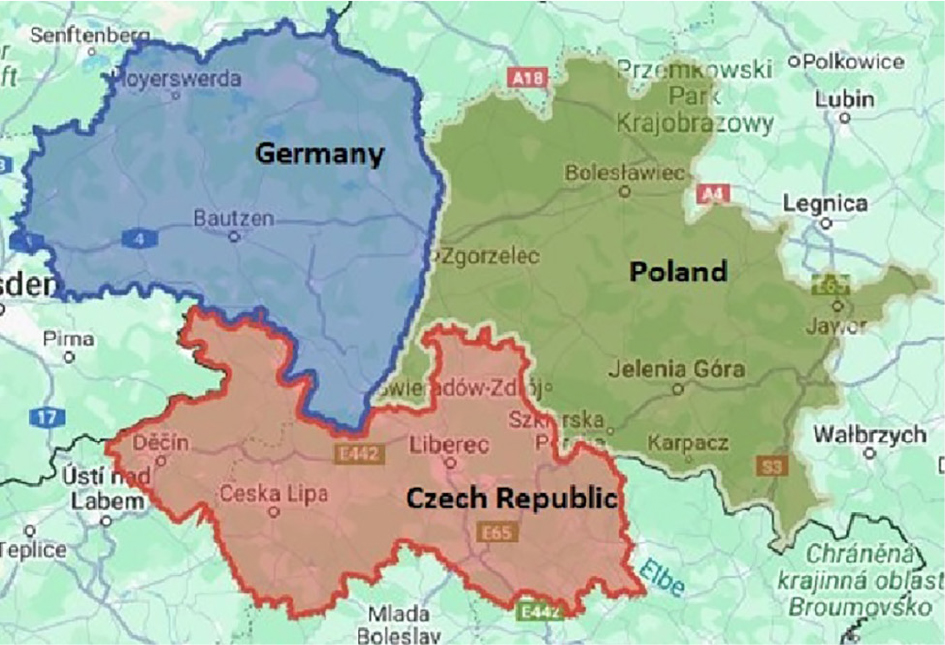
Fig. 1.
Euroregion Nisa by Google maps.
Cross-border purchases have a long tradition in the Euroregion Nisa, which is also due to the fact that the borders have moved several times. The territory has belonged to various state groups over time, and it was only after the Second World War that the current borders were established (Doležalová 2016).
Methodology
The methodology was based on secondary research, the results of which are presented in the literature review. The secondary research was exploratory in nature, providing insight into the issue of cross-border shopping tourism. The term shopping tourism has several meanings that have been discussed. At the same time, the factors that influence shopping tourism in different regions have been examined. The paper introduces the Euroregion Nisa, where the primary research was conducted. The literature review also served as the basis for preparing the questionnaire for the primary research. The questionnaire used closed-ended questions with defined response options based on the secondary research.
The primary research followed up on the secondary research by conducting a combination of face-to-face and electronic interviews. A total of 1028 valid responses were obtained from respondents. The response return rate was 24%, as respondents were able to enter a competition to win prizes. The data were collected in the Czech part of the Euroregion Nisa by a random selection of respondents contacted by a professional agency. The research was conducted from September to November 2023 and was preceded by a pilot test of the questionnaire on a sample of 20 students. The questionnaire consisted of three parts:
First part: Questions on cross-border shopping tourism. Respondents were asked about the frequency of their purchases, depending on the type of goods and the type of store, before and after the COVID-19 pandemic. The questions were first directed at non-durable and durable goods, then both groups were broken down into typical product classes. Similarly, the questions focused on the type of shop the respondent visited abroad. The questions used were closed multiple-choice with one response option and open-ended with multiple response options. Relative frequencies were used for the evaluation.
Second part: Reasons why customers travel abroad to shop. There are two parts to this. The first aim was to identify the factors that influence customer shopping behaviour. A list of basic factors was used from the secondary research. Factors were identified using content analysis by authors (Oliver 1999, Cialdini 2001, Zaltman 2007, Kahneman 2011, Kotler, Keller 2014, Solomon 2020) who all look at customer shopping behaviour. Analysis of the content provides a breakdown of the fundamental directions of the document. The content of the document, expressed in words, was converted into factual selection data. Content analysis was followed by synthesis, resulting in the reunification of the information that had been broken down. In conclusion, the seven main factors that influence customer shopping behaviour were identified.
The second part aimed to identify the importance of those factors that were included in the scaled question. A 5-point scale was used, ranging from 1 = extremely important to 5 = completely unimportant. The question was asked separately to identify factors that influence shopping in Poland and those that influence shopping in Germany. Relative frequencies were used for the evaluation.
Third part: The classification questions consisted of a socio-demographic section focusing on age, gender and net household income. The next classification question dealt with the distance that the respondent had to travel for a shopping trip. The last classification question asked whether the respondent went shopping in Poland or Germany, to filter out those who did not shop abroad. Questions were closed, dichotomous or multiple-choice. The evaluation was performed using the Pearson chi-square test. If statistically significant differences were identified for a characteristic, the question of how and why the results differed was further examined.
Results of the research
The research results can be divided into three blocks corresponding to the three sub-objectives. The first part focuses on customer behaviour in cross-border shopping tourism and is followed by the identification of the factors that influence this shopping tourism. The third part of the research focuses on the differences arising from the characteristics of the respondents, focusing on age, gender, travel distance and household income. The classification questions also include the country of purchase (Germany and Poland). A total of 1028 respondents were included in the survey. The basic classification question was whether respondents shop outside the Czech Republic in Poland and Germany. A total of 574 respondents, i.e. 55.8%, answered in the affirmative. A total of 27.2% of customers travel to both countries to shop, 15.1% go to Poland and 13.5% go to Germany.
Cross-border shopping tourism
Cross-border shopping tourism was first examined in terms of the frequency of purchases in relation to the type of goods purchased and the type of store where respondents made their purchases. Everything was studied regarding habits before and after the COVID-19 pandemic. The research was intended to meet the first sub-objective: to compare cross-border shopping tourism in terms of frequency of purchases by type of goods and type of store before and after COVID-19. The question asked respondents to compare their purchasing behaviour for non-durable and durable goods in 2019, before the pandemic, and in 2023, after the pandemic. The resulting values are presented in Table 1. The evaluation included 574 respondents who reported shopping abroad. The differences are presented in Table 1.
Table 1.
Frequency of purchases by Czech citizens abroad before and after the pandemic.
| Type of goods | Year | Once a week | Twice a month | Once a month | Once every six months | Once a year | I don’t shop at all | Total |
|---|---|---|---|---|---|---|---|---|
| Non-durable goods | 2019 | 6% | 13% | 26% | 28% | 6% | 21% | 100% |
| 2023 | 10% | 27% | 41% | 17% | 3% | 1% | 100% | |
| Durable goods | 2019 | 1% | 4% | 12% | 15% | 19% | 48% | 100% |
| 2023 | 3% | 9% | 10% | 25% | 22% | 31% | 100% |
When the evaluation focused only on non-durable goods, the number of shoppers increased from 79% before the pandemic to 99% after the pandemic. The intensity of purchases also increased significantly in the aftermath of the pandemic. It can be stated that if Czech customers travel abroad, in 99% of cases, they go for non-durable goods. Czech customers most often shop abroad once or twice a month. With durable goods, the situation is somewhat different, although the trend of rising purchases is also on the increase. Before the pandemic, 52% of Czech customers purchased durable goods; after the pandemic, the figure increased to 69%. As these are durable goods where consumption is also long-term, the intensity of purchases increased only slightly among new customers who had not previously purchased these goods. The research on customer behaviour also focused on the type of shops that Czech customers visit abroad. Respondents were given a choice of five types of shops, as shown in Table 2.
Table 2.
Type of shops where Czech customers shop abroad before and after the pandemic.
| Type of goods | Year | Shopping centres | Hypermarkets (e.g. Kaufland) | Hobby markets (e.g. Bauhaus, Castorama) | Discount stores (e.g. Lidl, Biedronka) | Specialty shops, small shops | Total |
|---|---|---|---|---|---|---|---|
| Non-durable goods | 2019 | 10% | 41% | 6% | 33% | 10% | 100% |
| 2023 | 9% | 38% | 5% | 38% | 10% | 100% | |
| Durable goods | 2019 | 15% | 23% | 28% | 16% | 18% | 100% |
| 2023 | 16% | 23% | 29% | 14% | 18% | 100% |
Customers mostly visit hypermarkets and discount stores to shop for non-durable goods. The popular chains are those that also operate in the Czech Republic, the exception being a discount retailer in Poland called Biedronka. On the other hand, hobby markets are the most popular for durable goods. On the contrary, chains that do not operate in the Czech Republic, such as Polish Castorama, are popular here. The pandemic had no significant impact on the type of outlets where customers shopped, and the distribution before and after the pandemic was almost the same. From durable and non-durable goods, the most common specific groups of goods were selected, and respondents compared the frequency of their purchases. The following were selected as non-durable goods: food, petrol, diesel, alcohol, cigarettes, cosmetics, drugstore items. The frequency of purchases is shown in Table 3.
Table 3.
Frequency of purchases of non-durable goods before and after the pandemic.
| 2019 | Once a week | Twice a month | Once a month | Once every six months | Once a year | I don’t shop at all | Total |
|---|---|---|---|---|---|---|---|
| Food | 8% | 8% | 28% | 30% | 7% | 18% | 100% |
| Petrol, diesel | 4% | 10% | 16% | 10% | 4% | 57% | 100% |
| Alcohol | 2% | 6% | 13% | 13% | 8% | 58% | 100% |
| Cigarettes | 1% | 4% | 11% | 6% | 2% | 77% | 100% |
| Cosmetics, drugstore items | 1% | 8% | 27% | 26% | 11% | 26% | 100% |
| 2023 | Once a week | Twice a month | Once a month | Once every six months | Once a year | I don’t shop at all | Total |
|---|---|---|---|---|---|---|---|
| Food | 9% | 30% | 41% | 15% | 4% | 9% | 100% |
| Petrol, diesel | 4% | 20% | 22% | 9% | 4% | 42% | 100% |
| Alcohol | 3% | 10% | 15% | 16% | 5% | 57% | 100% |
| Cigarettes | 1% | 11% | 11% | 5% | 4% | 69% | 100% |
| Cosmetics, drugstore items | 4% | 17% | 38% | 21% | 9% | 11% | 100% |
For all types of non-durable goods, the number of shoppers in Poland increased after the pandemic. The most significant number of Czech customers purchase food, cosmetics and drugstore items. On the other hand, the fewest buy cigarettes. The different types of goods can be assessed before and after the pandemic:
– Food: Shopping intensity has increased significantly as has the number of shoppers, with the typical shopper traveling for groceries twice a month and over 90% of respondents shopping abroad.
– Petrol, diesel: The intensity has slightly increased; most customers drive abroad once or twice a month, which corresponds to one full tank. The number of shoppers has also increased, with almost 60% of Czech customers going shopping.
– Alcohol: The intensity of purchases is almost the same; most often, customers buy alcohol once every six months. The number of customers is also approximately the same. However, this refers to alcohol consumed in restaurants visited by customers on trips to Poland, rather than alcohol purchased directly in brick-and-mortar shops.
– Cigarettes: The intensity has increased very slightly; most customers go to buy them once or twice a month. The number of shoppers increased to 30% of customers. One of the reasons for this is the different legislation, where, after the pandemic, it was possible to sell fruit fillings for cigarettes in Poland, which were already banned in the Czech Republic.
– Cosmetics, drugstore items: The purchase intensity has slightly increased; customers mostly go to buy these once a month. The number of customers has increased, with nearly 90% of them purchasing cosmetics.
In parallel, durable goods were examined in terms of purchase intensity and the number of customers who purchased them before and after the pandemic. Durable goods means clothing, footwear, sports equipment, toys, furniture, electronics, household equipment, garden items and hobby tools. The resulting figures are presented in Table 4.
Table 4.
Frequency of durable goods purchases before and after the pandemic.
| 2019 | Once a week | Twice a month | Once a month | Once every six months | Once a year | I don’t shop at all | Total |
|---|---|---|---|---|---|---|---|
| Clothing, footwear | 4% | 4% | 8% | 27% | 15% | 41% | 100% |
| Sports equipment, toys | 0% | 2% | 10% | 19% | 14% | 55% | 100% |
| Furniture, electronics | 0% | 4% | 6% | 7% | 20% | 63% | 100% |
| Household equipment | 4% | 1% | 4% | 19% | 21% | 51% | 100% |
| Garden items, hobby tools | 2% | 4% | 5% | 14% | 20% | 54% | 100% |
| 2023 | Once a week | Twice a month | Once a month | Once every six months | Once a year | I don’t shop at all | Total |
|---|---|---|---|---|---|---|---|
| Clothing, footwear | 4% | 8% | 13% | 26% | 15% | 34% | 100% |
| Sports equipment, toys | 0% | 7% | 8% | 21% | 20% | 44% | 100% |
| Furniture, electronics | 0% | 4% | 7% | 13% | 21% | 56% | 100% |
| Household equipment | 4% | 4% | 11% | 31% | 18% | 33% | 100% |
| Garden items, hobby tools | 1% | 6% | 13% | 20% | 19% | 40% | 100% |
As with non-durable goods, the number of shoppers increased for all five types of goods after the pandemic. Nevertheless, customers from the Czech Republic do not travel as frequently to purchase durable goods. Most of them go shopping for clothes, footwear and household equipment. The different types of goods can be assessed before and after the pandemic:
– Clothing, footwear: The intensity of purchases has slightly increased; Czech customers most often go shopping for these once every six months; this interval has not changed even after the pandemic. The total number of shoppers increased slightly to 66%.
– Sports equipment, toys: The intensity is almost unchanged; customers go shopping for these only exceptionally, once every six months or once a year. The number of customers who rarely shop for this type of goods has increased to 56%.
– Furniture, electronics: Purchase intensity has remained the same; most of these goods are purchased by Czech customers once a year. Currently, 44% of customers drive to buy these products. This type of goods is in the least demand amongst Czech customers.
– Household equipment: The intensity has slightly increased; customers most often buy this once every six months. The number of shoppers has increased significantly, with nearly 70% of customers travelling abroad to purchase these goods.
– Garden items, hobby tools: The intensity has slightly increased; most often customers go once every six months or once a year. The number of customers has increased, and 60% of customers go shopping for this type of goods after the pandemic.
Overall, it was found that cross-border shopping tourism increased significantly after the pandemic. Significantly more customers are purchasing non-durable goods, especially food, cosmetics and drugstore items. The exception is alcohol, which is purchased, but mostly in restaurants, by tourists from the Czech Republic. Most Czech customers visit hypermarkets of brands that operate on both sides of the border. Equally popular are the discount outlets, led by the Polish Biedronka chain.
Factors influencing customer decisions
After identifying the intensity of purchases and the number of Czech customers buying goods abroad, the research focused on the factors that influence shopping outside the country. There was no difference between the time before and after the pandemic as respondents were unable to accurately identify the purchasing decision-making process in the past, as reported by Han et al. (2015). Therefore, factors were only identified for the current post-pandemic period. Again, only customers who actively shop abroad participated in the evaluation. Eight factors identified in the literature review were defined for the research. The question was divided into two parts: factors influencing shopping in Poland and factors influencing shopping in Germany. This part of the research was intended to answer the second sub-objective: to determine the importance of factors influencing cross-border shopping tourism in Poland and Germany. A scaled question was used, where 1 = extremely important and 5 = completely unimportant. The resulting relative frequencies for purchases in Poland are shown in Table 5.
Table 5.
Importance of factors influencing shoppers in Poland.
| Factor | 1 | 2 | 3 | 4 | 5 | Total |
|---|---|---|---|---|---|---|
| Product quality | 52% | 41% | 7% | 0% | 0% | 100 |
| Product price | 55% | 31% | 12% | 2% | 0% | 100 |
| Products not available in Czech Republic | 19% | 29% | 18% | 18% | 16% | 100 |
| Tradition, custom | 10% | 27% | 28% | 21% | 14% | 100 |
| Country of origin | 11% | 23% | 26% | 22% | 17% | 100 |
| Environmentally-friendly product | 6% | 26% | 32% | 18% | 17% | 100 |
| Product packaging | 3% | 19% | 37% | 21% | 21% | 100 |
| New product on market | 4% | 10% | 29% | 30% | 26% | 100 |
The factors evaluated can be divided into four groups according to their level of importance:
– First group: The most important factor is product quality, which 93% of customers ranked as extremely or very important. An almost equally important factor is price, which was rated as extremely or very important by 86% of customers.
– Second group: A very important factor is the chance to buy goods that cannot be purchased in the Czech Republic. This factor was rated as extremely or very important by 48% of customers. Conversely, it is rated as moderately or completely unimportant by 34% of customers.
– Third group: Respondents identified four factors as moderately important: tradition and custom, country of origin, environmentally-friendly product and product packaging. These factors are rated as extremely or very important by 20%–40% of customers. However, there is already an increasing number of customers for whom these are moderately or completely unimportant factors, again 20%–40% of respondents.
– Fourth group: The least important factor for Czech customers is the chance to buy a new product on the market. This reason for purchase was identified as extremely or very important by 14% of customers. Conversely, for 56% of customers, this is not a reason to do shopping in Poland.
Evaluation of the factors shows that price is as important as quality, which contradicts the assumption that Czech consumers travel to Poland only for the price. From the results it can be concluded that Czech customers see that Poland offers the possibility to buy the same or higher quality at a lower price. At the same time, it can be stated that customers travel abroad because of the diversity of the range; another very important factor is that they go for products that are not available in the Czech Republic. At the same time, these are mostly customers who are not overly interested in sustainability or corporate social responsibility. Customers shopping abroad are not interested in new products on the market and tend to be conservative, buying the same range of goods. In addition to rating the importance of factors influencing shopping in Poland, respondents were also asked to rate the importance of influencing factors when shopping in Germany. The resulting relative frequencies are shown in Table 6.
Table 6.
Importance of factors influencing shopping in Germany.
| Factor | 1 | 2 | 3 | 4 | 5 | Total |
|---|---|---|---|---|---|---|
| Product quality | 64% | 31% | 5% | 0% | 0% | 100 |
| Product price | 28% | 56% | 12% | 4% | 0% | 100 |
| Products not available in Czech Republic | 35% | 46% | 10% | 5% | 4% | 100 |
| Country of origin | 20% | 31% | 19% | 19% | 11% | 100 |
| Environmentally-friendly product | 15% | 29% | 38% | 10% | 8% | 100 |
| New product on market | 14% | 23% | 33% | 16% | 14% | 100 |
| Product packaging | 8% | 12% | 29% | 25% | 24% | 100 |
| Tradition, custom | 9% | 10% | 35% | 16% | 30% | 100 |
The factors evaluated can be divided into four groups according to their level of importance:
– First group: Respondents identified three factors as most important: quality, price and the opportunity to buy products that are not available in the Czech Republic. Over 80% of respondents ranked these factors as extremely or very important. Customers travel to Germany to buy quality products that are comparable in price to those in the Czech Republic, but that cannot be bought in the Czech Republic.
– Second group: Very important factors are country of origin and environmentally-friendly product, which over 40% of respondents rated as extremely or very important. Customers go to Germany for the higher quality they can get by shopping directly in Germany. At the same time, these are respondents with a positive attitude towards sustainability.
– Third group: Respondents ranked the factor of new product on the market as moderately important; this was rated extremely or very important by 37% of customers. A relatively large number of customers from the Czech Republic go to Germany to buy new products, which often go on sale earlier in Germany than in the Czech Republic.
– Fourth group: Two factors are the least important for Czech customers: product packaging and tradition as well as custom, which only 20% of customers rated as extremely or very important. Customers from the Czech Republic are not attracted to the packaging of the product and are not very familiar with traditional regional German products they could go abroad to buy.
Evaluation of the factors shows that the most important factor in the customer decision-making process is the quality of the product. It is significantly higher than the assessment in Poland. On the other hand, the importance of price when shopping in Germany is lower than when shopping in Poland, but it remains significant nonetheless. A strong reason for shopping in Germany is the chance to buy goods that are not available in the Czech Republic, particularly more so than in Poland. More environmentally minded customers travel to Germany, and they care about the responsible approach of the brand or the manufacturer. Conversely, customers are not attracted to local regional producers or retailers; instead, they prefer to drive to hypermarkets to shop. Overall, it can be summarised that when shopping in Poland, the most important thing is price, followed by quality. When shopping in Germany, it is the other way around; quality is the most important factor, followed by price.
Influence of customer characteristics
The assessment presented here may not be applicable to all respondents; therefore, the research included classification questions that divided respondents by economic and demographic factors. A third sub-objective was defined for this purpose: to determine the influence of respondents’ socio-demographic characteristics on cross-border shopping tourism. Classification characteristics were gender, age, travel distance and income. Table 7 shows the division of respondents into individual groups.
Table 7.
Influence of classification parameters.
| 1. Travel distance in km | 2. Age | 3. Gender | 4. Net household income in CZK | ||||
|---|---|---|---|---|---|---|---|
| Less than 25 | 29.6% | 20–29 | 35% | Men | 60.3% | 0–15,000 | 3.9% |
| 26–50 | 39.3% | 30–39 | 25.3% | Women | 39.7% | 15,001–30,000 | 13.6% |
| 51–75 | 16.7% | 40–49 | 20.6% | 30,001–40,000 | 17.1% | ||
| 76–100 | 7.8% | 50–59 | 13.2% | 40,001–50,000 | 18.3% | ||
| 101 and more | 6% | 60 and more | 5.9% | 50,001–60,000 | 18.7% | ||
| 60,001–70,000 | 10.9% | ||||||
| 70,001–80,000 | 5.8% | ||||||
| more than 80,001 | 11.7% | ||||||
| Total | 100% | Total | 100% | Total | 100% | Total | 100% |
Pearson’s chi-square test was used to calculate statistically significant differences. The following table presents the p-value, but not the critical values. The tests were performed at a significance level of α = 0.05. In order to evaluate the impact of classification questions, a hypothesis was set with four variants, one for each classification question. The resulting figures are presented in Table 8.
Table 8.
Resulting p-value.
| 1. Travel distance in km | 2. Age | 3. Gender | 4. Net household income in CZK | |||||
|---|---|---|---|---|---|---|---|---|
| 1. Frequency of purchases of durable goods | p-value | 0.0124 | p-value | 0.3221 | p-value | 0.2012 | p-value | 0.2414 |
| 2. Frequency of purchases of non-durable goods | p-value | 0.1121 | p-value | 0.0147 | p-value | 0.0181 | p-value | 0.0114 |
| 3. Type of shops | p-value | 0.1455 | p-value | 0.0199 | p-value | 0.2021 | p-value | 0.0965 |
| 4. Factors influencing shopping | p-value | 0.0045 | p-value | 0.0187 | p-value | 0.2231 | p-value | 0.0412 |
H0: There are no statistically significant differences in responses to the classification question.
H1: non-H0.
The evaluation covered four parts of the research that identified consumer behaviour. Statistically significant differences were identified and the responses were analysed to identify the differences:
Frequency of purchases of durable goods: In the evaluation of the classification questions, a statistically significant difference was confirmed only for customers’ travel distance. This is almost a direct proportionality, where the frequency of purchases decreases as the distance increases. Most customers drive shorter distances for clothing, footwear, garden items and hobby tools. Most customers come from further afield to buy furniture and electronics.
Frequency of purchases of non-durable goods: A statistically significant difference was identified for two classification questions. The first is gender; short-term goods are purchased far more often by women. The second is net income, with people with an average income of CZK 50–70 thousand travelling the most. Low- and high-income customers shop abroad significantly less.
Type of shops: There is a statistically significant difference in the age of customers. Older shoppers in their 50s are significantly more likely to visit discount stores. Younger customers, on the other hand, prefer shopping centres and hobby markets.
Factors influencing shopping: A statistically significant difference was identified for two classification questions. In terms of travel distance, the most significant factors, price and quality, showed the largest differences. People from farther away preferred quality, while those from closer places preferred price. For income levels, higher-income customers prefer quality, while lower-income customers prefer price.
Discussion
The main objective of this research was to identify cross-border shopping tourism amongst Czech customers before and after COVID-19 in the Euroregion Nisa. Research into Czech consumers revealed a significant increase in cross-border shopping tourism following the COVID-19 pandemic. This is a big difference compared to similar research conducted in Europe (Malkowski et al. 2020, Machová et al. 2021, Tömöri, Staniscia 2023), which shows that the decline in cross-border shopping tourism continued after the pandemic came to an end in 2023. Research suggests that the reason in most countries in 2023 was a persistent fear of health risks and a general decline in interest in shopping abroad. On the contrary, the research presented here shows an increase in cross-border shopping tourism amongst Czech customers of almost 30%. According to Yiu (2023), the difference in the magnitude of post-pandemic shopping tourism is linked to the type of range available. The purchase of durable goods has tended to move more online. In contrast, the research showed that non-durable goods, which are the focus for Czech consumers, have seen an increase in demand following the pandemic. This is because Czechs prefer to buy non-durable goods (e.g. food) in person (NIQ, 2023).
The large difference between Czech and European customers in their cross-border shopping tourism habits is attributed to the fact that Czech customers are highly sensitive to price changes, becoming the most sensitive nation in Europe, according to Spilková (2018). The situation is similar, for example, on the border between Ireland and Northern Ireland, where Irish consumers often travel to Northern Ireland in search of cheaper food and fuel (Hunter 2022). Cross-border shopping tourism depends on the level of GDP per capita and on the differences between neighbouring countries (Malkowski et al. 2020). There is also a difference in GDP per capita in the Euroregion Nisa, where German residents have a significantly higher disposable income. However, they only go to the neighbouring two countries to buy services, where the price difference is large but the quality is comparable. This principle of cross-border shopping tourism also works in other parts of Europe. According to a study by Dmitrovic and Vida (2007), the cross-border shopping habits of the Croatians, Hungarians, Germans and Austrians depend on their standard of living. The Croatians and Hungarians tend to buy goods in Germany and Austria because of their quality, while the Germans and Austrians, on the other hand, mainly buy services (e.g. restaurants and holidays) (Michalkó, Rátz 2006).
A study by Timothy (1999) examining cross-border shopping tourism between the US and Canada shows that, in addition to price differences, exchange rates and tax credits also play a role. These factors may also matter in the Euroregion Nisa, as all three countries – the Czech Republic, Poland and Germany – have different currencies, excise duties and VAT. Although Czech customers are price-sensitive, they also accept at least average quality goods (Czech Republic, 2024). The research confirmed that quality is the second strongest factor influencing decisions, even more important than price for shopping in Germany. Although the research identified product quality as the most important factor in shopping decisions, Więckowski and Timothy (2021) contend that price differences are key when it comes to certain specific products, such as alcohol, tobacco and fuel. The author goes on to mention other factors that did not appear in the research presented, such as the proximity of culture and language, which makes communication easier and lowers the psychological barrier of crossing a border, using the town of Vaals on the tripoint of the Netherlands, Belgium and Germany as an example. Van Der Velde, Spierings (2010) and Segerer et al. (2020) also confirm that cross-border shopping is not controlled by price alone, but by cultural proximity too. Consumers choose places where they feel at ease. While perceived cultural differences can be attractive, they are also frequently off-putting as well. Research carried out by different authors (Leick et al. 2021, Makkonen 2022) underlines the significant role of age, in which younger tourists are motivated by curiosity and the experience. In contrast, older consumers favour price and familiar surroundings. This contention is partly upheld by our research, when statistically significant differences in age were identified depending on the types of shopping.
These comparisons show that cross-border shopping tourism is a global phenomenon, influenced by several factors that are often similar across different regions of the world. The importance of price differences, the quality of goods and services, specific products and regional infrastructure is key to understanding this phenomenon. This conclusion supports the idea that although regional specificities may differ, the underlying motivation of customers to shop across borders remains consistent.
Conclusion
In conclusion, cross-border shopping tourism in the Euroregion Nisa is an important phenomenon that has an impact on the economy of the border areas. The results of the research showed that the main factor influencing Czech customers’ decision to shop in Poland is the difference in prices, while in Germany it is the quality of goods offered. The research also confirmed that the COVID-19 pandemic had a significant impact on cross-border shopping habits. While before the pandemic, the motivation for cross-border shopping was primarily economic, now other factors such as higher price sensitivity due to inflation and changes in the availability of goods also matter.
It is important to mention that cross-border shopping tourism presents both opportunities and challenges. On the one hand, it promotes economic exchange and strengthens links between neighbouring regions; on the other, it can lead to imbalances in local economies, especially for retailers. For this reason, steps should be taken to monitor and regulate this phenomenon to ensure the sustainable development of cross-border areas.
The primary objective and all sub-objectives were fully achieved. The paper advances the knowledge base regarding cross-border shopping behaviour at the tri-border of the Czech Republic, Germany and Poland. The results fill a research gap that opened up following the COVID-19 pandemic and other turbulent changes, which have influenced consumer shopping behaviour. Overall, it has been shown that shopping decisions in border regions result from the combination of economic rationality, socio-demographic characteristics and cultural habits. The limitation of the research is the time factor, which is dependent on changes in the macroeconomic conditions of individual countries.