
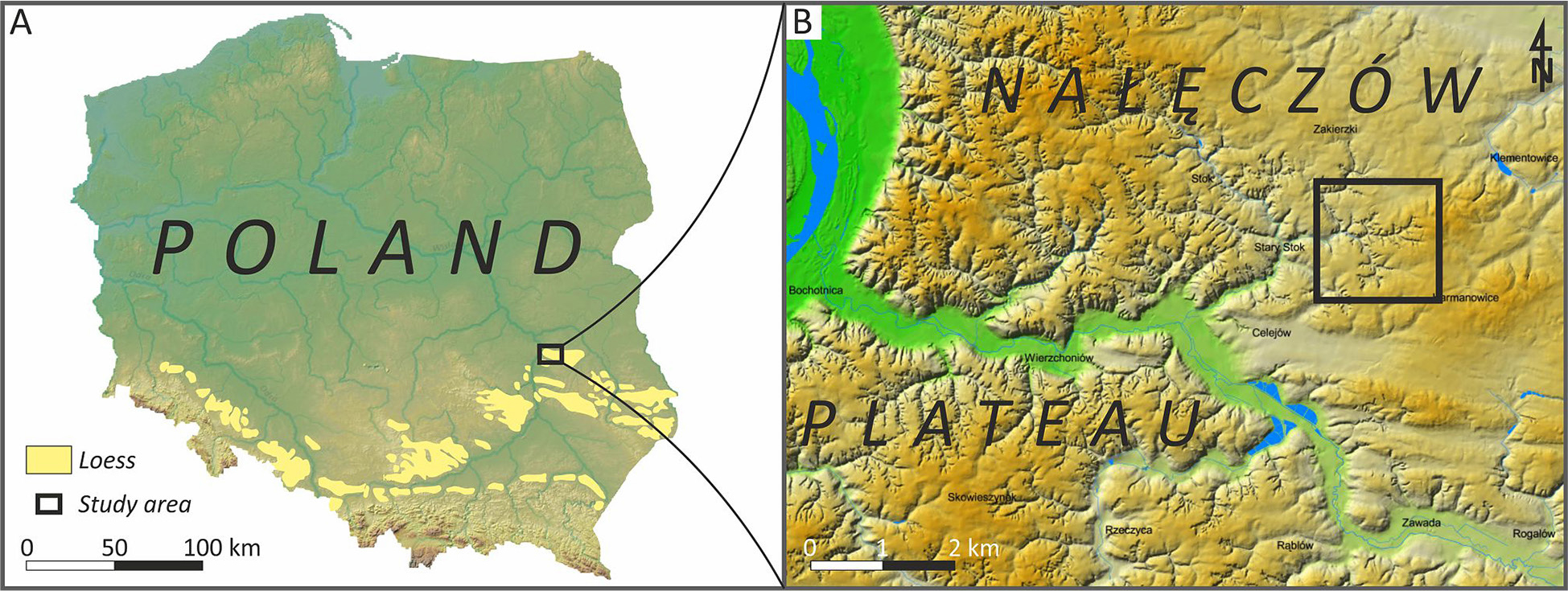
Fig. 1.
Location of the kolonia Celejów gully catchment, A) against the Polish loess belt (Główny Urząd Geodezji i kartografii. 2024. LiDAR. Access November 2024. https://www.geoportal.gov.pl/; loess cover after Maruszczak 1991), B) in the western part of the Nałęczów Plateau.
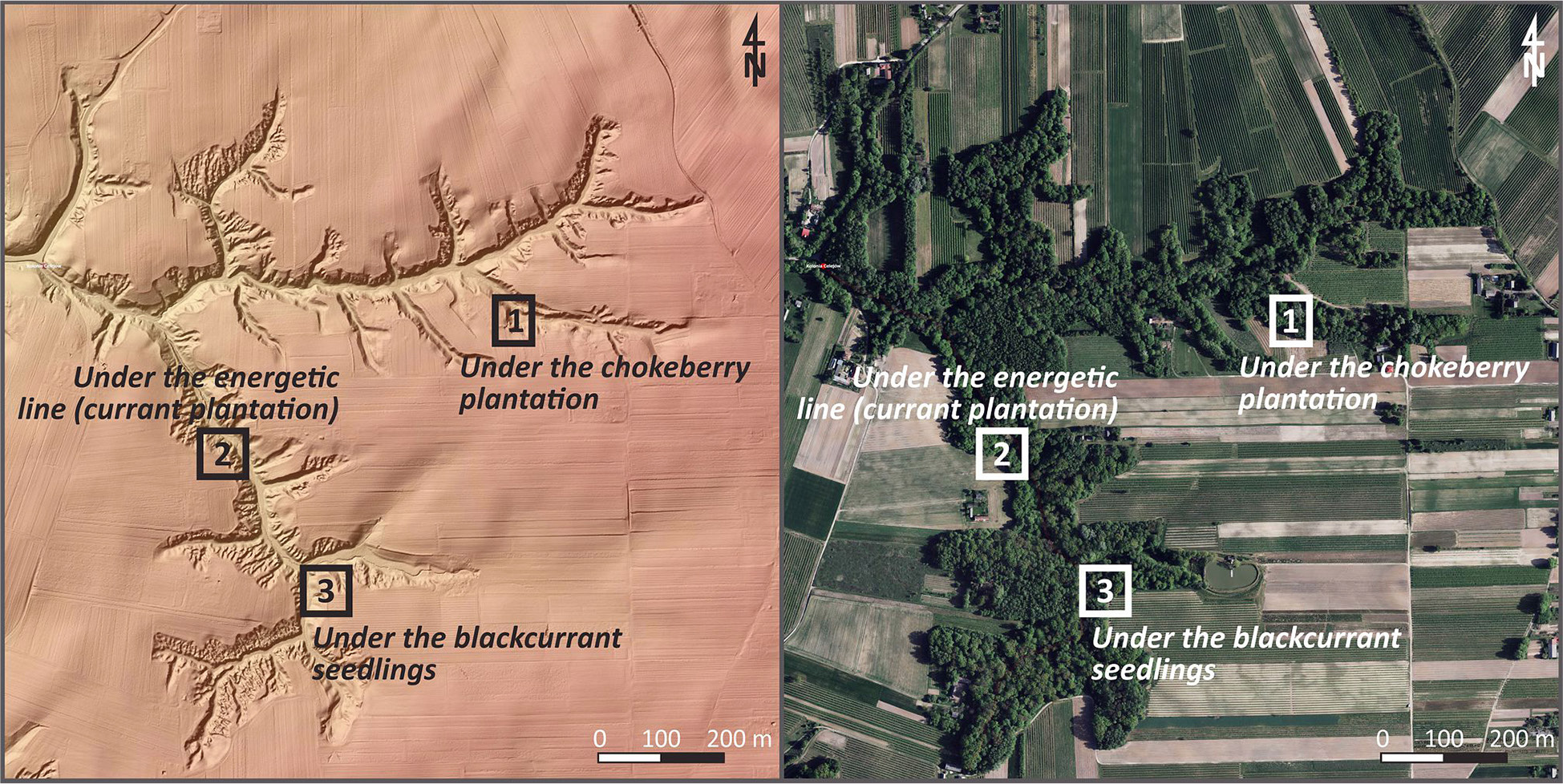
Fig. 2.
Relief of gully catchment in kolonia Celejów – DEM from 2022 (Główny Urząd Geodezji i kartografii. 2024. LiDAR. Access November 2024. https://www.geoportal.gov.pl/) (left), and land use – Orthophotomap 2024 (right). The location of studied collapsed pipes. 1 – Site 1, 2 – Site 2, 3 – Site 3.
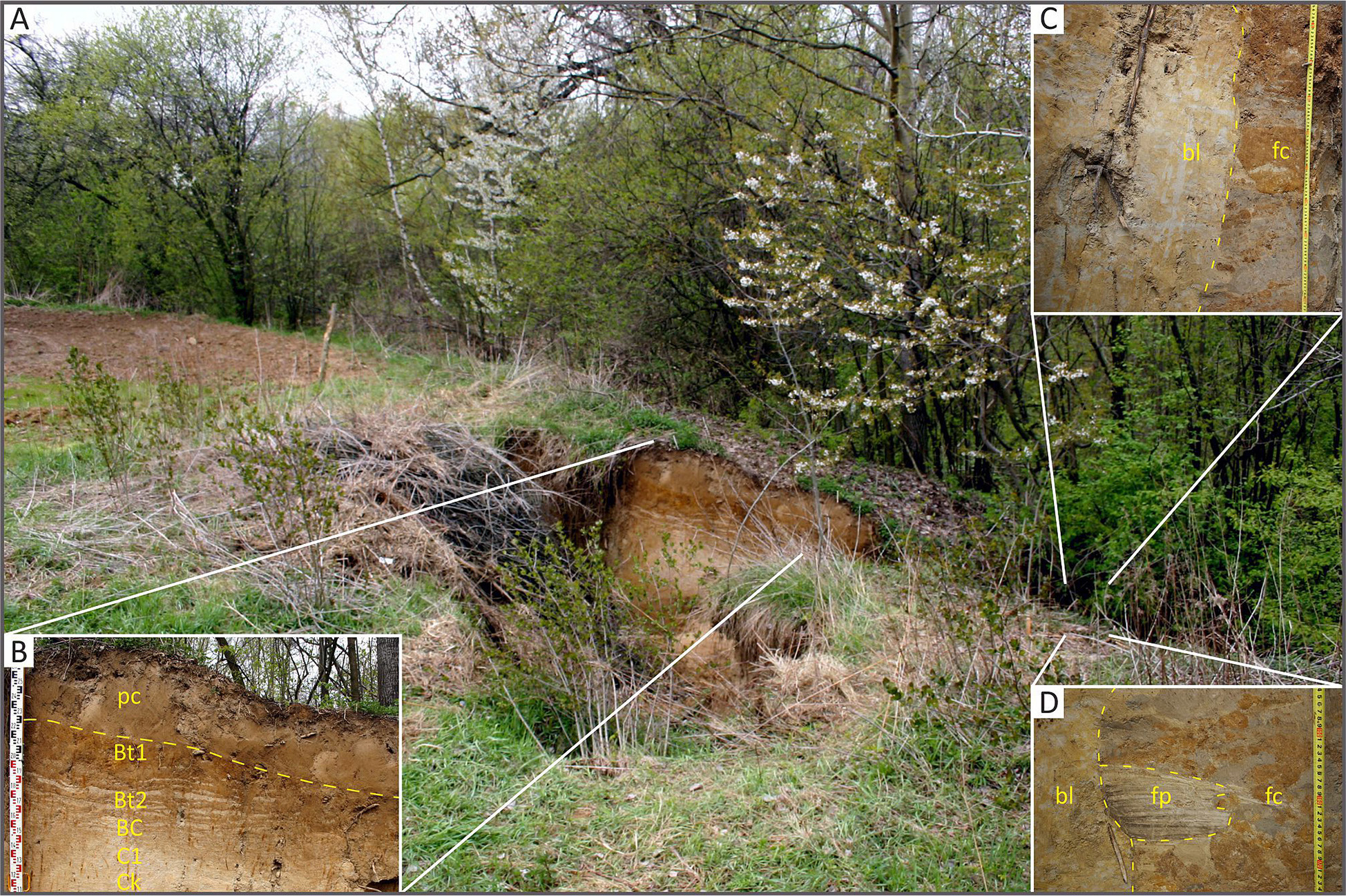
Fig. 3.
Cross-section of modern forest edge (A), with truncated and overlying Luvisol profile (B): and contact of loess sinkhole wall with fill deposits (C) and silted channel (D). pc – ploughing colluvia, bl – basal loess, fc – falling colluvia, fp – fossil pipe.
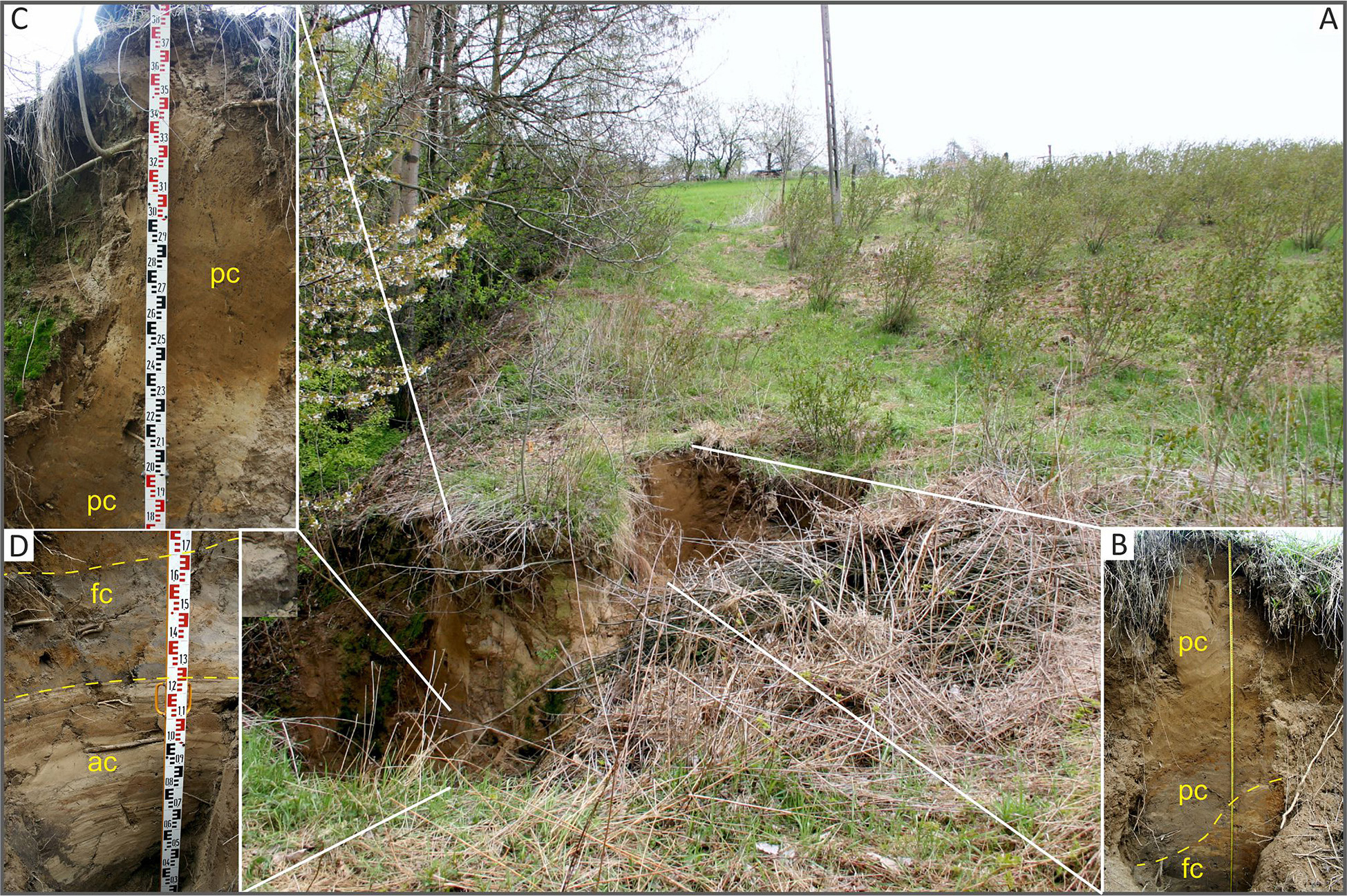
Fig. 4.
Dissection of the forest edge under the chokeberry plantation (A) and exposures of sediments infilling the old sinkhole (B, C, D): ac – water colluvia, fc – falling colluvia, pc – ploughing colluvia.
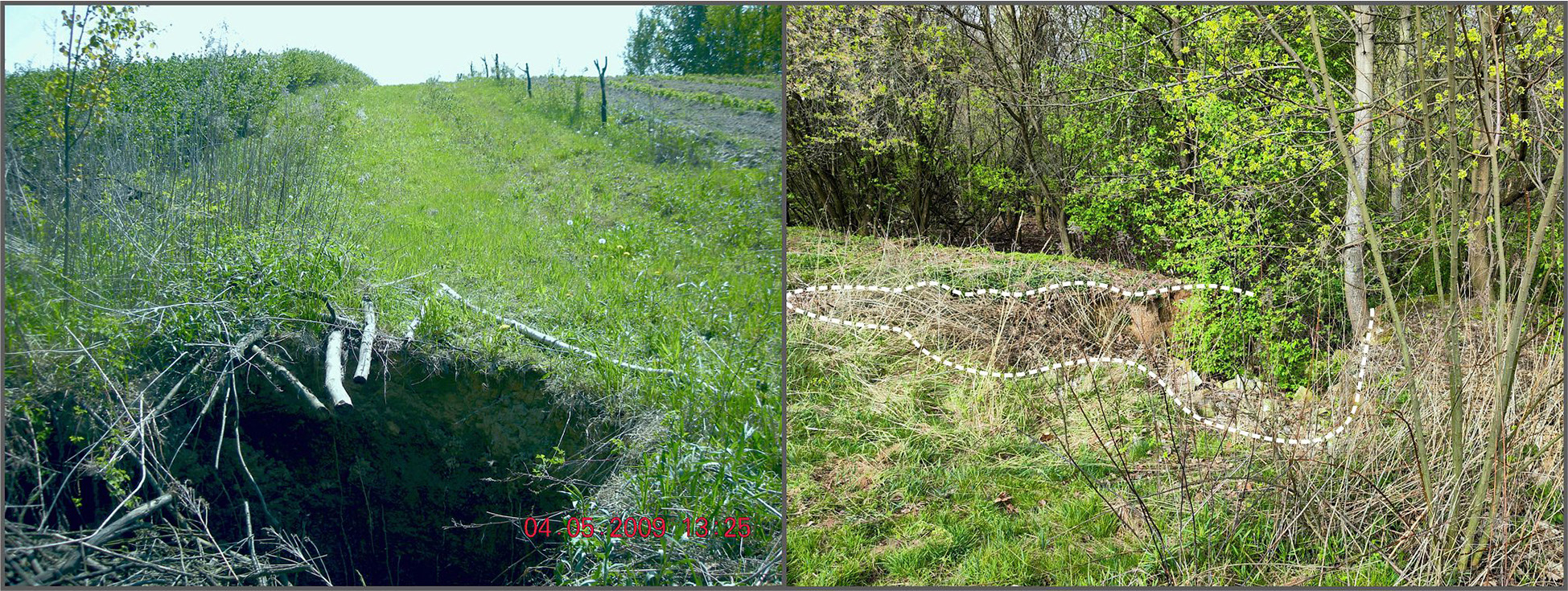
Fig. 5.
Development of the secondary collapsed pipe at Site 1: A – view of the collapsed pipe catchment. B – recent edge of the collapsed pipe on the agricultural terrace (white dotted line).
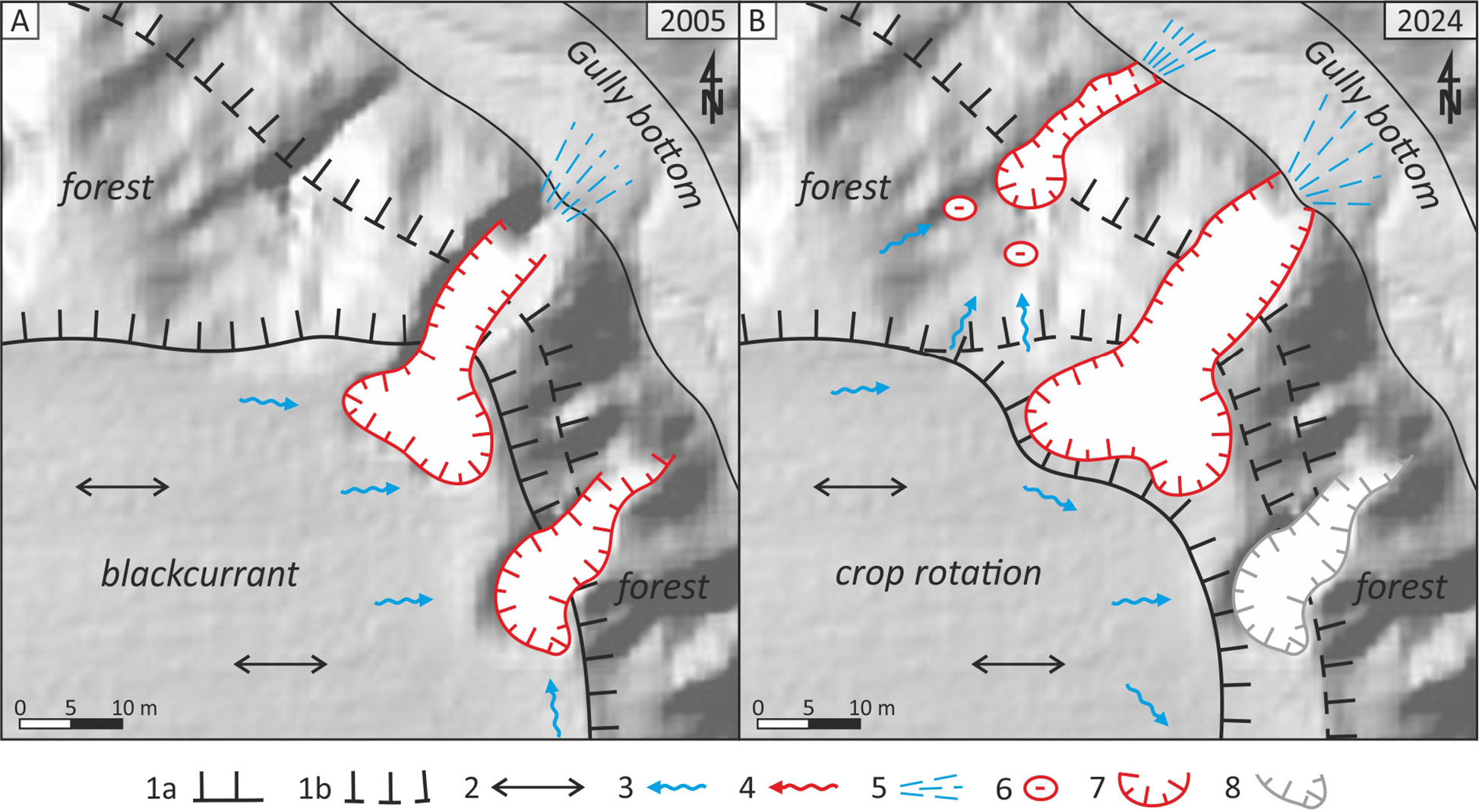
Fig. 6.
Development of the collapsed pipe at Site 2, A – in 2004. B – in 2024. red arrow – erosion furrow. 1 – forest edge, 1a – contemporary, 1b – former, 2 – direction of tillage, 3 – direction of surface runoff, 4 – ploughed erosion rills; 5 – colluvial fan, 6 – sinkhole, 7 – collapsed pipe, 8 – reclaimed pipe. DEM from 2022 (Główny Urząd Geodezji i Kartografii. 2024. LiDAR. Access November 2024. https://www.geoportal.gov.pl/).
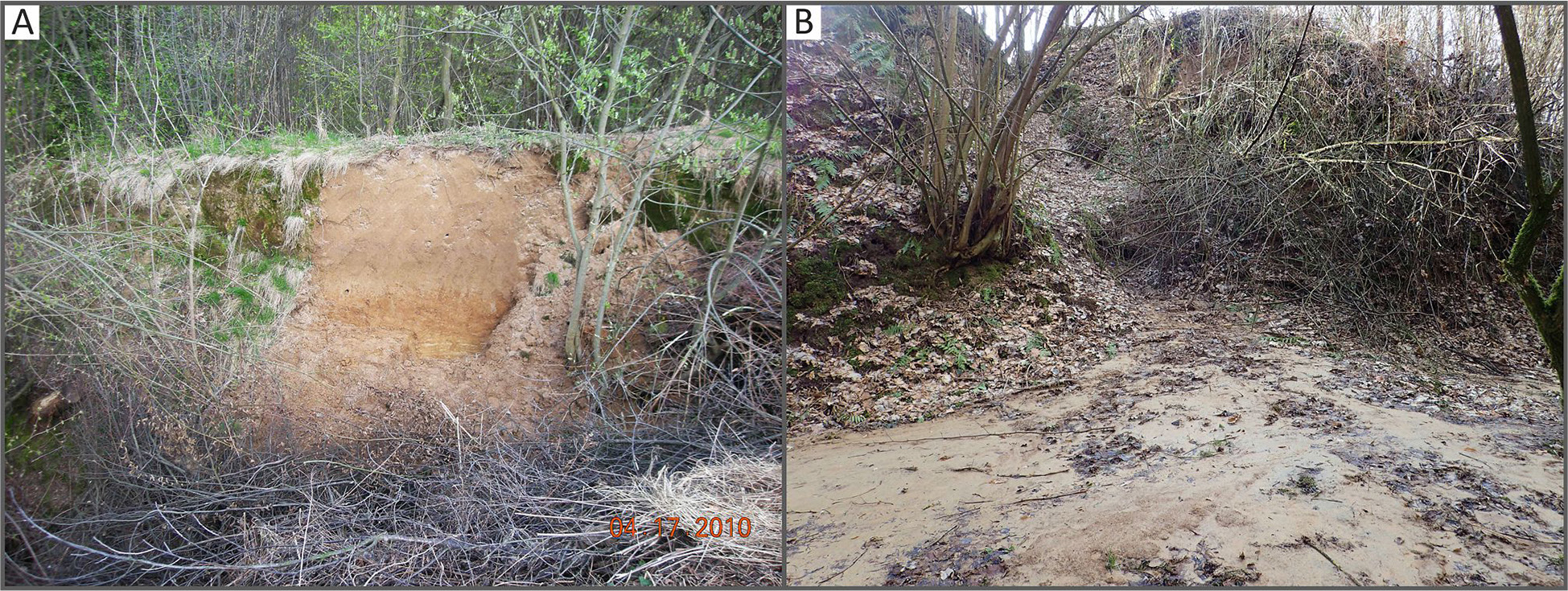
Fig. 7.
The collapsed pipe at site 1: A – Luvisol and agricultural colluvia on the collapsed pipe wall. B – drainage channel with pipes and depositional cone at the outlet.
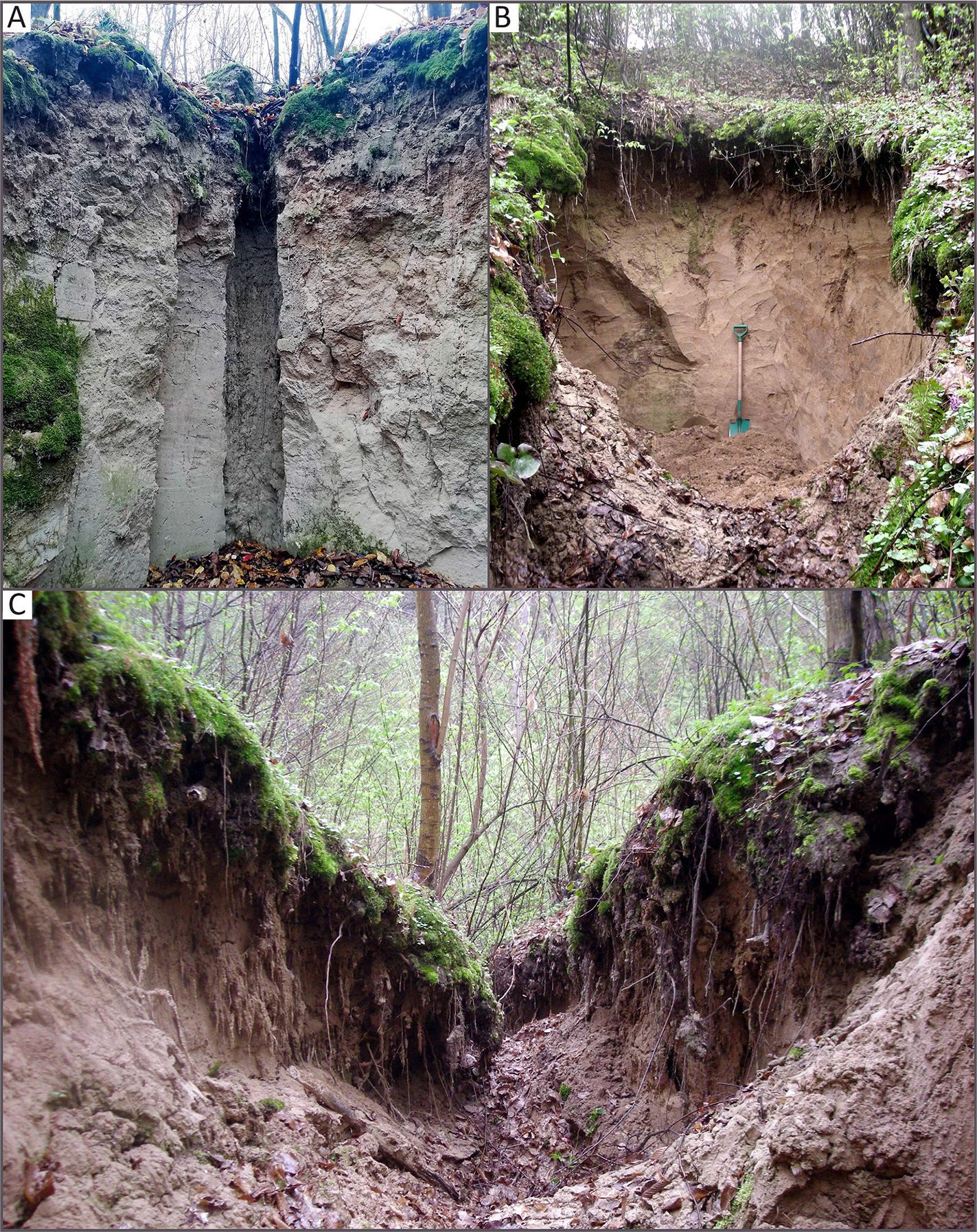
Fig. 8.
The secondary collapsed pipe at Site 2: A – front loess wall with pipe, B – side wall with colluvial fill, C – drainage channel.
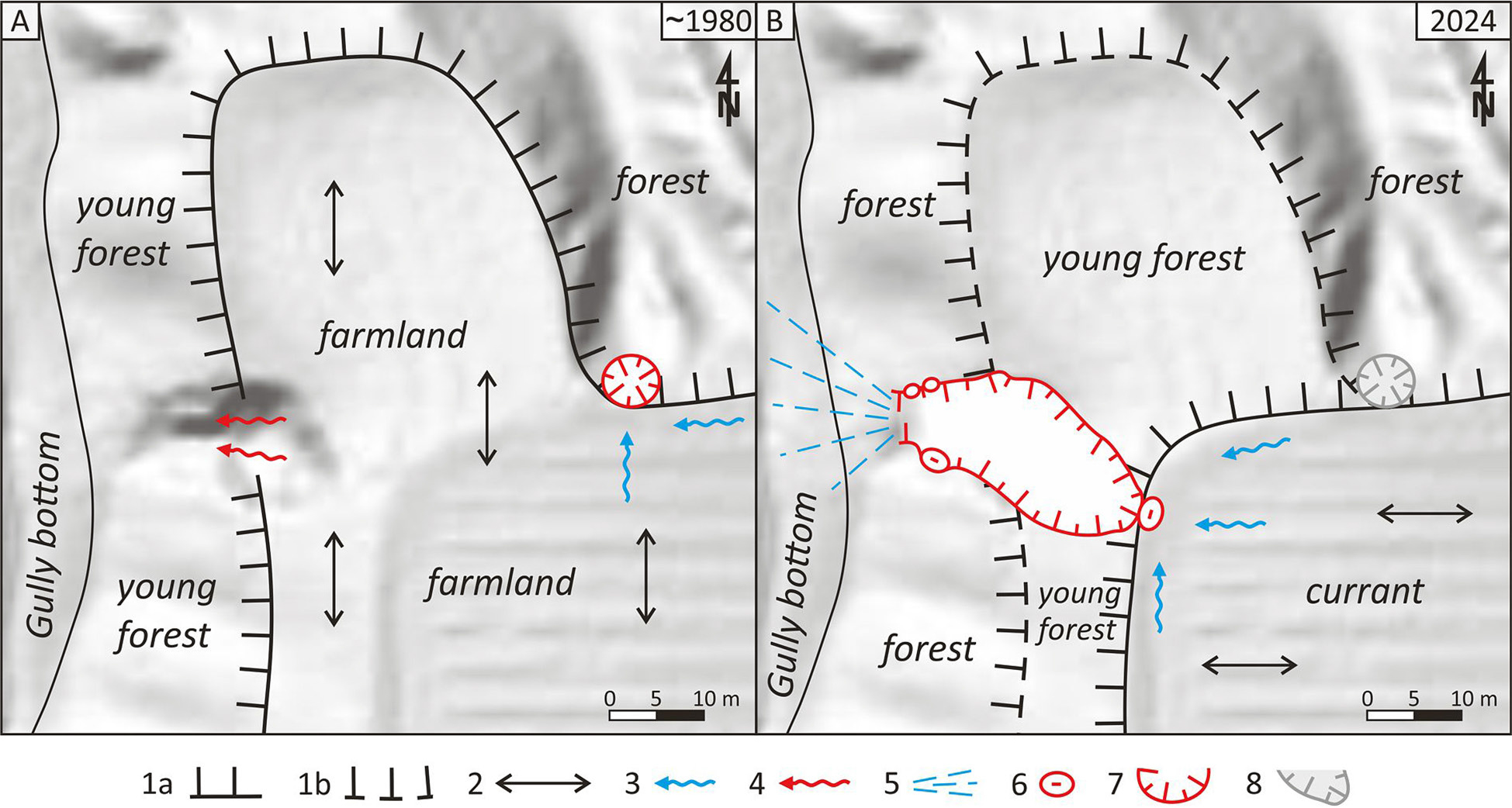
Fig. 9.
Changes in the development conditions of the Site 3: A – state before 1980. B – present state. 1 – forest edge, 1a – contemporary, 1b – former, 2 – direction of tillage, 3 – direction of surface runoff, 4 – ploughed erosion rills; 5 – colluvial fan, 6 – sinkhole, 7 – collapsed pipe, 8 – reclaimed pipe. DEM from 2022 (Główny Urząd Geodezji i kartografii. 2024. LiDAR. Access November 2024. https://www.geoportal.gov.pl/)
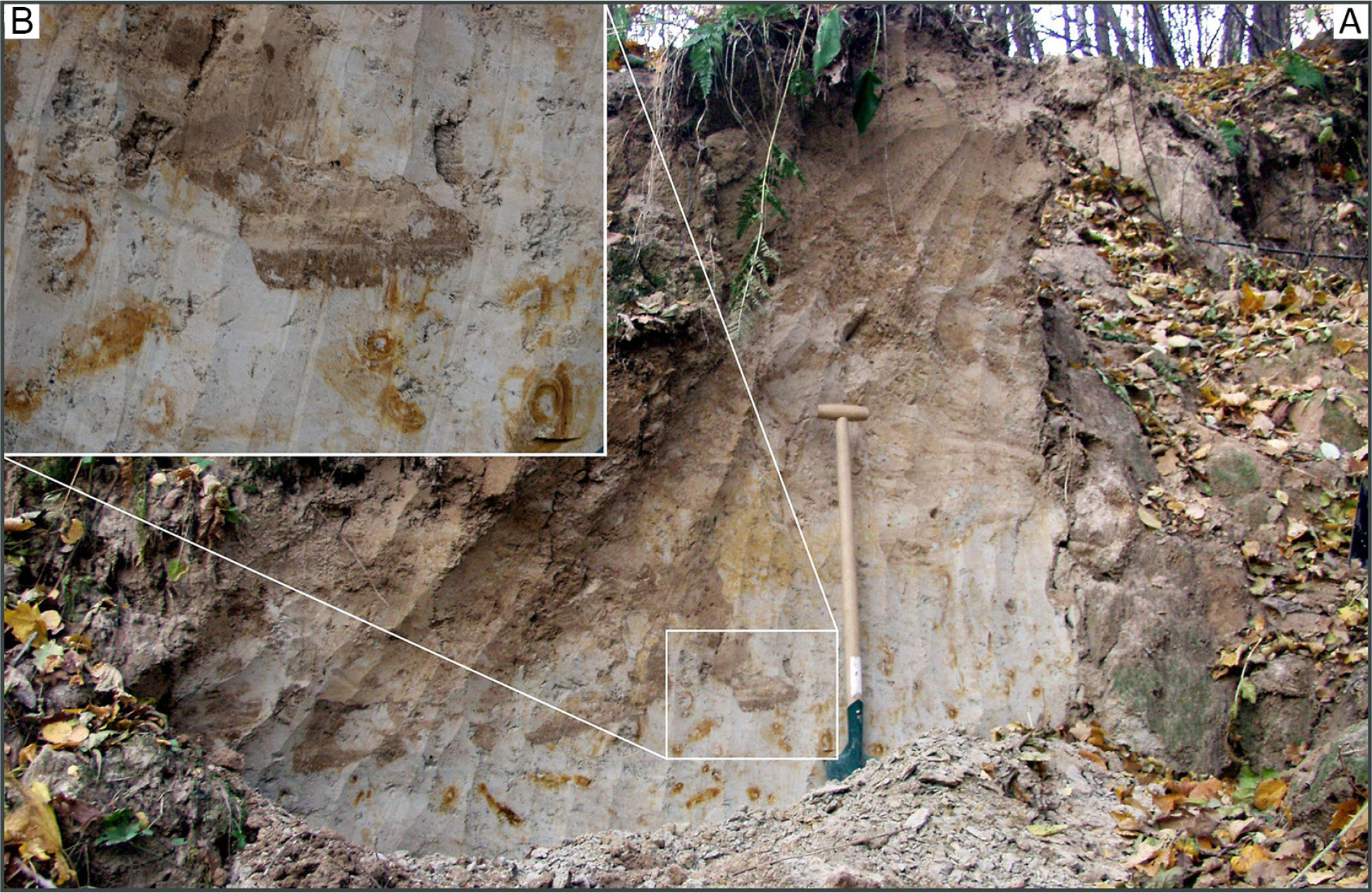
Fig. 10.
Pipe filled up with sediments at the intermediate forest edge.
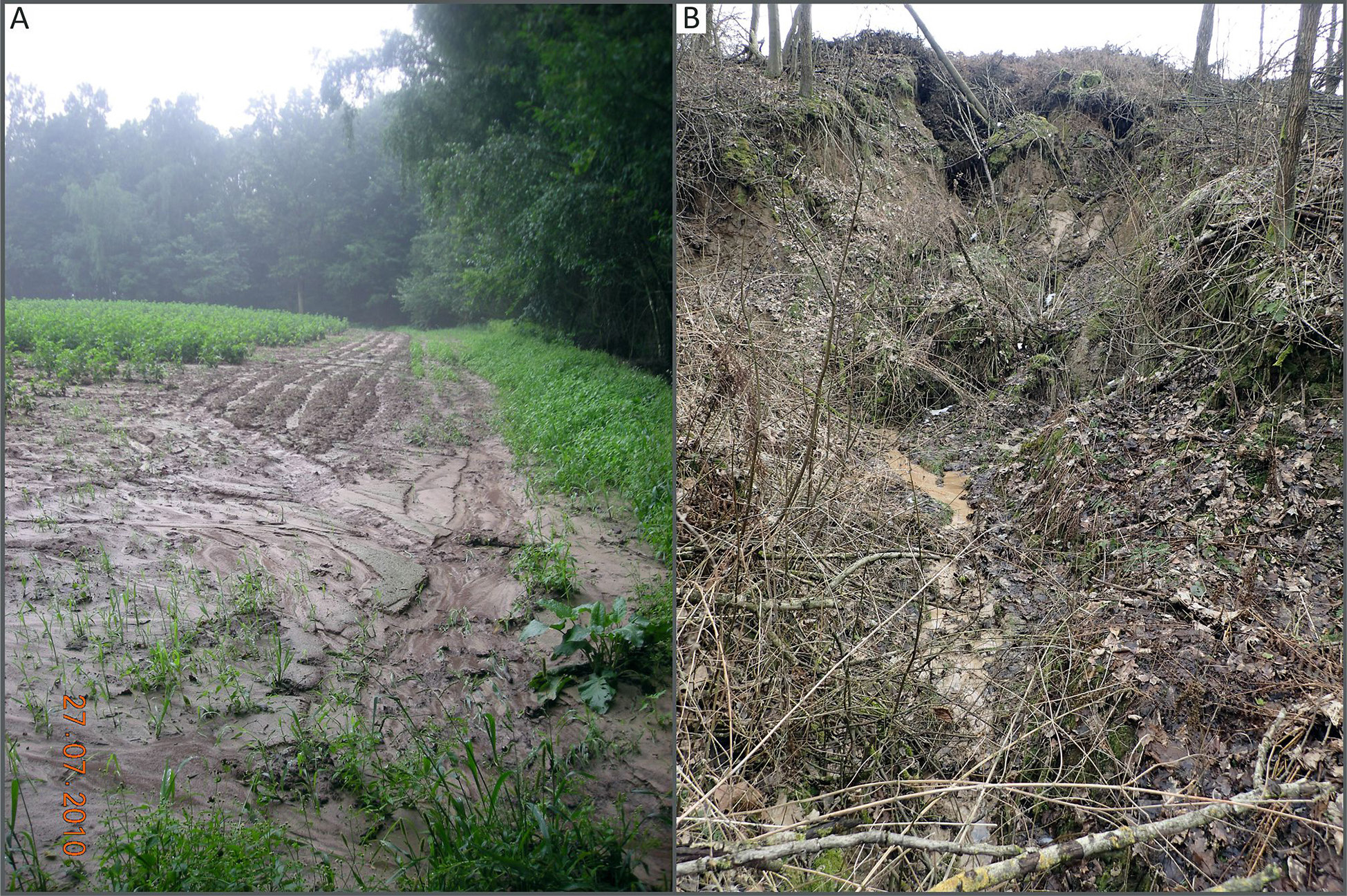
Fig. 11.
Pattern of runoff along the recent forest edge on the agricultural terrace (A) and severe piping on the slope of the gully (B).
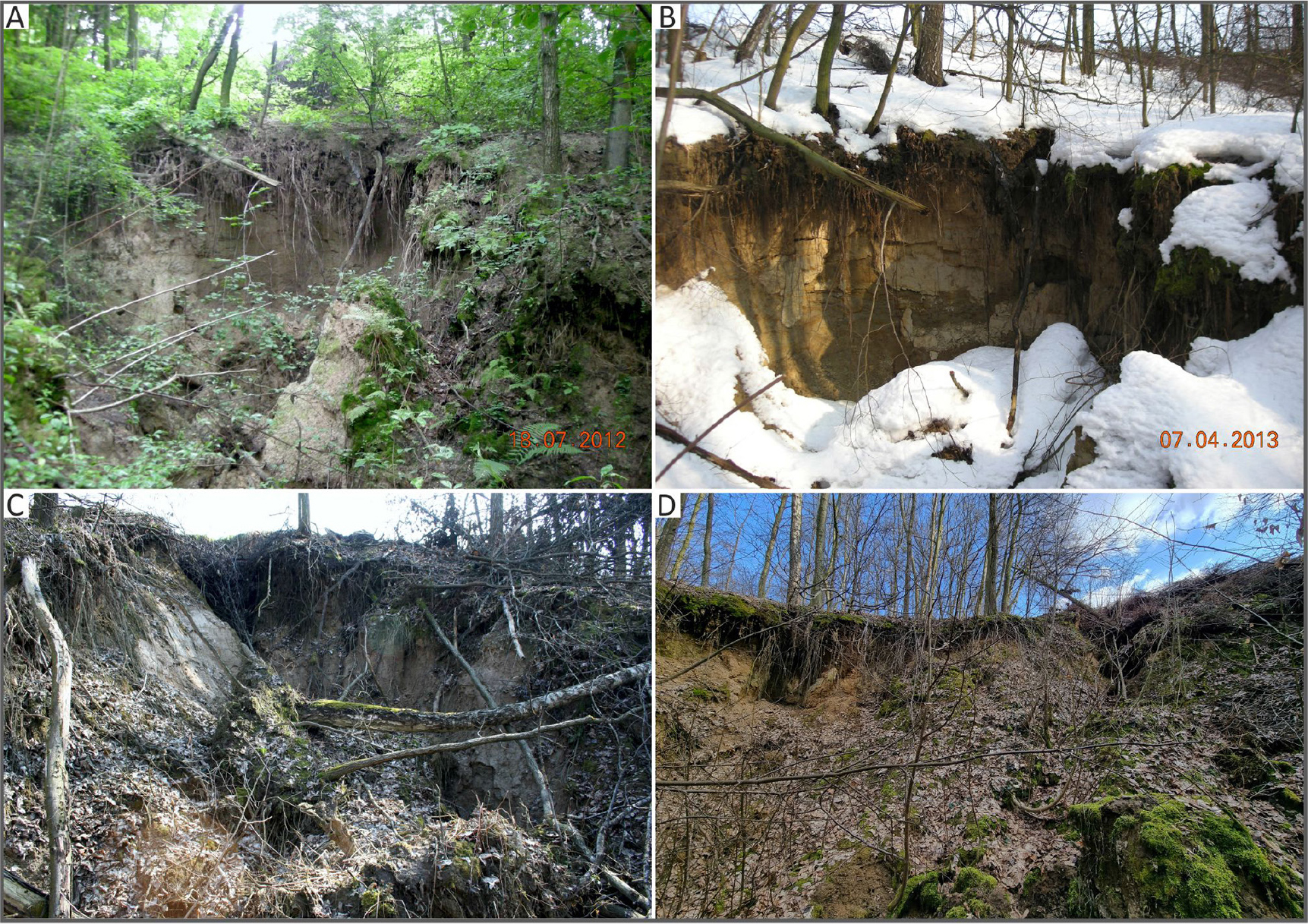
Fig. 12.
Dynamic development of the single Site 3 collapsed pipe: A – 2012, B – 2013, C – 2015, D – 2022.
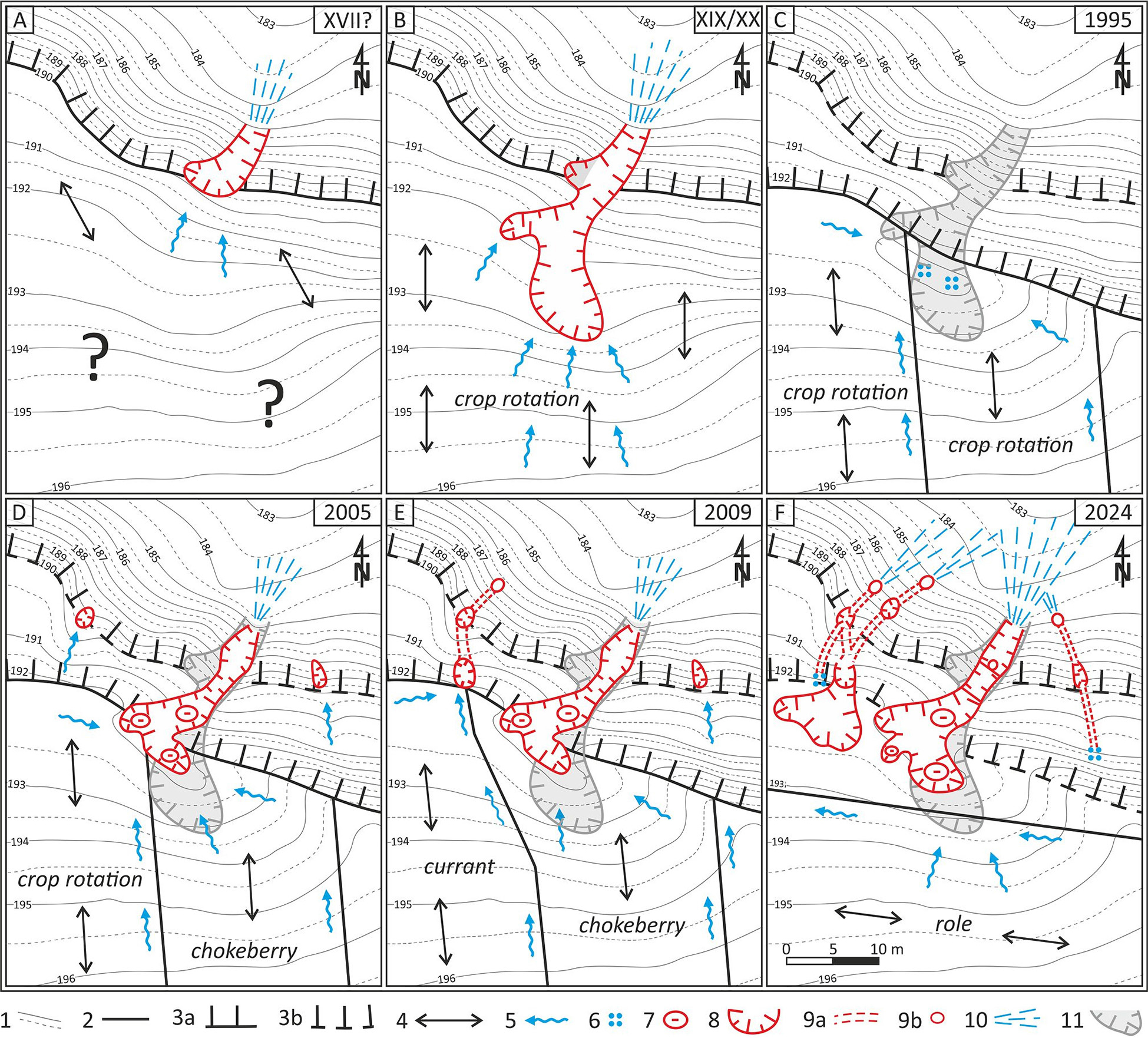
Fig. 13.
Development phases of the Site 1 collapsed pipe: A – dissection of the young gully escarpment in axis of depression. B – development of the large collapsed pipe on the line of concentrated runoff after the change of cultivation direction. C – relocation of the forest edge and reclamation of the collapsed pipe. D – reactivation of the collapsed pipe under the chokeberry plantation. E – the beginning of the development of secondary collapsed pipes during the period of stabilization, F – Intensive development of secondary forms during periods of higher rainfall. Explanations: 1 – contour lines, 2 – parcel borders, 3 – forest edge, 3a – current, 3b – former, 4 – direction of cultivation, 5 – direction of surface runoff, 6 – increased infiltration, 7 – sinkhole, 8 – collapsed pipe, 9 – piping channel, 9a – subsurface, 9b – open, 10 – colluvial fan, 11-colluvial filling of the reclaimed collapsed pipe.
Table 1.
Reactivation of selected collapsed pipes in the gully system of kolonia Celejów under the influence of runoff episodes from fruit plantations.
| Collapsed pipe | Role in local system | Start | Reasons for activity | Volume in m3 (approximately) | ||||
|---|---|---|---|---|---|---|---|---|
| Initiation | Development | 1999 | 2005, 2006 | 2009, 2013, 2015 | 2024 | |||
| Site 1 | Main form | 1996, 1997 | Longitudinal cultivation | New planted chokeberry | 270* (1940) | 106 | 240 | |
| Secondary form | 2006 | As above New planted blackcurrant | Concentrated runoff from blackcurrant plantation | – | – | 24 (2013) 36 (2015) | 95 | |
| Site 2 | Main form | 1996, 1997 | Diagonal cultivation | New planted blackcurrant plantation | 85 | 186 | ? | 240 |
| Secondary form | 2006 | Flow diversion | As above | – | 27 | 50 | 114 | |
| Site 3 | Main form | 1996, 1997 | Longitudinal cultivation New planted blackcurrant | Continuous blackcurrant seedlings plantation | 45 | ? | ? | 912 |
| Sites 1–3 | Differentiated | 1996– 2006 | New fruit plantation | Shrub rows parallel to slope | – | – | – | – |
1 * approximate volume of waste in the reclaimed collapsed pipe at Site 1 before reactivation.
Table 2.
Determinants of the development of collapsed pipes on the gully bank as a result of agricultural activity.
| Natural conditions and processes | Processes | Anthropogenic conditions and processes | ||
|---|---|---|---|---|
| Moisture – high susceptibility of loess to erosion | Large slopes and denivelations – gravitational force | Snowmelts, downpours slope runoff | Tillage perpendicular to the contour | Cultivation of crops that do not cover soil sufficiently |
| Disintegration of aggregates | Creeping | Sheet and rill erosion | Tillage erosion | Splash, sheet and rill erosion |
| Effect – transport of soil material and accumulation in the form of an agricultural terrace at forest edge | ||||
| Flattening of the slope – infiltration | Threshold – increase in slope | Concentration of runoff along the edge | Ploughing up of small incisions | Creation of a new forest edge |
| Piping, channel widening | Increase in gravitational force | Headcut erosion, pipes | Vulnerability to erosion of agricultural colluvia | Visual increase in the depth of the gully |
| The result – the development of a collapsed pipe with a drainage channel and a depositional cone | ||||
| Soil slides on edges | Blocking the outflow and silting up the bottom | Collapsed pipe stabilization and infilling | Cutting off the edge of the collapsed pipe and backfill | Ploughing around the collapsed pipe |
| Effect – reclamation of the form – adaptation to agricultural use | ||||
| Piping, headcut erosion | Unblocking the drain, piping | Infiltration, piping | Reduction of inflow – development of secondary forms | Accelerated collapsed pipe development |
| The result – reactivation of the collapsed pipe | ||||