
Introduction
In 2023, an attempt was made to study the community of cave descenders in Poland who met the criteria of so-called qualified tourists. The area of interest included issues concerning their motivation, emotional states accompanying cave descents, perception of the undertaken activity as such, as well as in the context of existing risk factors and overall tourist phenomena. The size of the ‘cavers’ community’ was estimated based on the membership in caving clubs operating within the Polish Mountaineering Association (PZA). It is about 2300 people (PZA n.d.). The PZA organises caving courses that equip their participants with the skills necessary in the underground, including knowledge of mountaineering or diving techniques. The survey conducted through caving clubs in terms of the representativeness of the sample surveyed was unsuccessful. Fifty-seven survey questionnaires were obtained, making the sample too small to be used for broader generalisations. Also, the survey questions were answered by those who wished to do so, and this simple fact means that the sample is non-prob-abilistic. Does the material obtained remain worthless? The author does not think so for reasons discussed below. Fifty-seven insightful descriptions of the experiences of people indulging in the passion of cave exploration were acquired, shedding light not only on the individuality of their experiences but also showing several similarities that allow us to sketch a collective portrait of this micro-community. The vast majority of research conducted among cave tourists concerns the so-called ‘casual cave tourist’, i.e. tourists visiting caves adapted for tourism and accessible to everyone (see for example Kim et al. 2008, Rachmawati, Sunkar 2013, Allan et al. 2015, Akca et al. 2016, Crane, Fletcher 2016, Shavanddasht et al. 2017, Antić et al. 2022b, Zieliński et al. 2022). On the contrary, the presented study describes the experiences of those cave tourists who descend into the natural ‘non-tourist’ underground, inaccessible to the average tourist. Thus, the members of the studied group might be named ‘dedicated cave tourist’. The perceived regularities can serve as a springboard for further research confirming or not the myth of the elitism of this part of the cavers’ community and the special place of the activity of descending into caves existing outside mass tourism, within cave tourism and tourism in general. Moreover, the research opens room for further investigations on the authenticity of cave tourists’ experiences and readiness for their commodification. The study also tries to fill the gap in research on cave tourism when it comes to the part of the phenomenon that happens outside show caves and the organised tourist space.
Cave tourism and people who go underground
Cave tourism involves visiting caves for motivations that are perceived as touristic. Speleotourism is based not only on the natural qualities of caves (Crane, Fletcher 2016), primarily material (rock formations, flowstone formations, etc.) but also on their beauty, mystery, and myths associated with them. Owing to the nature of the cave environment (darkness, cold, water, and tight passageways) and the demands it places on man (mental and physical resilience, perseverance, and self-control), most caves are inaccessible to the mass, unprepared or unskilled tourist. For educational, protective, but also market reasons (a new tourist attraction drawing tourist traffic; Akca et al. [2016]), the caves with the greatest potential in these contexts have usually been adapted for tourism as so-called show caves (Cigna 2016). This part of cave tourism is of the most ‘conventional’ and usually mass character. It is attended by tourists from a broad socio-demographic spectrum (from families with children to seniors), visiting the caves individually or in organised groups under the supervision of a qualified tour guide. They are characterised by a different degree of substantive and psychophysical preparation for a visit to the cave environment and acquaintanceship in cave issues (or more broadly related to geoheritage). In this case, unique caves (e.g., the largest and deepest), with well-preserved flowstone formations, hiding ‘surprises’ in the form of underground rivers, waterfalls, reservoirs, monumental passages and chambers, prehistoric cave art, etc., are made available. Artificially illuminated show caves, with prepared infrastructural facilities, are usually made available within the framework of organised access under the supervision of a guide (guided tours; Cigna, Burri 2000, Garofano, Govoni 2012, Crane, Fletcher 2016, Antić et al. 2022a, Chiarini et al. 2022, Zieliński et al. 2022). Cave tourism, depending on what qualities of the caves are the basis for tourist use and interpretation, can carry out the tasks of sightseeing (general knowledge of the region), geotourism (cave structure, processes, and flowstone formations; kubalíková 2013, Antić et al. 2019, Antić et al. 2022a, Tomić, Marianović 2022, Zieliński et al. 2022, Tesfa, Zewdie 2023), ecotourism (flora and fauna of the caves), (paleo)archeotourism (cultural heritage of the protohumans, paleontology; Duval et al. [2017]). In the caves, to make them more attractive to a mass audience with different interests and needs in terms of leisure and entertainment, various other activities are carried out: cultural (concerts in the Drach Cave, Mallorca) or team-building events are organised, unconventional weddings or other special events are held (Jenolan Caves, Australia). Various trains run through the caves (Postojna Jama Cave, Slovenia), boats float (Waitomo Caves, New Zealand), luxury or unconventional accommodations are built based on them. A visit to a cave can therefore be part of cultural tourism (Antić, Mayor 2023), adventure tourism (Spalević, Igračev 2011) or finally incentive tours. The attractiveness of caves also stems from the physical demands it places on explorers. Participants in mass cave tourism are subject to research and segmentation (Kim et al. 2008, Allan et al. 2015, Antić et al. 2022b), mainly because the cave becomes a tourist product which is supposed to satisfy the needs of different groups of consumers and stakeholders involved in its creation (local governments, investors, residents, etc.).
On the opposite side of ‘conventional’ cave tourism, there are descents to caves outside a regular tourist traffic, devoid of infrastructure, inaccessible to anyone because of the degree of difficulty of exploration and required psychophysical resilience and skills. The need for the combined mastery of rope, climbing, or diving techniques allows tourists to achieve a high degree of qualification and mastery among practitioners of various forms of qualified tourism. Such cave descents are therefore often of an exploratory or athletic/sporting nature, sometimes of a scientific nature (caves as a training ground for space research, Kambesis 2007, Bessone et al. 2023). Organised individually or in groups of enthusiasts (e.g., cavers’ associations), they elude cave tourism traffic statistics, thus remaining on the margins (in terms of description and scientific research) of the phenomenon.
Analogously to how Hose (2005) describes geotourists (casual/accidental and dedicated geotourists), depending on their level of involvement, knowledge and skills, cave tourists might be divided into two main groups: casual and dedicated cave tourists. Božić and Tomić (2015) use a distinction between general (geo)tourists and pure (geo)tourists, which also applies to cave tourists, emphasising the greater personal (emotional and intellectual) involvement of the latter, going beyond the mere pleasure of interacting with such geosites (the authors also examined how these two groups differ in terms of their attitude to selected scientific and non-scientific cave values, the presence of tourist infrastructure or tourists’ attitudes to cave protection). The community of dedicated cave tourists and people dealing with caves professionally, although insignificantly, notice the threats to the cave environment related to its exploration (not only with tourist traffic in show caves). This concerns various types of interference in the cave’s structure (opening corridors, marking passage routes) or everything related to the presence of humans in an environment where they do not occur regularly (biological impact, littering, and disturbing the peace of creatures living in caves). To optimise cave exploration and make it more sustainable, speleological organisations (international such as the International Union of Speleology as well as national ones), practitioners, and scientists try to define and implement good practices for going into caves (for tourist, exploration, and scientific purposes) and their adaptation for tourists (International Union of Speleology 2013, Tičar et al. 2018, International Union of Speleology 2022, Piano et al. 2024).
It is worth emphasising that a bipolar way of characterising tourist segments involved in practicing a selected type of tourism also appears in cultural tourism, although here the dual division of tourists (specific and general cultural tourists) is increasingly being abandoned in favour of a kind of continuum (e.g. McKercher 2002, McKercher, Du Cros 2003 – from pure cultural tourists to incidental cultural tourists). Assuming the basic division of cave tourists into two groups (those visiting show caves, adapted for tourist needs and those who go down into the ‘unknown’), it should also be assumed that these groups are not homogeneous. In terms of tourists visiting show caves, this is confirmed by numerous research, including Kim et al. (2008) or Antić et al. (2022b). The much smaller and more difficult-to-access research group of dedicated/pure cave tourists has not been studied yet in terms of its internal diversity. Professional speleologists constitute a separate group of people visiting caves. Owing to the nature of cave descents undertaken most often in connection with work (conducting scientific research) and beyond leisure, this travel should not be classified as tourism (as well as cave tourism).
Methodology
Procedure, research sample and research instrument
In the summer of 2023, a survey distributed by the PZA was conducted among members of cavers’ clubs affiliated with this organisation. Cavers’ clubs and associations (a total of 29 in 2023) were asked to distribute the survey in the form of a Microsoft (MS) Forms questionnaire to their members, asking them to fill it out. It was decided to go through the intermediary of cavers’ clubs with the idea of reaching people who met the criteria of so-called ‘dedicated tourists’, or in Polish terminology ‘qualified tourists’ (in Polish turyści kwalifikowani), who were formally authorised to practise the studied activity in a professional manner, usually outside generally accessible caves, the so-called ‘show caves’. Descent into caves here is often of exploratory (discovering new caves, passages or descending into caves accessible to few due to the degree of difficulty or special environmental conditions) or sporting nature.
A total of 57 members from 14 clubs completed the survey. The survey form, made in MS Forms, consisted of up to 34 closed and open questions, the total number depending on the answers. The research questions covered a wide spectrum of issues: from motivation (the power of individual motivations and causal powers), to emotional states (including the experience of ‘flow’), perceived benefits and costs of the practiced activity in various spheres, attitudes to risk and risk-generating factors in cave exploration, perception of the group and oneself in the cavers’ community, perceptions of exploration and cave tourism in the context of tourism phenomena in general. The risk factors were subject to prioritisation. The article analysed the majority of the mentioned aspects of the caving experience, except for emotional states, which became the subject of a separate analysis.
Results
The respondents
The group of respondents participating in the survey was heterogeneous in terms of both socio-demographic characteristics and caving experience. The questionnaire was completed by 42 men aged 21–72 and 15 women aged 25–50 (73.7% and 26.3% of the total respondents, respectively). Overall, and in both men and women, the largest group was composed of mature people aged 36–45 (42.1%, 40.5% and 46.7%, respectively). The family situation, which may affect the respondents’ travel behaviour, was defined by the existence of formal obligations or voluntary/compulsory tending to someone (partner, children, parents, etc.). The described situation (in both variants) was indicated by the majority of the total respondents and the vast majority of men (71.93%, 80.95%). Among the ladies, the option of having no obligations towards others slightly outweighed by one respondent (a third of the women were ladies aged 26–35, the average age of giving birth to the first child has been increasing in Poland in recent years).
Given caving experience, the studied group demonstrated high heterogeneity. It included people only just starting their adventure with caving as well as those who had been engaged in this activity for several decades (Table 2). The respondents also differed in terms of the regularity of undertaking the studied activity (Table 3). The group of people practising caving for a relatively short time (1–5 years) was clearly dominated by those who do it several times a year or more often (80%; caving may still be a kind of ‘novelty’ at that time, providing a high intensity of experience). The respondents rated their own caving experience in different ways (Figs 1 and 2), viewing themselves as experienced cavers (26 people), cavers developing the experience they have already had (20 people) or amateur cavers (11 people).
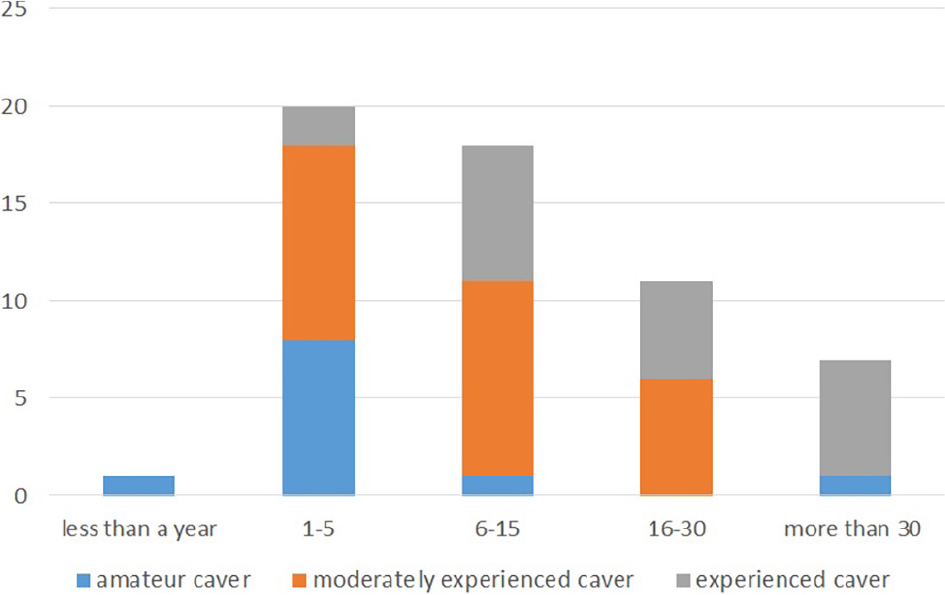
Fig. 1.
Caving experience vs respondents’ self-description.
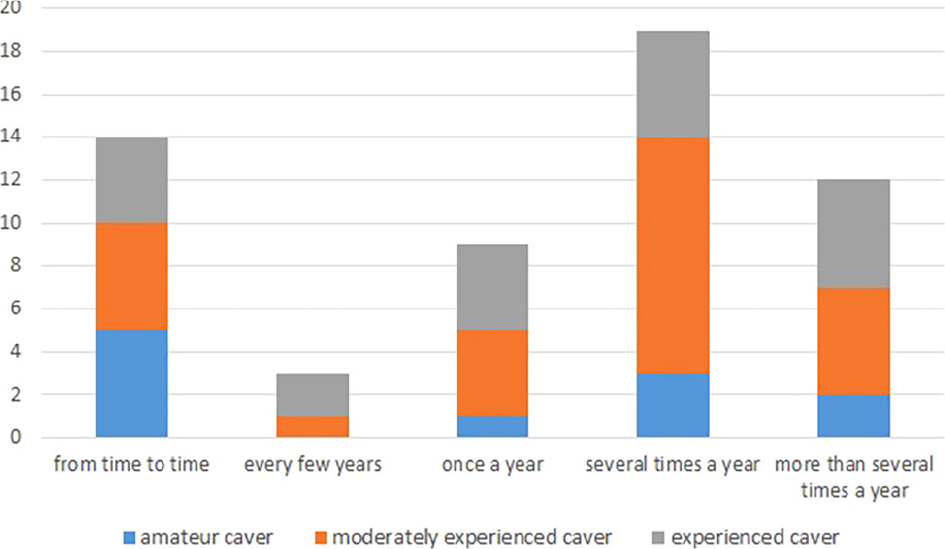
Fig. 2.
Frequency of cave descents vs respondents’ self-description.
Table 1.
Selected socio-demographic characteristics of the respondents.
| Characteristics of respondents | Total (N = 57) | Men (N = 42) | Women (N = 15) | ||||
|---|---|---|---|---|---|---|---|
| N | % | N | % | N | % | ||
| Age | 0–25 | 5 | 8.8 | 4 | 9.5 | 1 | 6.7 |
| 26–35 | 13 | 22.8 | 8 | 19.0 | 5 | 33.3 | |
| 36–45 | 24 | 42.1 | 17 | 40.5 | 7 | 46.7 | |
| 46–55 | 11 | 19.3 | 9 | 21.4 | 2 | 13.3 | |
| 56 and above | 4 | 7.0 | 4 | 9.5 | 0 | 0 | |
| Responsibilities towards others | I am not responsible for anyone, only for myself. | 15 | 26.32 | 7 | 16.67 | 8 | 53.33 |
| I am/feel responsible for someone else. | 41 | 71.93 | 34 | 80.95 | 7 | 46.67 | |
| Prefer not to say. | 1 | 1.75 | 1 | 2.38 | 0 | 0 | |
Table 2.
Time spent practising caving descents by the respondents: overall and by gender.
| Time (years) | Overall (N = 57) | Men (N = 42) | Women (N = 15) | |||
|---|---|---|---|---|---|---|
| N | % | N | % | N | % | |
| <1 | 1 | 1.75 | 1 | 2.38 | 0 | 0 |
| 1–5 | 20 | 35.09 | 13 | 30.95 | 7 | 46.67 |
| 6–15 | 18 | 31.58 | 11 | 26.19 | 7 | 46.67 |
| 16–30 | 11 | 19.30 | 10 | 23.81 | 1 | 6.67 |
| >30 | 7 | 12.28 | 7 | 16.67 | 0 | 0 |
Table 3.
Frequency of cave descents vs caving experience.
| “How long have you been doing cave descents?” | Overall N = 57 | < 1 year N = 1 | 1–5 years N = 20 | 6–15 years N = 18 | 16–30 years N = 11 | > 30 years N = 7 | ||||||
|---|---|---|---|---|---|---|---|---|---|---|---|---|
| N | % | N | % | N | % | N | % | N | % | N | % | |
| From time to time, irregularly | 14 | 24.56 | 1 | 100 | 3 | 15 | 5 | 27.78 | 2 | 18.18 | 3 | 42.86 |
| Every few years | 3 | 5.26 | 0 | 0 | 0 | 0 | 2 | 11.11 | 1 | 9.09 | 0 | 0 |
| Once a year | 9 | 15.79 | 0 | 0 | 1 | 5 | 4 | 22.22 | 2 | 18.18 | 2 | 28.57 |
| Several times a year | 19 | 33.33 | 0 | 0 | 12 | 60 | 2 | 11.11 | 4 | 36.36 | 1 | 14.28 |
| More than several times a year | 12 | 21.05 | 0 | 0 | 4 | 20 | 5 | 27.78 | 2 | 18.18 | 1 | 14.28 |
A great majority of the respondents are people who are active in their leisure time. For 46 of them (77.97%) cave descending is one of many leisure activities, while for 11 it is the main form of leisure activity they practise (18.64%). Two people indicated that cave exploration was also a job for them (3.39%). Among the respondents, there was no person for whom this activity was the only one they undertook in their free time. In terms of dominant tourist motivations (Fig. 3), the respondents, who are practising a physically demanding activity and at the same time strongly associated with a specific type of natural environment, did not differ significantly from the general tourists as such. Most cited the opportunity to explore the unknown (search for novelty, difference, the main motivator of exploration activities in general; Pearce, Lee 2005) as the decisive, causal motivation pushing them to descend into caves, followed by curiosity about caves (cognitive motive) and the search for aesthetic sensations, admiring caves (emotional, sensory motive).
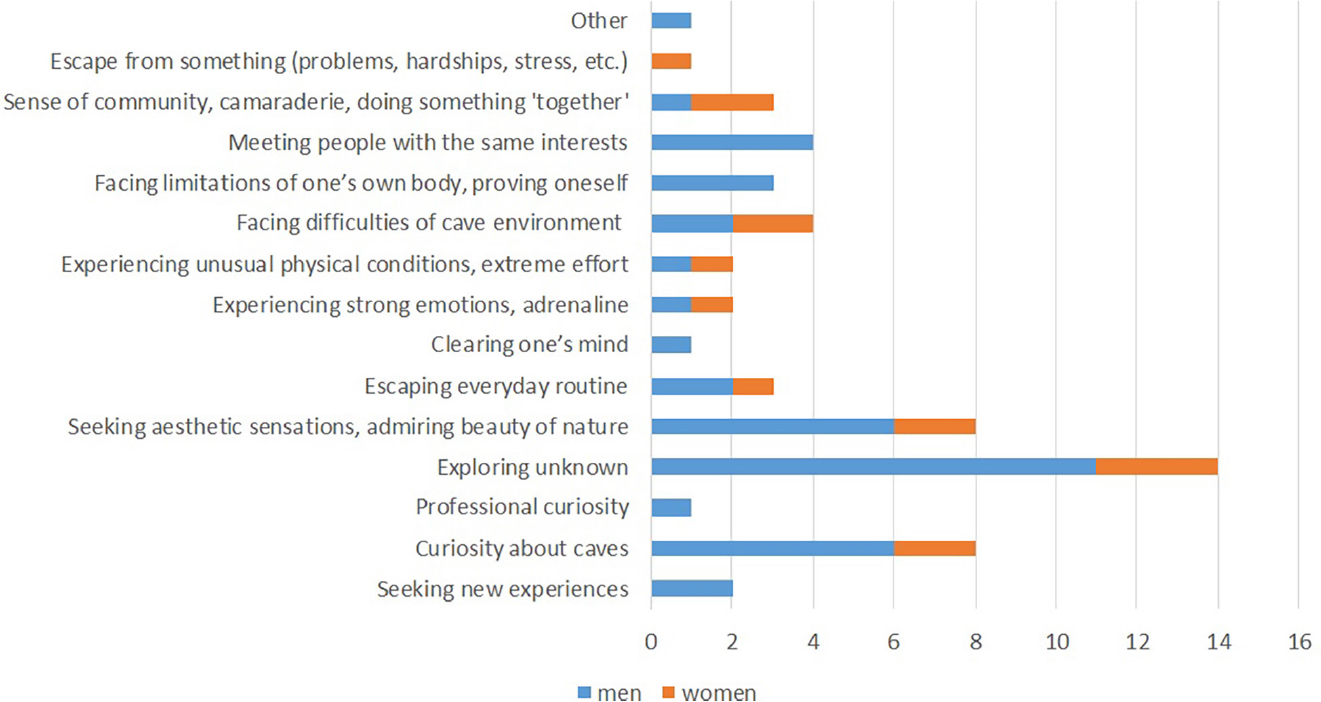
Fig. 3.
Dominant motivation for cave descents.
Benefits and costs of cave exploration
Descending into caves, although possibly arising from various motivations, like any freetime activity is expected to bring certain benefits to the person practising it. Ultimately, they may serve the individual’s psycho-physical well-being, the development of social or personal skills (cognitive or physical), emotional needs, etc. The respondents were free to indicate any number of benefits or name others, not mentioned in the survey. The vast majority of respondents identified the following as the main benefits (Fig. 4): improving physical fitness, improving technical skills (caving, climbing, diving), improving mental condition, increasing self-confidence, and building and strengthening interpersonal bonds. In contrast, only a few individuals in the study group descend into caves for fame (prestige), slightly more for the nimbus of precedence (“no one has done it before me”) or for crossing human boundaries.
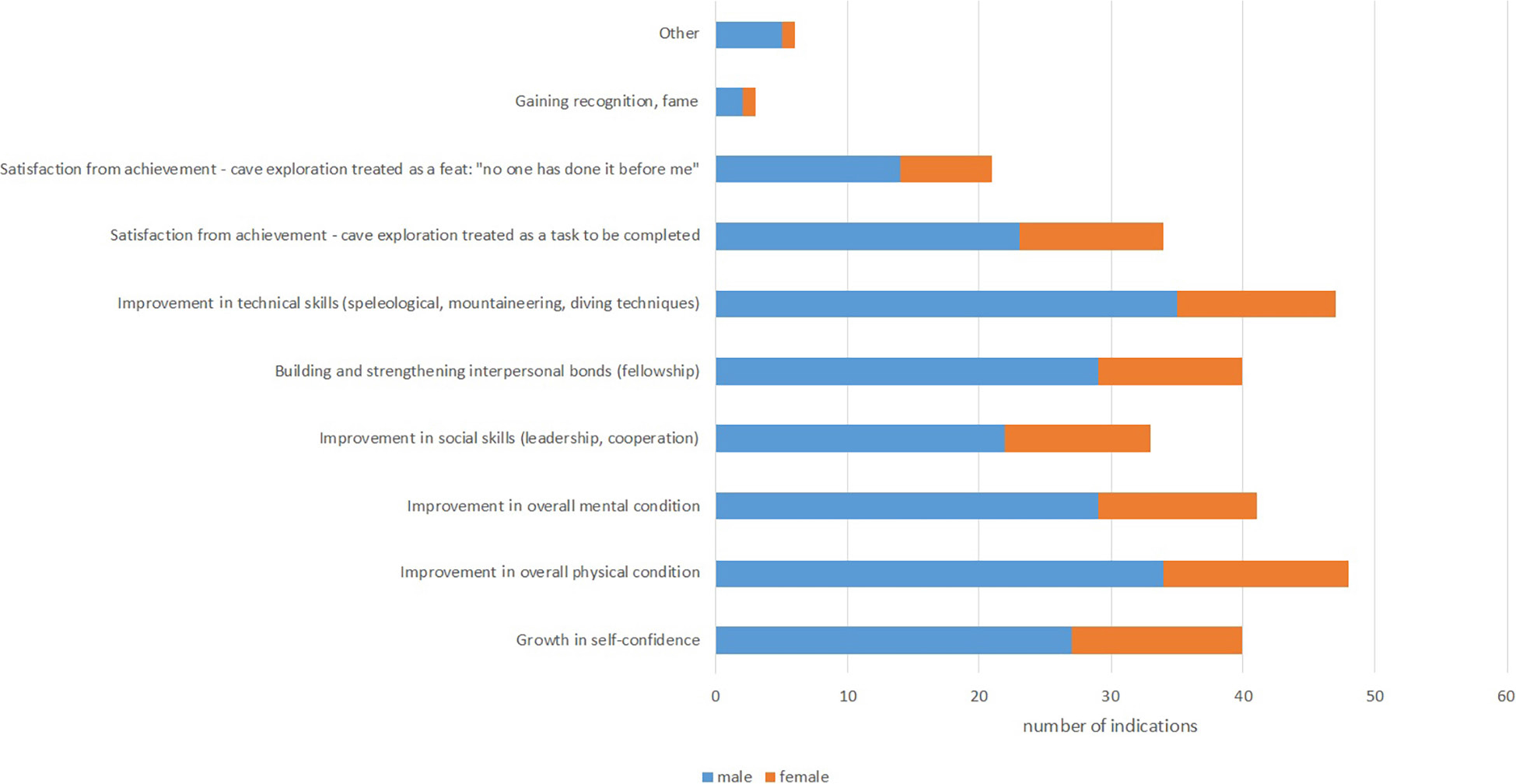
Fig. 4.
Benefits from cave descents according to the respondents.
The respondents were also asked to provide psychological benefits from practising descents. Although indicated by fewer respondents than the advantages related to the athletic, technical or competitive nature of cave descents, they resounded noticeably in the descriptions of the importance of caves in the respondents’ lives. Caves are: “self-therapy…”, “(…)A place used for ‘head hygiene’”, “It’s a great place in which there is no range. This way I completely cut myself off from stimuli, I am in another world”.
While none of the respondents negate the fact of gaining different benefits of going underground, most also see various costs associated with it. However, there are also those for whom going down to the caves does not involve any costs (22.81%). The most common concern, for almost half of the members of the surveyed group (47.37%) and for 60% of women, is loss of health (due to injuries, accidents), one in three respondents (31.58%) point to the burden on the household budget of this expensive passion (buying equipment, expedition costs). 22.81% of the respondents have to deal with the deterioration of relationships with relatives due to their concern about the safety of the activity practised and 14.04% also due to other priorities in the life of the surveyed individuals and their relatives. In ‘Other costs’, the respondents (5.26%) included the time-consuming and costly nature of the activity, which “hinders the simultaneous development of other passions and professional life”.
Attitude to risk and its main factors
Concerns about the loss of health that may result from injury or accident during a descent into the underground appear to be rational and probably stem from an awareness of the risks associated with this activity. The vast majority of respondents are aware of the risks, with a slight prevalence of the group (overall and by gender) who condition their actions on the degree of risk (including abandoning the expedition; Table 4). Conscious risk-taking was indicated by only three people, and they were men (however, the gender differences in responses were not found to be statistically significant). A reasonable attitude to risk also characterised the majority of respondents, regardless of their experience in the caving passion (Table 5).
Table 4.
Attitude to risk in practising caving descents.
| “Cave descents are connected to risk.” | Overall (N = 57) | Men (N = 42) | Women (N = 15) | |||
|---|---|---|---|---|---|---|
| N | % | N | % | N | % | |
| I have no influence on that so I don’t think about it. | 1 | 1.75 | 0 | 0.00 | 1 | 6.67 |
| I’m aware of that, so I consider carefully every cave descent. Too high risk makes me give up the caving expedition. | 29 | 50.88 | 21 | 50.00 | 8 | 53.33 |
| I’m aware of that, but it doesn’t influence the decisions I take, although I try to act sensibly. | 24 | 42.11 | 18 | 42.86 | 6 | 40.00 |
| I’m aware of that, but I still take the risk. | 3 | 5.26 | 3 | 7.14 | 0 | 0.00 |
Table 5.
Risk vs caving experience.
| “Cave descents are connected with risk so…” | < 1 year (N = 1) | 1–5 years (N = 20) | 6–15 years (N = 18) | 16–30 years (N = 11) | > 30 years (N = 7) | |||||
|---|---|---|---|---|---|---|---|---|---|---|
| N | % | N | % | N | % | N | % | N | % | |
| I have no influence on that so I don’t think about it. | 0 | 0 | 0 | 0 | 1 | 5.56 | 0 | 0 | 0 | 0 |
| I’m aware of that, so I consider carefully every cave descent. Too high risk makes me give up the caving expedition. | 1 | 100 | 10 | 50 | 10 | 55.56 | 5 | 45.45 | 3 | 42.86 |
| I’m aware of that, but it doesn’t influence the decisions which I take, although I try to act sensibly. | 0 | 0 | 9 | 45 | 5 | 27.78 | 6 | 54.55 | 4 | 57.14 |
| I’m aware of that, but I still take the risk. | 0 | 0 | 1 | 5 | 2 | 11.11 | 0 | 0 | 0 | 0 |
Risk in cave descents can generally stem from two sources: it is either human failure or the cave environment itself carries certain risks. In the first case, danger may be brought by inexperience of oneself/partners or overestimation of one’s own skills, bravado (taking unnecessary risks) or panic resulting from loss of control over oneself or group members. In caves, people are surrounded by darkness, which may affect spatial orientation and cause hallucinations. Narrow passageways pose the danger of getting stuck and the risk of claustrophobia. Low temperatures and cold water may lead to hypothermia. While in the cave, explorers also sometimes encounter unknown or dangerous pathogens, be affected by poisonous gases or lack of oxygen. Prolonged exposure to an environment devoid of stimuli (sensory deprivation) may also adversely affect the psycho-physical condition of the human body. In addition, people descending into caves, regardless of experience, are threatened by sudden events that are difficult to predict, including rockfalls, flooding of passages and thus cutting off the way back. In the survey, respondents indicated the order in which they considered the most important risk factors (Tables 6 and 7). The first positions in the ranking were (in terms of the highest number of indications) random factors (I, sudden, unpredictable) and human factors (II, III): inexperience and bravado. Risk factors related to the specifics of the cave environment tended to be indicated further down the list (outside the top five) and their ranking was ambiguous. Among the human factors responsible for risk while in caves, the low ranking of the factor described as “panic, loss of control over oneself or the rest of the group” (IV) stood out, with most respondents ranking it eighth.
Table 6.
Ranking risk factors in cave descents according to the respondents.
| Position | Risk factors (% respondents, N = 57) | |||||||||
|---|---|---|---|---|---|---|---|---|---|---|
| I | II | III | IV | V | VI | VII | VIII | IX | X | |
| 1 | 52.63 | 8.77 | 7.02 | 1.75 | 1.75 | 5.26 | 7.02 | 15.79 | 1.75 | 1.75 |
| 2 | 14.04 | 26.32 | 22.81 | 3.51 | 5.26 | 10.53 | 3.51 | 12.28 | 3.51 | 1.75 |
| 3 | 5.26 | 12.28 | 21.05 | 15.79 | 7.02 | 17.54 | 7.02 | 12.28 | 3.51 | 1.75 |
| 4 | 17.54 | 7.02 | 8.77 | 12.28 | 8.77 | 7.02 | 12.28 | 19.30 | 8.77 | 5.26 |
| 5 | 5.26 | 12.28 | 7.02 | 12.28 | 12.28 | 17.54 | 10.53 | 14.04 | 12.28 | 5.26 |
| 6 | 0.00 | 10.53 | 15.79 | 10.53 | 10.53 | 24.56 | 12.28 | 10.53 | 38.60 | 1.75 |
| 7 | 3.51 | 7.02 | 3.51 | 3.51 | 17.54 | 14.04 | 29.82 | 8.77 | 31.58 | 3.51 |
| 8 | 0.00 | 8.77 | 0.00 | 19.30 | 17.54 | 3.51 | 14.04 | 7.02 | 0.00 | 15.79 |
| 9 | 1.75 | 5.26 | 10.53 | 7.02 | 5.26 | 0.00 | 1.75 | 0.00 | 0.00 | 29.82 |
| 10 | 0.00 | 1.75 | 3.51 | 14.04 | 14.04 | 0.00 | 1.75 | 0.00 | 0.00 | 33.33 |
1 I – sudden, unpredictable events; II – lack of one’s own or partners’ experience, or overrating one’s own skills; III – bravado, taking too much risk; IV – panic, loss of control over oneself or group members; V – darkness; VI – water; VII – confined space (possibility to get stuck); VIII – cold; IX – unknown pathogens, caves’ flora and fauna; X – poisonous gases, lack of oxygen.
Table 7.
Risk factors of cave descents – descriptive statistics.
| Risk factors | Descriptive statistics | |||
|---|---|---|---|---|
| Mode (Mo) | Cardinality | Min. | Max. | |
| I – sudden, unpredictable events | 1 | 30 | 1 | 9 |
| II – lack of one’s own or partners’ experience, or overrating one’s own skills | 2 | 15 | 1 | 10 |
| III – bravado, taking too much risk | 2 | 13 | 1 | 10 |
| IV – panic, loss of control over oneself or group members | 8 | 11 | 1 | 10 |
| V – darkness | multiple | 10 | 1 | 10 |
| VI – water | 6 | 14 | 1 | 8 |
| VII – confined space (possibility to get stuck) | 7 | 17 | 1 | 10 |
| VIII – cold | 4 | 11 | 1 | 8 |
| IX – unknown pathogens, caves’ flora and fauna | 9 | 22 | 4 | 10 |
| X – poisonous gases, lack of oxygen | 10 | 19 | 1 | 10 |
Descending into caves and tourist phenomena
Nowadays, conventional cave tourism for most tourists means visiting so-called show caves, facilities adapted for tourist purposes, requiring no special skills, completely safe, with no exploratory features. The PZA courses are therefore designed for people who plan to visit caves unsuitable for mass tourism, the descents to which can be of a sporting or exploratory nature. Respondents perceive cave descents as a freetime activity (one of the many they do or their main activity), so it was examined whether the activity is perceived as a tourist activity. Among respondents overall, there is a slight dominance of those who do not equate cave descents with tourism (albeit for different reasons), which is also how respondents in different age groups (except for the oldest group) understand the phenomenon. Taking gender into account, the general tendency in the presented opinion is represented by women, among men the conviction about the touristic nature of cave exploration slightly prevails. In the belief about the relationship between cave descents and tourism, the opinion that the easier the cave descent, the more touristic it is prevails. Among the respondents who did not identify cave descents with tourism, the largest group indicated the ‘other’ nature of the activity. Lifestyle or sports/hobby motives did not appeal to the respondents very clearly in the survey (Table 8).
Table 8.
Opinions about relationships between cave descents and tourism.
| “Do you think cave exploration enters the category of tourist phenomena?” | Overall N = 57 | 0–25 N = 5 | 26–35 N = 13 | 36–45 N = 24 | 46–55 N = 11 | ≥ 56 N = 4 | ||||||
|---|---|---|---|---|---|---|---|---|---|---|---|---|
| N | % | N | % | N | % | N | % | N | % | N | % | |
| I don’t know. | 3 | 5.26 | 0 | 0 | 1 | 7.69 | 0 | 0 | 2 | 18.18 | 0 | 0 |
| Yes, completely. | 2 | 3.51 | 0 | 0 | 0 | 0 | 1 | 4.17 | 1 | 9.09 | 0 | 0 |
| Yes, but it depends on the level of difficulty (the easier the descents, the more ‘tourist’ they are). | 24 | 42.11 | 2 | 40 | 6 | 46.15 | 10 | 41.67 | 3 | 27.27 | 3 | 75 |
| No, it’s a lifestyle. | 8 | 14.04 | 0 | 0 | 3 | 23.08 | 3 | 12.50 | 2 | 18.18 | 0 | 0 |
| No, it’s a sport, achievement, competition. | 7 | 12.28 | 1 | 20 | 1 | 7.69 | 4 | 16.67 | 1 | 9.09 | 0 | 0 |
| No, it’s something else. | 13 | 22.81 | 2 | 40 | 2 | 15.38 | 6 | 25.00 | 2 | 18.18 | 1 | 25 |
Among the respondents denying the connection between cave exploration and tourism, the common denominator was the belief that challenging cave descents which are inaccessible to anyone (because of lack of appropriate skills) or involve exploring new passages lie outside tourism:
Cave exploration, in the sense of discovering new cave passages, requires skill, experience and group action. It’s discovering something new, it’s painstaking work and risk. There is cave tourism – walking in caves that have already been explored, and mapped – in this sense it can be tourism, just as one can do climbing tourism, for example
(Female, 46 years old).
Tourism appears to them as a safe activity, even trivial in a way:
Tourist caves, for me, are something different from real speleo. Even the simplest speleo requires self-responsibility and some non-standard skills – the opposite is true of ‘tourism’ (…)
(Male, 40).
Moreover, tourism appears to be a threat to real cave exploration:
I think few people can afford the cost of choosing ‘it’s a lifestyle’, and the variety of motivations and commercialisation looming on the horizon are slowly pushing cave exploration towards tourism
(Male, 41).
The vast majority of respondents believe that cave tourism is poorly commercialised (most of such expeditions take place outside the formal tourism market) or non-commercialised (it is a true adventure/authentic experience created individually by its creators), 43.86% and 40.35% of the total respondents, respectively.
Group and individual elitism vs practising cave descents
Slightly more than half of the respondents see people who practise cave exploration as an elite group, special in some way (52.63%). This uniqueness is not perceived by 15.68% of the respondents, the rest have no opinion on this issue. In the first group, as reasons for this uniqueness, the special psychophysical predispositions of people going down into caves and their above-average cold blood in extremely difficult, emergency situations, in an unfamiliar environment, are clearly emphasised. Respondents also refer to character traits or principles that guide cave enthusiasts. The community of ‘cavers’ are people who are “brave, empathetic, work in a group” (Female, 40), “(…) who appreciate different values than most people, don’t mind temporary discomfort, don’t complain about little things, aren’t afraid of challenges, friendship is for them” (Male, 37), the uniqueness of this group lies in “partnership, friendship, selflessness, dedication, principles” (Male, 51). The last thought is also developed by another respondent:
Activities such as underground mountaineering mainly attract people with a certain similar set of qualities which include curiosity about the world, courage, a lust for adventure, an open mind, and aesthetic and natural sensitivity. These people are the minority in society and are very valuable
(Male, 21).
In the respondents’ opinion, the group’s sense of elitism is also due to the fact that caving communities tend to be relatively small and the demands of the caving environment quickly verify their abilities: “Not everyone is willing or able to go caving, and even such people are in the minority” (Female, 37), “Not everyone is able to overcome their fears and get out of their comfort zone” (Female, 36). Going into caves manifests the characteristics of a kind of ‘initiation’, it is “discovering something unknown to anyone and COMPLETELY unknowable, something that sometimes maybe no one will see again and no one will be there!” (Male, 50), and “Cavers experience states (e.g., extreme exhaustion) and emotions that even advanced surface mountaineers often do not experience” (Male, 39).
In the group of the respondents who perceive people who go into caves as an exceptional, elite group, almost every other respondent also ascribes to themselves a certain uniqueness as a result of practising this activity. Here, too, just like before, the source of the described assessment is the conviction of possessing the psychophysical or character traits necessary in cave exploration (“I do what others can’t or are afraid to do, I’ve been to places which a handful of people have been to”, “I’m able to cope with difficult conditions by overcoming my own limitations that takes place during cave exploration”), and participation in an activity not available to everyone (“I do what others can’t or are afraid to do, I’ve been to places which a handful of people have been to” [Male, 38], “Very few people do something similar, understanding exploration as discovering new caves, not cave tours” [Male, 35], “I do things out of the ordinary” [Male, 48]). Selfuniqueness also comes from a sense of fulfilment, and satisfaction with life:
Several decades of caving activities have shaped my person, I have had quite a few achievements in caves. It gave me recognition, not only in the caving community. It has contributed to maintaining an exceptional condition, not bad health to a late age
(Male, 72).
Discussion and implications
Although, as indicated in the introduction, the analysed collective does not exhaust the conditions for a representative sample, the obtained results draw attention to several noteworthy issues, opening up new fields of research into cave tourism. In an era of increasingly intense commercialisation of tourism, descending into caves that are generally inaccessible to the mass tourist is undoubtedly a source of existential authenticity, related to both the attributes of the place (poorly explored, ‘virgin’ caves) and the intensity of the experience (both one’s own emotions and those of the shared experience of people descending into the dark and unknown together). In the scientific literature, the (qualified) cave community and its experiences are generally not discussed (unlike the popular science or biographical literature), unlike, for example, the community of climbers or high-altitude mountaineers (cf. Rickly-Boyd 2012, Vespestad et al. 2019).
Motivation surveys pointed to a seeming contradiction. Although exploration of the unknown was most often cited as the dominant, causal motivation for descending into caves, few respondents consider the satisfaction of being first as a benefit of engaging in this activity. Perhaps this is due to the realisation that it is difficult to be the first in a shrinking world that no longer holds many secrets. On the other hand, the ‘unknown’ for the respondents most likely does not have to be purely geographical at all. The role of the ‘unknown’ in the caves can be played by various unusual and intense emotions, mental states, and situations, forcing explorers to act unconventionally, react quickly, make difficult decisions, and prove themselves. In this context, the depleting stock of new, unexplored caves (although there is still a long way to go before it is emptied) does not pose a threat to cave tourism, since the basic attributes of caves and the conditions for their exploration remain the same.
The risks posed by cave exploration, and which arise from the peculiarities of the cave environment, seem to be tame among those descending into caves. This does not demonstrate overconfidence or even a kind of ‘arrogance’ of respondents towards caves, but the result of a kind of pre-selection – darkness, cold or other peculiarities of the underworld are not a source of fear for those who descend to caves, because they are inherent in the activity and can be expected. The human factor, apart from random events, remains the ‘weakest link’ in safe cave exploration. This belief seems to be common and it is reflected in many professional guides addressed to people going down to caves. The methods of counteracting this are included in the Caving Codes of Conduct (British Columbia Speleological Society, n.d.). The most important include (1) planning cave descents taking into account age, experience, skills, and physical condition, (2) not exceeding own abilities and acceptance for limitations, and (3) consent to the leadership of the most experienced team member and acceptance of their decisions. In the context of further research, it would be interesting to identify the factors responsible for the selection of cave descent partner(s) in the caving community. Given the nature of the activity described, cave exploration is eminently collective, although its benefits, conversely, are largely individual. The collectivity of cave exploration is emphasised by the cavers community as a necessary condition for safe descent into caves. “Cave as a team. Help each other through the cave and ensure that party members stay together. Stragglers may take the wrong route and enter vulnerable areas” – these are the words of the British Caving Association (n.d., p. 3) instructing cave enthusiasts. However, all this does not mean acquiescence to the massification of cave tourism. The need to adapt the size of the exploration group to the sensitivity of the cave environment is strongly underlined.
Although cave tourism is perceived as a highly athletic/endurance form of tourism and almost all of the caving experience involves grappling with the difficulties of this challenging environment, it seems that this aspect of it may be viewed by cave tourists more as a benefit rather than a motivational factor of the activity undertaken. The hardships experienced by the body and the beauty of the caves open the way for explorers to experience complex sensory and emotional experiences. The psychological and emotional aspects of the experiences of those going underground need further exploration.
The research may suggest that the community of cave descent practitioners has a strong sense of distinctiveness, a peculiar identity derived, on the one hand, from the high demands placed on them by the cave environment and, on the other, a community of experiences, at least some of which are liminal in nature. This thread, however, needs to be explored in further research. The studied group was not fully heterogeneous, however; among them would be both ‘cave people’, ‘cave tourists’ and ‘explorers’.
The perception that at least some of the cave descents, the most difficult ones, are activities that lie outside tourism may indicate the complex nature of cave tourism (Fig. 6), which potentially has implications for tourism as such (especially in its market dimension).
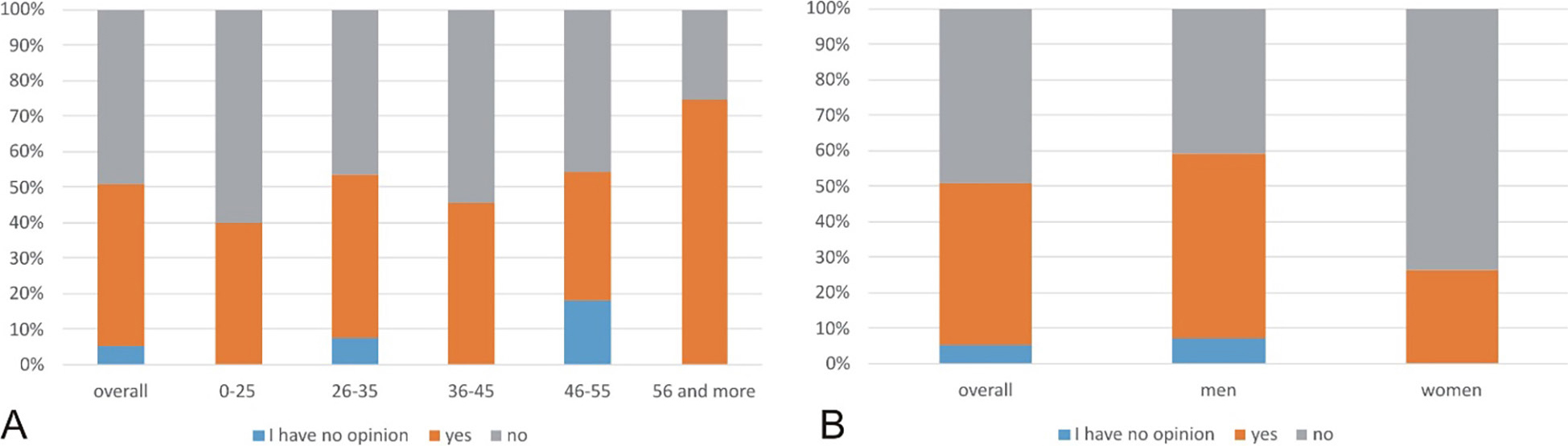
Fig. 5.
Identification of cave descents within tourist phenomena according to respondents overall, by age (A) and gender (B).
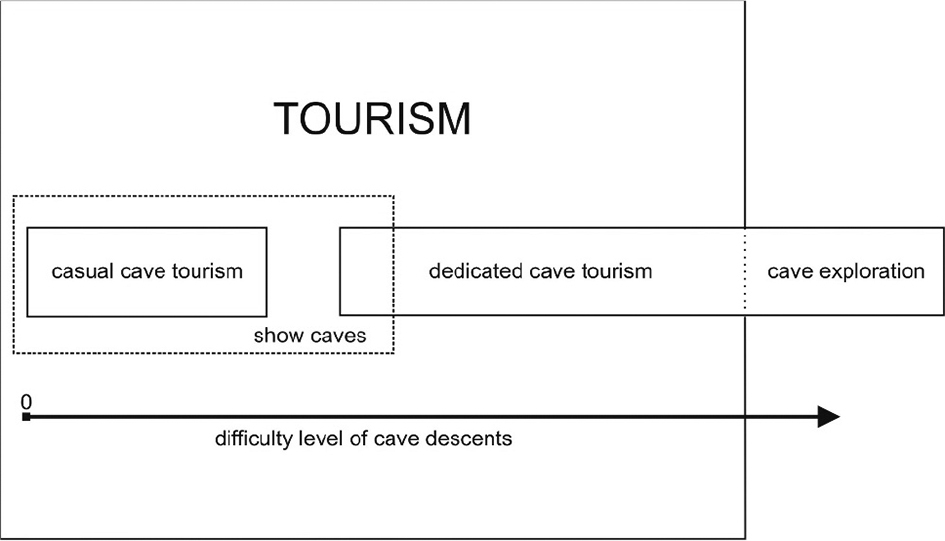
Fig. 6.
Cave tourism vs tourism.
Infrastructural and product development, and commercialisation seem to raise the tourist attractiveness of show caves in the eyes of casual cave tourists. For caves explored outside a regular tourist traffic, however, it is a threat, as it harms what constitutes their qualities – opportunities to experience existential authenticity. Consequently, from the point of view of the tourism market, are these latter caves and their group of enthusiasts lost? The answer to this question may be provided by research on the perception of the ‘difficulty’ of cave descents, serving to define the boundary beyond which cave descents cease to be tourism and become ‘something else’ (even if it means something different to everyone). In other words, it would be necessary to study what services or infrastructure, primarily in terms of providing access to caves, information, cave safety, would be desired by the caving community on the part of the tourism market, but which would not diminish the quality of the caving experience. It should be added, however, that this does not necessarily mean the massification of cave tourism, especially since worldwide cave communities strive to codify activities in caves that would be, on the one hand, ethical and, on the other hand, safe for the cave environment. The desired solutions lie more in the functional area (such as clear procedures and organisation of the cave rescue system, accessibility to emergency equipment, basic medical training, etc.) than in the infrastructure area. Caves cannot be treated as a place of competition and cave tourism is to develop sustainably (International Union of Speleology, 2013). Being traceless seems to be the underlying principle in dedicated cave tourism. This is especially important if we treat virgin caves as a non-renewable source (cf. Ganter 1998). Preserving the unique values of the caves in their most natural state is in the interest of both casual cave tourists (otherwise even show caves will resemble a city sidewalk) and dedicated cave tourists.
General conclusions
The studied group of people who go into non-tourist caves is heterogeneous in terms of their cave experience and the frequency with which they practise cave exploration, but quite homogeneous in terms of the basic motivations or expected benefits of undertaking the described activity.
Among the people participating in the study and assigned a priori to ‘dedicated/pure cave tourists’ based on their skills and formal qualifications, at least some do not perceive themselves as tourists. This usually has to do with the degree of difficulty of cave descents.
Cave tourism, in its specialised form, is a highly formative phenomenon – physically, emotionally, and to some extent spiritually (although not related to the cave perceived as sacrum).
Limitations and further research
Owing to the nature and size of the sample, the study provides limited opportunities for population-based inference, but could be comparative. Further analysis would need to be conducted on the psychological and emotional dimensions of the cave experience of different groups participating in tourist and exploratory cave descents, thus filling a gap that exists in the scientific literature.
Acknowledgements
The author would like to thank all study participants for sharing their experiences related to cave descents.
Notes
[2] Contributed by Authors’ contribution
All work on the paper was done by the author.