
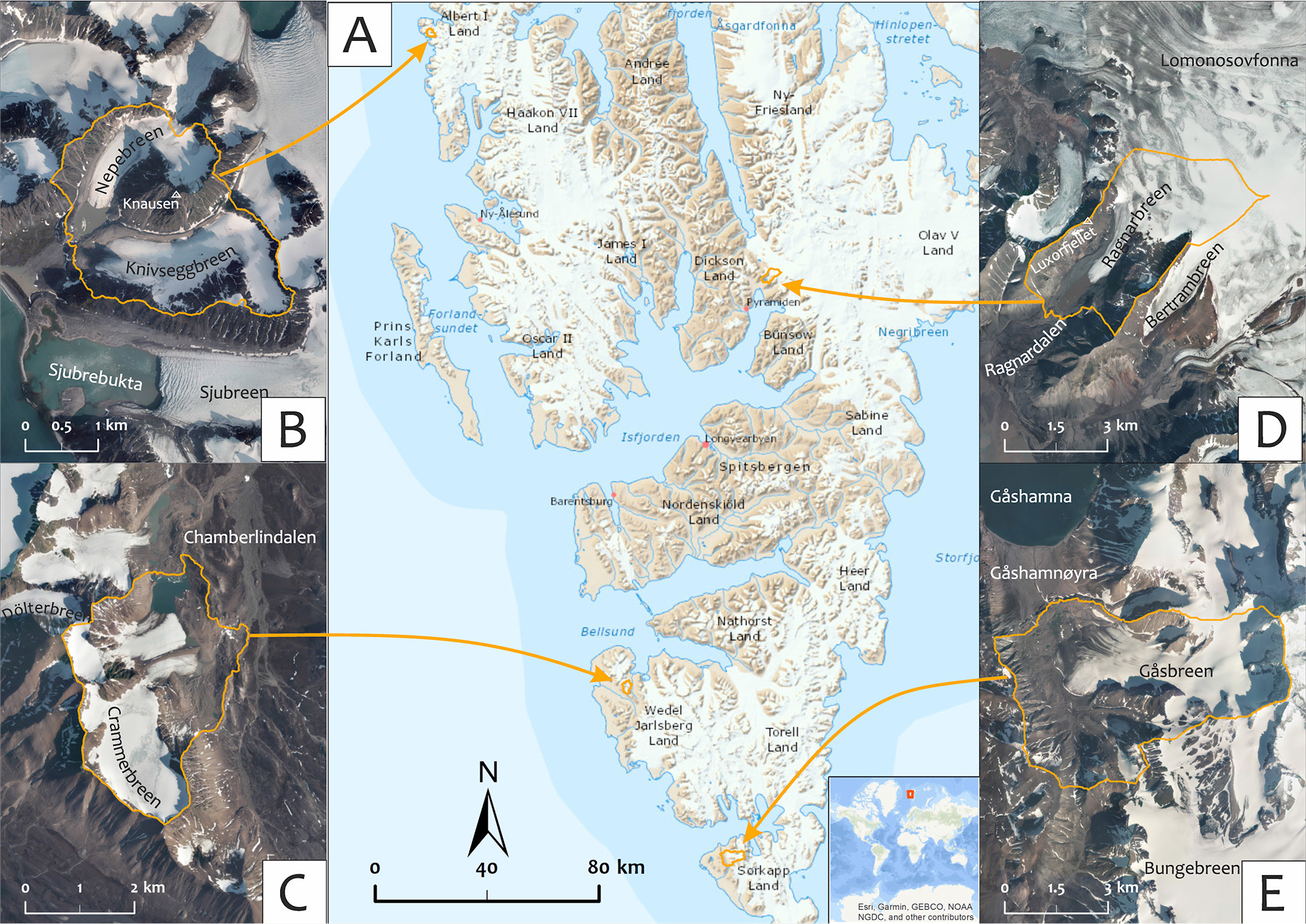
Fig. 1.
Selected catchments for case studies of Svalbard glacial lakes. A – Map of Spitsbergen, B – Nepebreen and Knivseggbreen watersheds, C – Crammerbreen watershed, D – Ragnarbreen watershed, E – Gåsbreen watershed. Source: NPI Ortofoto and Basiskart. NPI, Norwegian Polar Institute.
Table 1.
Summary of the basic morphometric and meteorological parameters of the selected catchments.
| Lake location near the glacier | Catchment area | Glacier area | Annual temperature | Annual precipitation | Altitude min-max | Glacier retreat |
|---|---|---|---|---|---|---|
| [km2] | [°C] | [mm] | [m a.s.l.] | [m · a−1] | ||
| Gåsbreen | 30.77 | 12.59 | −4.0 Osuch, Wawrzyniak (2017) | 432.9 Błaszczyk et al. (2019) | 18–1388 | 18 |
| Crammerbreen | 9.47 | 5.5 | −2.5 Repelewska-Pękalowa et al. (2013) | 32.4 Mędrek et al. (2014) | 55–820 | 11 |
| Knivseggbreen and Neppebreen | 6.30 | 2.87 | −6.9 | 200–400 | 51–716 | 4 |
| Ragnarbreen | 18.22 | 9.39 | >0 Rachlewicz, Styszyńska (2007) | 189.1 Bednorz, Jakielczyk (2014) | 86–939 | 9 |
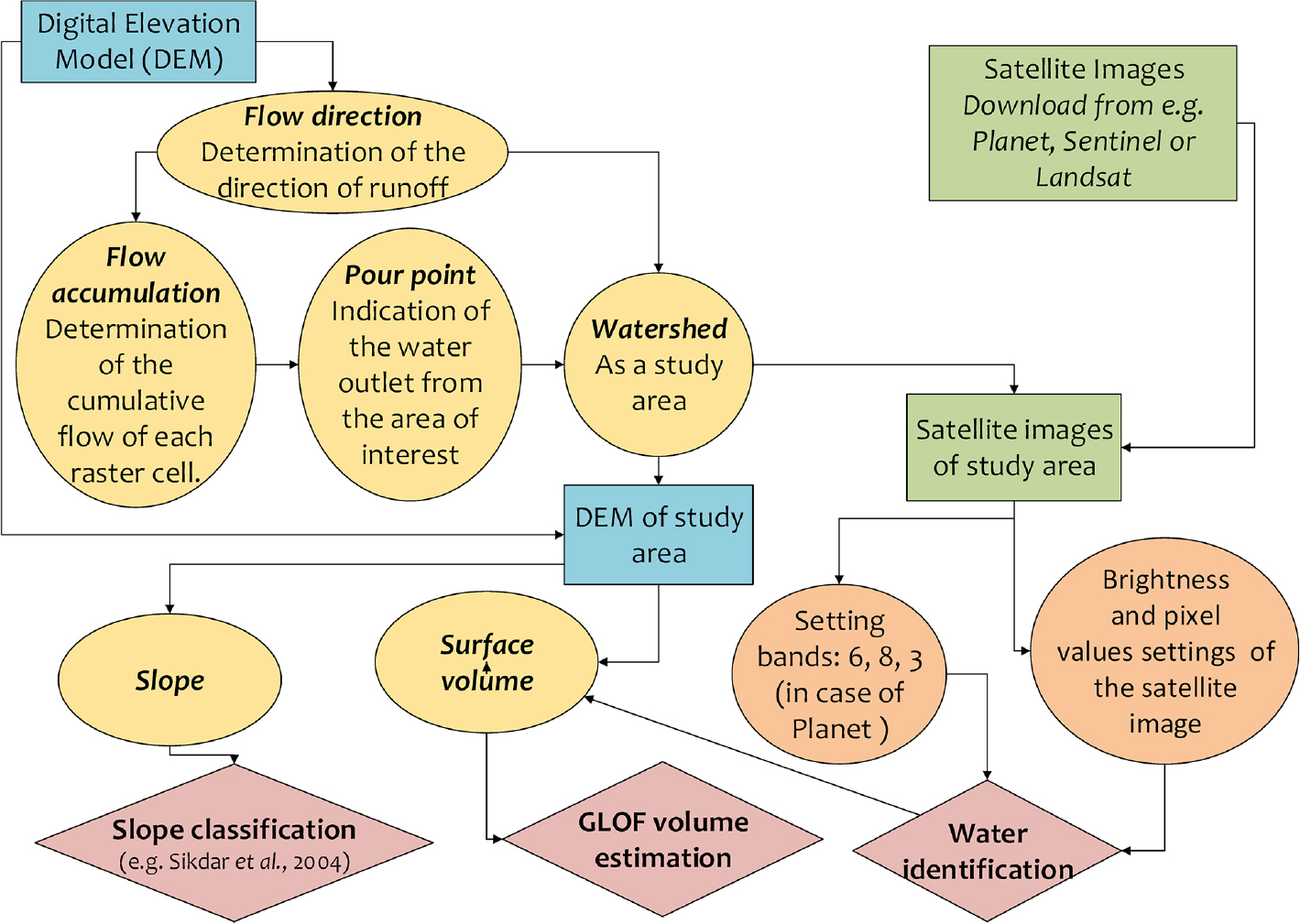
Fig. 2.
Methodological process. DEM – digital elevation model; GLOF – glacial lake outburst flood.
Table 2.
Comparison of glacial lake outburst flood type, area, and volume for glacial lakes in each watershed.
| Classification | Unit | Knivseggbreen | Nepebreen | Crammerbreen | Goësvatnet | Ragnarbreen |
|---|---|---|---|---|---|---|
| Frontal morainedammed lake | Frontal morainedammed lake | Medial-moraine dammed lake | Ice-dammed lake | Frontal morainedammed lake | ||
| Biggest recorded area (date) | [m2] | 115,166 (2015) | 206,859 (2022) | 418,292 (2019) | 930,000 (1938) | 546,743 (2023) |
| Area before GLOF | [m2] | 49,388 | 197,264 | 418,292 | 370,000 | – |
| Area after GLOF | [m2] | 0 | 145,741 | 197,395 | 50,000 | – |
| Estimated GLOF volume | [m3] | 666,389 | ND | 4,624,892 | 7,391,392 | – |
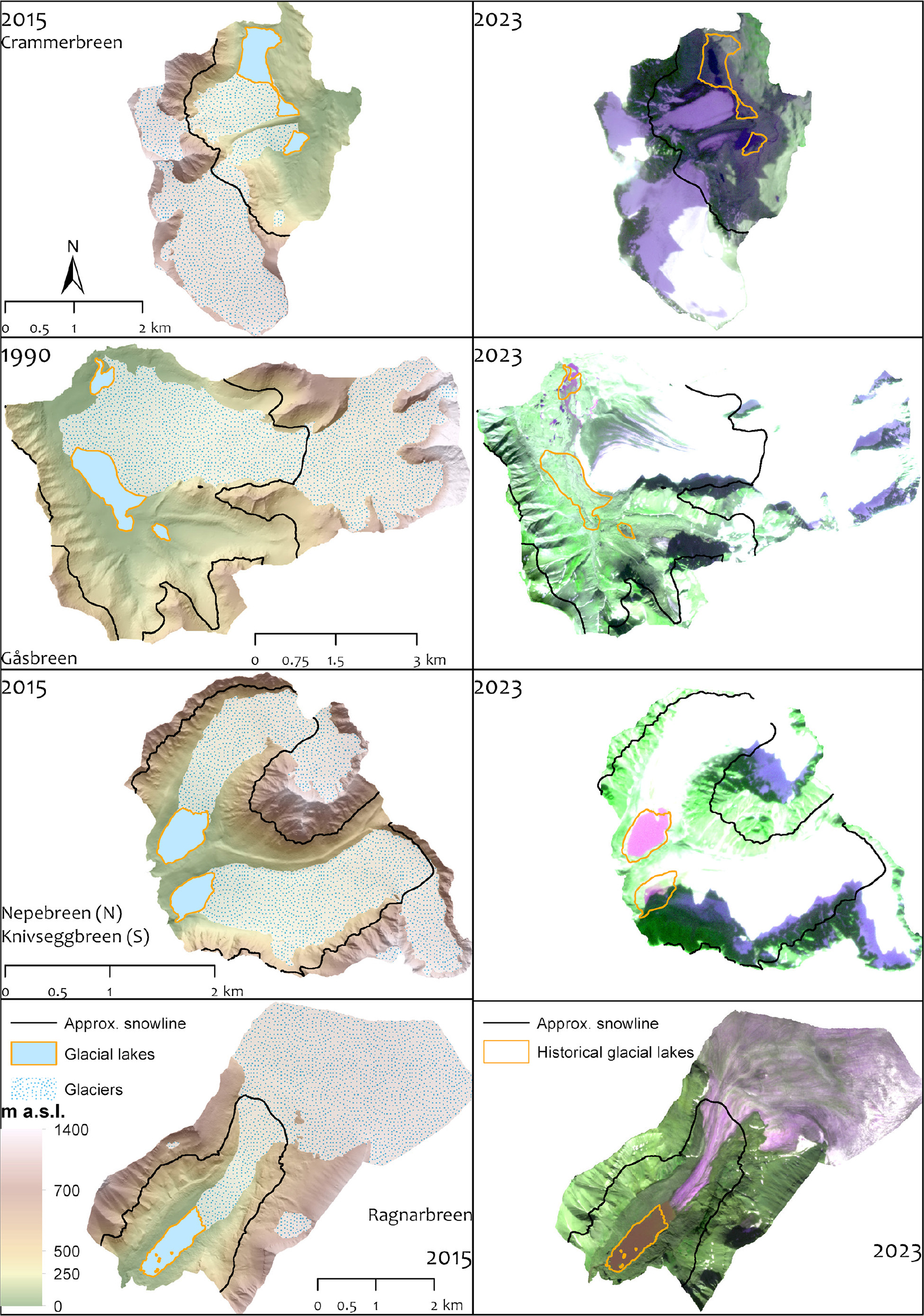
Fig. 3.
Catchments of Crammerbreen, Gåsbreen, as well as Knivseggbreen and Neppebreen before GLOF and in 2023 and catchment of Ragnarbreen in 2015 and 2023. The left column shows the DEM of the catchment before GLOF, and the right column shows the current state of the catchment as seen on satellite imagery using settings that emphasise water (glacial lakes) and glaciers. DEM – digital elevation model; GLOF – glacial lake outburst flood. Source: ArcticDEM, Image © 2023 Planet Labs PBC.
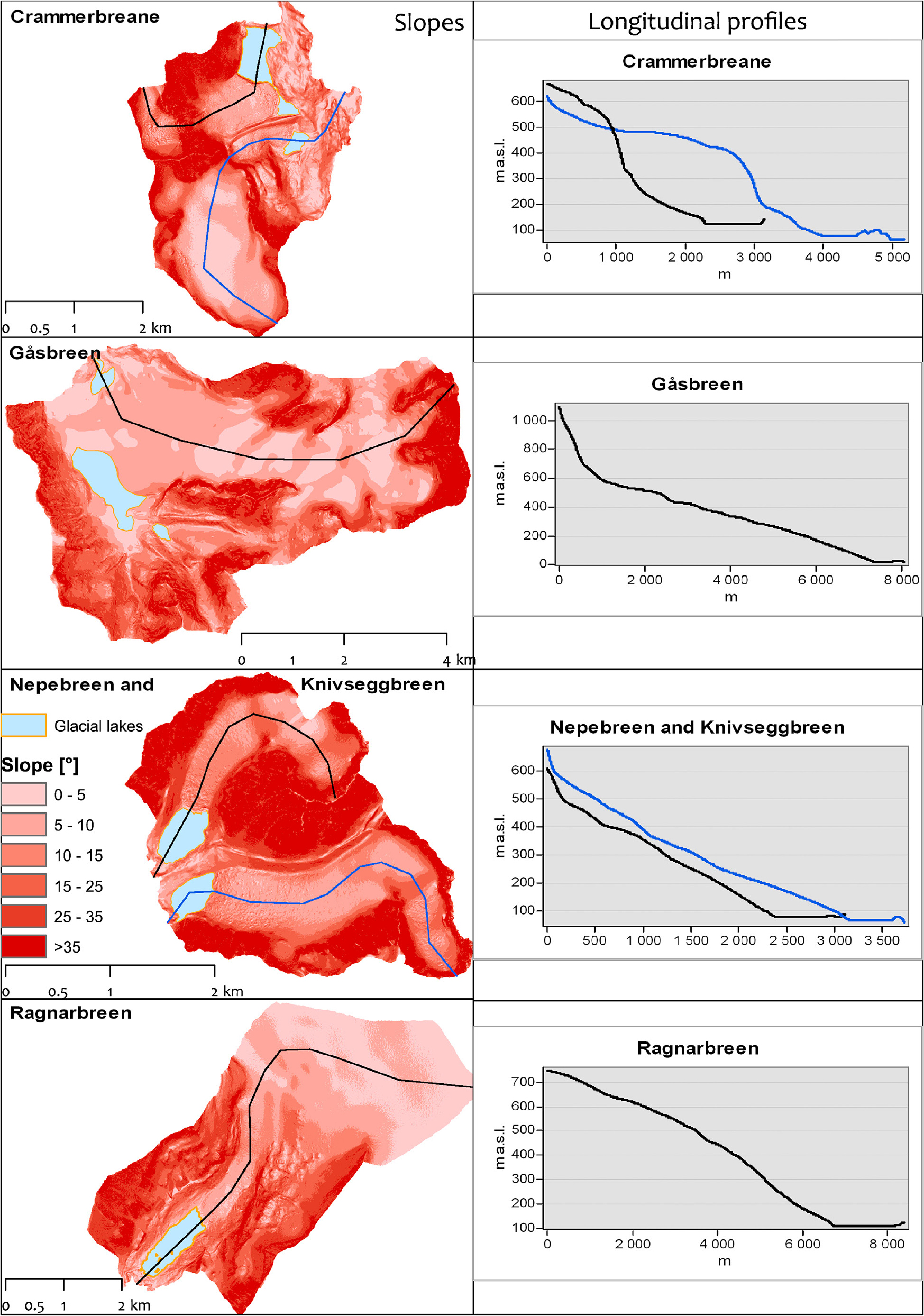
Fig. 4.
Comparison of slopes (left column) and the longitudinal profiles (right column) of different glaciers and their slopes. Source: ArcticDEM. DEM, digital elevation model.