
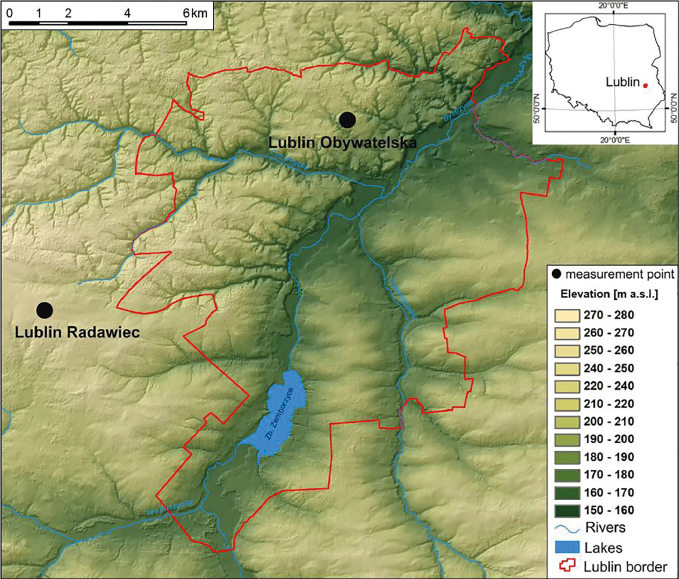
Fig. 1.
Location of measurement points.
Table 1.
Scale of assessment of thermal stress of the organism according to UTCI, and ways of counteracting unfavourable biothermal conditions from a given class (Błażejczyk et al. 2013).
| UTCI [°C] | Stress category | Physiological responses |
|---|---|---|
| >46 | extreme heat stress (EHS) |
|
| 38.1–46.0 | very strong heat stress (VSHS) |
|
| 32.1–38.0 | strong heat stress (SHS) |
|
| 26.1–32.0 | moderate heat stress (MHS) |
|
| 9.1–26.0 | no thermal stress (NTS) |
|
| 0.1–9.0 | slight cold stress (SlCS) |
|
| -12.9 to 0.0 | moderate cold stress (MCS) |
|
| -26.9 to -13.0 | strong cold stress (SCS) |
|
| -39.9 to -27.0 | very strong cold stress (VSCS) |
|
| <-40.0 | extreme cold stress (ECS) |
|
Table 2.
Scale of the estimation of air quality according to the CAQI calculation grid (van den Elshout et al. 2014).
| Index | Grid | City background | |||||
|---|---|---|---|---|---|---|---|
| Core pollutants | Pollutants | ||||||
| NO2 | PM10 | O3 | PM2.5 | CO | SO2 | ||
| [μg · rn 1 | |||||||
| very low class (VLC) | 0 | 0 | 0 | 0 | 0 | 0 | 0 |
| 25 | 50 | 25 | 60 | 15 | 5000 | 50 | |
| low class (LC) | 25 | 50 | 25 | 60 | 15 | 5000 | 50 |
| 50 | 100 | 50 | 120 | 30 | 7500 | 100 | |
| medium class (MC) | 50 | 100 | 50 | 120 | 30 | 7500 | 100 |
| 75 | 200 | 90 | 180 | 55 | 10,000 | 350 | |
| high class (HC) | 75 | 200 | 90 | 180 | 55 | 10,000 | 350 |
| 100 | 400 | 180 | 240 | 110 | 20,000 | 500 | |
| very high class (VHC) | >100 | >400 | >180 | >240 | >110 | >20,000 | >500 |
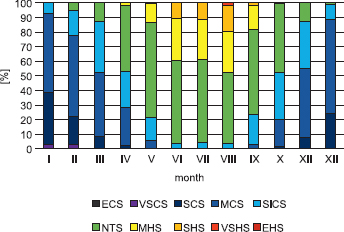
Fig. 2.
Frequency of occurrence of thermal stress classes (UTCI) at 12 UTC.
EHS – extreme heat stress; ESC – extreme cold stress; MHS – moderate heat stress; MSC – moderate cold stress; NTS – no thermal stress; SCS – strong cold stress; SHS – strong heat stress; SlCS – slight cold stress; VSCS – very strong cold stress; VSHS – very strong heat stress.
Table 3.
| Pollutant | Unit | Averaging time | AQG level (WMO 2005 recommendation) | AQG level (WMO 2021 recommendation) | Dz.U.2021.845 |
|---|---|---|---|---|---|
| PM2.5 | μg · m−3 | Annual | 10 | 5 | 20c |
| 24-h | 25 | 15a | – | ||
| PM10 | Annual | 20 | 15 | 40c | |
| 24-h | 50 | 45a | 50c | ||
| O3 | Peak season | 60b | |||
| 8-h | 100 | 100a | 120d | ||
| No2 | Annual | 40 | 10 | 40c | |
| 24-h | – | 25a | – | ||
| SO2 | Annual | – | 20 | ||
| 24-h | 20 | 40a | 125 | ||
| CO | mg · m–3 | 24-h | – | 4a | – |
1b mean daily value of maximum 8-h O3 concentration in 6 subsequent months with a higher level of O3 concentration
1d maximum 8-h mean value among rolling averages calculated from 1-h means in a day; each resulting 8-h mean is ascribed to the day in which it ends; the first calculation period for each day is the period from 17:00 of the previous day to 10:00 of the following day; the last calculation period for each day is the period from 16:00 to 24:00 of that day, all time yardsticks being based on Central European Time (CET).
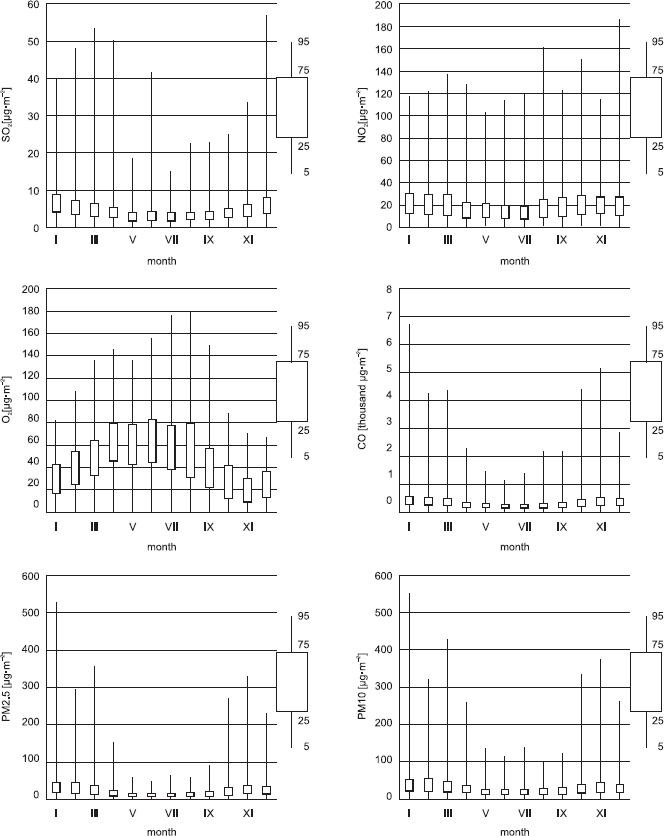
Fig. 3.
Monthly values of the 5th, 25th, 75th and 95th percentiles of selected air pollutants in Lublin (2015–2021).
Table 4.
Mean annual concentration values (μg o m−3) of selected air pollutants in Lublin (2015–2021).
| Pollutants | 2015 | 2016 | 2017 | 2018 | 2019 | 2020 | 2021 | 2015–2021 |
|---|---|---|---|---|---|---|---|---|
| SO2 | 3.6 | 3.8 | 5.2 | 4.8 | 4.8 | 4.3 | 5.0 | 4.5 |
| NO2 | 23.3 | 21.7 | 21.7 | 21.5 | 19.5 | 17.2 | 17.0 | 20.3 |
| CO | 300 | 400 | 400 | 400 | 300 | 300 | 300 | 400 |
| O3 | 45.1 | 37.4 | 48.0 | 48.8 | 50.6 | 43.1 | 37.6 | 44.4 |
| PM2.5 | 28.1 | 26.6 | 22.0 | 24.5 | 20.3 | 18.7 | 23.9 | 23.4 |
| PM10 | 36.4 | 30.8 | 32.5 | 33.6 | 26.5 | 22.3 | 28.9 | 30.1 |
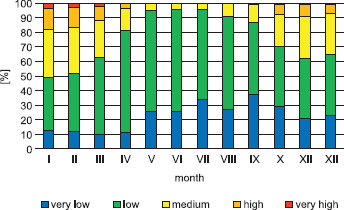
Fig. 4.
Frequency of occurrence of air quality classes according to CAQI during the day.
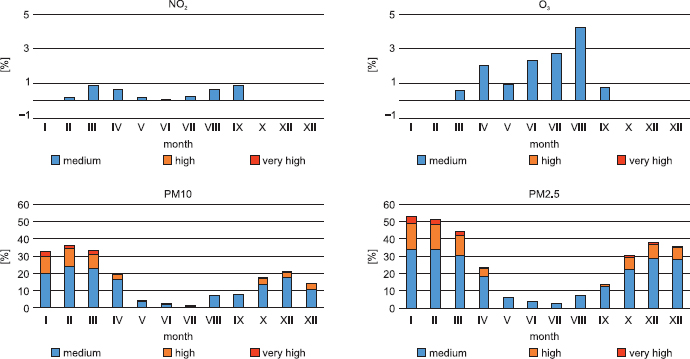
Fig. 5.
Frequency of occurrence of air quality classes (CAQI) during the day, determined by NO2, O3, PM10 and PM2.5.
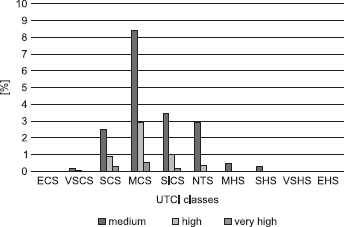
Fig. 6.
Frequency of occurrence of classes of medium (MC), high (HC) and very high (VHC) CAQI air quality during particular types of UTCI thermal stress.
EHS – extreme heat stress; ESC – extreme cold stress; MHS – moderate heat stress; MSC – moderate cold stress; NTS – no thermal stress; SCS – strong cold stress; SHS – strong heat stress; SlCS – slight cold stress; VSCS –very strong cold stress; VSHS – very strong heat stress.
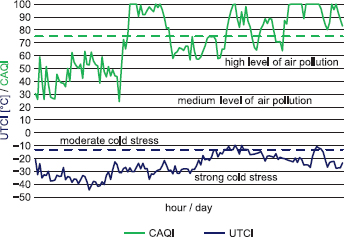
Fig. 7.
Course of the CAQI and UTCI indices during the cold wave in Lublin during 6–11 January 2017.
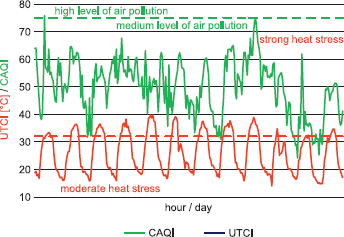
Fig. 8.
Course of the CAQI and UTCI indices during the heat wave in Lublin during 4–15 August 2015.