
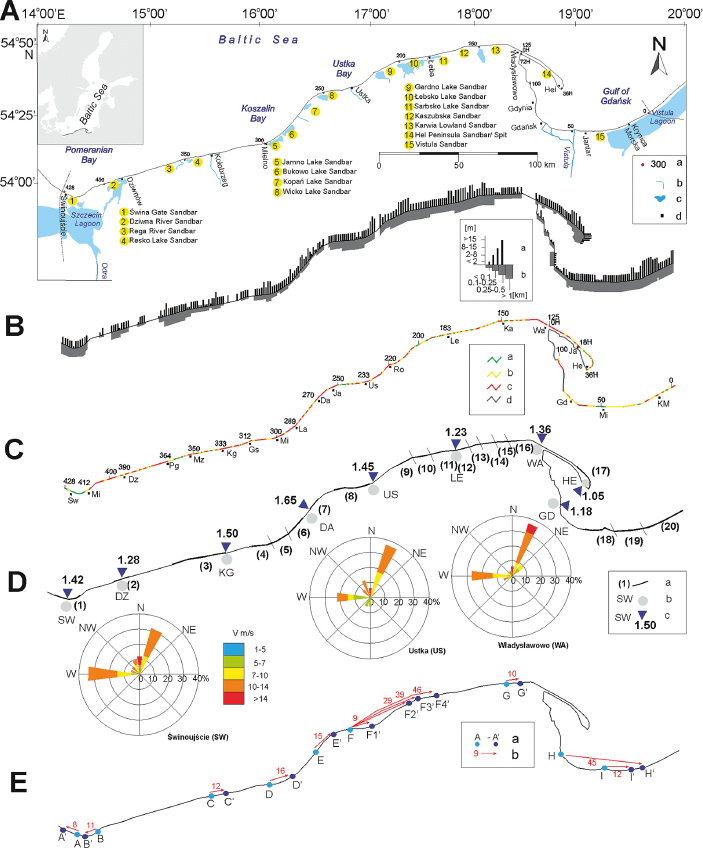
Fig. 1.
The Polish Baltic coast.
A – coastline with sandbars’ location, a – coast kilometrage 0–428, b – rivers, c – lakes and lagoons, d – main towns. B – sandbars’ morphology, a – height, b – width. C – the average trend of coast dynamics with kilometrage division (Łabuz 2013), a – accumulative, b – stable, c – erosive, d – no data. D – analysed sections of the coast, highest sea level (SL) and wind roses during Axel, a – investigated sandbars, see Table 3, b – gauge stations, c – maximum sea level. E – location change of artefacts washed from the land and shifted by surge Axel (Table 4), a – from location A to new position A’, b – No. of shifted kilometres.
Table 1.
Characteristics of storm surges during autumn–winter 2016/2017 along Polish gauge stations (location in Fig. 1D).
| No. | 1 | 2 | 3 | 4 | 5 | 6 | Mean SL [m] |
|---|---|---|---|---|---|---|---|
| Date | 4–6.10.2016 | 3–4.11.2016 | 27–28.11.2016 | 12–14.12.2016 | 27–28.12.2016 | 4–6.01.2017 | – |
| Name | Angus | NN | NN | NN | Barbara | Axel | – |
| Wind velocity (m · s−1) | 13–17 | 11–14 | 12–15 | 11–14 | 13–18 | 13–18 | – |
| Wind direction | NE–NNE | W–NNW | WNW–NNW | W–WNW | NW–N | NW–NE | – |
| Świnoujście (SW) | 1.13 | 0.48 | 0.93 | 0.66 | 0.90 | 1.42 | 0.92 |
| Kołobrzeg (KG) | 0.63 | 0.53 | 0.72 | 0.64 | 1.12 | 1.50 | 0.86 |
| Darłowo (DA) | 0.42 | 0.44 | 0.56 | 0.55 | 0.89 | 1.65 | 0.75 |
| Ustka (US) | 0.40 | 0.46 | 0.56 | 0.53 | 0.88 | 1.45 | 0.71 |
| Łeba (LE) | 0.42 | 0.40 | 0.57 | 0.47 | 0.74 | 1.23 | 0.64 |
| Wład. (WA) | 0.54 | 0.32 | 1.01 | 0.46 | 0.92 | 1.36 | 0.77 |
| Hel (HE) | 0.36 | 0.25 | 0.71 | 0.44 | 0.84 | 1.05 | 0.61 |
| Gdansk (GD) | 0.40 | 0.18 | 0.82 | 0.35 | 0.75 | 1.18 | 0.61 |
| Mean SL (m) | 0.54 | 0.38 | 0.74 | 0.51 | 0.88 | 1.36 | 0.74 |
Table 2.
Characteristics of the Axel January 2017 storm surge along Polish gauge stations (location in Fig. 1D).
| Harbour, gauge station | Świnoujście (SW) | Kołobrzeg (KG) | Darłowo (DA) | Ustka (US) | Łeba (LE) | Władysławowo (WA) | Gdańsk (GD) |
|---|---|---|---|---|---|---|---|
| Location of harbour | 53°55’N 14°16′E | 54°11’N 15°33′E | 54°26’N 16°22′E | 54°45’N 16°51’E | 54°46’N 17°33’E | 54°47’N 18°25’E | 54°21’N 18°39’E |
| Wind V max [m · s−1] | 14–15 | 14–16 | 15–18 | 13–15 | 14–15 | 12–16 | 12–14 |
| Wind duration V > 10 [m · s−1] (t, h) | 62 | 65 | 57 | 54 | 55 | 50 | 42 |
| Storm duration H > 0.8 m (t, h) | 39 | 36 | 30 | 33 | 31 | 34 | 27 |
| Storm duration H > 1 m (t, h) | 28 | 26 | 23 | 20 | 14 | 19 | 11 |
| Storm duration H > 1.2 m (t, h) | 18 | 15 | 12 | 9 | 3 | 7 | 0 |
| Max. SL, 4 Jan (h) | 10 | 10 | 11 | 11 | 14 | 14 | 17 |
| Max. sea level [m AMSL] | 1.42 | 1.50 | 1.65 | 1.45 | 1.23 | 1.36 | 1.18 |
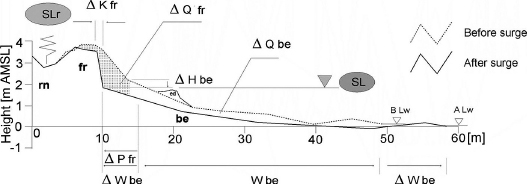
Fig. 2.
Forms measured along the profile and indicators of their dynamics (B – before the surge, A – after the surge).
DHbe – beach height change; DKfr – foredune top/edge change; DPfr – foredune foot change; DQbe – beach sand volume change; DQfr – foredune sand volume change; DWbe – beach width change; ALw – water line after the surge; BLw – water line before the surge; SL – sea level; SLr – water run-up; Wbe – beach width.
Table 3.
List and date of investigated sandbar sections, average dune toe erosion and selected SL parameters during Axel storm surge (location in Figure 1A, C).
| No. | Investigated sandbar name/part | Length [km] | Measurement date, before, after surge (month) | Average dune toe retreat (m) | SL > 1 m (t, h) | Max. SL in gauge station, SL [m] | Max. run-up on the shore, SLR [m] | Harbour (gauge station), location | ||
|---|---|---|---|---|---|---|---|---|---|---|
| Before, in 2016 | After, in 2017 | Mean | Median | |||||||
| 1 | Świna Gate | 16 | 9, 11, 12 | 1, 4 | 5.4 | 5.7 | 28 | 1.42 | 3.9 | Świnoujście (SW) 53°55N 14°16E |
| 2 | Dziwnów | 11 | 9 | 1, 6 | 7.3 | 7.5 | 28 | 1.42 | 3.7 | |
| 3 | Liwia Lake to Rega river | 15 | 9 | 2, 4 | 4.4 | 4.1 | 28 | 1.42 | 3.8 | |
| 4 | Resko Lake to Parsęta river | 14 | 9, 11 | 2, 5 | 6.0 | 5.9 | 26 | 1.50 | 3.7 | Kołobrzeg (KG) 54°11N 15°33E |
| 5 | Jamno Lake | 11 | 9 | 2, 9 | 6.2 | 5.2 | 26 | 1.50 | 3.7 | |
| 6 | Bukowo Lake | 12 | 9 | 1, 9 | 9.4 | 9.8 | 23 | 1.65 | 3.9 | Darłowo (DA) 54°26N 16°22E |
| 7 | Kopań Lake | 10 | 9 | 1, 9 | 8.4 | 9.0 | 23 | 1.65 | 4.1 | |
| 8 | Wicko Lake | 15 | 6 | 3, 6 | 5.3 | 4.0 | 20 | 1.45 | 3.8 | Ustka (US) |
| 9 | Gardno Lake | 10 | 9 | 4, 9 | 3.6 | 3.0 | 20 | 1.45 | 3.6 | 54°45N 16°51E |
| 10 | Lebsko Lake 1/west/Czołpińska Dune | 10 | 9, 11 | 4, 9 | 5.4 | 3.5 | 14 | 1.23 | 3.5 | Łeba (LE) 54°46N 17°33E |
| 11 | Lebsko Lake 2/east/Łącka Dune | 16 | 9, 11 | 4, 9 | 5.0 | 2.7 | 14 | 1.23 | 3.5 | |
| 12 | Sarbska Sandbar | 9 | 9, 11 | 4, 9 | 4.5 | 3.1 | 14 | 1.23 | 3.4 | |
| 13 | Kaszubska 1/west/Stilo Dunes | 7 | 9, 11 | 4, 9 | 7.9 | 8.0 | 14 | 1.23 | 3.4 | |
| 14 | Kaszubska 2/middle/Lubiatowska Dune | 6 | 9 | 5, 6 | 5.5 | 4.2 | 19 | 1.36 | 3.4 | Władysławowo (WA) 54°47N 18°25E |
| 15 | Kaszubska 3/east/Biała Góra Dune | 9 | 9, 11 | 5, 9 | 3.6 | 1.8 | 19 | 1.36 | 3.5 | |
| 16 | Karwia | 12 | 9, 11 | 6 | 4.9 | 19 | 1.36 | 3.6 | ||
| 17 | Hel Spit | 35 | 9, 11 | 4, 6 | 6.8 | 8.0 | 19 | 1.36 | 3.8 | |
| 18 | Vistula Sandbar 1/west/channel mouth | 10 | 11 | 2, 6 | 2.3 | 2.1 | 11 | 1.18 | 3.7 | Gdańsk (GD) 54°21N 18°39E |
| 19 | Vistula Sandbar 2/middle part | 19 | 11 | 4, 6 | 4.2 | 4.1 | 11 | 1.18 | 3.7 | |
| 20 | Vistula Sandbar 3/east/Camel Hump Dune | 24 | 11 | 6 | 4.4 | 4.5 | 19 | 1.36 | 3.9 | Władysławowo (WA) 54°47N 18°25E |
Table 4.
Characteristics of the transported large items during storm surge Axel (location in Fig. 1E).
| No. | Item characteristics | Weight in ca. kg | No. of travelled km | Azimuth, from–to | Shift (sandbar/town, coast kilometrage start-end) |
|---|---|---|---|---|---|
| A | Wooden platform 5 m × 5 m | 20 | 8 | E–WNW | Świnoujscie to Ahlbeck, from 426 toward the west |
| B | Wooden board 6 m × 2 m | 8–10 | 11 | E–WNW | Międzyzdroje to Świnoujscie 411–422 |
| C | Metal garbage can 1 m × 0.5 m | 5 | 12 | WSW–NNE | Rega, 350–338 |
| D | Plastic parts from coast protection 0.5 m × 0.5 m | 1–2 | 16 | W–NE | Jamno to Bukowo, 300–284 |
| E | Metal garbage can 1 m × 0.5 m | 3–4 | 15 | W–NE | Kopań, 270–258 |
| F1 | Wooden and metal construction/military aim 8 m × 5 m | 5–8 | 9 | W–ENE | Wicko, 242–233 |
| F2 | Wooden and metal construction/military aim 5 m × 5 m | 3–5 | 29 | W–NE | Wicko to Gardno, 242–213 |
| F3 | Wooden and metal construction/military aim 5 m × 5 m | 4–6 | 39 | W–NNE | Wicko to Łebsko, 242–203 |
| F4 | Wooden and metal construction/military aim 5 m × 5 m | 4–6 | 46 | W–NNE | Wicko to Łebsko, 242–196 |
| G | Plastic parts from coast protection 0.5 m × 0.5 m | 1–2 | 10 | NW–SE | Karwia, 140–131 |
| H | Wooden and plastic parts from harbour 2 m × 3 m | 3–6 | 45 | W–E | Vistula, 75–30 |
| I | Floating trunk wood from Vistula river mouth, several, largest 12 m × 1 m | 30–50 | 12–17 | W–E | Vistula, 49–37 (32) |
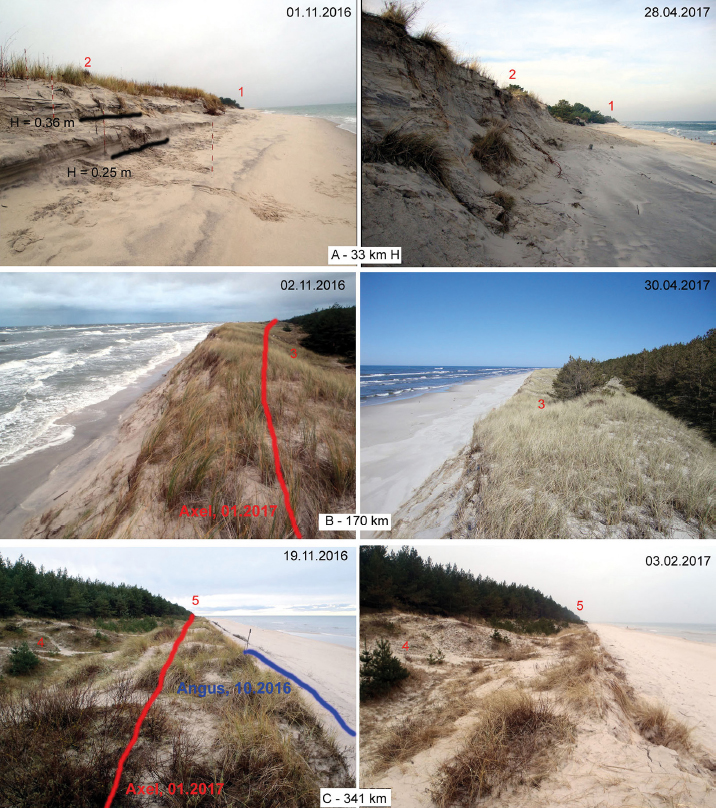
Fig. 3.
Examples of dune retreat caused by lower surges in 2016 and Axel in 2017.
A – two cutoffs of the dune after October and November surge (black lines) vs large erosion after Axel surge, Hel Spit 33 km H. B – cut off during November surge vs retreat after January 2017 (red line), Kashubian Sandbar, 170 km. C – erosion after October and November surge vs retreat after January 2017 (red line), Resko Lake Sandbar, 341 km; 1–5 – the same clumps of pine trees.
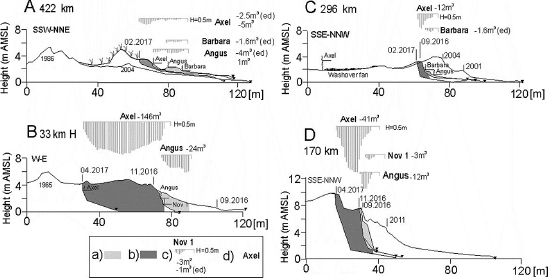
Fig. 4.
Dune erosion related to beach height, coast orientation and SL during low surges in 2016 and Axel in 2017.
A – concave bay on the west coast exposed to NNE. B – cutoff of the promontory exposed to NE on the Hel Spit. C – concave bay with high beach exposed to NW from the middle coast. D – retreat of promontory exposed to NW on the east coast. a – erosion during surges in 2016, b – erosion during Axel in 2017, c – morphodynamic bars (dynamic layer) every 1 m and total volume of the eroded dune (DQfr) or embryo dune (DQed), d – the height of surge run-up to the shore (HSLr).
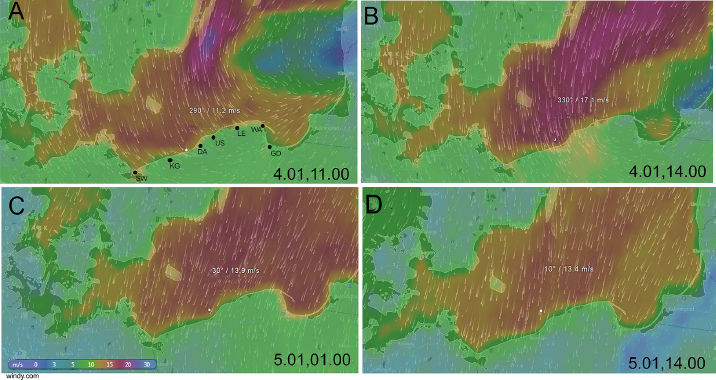
Fig. 5.
Phases of wind course during storm surge Axel in 2017 (SW to GD – gauge stations).
A – NW to NNW, rapid SL growth. B – N to NNE, maximum surge. C – NNE, slow SL drop. D – NNE to NE, wind decrease and sea level drop.
Source: windy.com.
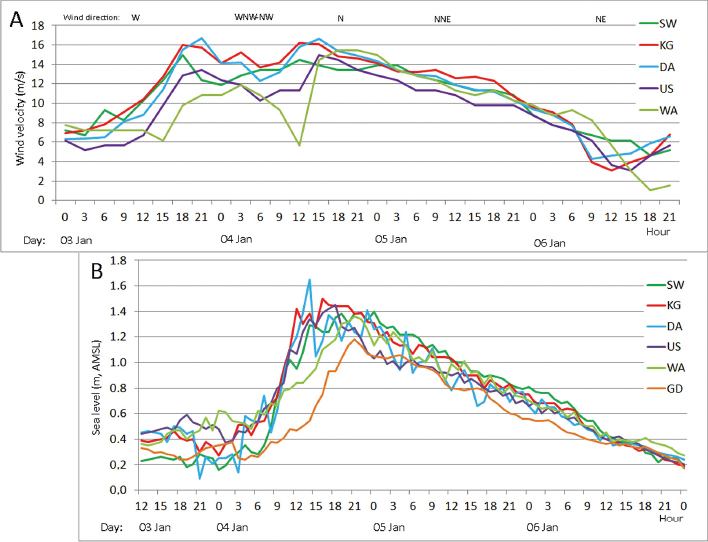
Fig. 6.
Wind and sea level course during storm surge Axel in 2017 (SW–GD – main gauge and wind stations, see Fig. 1).
Table 5.
Coefficients correlation of selected input and output variables of storm surge Axel in January 2017.
| Dependent variables | Max. SL (HSL, m) | SL length (TSL H > 0.8 m, h) | SL length (TSL H > 1.0 m, h) | SL length (TSL H > 1.2 m, h) | Max. run-up (HsLr, m) | Dune toe retreat (DPfr, m) |
|---|---|---|---|---|---|---|
| Independent variables | ||||||
| Max. SL (HSL, m) | × | 0.40 | 0.82 | 0.76 | 0.62 | 0.42 |
| SL length (TSL H > 0.8 m, h) | 0.40 | × | – | – | 0.38 | 0.17 |
| SL length (TSL H > 1.0 m, h) | 0.82 | – | × | – | 0.51 | 0.45 |
| SL length (TSL H > 1.2 m, h) | 0.76 | – | – | × | 0.75 | 0.42 |
| Max. wind vel. (Vw, m · s−1) | 0.79 | 0.18 | 0.50 | 0.49 | 0.83 | 0.83 |
| Time V > 10 m · s−1 (Vw, h) | 0.70 | 0.72 | 0.81 | 0.83 | 0.86 | 0.39 |
| Max. run-up (HSLr, m) | 0.62 | 0.01 | 0.40 | 0.43 | × | 0.55 |
| 1 Beach height before (Hbe B, m) | × | × | × | × | × | 0.49 |
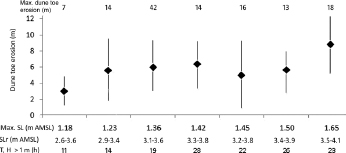
Fig. 7.
Relation of surge parameters to mean (sign), average (line) and max. value of erosion rate during surge Axel in 2017.
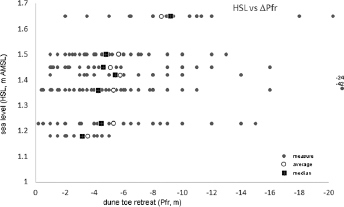
Fig. 8.
Relation of dune toe retreat (DPfr) to sea level (HSL) along the Southern Baltic coast during surge Axel in 2017.
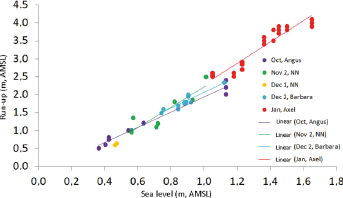
Fig. 9.
Relation of sea level (HSL) to water run-up height (HSLr) on the coast during all surges in 2016/2017, each dot marks measured SLr in the field, surges in Table 1.
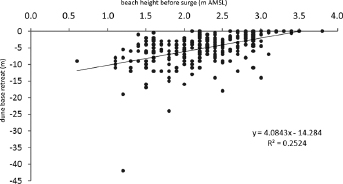
Fig. 10.
Relation of dune toe erosion (DPfr) to beach height (Hbe) in total during the Axel surge in January 2017.
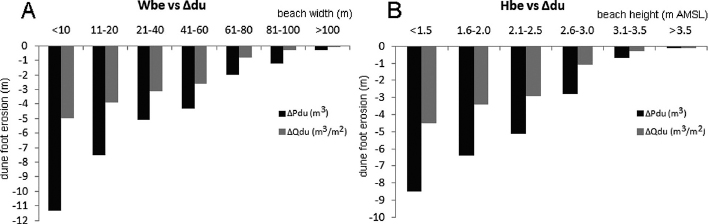
Fig. 11.
Overall relation of dune toe erosion (DPfr) to beach parameters (Hbe, Wbe) rate in January 2017.
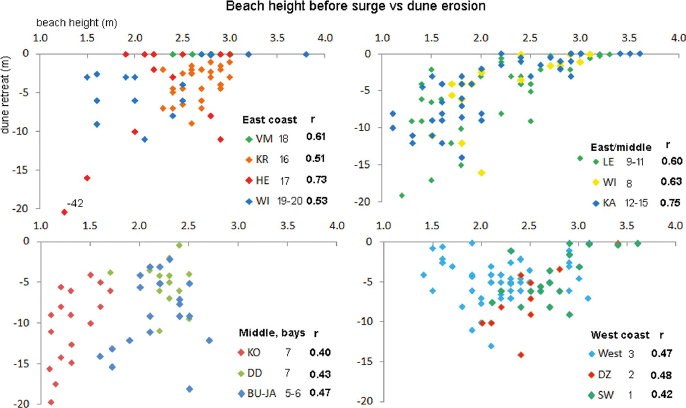
Fig. 12.
Relation of dune toe erosion (DPfr) to beach height (Hbe) on investigated sandbars divided for coast sections (Nos 1–20, Table 3) and Pearson coefficient (r) in January 2017.
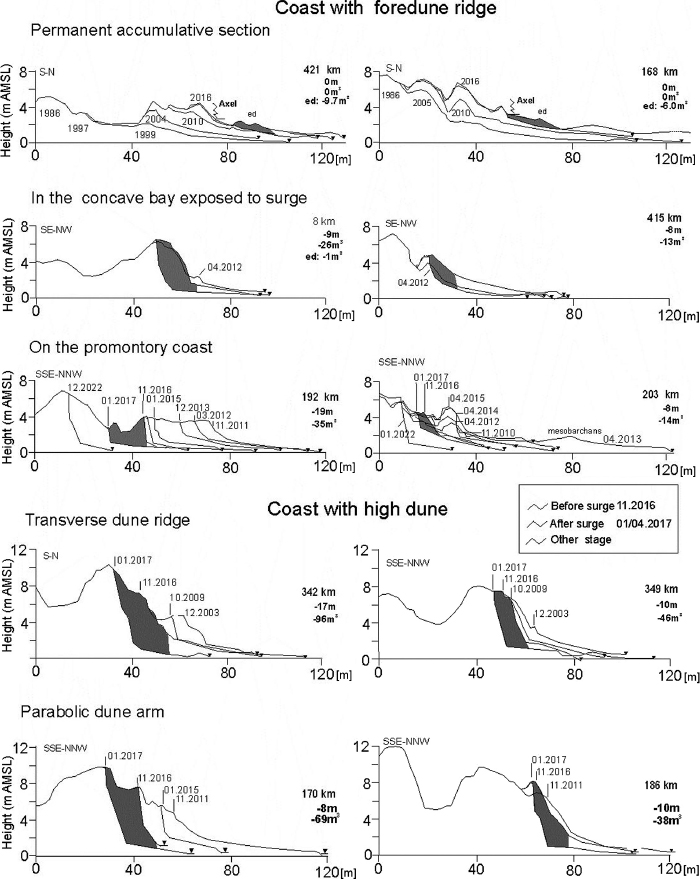
Fig. 13.
Erosion rate of the dune on the coast with different expositions during storm Axel, given toe retreat (m) and sand volume in grey (m3) of dune or embryo dune (ed), marked max. run-up and dates of dune’s previous position.
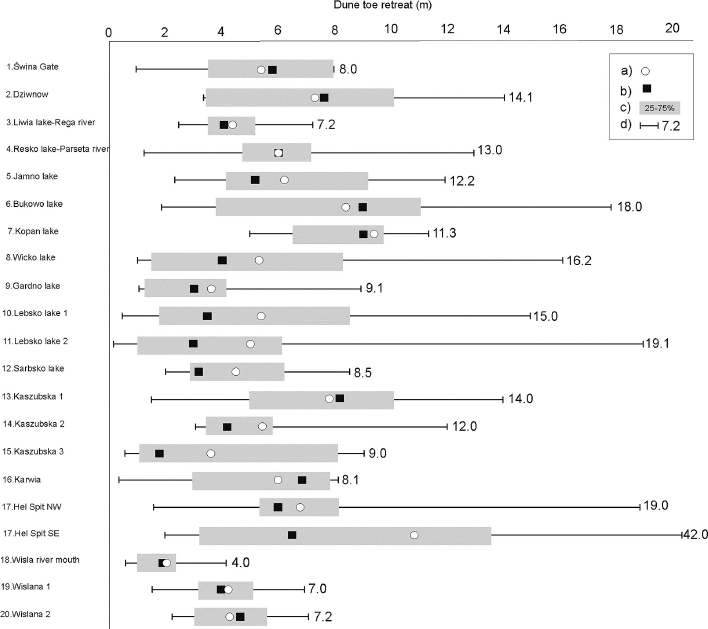
Fig. 14.
Statistical threshold values of the dune toe erosion caused by storm Axel, on investigated sandbars’ sections (Table 3).
a – average, b – median, c – 25–75 percentile of cases, d – min. and max. values.
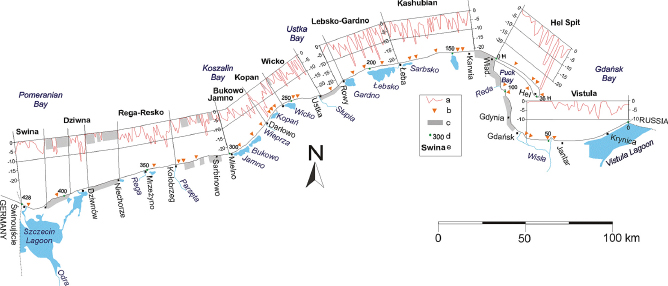
Fig. 15.
Dune retreat along Polish South Baltic coast during storm Axel in January 2017.
a – dune retreat (m), b – washover fans on the coast, c – no data, cliff coast or wetlands in bays, d – main kilometre division, e – names of main sandbars.