
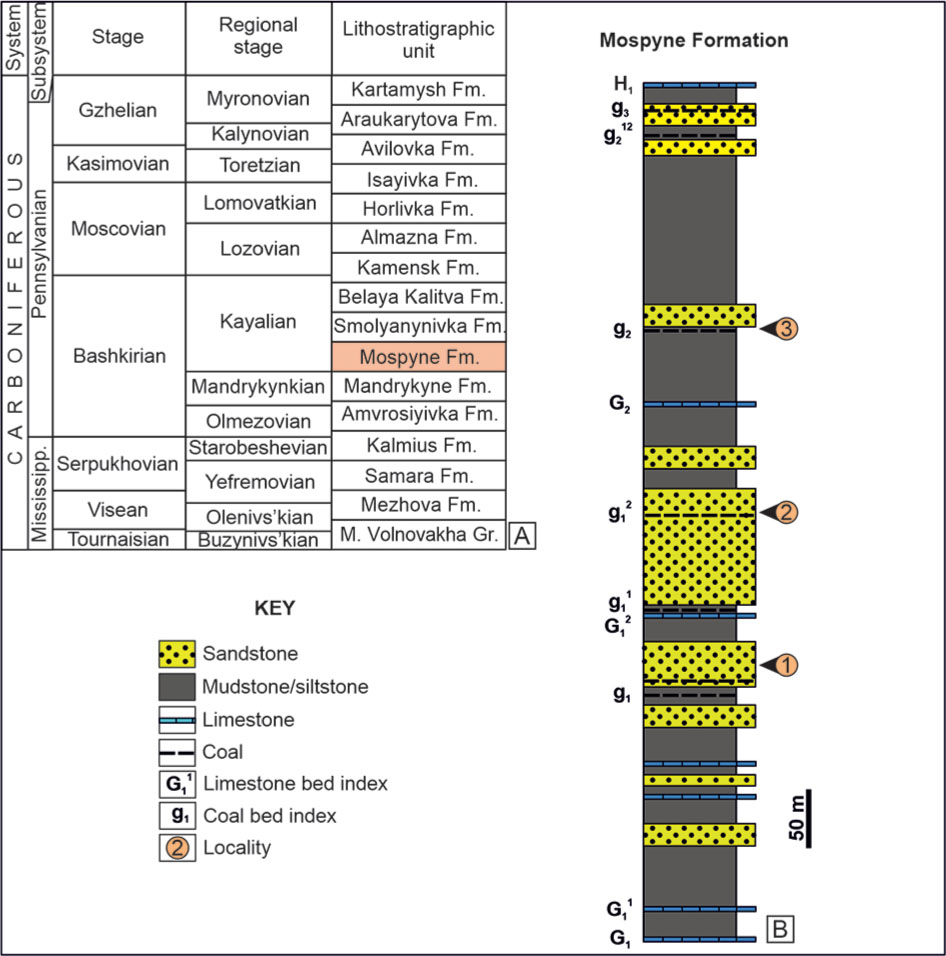
Fig. 1.
A – Stratigraphic position of the Mospyne Formation within the Carboniferous succession of the Donets Basin. B – Stratigraphic position of the xiphosurid-bearing horizons within the Mospyne Formation. Abbreviations: Fm, Formation; Gr, Group; M., Mokra.
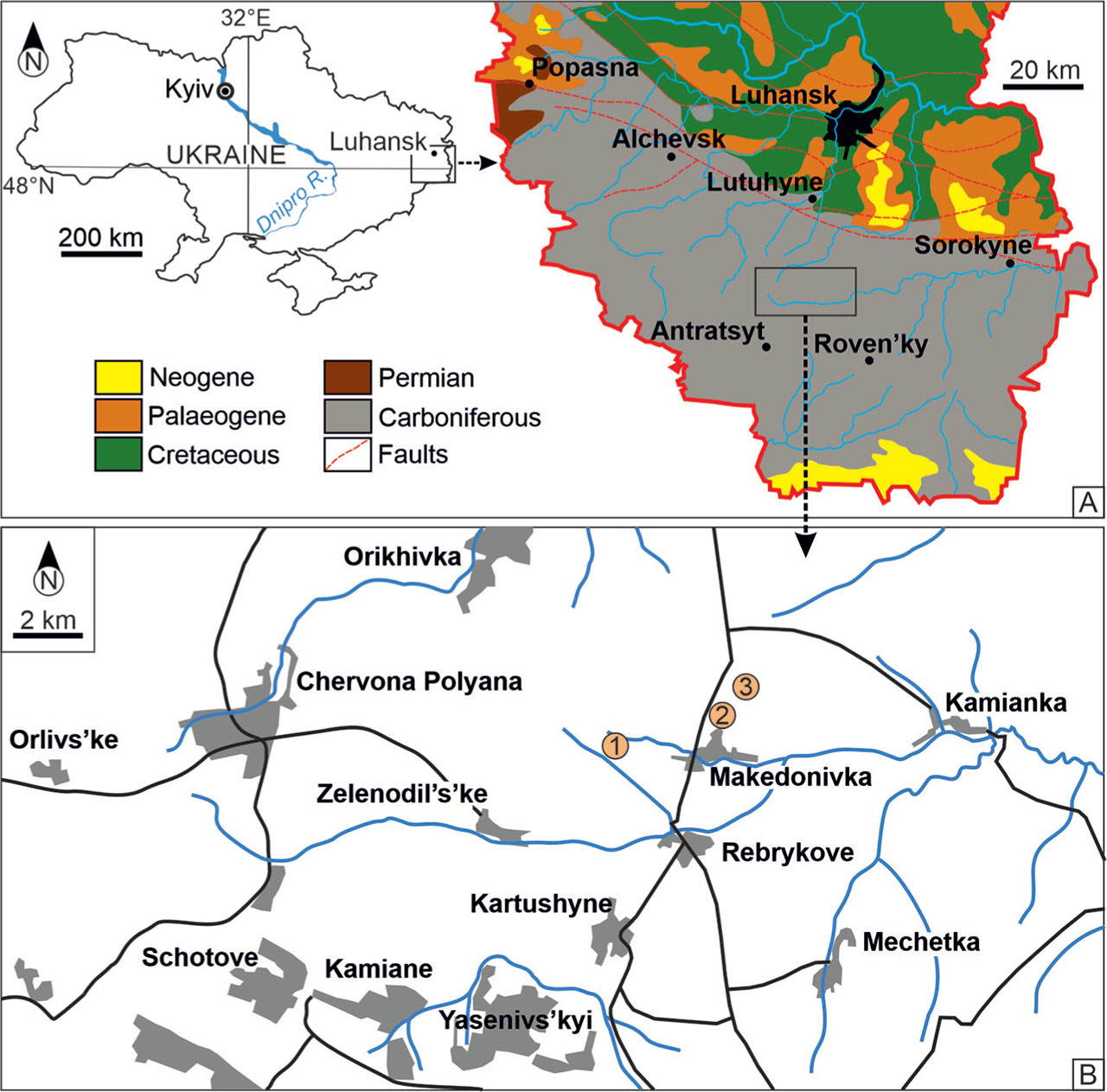
Fig. 2.
Localities yielding horseshoe crabs. A – Geological map of the southern part of Luhansk Oblast (modified after Dernov, 2025a). B – Detailed map of the area outlined in Fig. 2A.
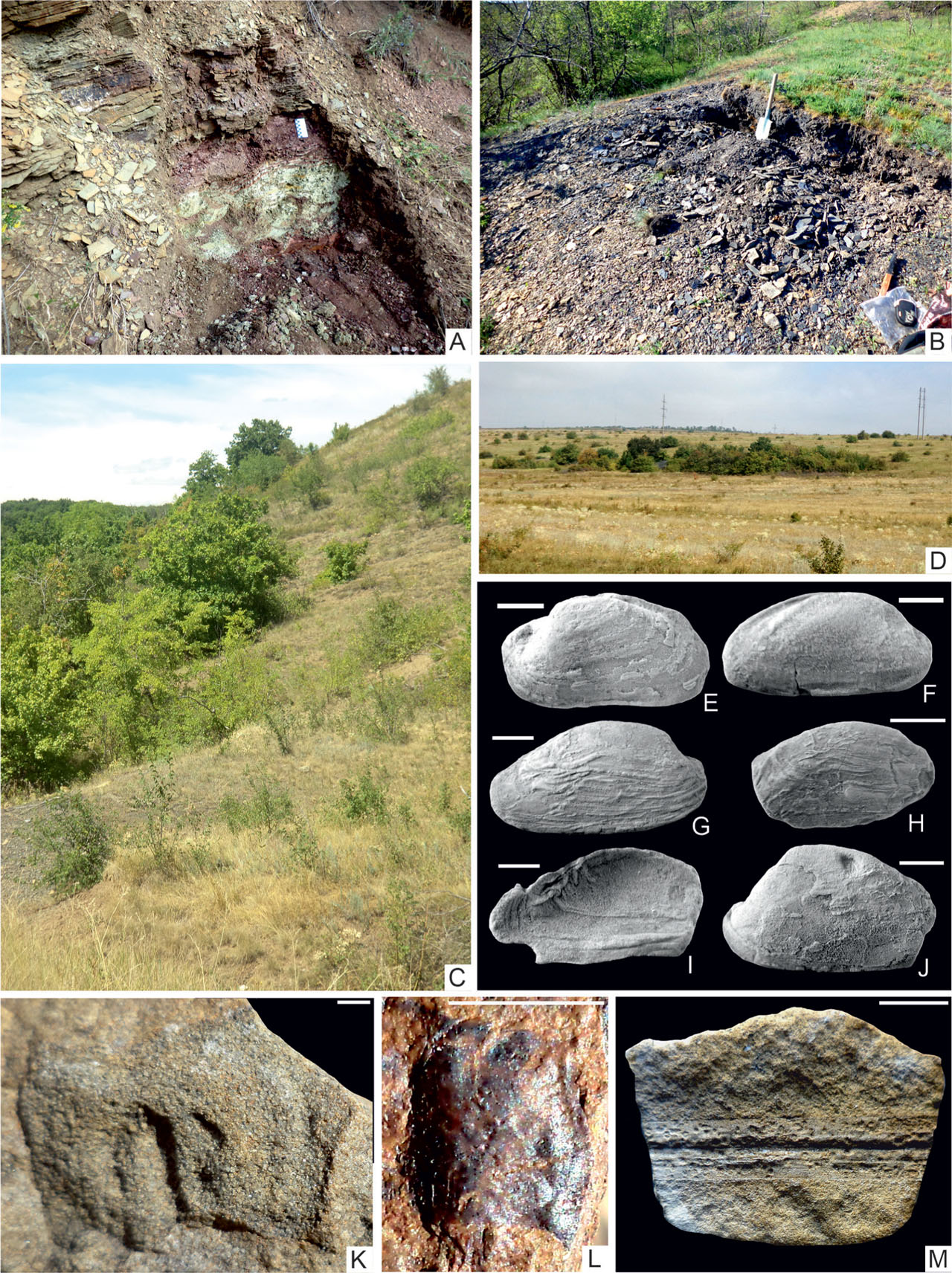
Fig. 3.
General views of the xiphosurid-bearing localities (A–D) and biota associated with horseshoe crabs from fossiliferous Horizon 1 (E–M). A – Siltstone exposure at fossil site No. 1; B – Spoil heap of an abandoned coal mine at fossil site No. 2; C – Slope above the entrance to an abandoned coal mine at fossil site No. 2; D – Spoil heap of an abandoned coal mine at fossil site No. 3; E–J – Non-marine bivalves from fossiliferous Horizon 1: E – Carbonicola rectilinearis Trueman & Weir, 1948 (IGS NASU-11/03); F – Carbonicola limax Wright, 1934 (IGS NASU-11/15); G–J – Shells showing injuries sustained during life (G, H) and blister pearl-like structures (I, J) (G – IGS NASU-11/09; H – IGS NASU-11/14; I – IGS NASU-11/17; J – IGS NASU-11/16); K – Poorly preserved prosoma of a horseshoe crab from the sandstone of fossiliferous Horizon 1 (GMLNU-56/01); L – Poorly preserved pygocephalomorph crustacean from fossiliferous Horizon 1 (field photograph); M – Evidence of a possible fungal–plant interaction on a lycopsid leaf (field photograph). Scale bars = 5 mm.
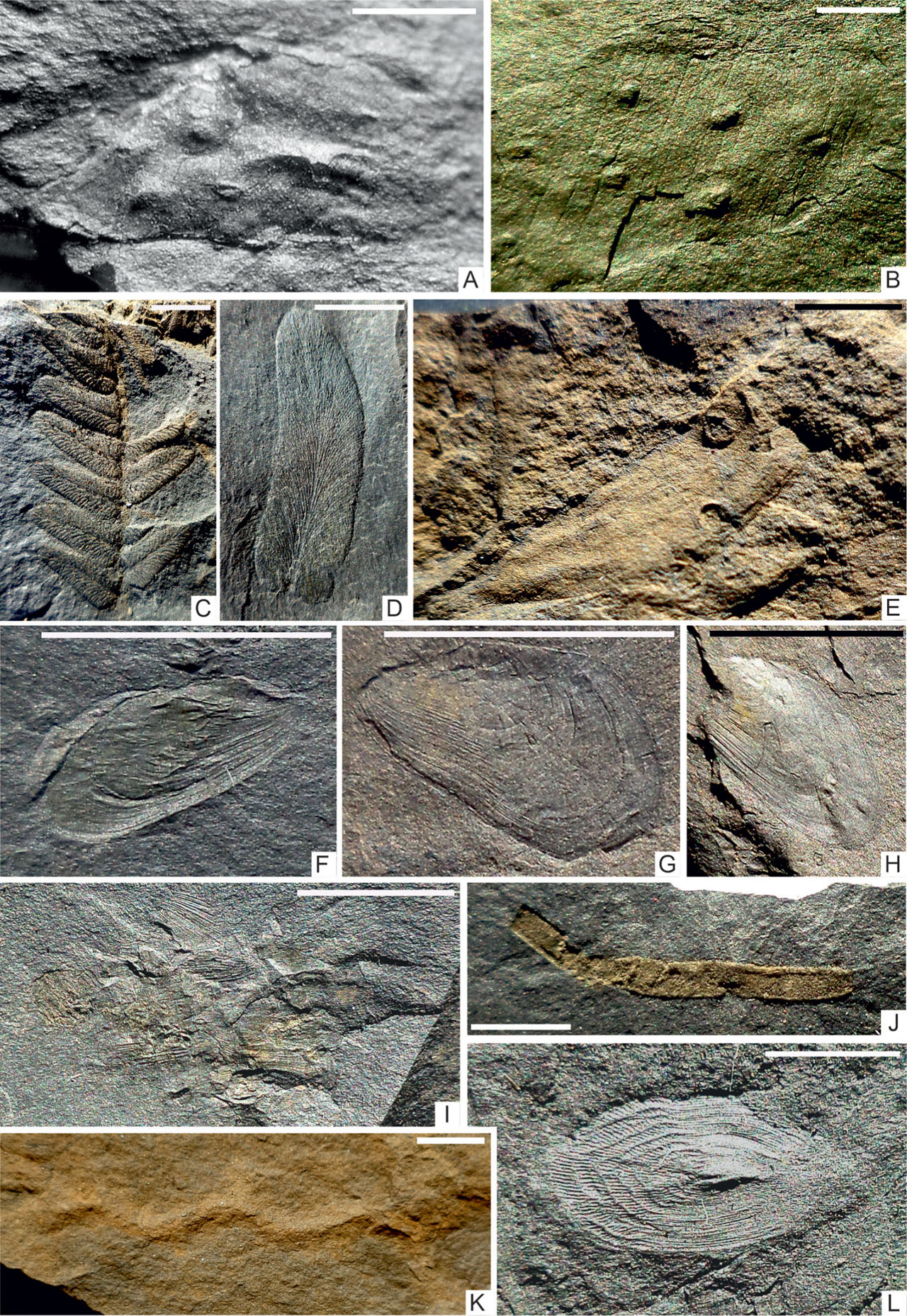
Fig. 4.
Biota associated with horseshoe crabs from fossiliferous Horizon 2. A, B – ?Paratergites of the myriapod Arthropleura sp. (A – NMNHU-G 8640/01; B – GMLNU-19/01); C – Pteridosperm Neuralethopteris schlehanii (Stur) Cremer (uncatalogued); D – Pteridosperm Paripteris gigantea (Sternberg) Gothan (uncatalogued); E – Galls on a plant stem (uncatalogued); F, G – Bivalves Curvirimula trapeziforma (Dewar, 1939) (F – IGS NASU-11/32; G – IGS NASU-11/34); H – Bivalve Curvirimula tesselata (Jones, 1891) (IGS NASU-11/43); I – Gastric residue composed of fragmented fish scales (uncatalogued); J – Limonitised coprolite (uncatalogued); K – Trace fossil Cochlichnus anguineus Hitchcock, 1858 (GMLNU-9/02); L – Fish scale belonging to Rhizodopsis sauroides (Williamson, 1849) (uncatalogued). Scale bars = 5 mm.
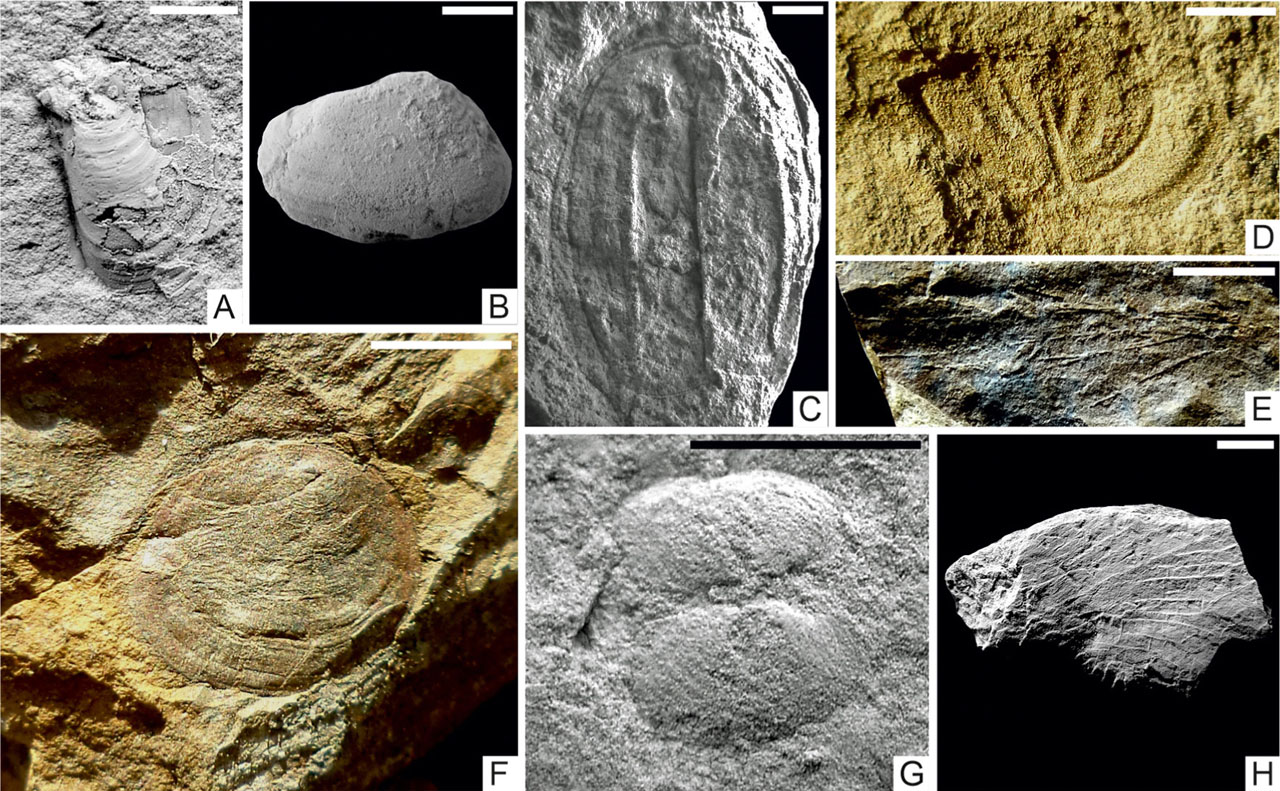
Fig. 5.
Biota associated with horseshoe crabs from fossiliferous Horizon 3. A – Bivalve Naiadites sp. (IGS NASU-11/45); B – Bivalve Carbonicola obtusa (Hind, 1894) (IGS NASU-11/21); C – Phyllocarid crustacean Dithyrocaris cf. granulata Woodward & Etheridge, 1873 (IGS NASU-41/01); D – Cyclidan crustacean Brittaniclus cf. scotti (Woodward, 1893) (IGS NASU-15/02); E, H – Insect wings (uncatalogued); F – Conchostracan Pseudestheria sp. (uncatalogued); G – Indeterminate conchostracan crustacean (uncatalogued). Scale bars = 5 mm.
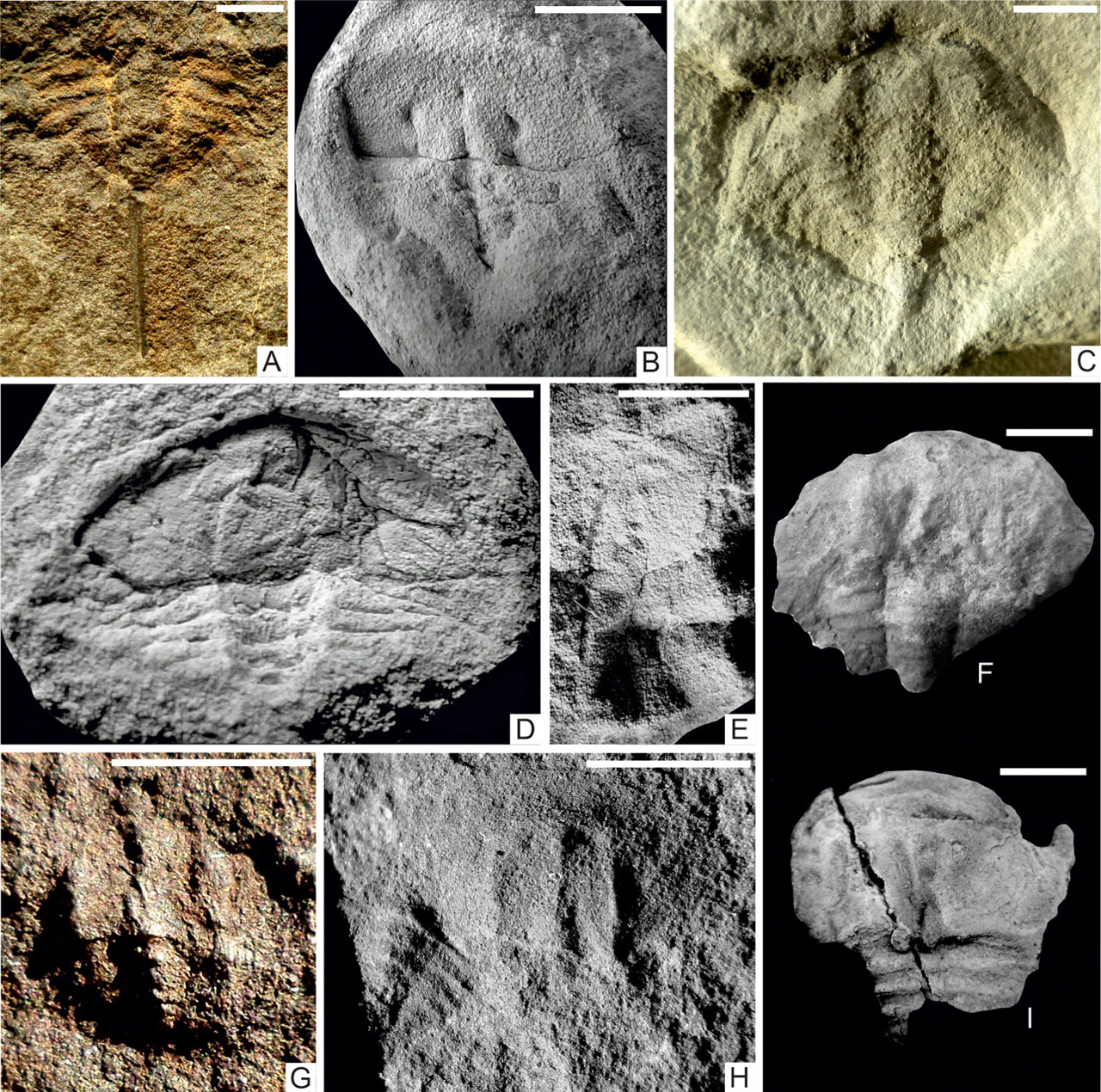
Fig. 6.
Xiphosurids from the Mospyne Formation. A – Belinurus sp. (compression of the thoracetron in dorsal view, GMLNU-56/06); B–E – ?Euproops sp. (B – impression of the prosoma and thoracetron in dorsal view, NMNHU G-10659/01; C – compression of the thoracetron with part of the prosoma, in dorsal view, GMLNU-56/09; D – enrolled exoskeleton, NMNHU G-10659/04; E – impression of a genal spine, NMNHU G-10659/03); F–I – Xiphosurida indet. (F, G – enrolled exoskeletons, GMLNU-56/11 and GMLNU-56/08; H – impression of the prosoma in dorsal view, NMNHU G-10659/02; I – compression of the prosoma with a partially preserved thoracetron, in dorsal view, GMLNU-56/10). Scale bars = 5 mm.
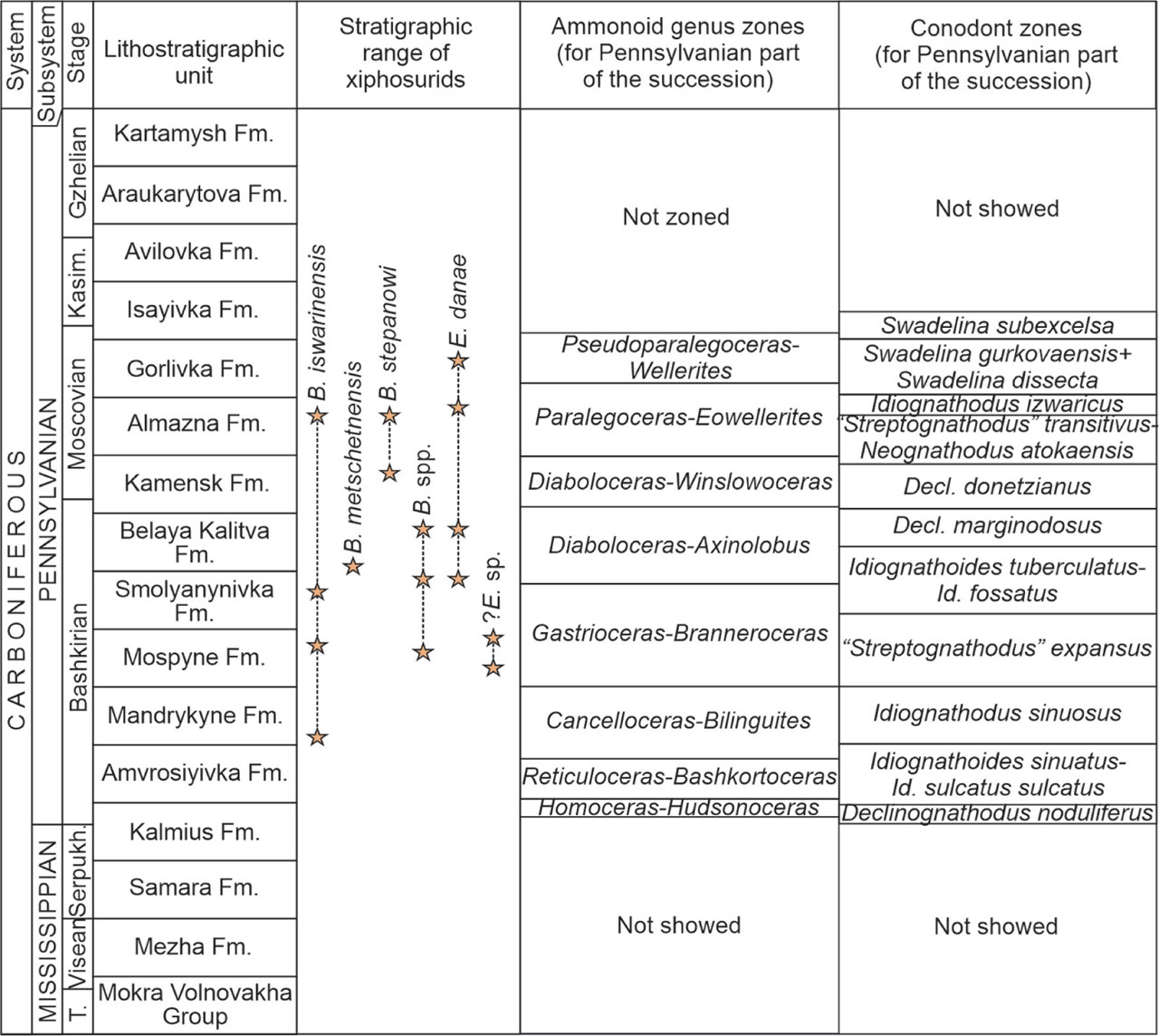
Fig. 7.
Stratigraphic distribution of horseshoe crab taxa within the Carboniferous succession of the Donets Basin (after Chernyshev, 1927, 1928, 1939; Shpinev, 2018; and this study). Abbreviations: B., Belinurus; D., Declinognathodus; E., Euproops. Ammonoid zonation after Popov (1979) and Dernov (2022e); conodont zonation after Nemyrovska (2017). Note: The precise stratigraphic position of the locality yielding the type series of Prestwichianella tschernyshewi Karlov, 1948, is unknown.