
Introduction
1.
Besides palaeobotany and organic petrography, gas chromatographic analysis of extractable organic matter (i.e., lipids) from low-rank coals has been used to gain information about the environmental conditions during peat formation. Investigations of biomarker composition and stable carbon isotope ratios of lignite and fossil wood were successfully used for the reconstruction of peat-forming vegetation, humification, microbial activity, and diagenetic changes during thermal maturation (Otto & Wilde, 2001; Bechtel et al., 2008, 2019). Lipids (especially hydrocarbons) are minor constituents in lignite and sub-bituminous coals. However, their composition provides information on palaeovegetation and palaeoclimate, especially if combined with the results of palaeontological studies (Widera et al., 2021a). Besides insights from biomarker data, environmental and climatic changes over Earth’s history have been reconstructed from the stable carbon isotope composition of lignites, xylites, and of cellulose extracted from tree rings and xylites (Lücke et al., 1999; Schleser et al., 1999; Arens et al., 2000; Marynowski et al., 2007). Biomarker data in combination with stable isotope analyses provided valuable information about changes in vegetation and carbon cycling during lignite deposition (Poole et al., 2006; Bechtel et al., 2008; Jahren & Sternberg, 2008).
During our previous studies (Bechtel et al., 2007, 2020), fossil wood remains (xylites) were collected from the 1st Mid-Polish and 2nd Lusatian lignite seams of the Lubstów, Adamów, Jóźwin IIB, and Tomisławice opencast mines in Poland, deposited during the Miocene Climatic Optimum (~17–15 Ma; Zachos et al., 2001; Widera et al., 2021a). Additionally, detritic lignite samples have been analysed from the 1st Mid-Polish lignite seam from the Adamów, Jóźwin IIB, and Tomisławice deposits (Bechtel et al., 2019). Based on previous investigations by Fabiańska & Kurkiewicz (2013), grasses and herbs were suggested as the peat-forming vegetation of detritic lignites, whereas biomarker data indicated xylitic lignites were primarily derived from woody conifers. This interpretation was supported by organic geochemistry and δ13C data of detritic lignite samples and xylites of the investigated mines within the Konin Basin (Bechtel et al., 2007, 2019, 2020). Factors affecting gelification and cellulose decomposition of wood remains have also been addressed.
However, information about the spatial and temporal variation of vegetation, available from these results, has not been discussed so far. The aim of the present study is to reconstruct palaeoenvironmental changes and vegetation dynamics linked to landscape evolution of the fluvial-influenced peat accumulation (i.e., overbank deposition).
Geological setting
2.
This study focuses on four opencast mines (Lubstów, Adamów, Jóźwin IIB, Tomisławice) exploiting the Lubstów, Adamów, Pątnów IV, and Tomisławice lignite deposits, respectively, near Konin in central Poland (Fig. 1). They are all located in the area of graben-like structures of very different depths, that is, from several dozen to over 240 m in the case of the Lubstów Graben (Ciuk & Grabowska, 1991; Widera, 2007). Their Mesozoic basement is composed mainly of Late Cretaceous marls and carbonate sandstones. Above this lies the Cenozoic succession, differing in lithology and lithostratigraphic completeness between the areas of the studied lignite deposits (Widera, 2021).
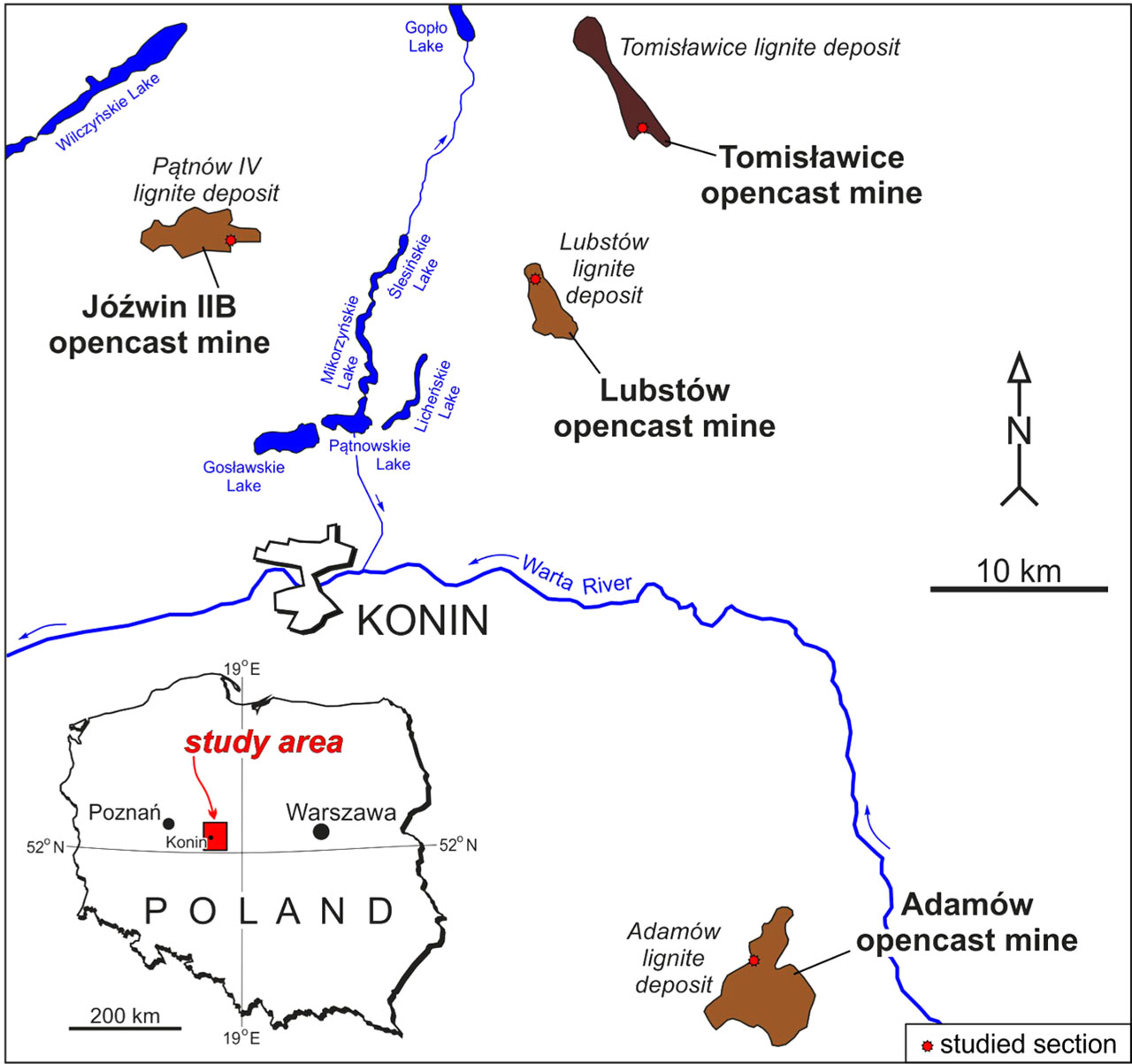
Fig. 1.
Location map of the sampled lignite opencast mines in the Konin Basin (modified according to Widera et al., 2021a).
Due to the presence of long-lasting stratigraphic gaps (hiatuses), the Paleogene is represented exclusively by sediments of early Oligocene (Rupelian) age in three of the mentioned areas. In the case of the Lubstów and Tomisławice opencast mines, they dominantly consist of glauconitic sands and rarely of beach gravels, both of marine origin. No sediments of this age have been found so far in the area of the Jóźwin IIB opencast mine (Widera & Kita, 2007). The Adamów opencast mine constitutes an exception, where the lower Oligocene is formed by ‘blue clays’ with xylites of lacustrine origin (Widera et al., 2022).
Sedimentation of the Neogene terrestrial sediments occurred after the late Oligocene tectonic uplift of the Polish Lowlands, including the study area. Initially, the deposits consisted primarily of fluvial sands with interbeddings of carbonaceous sands and lignite lenses. In the late Early Miocene–early Middle Miocene interval, peats were accumulated, from which the 2nd Lusatian lignite seam (LLS-2) was later formed (Fig. 2). In the study area, it occurs only in the Lubstów lignite deposit (Fig. 1), where its maximum thickness reaches 86.2 m. Lithostratigraphically, LLS-2 belongs to the Ścinawa Formation (e.g., Piwocki & Ziembińska-Tworzydło, 1997; Widera, 2007). LLS-2 from the Lubstów opencast mine is characterised by low rank (mean reflectance of ulminite in the range of 0.25–0.29%; Kwiecińska & Wagner, 2001), relatively low ash yield (15.2 wt% on average), and low sulphur content (0.8 wt% on average) (Widera, 2021). Palynologically, as indicated by autochthonic elements, this lignite seam was formed in the subenvironments of swamp forest (e.g., Taxodium, Glyptostrobus) and swamp bush (e.g., Cyrillaceae, Myricaceae) with plants inhabiting open water reservoirs such as Monogemmites, Sparganium, etc. However, the dry coniferous (e.g., Sequoia, Pinus) and deciduous (e.g., Engelhardtia, Tricolporopollenites pseudocingulum) forests were evidenced by allochthonous pollen assemblages (Ciuk & Grabowska, 1991). LLS-2 was deposited around the first peak of the Miocene Climatic Optimum, when the climate was warm temperate to subtropical (Zachos et al., 2001; Bruch et al., 2007; Kasiński & Słodkowska, 2016).
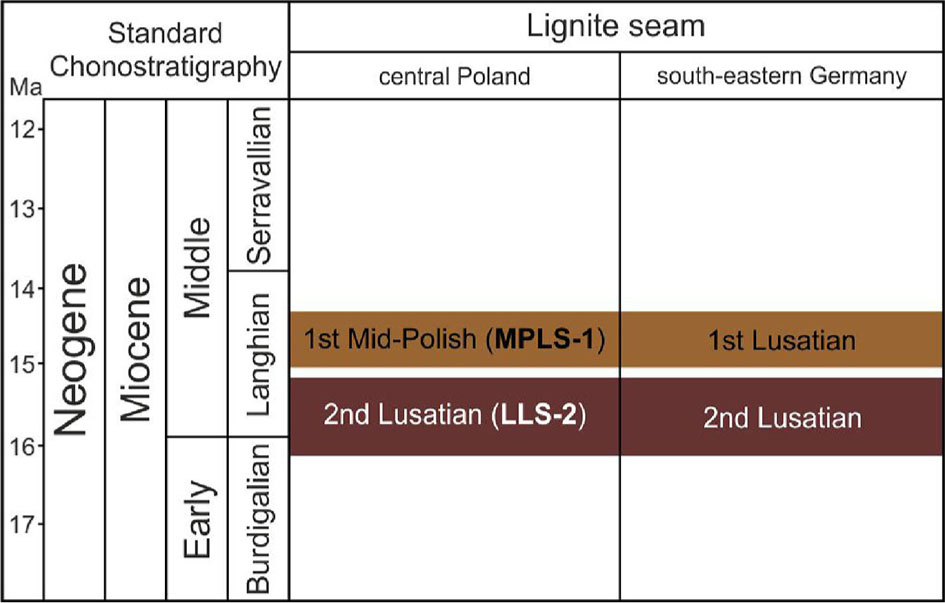
Fig. 2.
Approximate chronostratigraphic position of the sampled Neogene lignite seams in central-west Poland (Piwocki & Ziembińska-Tworzydło, 1997; Widera, 2007) and their stratigraphic correlates in south-eastern Germany (Grimm, 2002).
In the remaining area (Adamów, Jóźwin, and Tomisławice opencast mines; Fig. 1), peat accumulation started later, from which the first Mid-Polish lignite seam (MPLS-1) developed (Fig. 2). In these mines, its average thickness was in the range of 5.3–6.9 m, locally exceeding 10 m, and its maximum thickness in the Konin area reached 19.8 m (Widera, 2021). Peat, which subsequently transformed into MPLS-1, was accumulated ~15.1–14.3 Ma, that is, in the middle part of the Middle Miocene (Widera et al., 2021a, b). MPLS-1 belongs to the lower part (Grey Clay Member) of the Poznań Formation, which is the youngest, main lithostratigraphic unit of the Neogene in central Poland (Piwocki & Ziembińska-Tworzydło, 1997; Widera, 2007; Widera & Klęsk, 2025). It represents humic ortholignite with a low mean reflectance coefficient (0.24–0.28%; Kwiecińska & Wagner, 2001), relatively high ash yield (~20 wt% on average) and varied sulphur content (0.3–2.1 wt%; Widera, 2021). MPLS-1 was accumulated in wetter places (compared to LLS-2), indicated by swamp forest taxa composed of Taxodium, Nyssa, Alnus, and Liquidambar, as well as swamp bush with the following shrubs: Ruhs, Ilex, Ericaceae, Cyrillaceae, Cornaceae (Tricolporopllenites edmundi), etc. However, in dryer places coniferous forest (e.g., Sequoia, Pinus) and deciduous forest (e.g., Betula, Fagus, Quercus, Ulmus, Sciadopitys) dominated (Słodkowska & Widera, 2021, 2022; Worobiec et al., 2021). At that time, the climate was warm-temperate and humid, which can be directly correlated with the last peak of the Miocene Climatic Optimum (Zachos et al., 2001; Bruch et al., 2007; Kasiński & Słodkowska, 2016).
Both lignite seams (LLS-1 and MPLS-1) are covered mainly with Neogene fluvial sediments and Quaternary glaciogenic ones. They are 0–20 m and 35–60 m thick, respectively. The Neogene ends with varicolored muds, known as ‘green clays’ and ‘flamy clays’, which belong to the upper part of the above-mentioned Poznań Formation, that is, to the Wielkopolska Member (Piwocki & Ziembińska-Tworzydło, 1997; Widera, 2007). Their origin is connected with the late Neogene anastomosing (e.g., Widera et al., 2021b; Urbański et al., 2025; Widera & Klęsk, 2025) or anastomosing-to-meandering transitional fluvial system (Zieliński & Widera, 2020). The Neogene succession is covered by the glaciogenic deposits of Pleistocene age such as tills, gravels, sands, and muds, and a thin layer of Holocene soil and sediments of small surface streams.
Samples and analytical methods
3.
Seven samples of fossil wood remains (xylite) were from the Lubstów deposit at different positions within LLS-2 (Fig. 1; Table 1), as shown in Bechtel et al. (2007). Twenty-seven samples of xylite, carefully separated from the detritic lignite, were taken along three profiles within MPLS-1 at the Adamów, Jóźwin IIB and Tomisławice opencasts (Fig. 1; Table 1). The sampling locations are shown in our previous publications (Bechtel et al., 2019, 2020). Detritic lignite samples (27) were collected close to the sampling positions of xylite (Table 2).
Table 1.
Bulk organic geochemical parameters, biomarker concentrations, and C-isotope ratios of xylites and extracted cellulose from the 2nd Lusatian lignite seam (LLS-2) of the Lubstów deposit (Bechtel et al., 2007), as well as from the 1st Mid-Polish lignite seam (MPLS-1) from the Adamów, Jóźwin IIB, and Tomisławice deposits (Bechtel et al., 2020).
| Deposit | Sample | Sample postion (m a.s.l)a | TOCb (wt%) | n-Alkanes (μg/g TOC) | Hopanoids (μg/g TOC) | Sesquiterpenoids (μg/g TOC) | Diterpenoids (μg/g TOC) | Diterpenoids/(Di- + Tri-) | δ13C FWe (‰ vs PDBf) | Cellulose (wt%) | δ13C Cellg (‰ vs PDB |
|---|---|---|---|---|---|---|---|---|---|---|---|
| Lubstów | Lub 1 | 59.4 | 53.6 | 73 | 75 | 0.7 | 45 | Triterpc <LLDd | −22.8 | 34.4 | −19.5 |
| Lubstów | Lub 2 | 58.8 | 57.1 | 63 | 86 | 1.0 | 148 | Triterp <LLD | −25.7 | 7.1 | −22.6 |
| Lubstów | Lub 3 | 57.5 | 57.4 | 40 | 85 | 0.5 | 516 | Triterp <LLD | −25.7 | 4.5 | −21.1 |
| Lubstów | Lub 4 | 56.1 | 55.4 | 31 | 27 | 2.5 | 108 | Triterp <LLD | −24.2 | 12.8 | −21.0 |
| Lubstów | Lub 5 | 55.9 | 59.0 | 68 | 20 | 2.6 | 974 | Triterp <LLD | −24.5 | 4.8 | −20.8 |
| Lubstów | Lub 6 | 52.3 | 56.5 | 32 | 28 | 2.3 | 184 | Triterp <LLD | −23.1 | 31.1 | −19.6 |
| Lubstów | Lub 7 | 51.7 | 60.2 | 122 | 169 | 3.8 | 538 | Triterp <LLD | −25.3 | 5.4 | −21.4 |
| Average | – | 57.0 | 61 | 70 | 1.9 | 359 | – | −24.5 | 14.3 | −20.8 | |
| Adamów | AX-01 | 61.7 | 38.4 | 94 | 67 | 13.0 | 1698 | 0.99 | −25.3 | 6.8 | −21.6 |
| Adamów | AX-02 | 62.3 | 41.0 | 102 | 69 | 80.5 | 630 | 0.91 | −24.7 | 6.2 | −20.9 |
| Adamów | AX-03 | 63.0 | 39.3 | 243 | 84 | 24.3 | 741 | 0.95 | −24.0 | 6.3 | −19.9 |
| Adamów | AX-04 | 63.8 | 41.8 | 144 | 41 | 8.8 | 281 | 0.92 | −24.6 | 15.0 | −21.3 |
| Adamów | AX-05 | 64.3 | 42.7 | 125 | 55 | 6.7 | 153 | 0.89 | −25.6 | 10.6 | −21.9 |
| Adamów | AX-06 | 64.7 | 40.5 | 262 | 74 | 38.9 | 917 | 0.95 | −25.2 | 7.4 | −21.7 |
| Adamów | AX-07 | 65.5 | 37.9 | 440 | 108 | 51.7 | 466 | 0.85 | −26.2 | 5.8 | −22.5 |
| Adamów | AX-08 | 66.1 | 34.0 | 75 | 73 | 91.5 | 235 | 0.89 | −24.9 | 13.3 | −21.9 |
| Adamów | AX-09 | 66.8 | 45.0 | 383 | 66 | 45.6 | 1468 | 0.88 | −26.0 | 5.9 | −22.1 |
| Adamów | AX-10 | 67.6 | 43.6 | 250 | 84 | 64.0 | 329 | 0.91 | −26.1 | 9.1 | −22.7 |
| Average | – | 40.4 | 212 | 72 | 42.5 | 692 | 0.91 | −25.3 | 8.6 | −21.7 | |
| Jóźwin IIB | JX-01 | 41.5 | 41.5 | 258 | 69 | 12.2 | 148 | 0.76 | −24.4 | 5.7 | −21.4 |
| Jóźwin IIB | JX-02 | 42.3 | 36.9 | 298 | 147 | 26.8 | 553 | 0.88 | −26.6 | 1.6 | −22.4 |
| Jóźwin IIB | JX-03 | 43.2 | 52.8 | 93 | 45 | 5.1 | 948 | 0.94 | −24.3 | 18.2 | −22.0 |
| Jóźwin IIB | JX-04 | 44.3 | 43.1 | 263 | 159 | 51.9 | 640 | 0.84 | −25.4 | 4.8 | −21.0 |
| Jóźwin IIB | JX-05 | 44.8 | 44.8 | 85 | 133 | 5.4 | 513 | 0.86 | −25.5 | 5.2 | −21.5 |
| Jóźwin IIB | JX-06 | 45.9 | 48.2 | 234 | 120 | 7.6 | 281 | 0.78 | −25.5 | 3.7 | −21.5 |
| Jóźwin IIB | JX-07 | 46.1 | 43.8 | 76 | 85 | 18.5 | 596 | 0.92 | −25.5 | 3.7 | −21.9 |
| Average | – | 44.5 | 187 | 109 | 18.2 | 525 | 0.85 | −25.3 | 6.1 | −21.7 | |
| Tomisławice | TX-01 | 53.1 | 32.5 | 232 | 69 | 22.0 | 159 | 0.73 | −24.6 | 5.9 | −20.4 |
| Tomisławice | TX-02 | 54.2 | 53.6 | 221 | 42 | 5.5 | 331 | 0.87 | −24.6 | 21.8 | −21.9 |
| Tomisławice | TX-03 | 55.0 | 53.2 | 289 | 56 | 19.8 | 622 | 0.88 | −24.4 | 16.2 | −20.9 |
| Tomisławice | TX-04 | 56.2 | 48.7 | 99 | 75 | 48.4 | 765 | 0.89 | −24.9 | 7.4 | −20.6 |
| Tomisławice | TX-05 | 57.3 | 45.9 | 166 | 95 | 54.2 | 481 | 0.84 | −26.1 | 4.1 | −21.9 |
| Tomisławice | TX-06 | 58.2 | 47.9 | 218 | 63 | 9.1 | 623 | 0.85 | −23.8 | 24.2 | −20.3 |
| Tomisławice | TX-07 | 59.2 | 48.8 | 176 | 56 | 4.8 | 462 | 0.90 | −23.8 | 19.4 | −20.6 |
| Tomisławice | TX-08 | 60.4 | 45.7 | 82 | 84 | 3.4 | 227 | 0.86 | −23.8 | 13.5 | −20.2 |
| Tomisławice | TX-09 | 61.3 | 45.2 | 77 | 74 | 16.8 | 338 | 0.89 | −25.3 | 18.1 | −22.1 |
| Tomisławice | TX-10 | 62.0 | 46.5 | 22 | 37 | 19.9 | 297 | 0.93 | −23.7 | 19.3 | −20.6 |
| Average | – | 46.8 | 158 | 65 | 20.4 | 430 | 0.87 | −24.5 | 15.0 | −20.9 |
Table 2.
Bulk organic geochemical parameters, biomarker concentrations, and carbon isotope ratios of detritic lignite samples from the 1st Mid-Polish lignite seam (MPLS-1) of the Adamów, Jóźwin IIB, and Tomisławice deposits (Bechtel et al., 2019).
| Deposit | Sample | Sample postion (m a.s.l)a | TOCb (wt%) | n-Alkanes (μg/g TOC) | Hopanoids (μg/g TOC) | Sesquiterpenoids (μg/g TOC) | Diterpenoids (μg/g TOC) | Triterpenoids (μg/g TOC) | Diterpenoids (Di- + Tri-) | δ13C TOC (‰ vs PDBc) |
|---|---|---|---|---|---|---|---|---|---|---|
| Adamów | AD-01 | 61.7 | 46.6 | 154 | 74 | 0.4 | 16 | 76 | 0.18 | −26.0 |
| Adamów | AD-02 | 62.3 | 49.8 | 108 | 57 | 0.2 | 83 | 75 | 0.52 | −25.4 |
| Adamów | AD-03 | 63.0 | 52.3 | 188 | 85 | 2.2 | 293 | 125 | 0.70 | −24.7 |
| Adamów | AD-04 | 63.8 | 51.3 | 193 | 80 | 8.0 | 65 | 127 | 0.34 | −25.8 |
| Adamów | AD-05 | 64.3 | 49.1 | 71 | 42 | 25.1 | 28 | 52 | 0.35 | −25.7 |
| Adamów | AD-06 | 64.7 | 49.5 | 78 | 47 | 18.1 | 16 | 51 | 0.24 | −25.9 |
| Adamów | AD-07 | 65.5 | 42.9 | 215 | 68 | 1.9 | 25 | 90 | 0.22 | −26.0 |
| Adamów | AD-08 | 66.1 | 51.4 | 88 | 43 | 34.4 | 43 | 41 | 0.51 | −25.6 |
| Adamów | AD-09 | 66.8 | 49.3 | 88 | 46 | 52.3 | 23 | 44 | 0.34 | −25.5 |
| Adamów | AD-10 | 67.6 | 39.3 | 226 | 73 | 13.7 | 34 | 119 | 0.22 | −26.1 |
| Average | – | 48.1 | 141 | 62 | 15.6 | 62 | 80 | 0.36 | −25.7 | |
| Jóźwin IIB | JD-01 | 41.5 | 34.0 | 127 | 60 | 3.1 | 18 | 49 | 0.26 | −25.6 |
| Jóźwin IIB | JD-02 | 42.3 | 47.8 | 85 | 62 | 1.0 | 73 | 33 | 0.69 | −25.0 |
| Jóźwin IIB | JD-03 | 43.2 | 51.2 | 200 | 59 | 4.3 | 109 | 101 | 0.52 | −25.5 |
| Jóźwin IIB | JD-04 | 44.3 | 51.8 | 186 | 79 | 73.3 | 223 | 159 | 0.58 | −25.1 |
| Jóźwin IIB | JD-05 | 44.8 | 52.0 | 219 | 70 | 30.0 | 153 | 149 | 0.51 | −25.4 |
| Jóźwin IIB | JD-06 | 45.9 | 53.0 | 78 | 35 | 0.4 | 28 | 60 | 0.32 | −25.7 |
| Jóźwin IIB | JD-07 | 46.1 | 50.8 | 172 | 63 | 39.4 | 62 | 110 | 0.36 | −25.8 |
| Average | – | 48.7 | 152 | 61 | 21.6 | 95 | 94 | 0.46 | −25.5 | |
| Tomisławice | TD-01 | 53.1 | 16.7 | 117 | 74 | 7.2 | 34 | 54 | 0.39 | −25.8 |
| Tomisławice | TD-02 | 54.2 | 54.5 | 168 | 103 | 24.7 | 97 | 51 | 0.65 | −25.2 |
| Tomisławice | TD-03 | 55.0 | 58.8 | 94 | 49 | 1.8 | 16 | 75 | 0.18 | −26.2 |
| Tomisławice | TD-04 | 56.2 | 52.3 | 323 | 111 | 20.3 | 87 | 139 | 0.39 | −25.6 |
| Tomisławice | TD-05 | 57.3 | 53.4 | 353 | 89 | 1.9 | 152 | 156 | 0.49 | −25.2 |
| Tomisławice | TD-06 | 58.2 | 38.3 | 232 | 90 | 0.6 | 68 | 119 | 0.36 | −25.4 |
| Tomisławice | TD-07 | 59.2 | 22.0 | 216 | 95 | 4.3 | 22 | 44 | 0.34 | −25.6 |
| Tomisławice | TD-08 | 60.4 | 44.5 | 154 | 76 | 0.5 | 10 | 41 | 0.19 | −25.9 |
| Tomisławice | TD-09 | 61.3 | 41.5 | 108 | 72 | 7.2 | 29 | 32 | 0.47 | −25.6 |
| Tomisławice | TD-10 | 62.0 | 31.4 | 254 | 97 | 9.8 | 61 | 67 | 0.48 | −25.4 |
| Average | – | 41.3 | 202 | 86 | 7.8 | 58 | 78 | 0.39 | −25.6 |
Total organic carbon (TOC) contents of lignite and xylite samples were determined by Elemental Analysis after removal of carbonates by 1M HCl. For cellulose extraction, pieces of fossil wood (xylites) were freeze-dried and milled for homogenization. An aliquot of the sample was decalcified in a water bath (5% HCl, 50 °C) for two hours to remove inorganic carbonates prior to the analyses of δ13C of fossil wood. Cellulose extraction followed the CUAM protocol (Wissel et al., 2008) with slight adaptations for the specific samples.
For organic geochemical analyses, aliquots (5 g) of dry samples were extracted for approximately 1 hour using a mixture of dichloromethane (DCM) and methanol (MeOH) in a Dionex ASE 200 accelerated solvent extractor. The extracts of the xylite samples from Lubstów deposit were separated by medium-pressure liquid chromatography (MPLC) into saturated and aromatic hydrocarbons and polar fractions, after precipitation of asphaltenes (Bechtel et al., 2007). The extractable organic matter from the detritic lignite and xylite samples of the Adamów, Jóźwin IIB and Tomisławice opencast mines was separated using Supelco silica columns (LC-SI, 6 ml, 500 mg sorbent) into non-polar (hydrocarbon), low-polar (ketones) and polar fractions (Bechtel et al., 2019, 2020).
The hydrocarbon fractions from the Lubstów deposit were analysed using a gas chromatograph equipped with a 30 m DB-5MS fused silica column (i.d. 0.25 mm; 0.25 mm film thickness) and coupled to a Finnigan MAT GCQ ion trap mass spectrometer (Bechtel et al., 2007). The non-polar and low-polar fractions from the samples of MPLS-1 were analysed by gas chromatography using a 60 m DB-5MS fused silica column (i.d. 0.25 mm; 0.25 mm film thickness), coupled to a ThermoFisher ISQ quadrupole mass spectrometer. All samples were injected splitless, with the injector temperature at 275 °C. Helium was used as carrier gas. The spectrometers were operated in the EI (electron ionization) mode over a scan range from m/z 50 to 600 (0.7 s total scan). Data were processed using an Xcalibur data system. Compound concentrations were calculated from peak areas relative to the internal standards (deuteriated n-tetracosane and 1,1′-binaphthyl, respectively).
For δ13C analyses of organic matter from detritic lignite, fossil wood (xylite) and cellulose, aliquots of decarbonatised samples were weighed into tin foil capsules. Samples were combusted at 1050 °C with excess oxygen in an elemental analyser (EuroEA, Eurovector) and measured online with a coupled isotope ratio mass spectrometer (IsoPrime, GV-Instruments). Carbon content was determined from peak integration (m/z 44 and 45) and calibrated against a certified elemental standard. Samples were analysed together with laboratory standards calibrated against international carbon isotope standards and are reported as δ-values in per mil (‰) relative to the VPDB scale. The overall precision of replicate analyses was better than ±0.1‰.
Results
4.
In this study, only the results relevant for the evaluation of spatial and temporal variations of depositional environments and vegetation are presented below.
Bulk geochemical data
4.1.
The total organic carbon (TOC) contents of fossil wood remains (xylites) from MPLS-1 vary from 32.5 to 53.6 wt% (Table 1). Higher TOC values were obtained from the xylites of the LLS-2 (Lubstów, 53.6–60.2 wt%), despite similar degrees of organic matter decomposition (e.g., gelification, cellulose decay) and thermal maturity (Bechtel et al., 2007, 2020). Average TOC contents are lowest in the xylites from the Adamów deposit (Table 1). Low TOC contents (< 40 wt%) of the samples TX-01, JX-02, and of xylites of the Adamów mine most probably reflect impurities from inherent detritic lignite (Bechtel et al., 2020). Variable TOC abundances of detritic lignite samples (16.7–58.8 wt%; Table 2) from MPLS-1 are caused by dilution of organic carbon by mineral matter (Bechtel et al., 2019), reflecting periods of increased fluvial runoff (e.g., crevasse splay; Widera, 2016).
The yields of extracted cellulose from most xylites of the Lubstów deposit (LLS-2) were reported as low as 4.5–7.1 wt%, except for two samples with cellulose yields exceeding 30% (Table 1). These data indicated low to advanced degrees of cellulose decomposition by fungi and bacterial activities (Schleser et al., 1999; Bechtel et al., 2007). Cellulose yields of fossil wood remains from MPLS-1 ranged between 1.6 and 24.2% (dry weight; Table 1). The highest cellulose yields were recorded from xylites of the Tomisławice mine. Considering the original cellulose contents of wood (40–50%; Pettersen, 1984), the data indicate an advanced degree of cellulose decomposition. However, impurities due to inherent detritic lignite must be taken into account as an additional factor responsible for the low cellulose yields.
Molecular composition of lipids
4.2.
The n-alkanes contents of the xylite samples from the Adamów, Jóźwin IIB, and Tomisławice deposits (MPLS-1) vary from 75 to 440 μg/g TOC (Table 1). Lower n-alkane concentrations of xylites were obtained from the Lubstów deposit (LLS-2), varying from 31 to 122 μg/g TOC (average content: 61 μg/g TOC). Detritic samples of MPLS-1 are characterised by comparable n-alkane concentrations as the corresponding xylites (71–353 μg/g TOC; Table 2). However, relative abundances of n-alkanes are higher in the hydrocarbon fractions of detritic lignite samples due to reduced abundances of terpenoid hydrocarbons (Fig. 3C). The n-alkane patterns of all samples are dominated by long-chain (> n-C27) homologues with a marked predominance of odd carbon-numbered n-alkanes (Fig. 3), indicating their origin from plant-waxes and the immature character of organic matter (Eglinton & Hamilton, 1967). The carbon preference index (CPI, according to Bray & Evans, 1961) values of xylite samples vary between 3.0 and 8.9; whereas slightly higher CPI (3.6–10.0) were obtained from detritic lignite samples of MPLS-1.
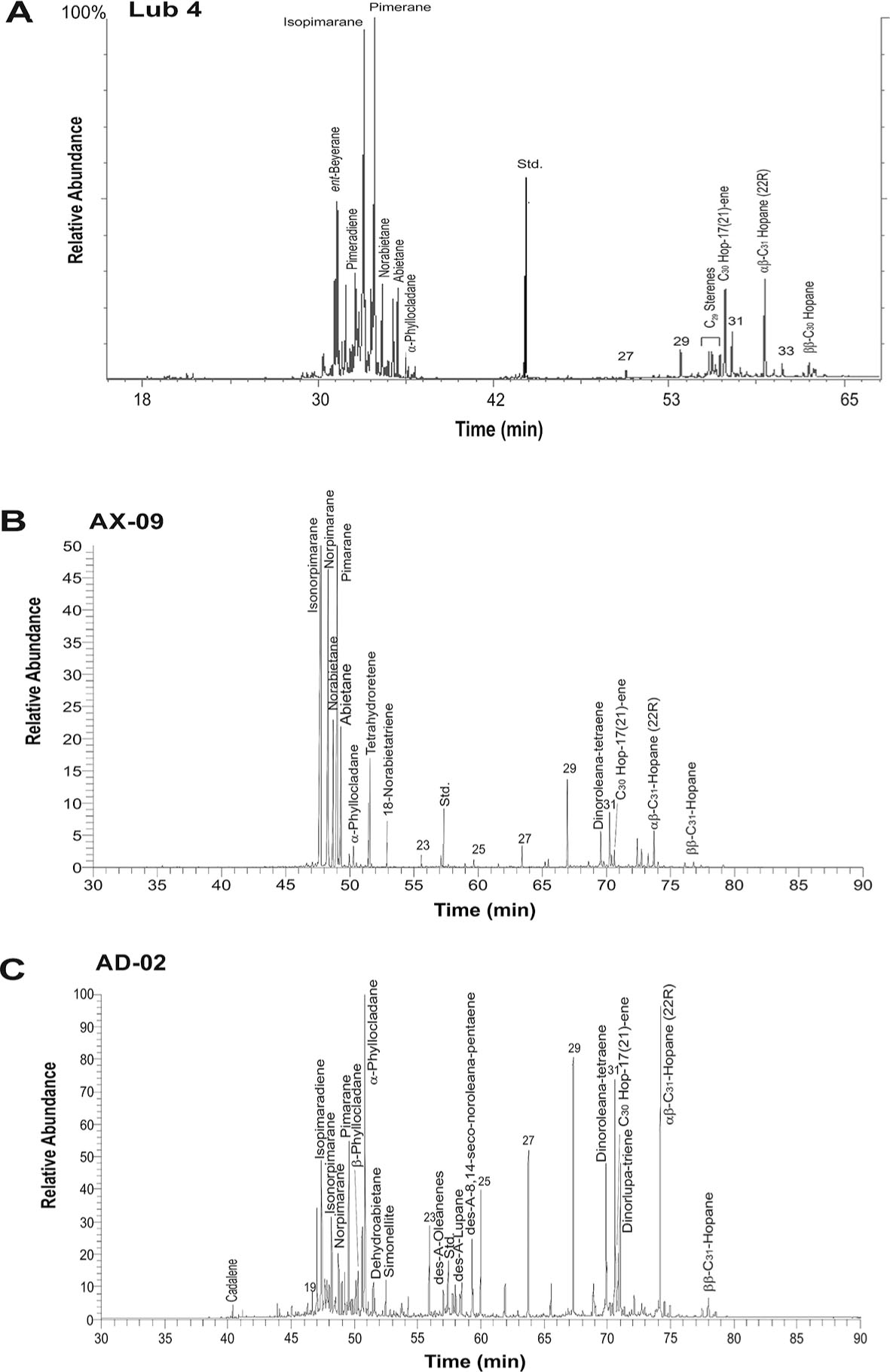
Fig. 3.
Representative total ion current chromatograms of the saturated hydrocarbon fraction of the xylites. A – Sample Lub 4 from the Lubstów opencast mine (Bechtel et al., 2007); B, C – The non-polar (hydrocarbon) fractions of xylite sample AX-09 and of detritic lignite sample AD-02 from the Adamów opencast mine, respectively (Bechtel et al., 2019, 2020); n-Alkanes are labelled according to their carbon number; Std. – Internal Standard (squalane).
Hopanoids are present in elevated concentrations in the extracts of the xylites collected from the investigated lignite deposits (Table 1; Fig. 3). Average concentrations of hopanoids vary between 65 μg/g TOC (Tomisławice mine) and 109 μg/g TOC (Jóźwin IIB mine). The concentrations of hopanoids of detritic samples from MPLS-1 fall within a comparable range (42–111 μg/g TOC). The 17α,21β(H)- and 17β,21β(H)-type hopanes from C27 to C31 were identified. The C28 hopanes are missing, and the 17α,21β(H)-C31 hopane (22R) predominates, especially in detritic lignite samples (Fig. 3). In addition to the hopanes, the C27 and C30 hop-17(21)-enes are present (Philp, 1985). Likewise, relative abundances of hopanes and hop-17(21)-ene are higher in the detritic lignite samples (AD-02; Fig. 3C).
The aromatic sesquiterpenoids curcumene, cuparene, and cadalene (Grantham & Douglas, 1980; Simoneit & Mazurek, 1982) are present in the extracts of fossil wood remains (xylite) from MPLS-1 in low to moderate concentrations (3.4–91.5 μg/g TOC; Table 1). In the Lubstów deposit very low contents of sesquiterpenoids (cadalene and 5,6,7,8-tetrahydrocadalene) were found in the range of 0.5–3.8 μg/g TOC. Cadalene predominates in all samples (Figs. 3B, C; 4A).
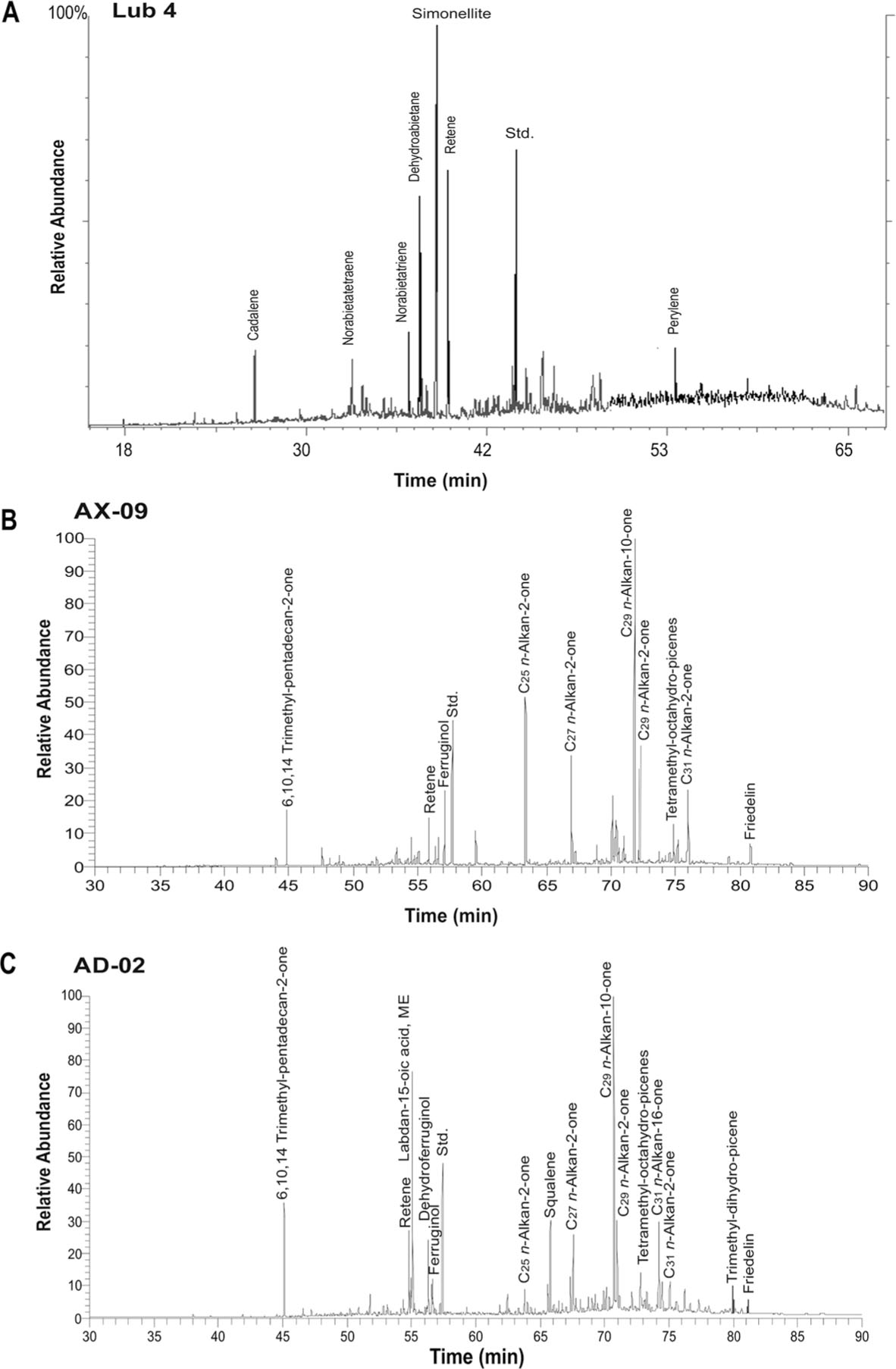
Fig. 4.
Representative total ion current chromatograms of the aromatic hydrocarbon fraction of the xylites. A – Sample Lub 4 from the Lubstów deposit (Bechtel et al., 2007); B, C – The low-polar (ketone) fractions of xylite sample AX-09 and of detritic lignite sample AD-02 from the Adamów mine, respectively (Bechtel et al., 2019, 2020); Std. – Internal Standard (1,1′-binaphthyl).
The non-aromatic diterpenoids found in xylites of the Lubstów mine (Fig. 3A) consist of compounds of the pimarane-type (pimaradiene, isopimarane, pimarane), the abietane-type (norabietane and abietane), as well as compounds of the tetracyclic series (ent-beyerane, 16α(H)-phyllocladane, 16β(H)-phyllocladane; Hagemann & Hollerbach, 1979; Noble et al., 1985; Philp, 1985). In the xylites from MPLS-1, additionally isonorpimarane and norpimarane have been identified, but pimaradiene and ent-beyerane are missing (Fig. 3B). Pimarane-type diterpenoids predominate in most of the xylite samples. In contrast, 16α(H)-phyllocladane predominates in most of the detritic lignite samples taken from the Adamów, Jóźwin IIB and Tomisławice deposits (Fig. 3C). Exclusively abietane-type diterpenoids were identified in the aromatic hydrocarbon fractions of xylite samples from the Lubstów deposit (Fig. 4A). Simonellite was present in the highest abundances in most samples. In the samples (xylites and detritic lignite) from MPLS-1, aromatic diterpenoids (e.g., dehydroabietane, 18-norabietatriene, tetrahydroretene, simonellite, and retene; Philp, 1985) were found in the hydrocarbons (Figs. 3B, C) and partly in the low-polar (ketone) fractions (Figs. 4B, C). Ferruginol and dehydroferruginol (Otto et al., 1997) occurred in the low-polar fractions of all samples from the Adamów, Jóźwin IIB, and Tomisławice deposits (Figs. 4B, C). These compounds are not identified in fossil wood samples from the Lubstów mine, as only the hydrocarbon fractions were analysed (Bechtel et al., 2007).
The average concentrations of all diterpenoid compounds quantified in the extracts from xylites (Table 1) are in the range of 359 μg/g TOC (Lubstów) and 692 μg/g TOC (Adamów). Much lower average concentrations have been found in detritic lignite samples from the investigated deposits within MPLS-1 (62–95 μg/g TOC; Table 2). As terpenoid compositions provided valuable information about palaeovegetation (Otto et al., 1997; Fabiańska & Kurkiewicz, 2013), abundances of pimarane, abietane, and phyllocladane type diterpenoids, as well as of ent-beyerane and ferruginol plus dehydroferruginol, relative to the total diterpenoid concentrations, were calculated (Tables 3, 4). Average relative abundances of diterpenoid biomarkers in the lipids from xylites of the investigated deposits (Table 3), and from detritic lignite samples of the Adamów, Jóźwin IIB, and Tomisławice mines (Table 4) are illustrated in Figure 5. Pimarane, abietane, and phyllocladane type diterpenoids predominate. Ferruginol and dehydroferruginol, not found in the Lubstów xylites, occur in variable abundances in the xylites from MPLS-1 (Fig. 5). The diterpenoid ent-beyerane has been identified only within the Lubstów samples. The Lubstów samples show, on average, higher relative abundances of abietane-type diterpenoids and lower relative abundances of phyllocladane-type diterpenoids than the xylites from MPLS-1 (Fig. 5). The detritic lignite samples from the Adamów, Jóźwin IIB, and Tomisławice deposits are characterised by low average abundances of abietane- and high relative contents of phyllocladane-type diterpenoids.
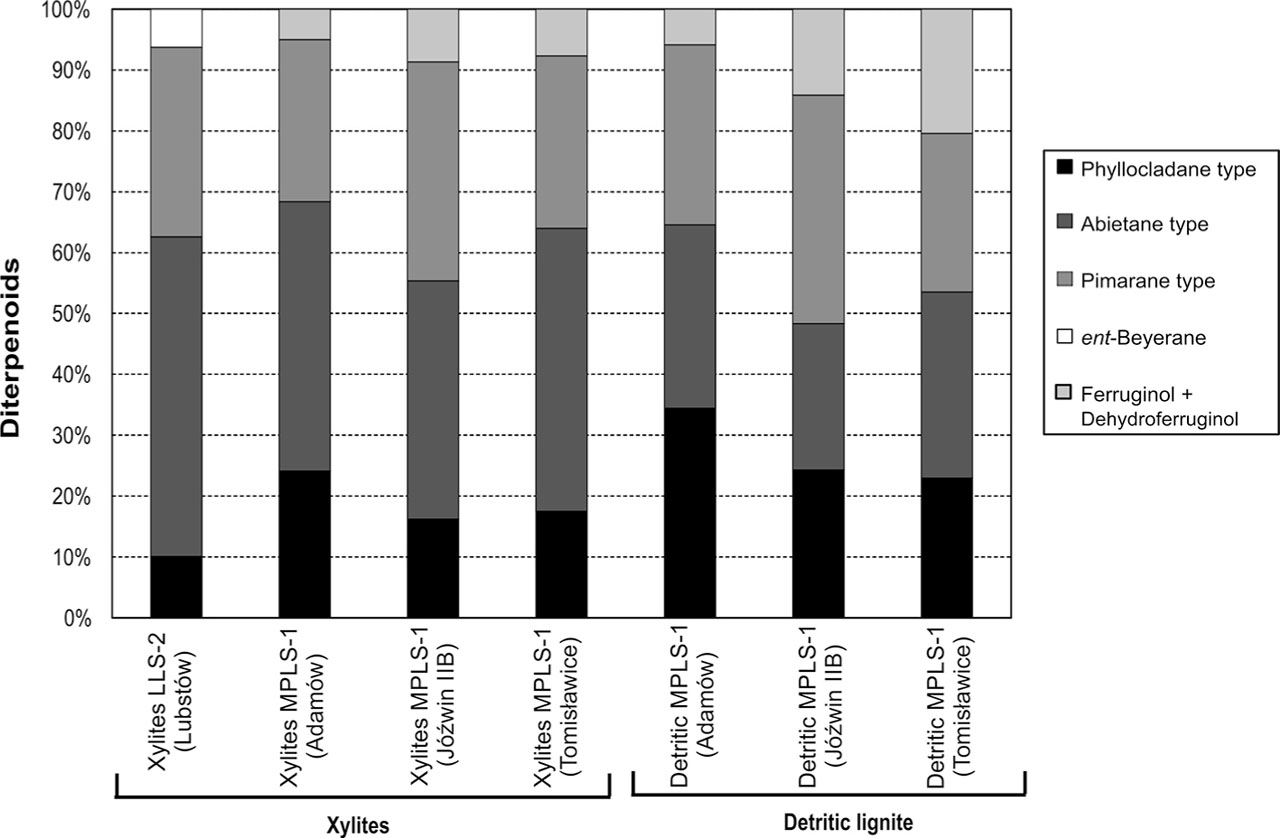
Fig. 5.
Average relative abundances of terpenoid biomarkers in the lipid fractions of the xylites from Lubstów, Adamów, Jóźwin IIB and Tomisławice opencast mines, and of detritic lignite samples from Adamów, Jóźwin IIB and Tomisławice opencast mines.
Table 3.
Relative abundances of diterpenoid compound groups in xylites from the 2nd Lusatian lignite seam (LLS-2) of the Lubstów deposit (recalculated according to Bechtel et al., 2007), as well as from the 1st Mid-Polish lignite seam (MPLS-1) from the Adamów, Jóźwin IIB, and Tomisławice deposits (recalculated according to Bechtel et al., 2020).
| Deposit | Sample | Phyllocladane type (%, Diterpa) | Abietane type (%, Diterp) | Pimarane type (%, Diterp) | ent-Beyerane (%, Diterp) | Ferruginol + Dehydroferruginol (%, Diterp) |
|---|---|---|---|---|---|---|
| Lubstów | Lub 1 | 8.3 | 52.7 | 35.9 | 3.1 | not analysed |
| Lubstów | Lub 2 | 10.7 | 56.3 | 25.5 | 7.5 | not analysed |
| Lubstów | Lub 3 | 10.1 | 37.7 | 42.5 | 9.8 | not analysed |
| Lubstów | Lub 4 | 20.3 | 40.4 | 35.1 | 4.2 | not analysed |
| Lubstów | Lub 5 | 4.1 | 56.2 | 34.2 | 5.5 | not analysed |
| Lubstów | Lub 6 | 6.7 | 73.7 | 15.6 | 4.0 | not analysed |
| Lubstów | Lub 7 | 10.7 | 50.4 | 29.0 | 9.8 | not analysed |
| Average | 10.1 | 52.5 | 31.1 | 6.3 | – | |
| Adamów | AX-01 | 17.8 | 53.7 | 24.7 | 0.0 | 2.0 |
| Adamów | AX-02 | 44.7 | 27.4 | 23.1 | 0.0 | 4.4 |
| Adamów | AX-03 | 43.4 | 28.4 | 23.9 | 0.0 | 3.9 |
| Adamów | AX-04 | 28.4 | 37.3 | 26.3 | 0.0 | 5.5 |
| Adamów | AX-05 | 25.3 | 30.7 | 28.7 | 0.0 | 13.2 |
| Adamów | AX-06 | 2.5 | 78.6 | 17.6 | 0.0 | 0.7 |
| Adamów | AX-07 | 34.4 | 39.4 | 22.8 | 0.0 | 1.7 |
| Adamów | AX-08 | 23.2 | 34.6 | 27.2 | 0.0 | 12.2 |
| Adamów | AX-09 | 2.3 | 58.1 | 37.9 | 0.0 | 1.0 |
| Adamów | AX-10 | 15.3 | 47.2 | 29.6 | 0.0 | 5.0 |
| Average | 23.7 | 43.5 | 26.2 | 0.0 | 5.0 | |
| Jóźwin IIB | JX-01 | 18.3 | 38.7 | 31.1 | 0.0 | 8.6 |
| Jóźwin IIB | JX-02 | 15.0 | 31.4 | 49.8 | 0.0 | 3.3 |
| Jóźwin IIB | JX-03 | 17.1 | 36.1 | 42.6 | 0.0 | 2.4 |
| Jóźwin IIB | JX-04 | 19.9 | 29.1 | 27.4 | 0.0 | 22.0 |
| Jóźwin IIB | JX-05 | 14.1 | 52.5 | 25.9 | 0.0 | 6.6 |
| Jóźwin IIB | JX-06 | 20.5 | 33.7 | 29.2 | 0.0 | 11.6 |
| Jóźwin IIB | JX-07 | 6.3 | 47.3 | 40.5 | 0.0 | 5.1 |
| Average | 15.9 | 38.4 | 35.2 | 0.0 | 8.5 | |
| Tomisławice | TX-01 | 15.6 | 43.0 | 33.5 | 0.0 | 8.3 |
| Tomisławice | TX-02 | 21.8 | 36.7 | 28.8 | 0.0 | 10.7 |
| Tomisławice | TX-03 | 21.1 | 40.0 | 32.1 | 0.0 | 6.5 |
| Tomisławice | TX-04 | 8.5 | 46.4 | 41.6 | 0.0 | 2.1 |
| Tomisławice | TX-05 | 5.8 | 62.9 | 20.1 | 0.0 | 11.1 |
| Tomisławice | TX-06 | 24.0 | 45.3 | 18.2 | 0.0 | 11.5 |
| Tomisławice | TX-07 | 26.6 | 38.4 | 30.9 | 0.0 | 4.0 |
| Tomisławice | TX-08 | 15.8 | 40.3 | 30.1 | 0.0 | 12.7 |
| Tomisławice | TX-09 | 24.6 | 34.9 | 27.8 | 0.0 | 6.4 |
| Tomisławice | TX-10 | 8.7 | 69.6 | 16.0 | 0.0 | 2.2 |
| Average | 17.3 | 45.8 | 27.9 | 0.0 | 7.6 |
Table 4.
Relative abundances of diterpenoid compound groups of detritic lignite samples from the 1st Mid-Polish lignite seam (MPLS-1) from the Adamów, Jóźwin IIB, and Tomisławice deposits (recalculated according to Bechtel et al., 2019).
| Deposit | Sample | Phyllocladane type (%, Diterpa) | Abietane type (%, Diterp) | Pimarane type (%, Diterp) | ent-Beyerane (%, Diterp) | Ferruginol + Dehydroferruginol (%, Diterp) |
|---|---|---|---|---|---|---|
| Adamów | AD-01 | 30.1 | 19.3 | 33.3 | 0.0 | 17.3 |
| Adamów | AD-02 | 45.7 | 30.3 | 19.5 | 0.0 | 4.5 |
| Adamów | AD-03 | 56.9 | 14.2 | 26.8 | 0.0 | 2.1 |
| Adamów | AD-04 | 30.3 | 26.1 | 36.5 | 0.0 | 7.1 |
| Adamów | AD-05 | 28.2 | 46.0 | 21.5 | 0.0 | 4.3 |
| Adamów | AD-06 | 17.3 | 46.0 | 31.8 | 0.0 | 4.9 |
| Adamów | AD-07 | 39.1 | 31.4 | 20.8 | 0.0 | 8.8 |
| Adamów | AD-08 | 51.1 | 9.0 | 38.9 | 0.0 | 1.0 |
| Adamów | AD-09 | 31.7 | 26.9 | 40.0 | 0.0 | 1.4 |
| Adamów | AD-10 | 13.9 | 52.2 | 26.3 | 0.0 | 7.6 |
| Average | 34.4 | 30.1 | 29.5 | 0.0 | 5.9 | |
| Jóźwin IIB | JD-01 | 30.4 | 49.6 | 16.5 | 0.0 | 3.5 |
| Jóźwin IIB | JD-02 | 36.6 | 4.4 | 58.4 | 0.0 | 0.6 |
| Jóźwin IIB | JD-03 | 46.0 | 7.3 | 44.8 | 0.0 | 1.9 |
| Jóźwin IIB | JD-04 | 31.1 | 13.7 | 39.8 | 0.0 | 15.4 |
| Jóźwin IIB | JD-05 | 9.5 | 29.5 | 43.4 | 0.0 | 17.6 |
| Jóźwin IIB | JD-06 | 9.6 | 28.4 | 34.9 | 0.0 | 27.0 |
| Jóźwin IIB | JD-07 | 7.0 | 35.1 | 25.1 | 0.0 | 32.8 |
| Average | 24.3 | 24.0 | 37.6 | 0.0 | 14.1 | |
| Tomisławice | TD-01 | 32.2 | 23.0 | 38.7 | 0.0 | 6.1 |
| Tomisławice | TD-02 | 27.5 | 27.9 | 34.0 | 0.0 | 10.7 |
| Tomisławice | TD-03 | 21.6 | 36.8 | 13.9 | 0.0 | 27.8 |
| Tomisławice | TD-04 | 7.5 | 32.5 | 14.2 | 0.0 | 45.8 |
| Tomisławice | TD-05 | 37.7 | 15.7 | 40.6 | 0.0 | 6.0 |
| Tomisławice | TD-06 | 12.0 | 34.4 | 43.5 | 0.0 | 10.2 |
| Tomisławice | TD-07 | 23.0 | 38.9 | 35.1 | 0.0 | 3.0 |
| Tomisławice | TD-08 | 22.4 | 39.3 | 10.0 | 0.0 | 28.3 |
| Tomisławice | TD-09 | 13.6 | 17.8 | 9.0 | 0.0 | 59.6 |
| Tomisławice | TD-10 | 32.3 | 39.8 | 21.0 | 0.0 | 6.9 |
| Average | 23.0 | 30.6 | 26.0 | 0.0 | 20.4 |
Aromatic angiosperm-derived triterpenoids are present in some samples of xylites from the Lubstów mine in very low abundances insufficient for peak integration (Fig. 4A; Table 1). In most xylites from MPLS-1, the following oleanane, ursane, and lupane type triterpenoids were identified in very low abundances in the hydrocarbon fractions: des-A-oleanenes, des-A-lupane, olean-12-ene, olean-13(18)-ene, and urs-12-ene (Philp, 1985; ten Haven et al., 1992; Logan & Eglinton, 1994; Rullkötter et al., 1994). The aromatic triterpenoid hydrocarbons included 24,25-dinoroleana-1,3,5(10),12-tetraene (Fig. 3B), 24,25-dinoroleana-1,3,5(10)-triene, 24,25-dinorlupa-1,3,5(10)-triene (Spyckerelle et al., 1977; Wakeham et al., 1980; Wolff et al., 1989), as well as tetramethyl-octahydro-picenes (Fig. 4B) and trimethyl-tetrahydro-picenes. Total concentrations of non-hopanoid triterpenoids in the fossil wood remains (xylite) are low compared to the contents of diterpenoids (di-/(di- + tri-)terpenoid ratios > 0.84 in most samples; Table 1) and were suggested to represent impurities from inherent detritic lignite (Bechtel et al, 2020). In contrast to the xylites from the Adamów, Jóźwin IIB, and Tomisławice deposits, angiosperm-derived triterpenoids were present in high abundances in the hydrocarbon (Fig. 3C) and low-polar fractions (Fig. 4C) of detritic lignite. Their concentrations (32–159 μg/g TOC) vary over a comparable range as the diterpenoid contents of the samples (10–293 μg/g TOC; di-/(di- + tri-)terpenoid ratios: 0.18–0.70; Table 2).
Carbon isotopic composition of xylites, cellulose and detritic lignite
4.3.
The δ13C values of the fossil wood (FW; xylites) from the Lubstów deposit vary between −22.8 and −25.7‰ (Table 1; Fig. 6A). The average carbon isotopic composition (δ13C = −24.5‰) is nearly identical to that reported for xylites from the Adamów (δ13C = −25.3‰), Jóźwin IIB (δ13C = −25.3‰), and Tomisławice (δ13C = −24.5‰) mines (Table 1; Fig. 6B). Carbon isotope ratios of extracted cellulose (Cell) from xylites of the Lubstów mine are in the range from −19.5 to −22.6‰ (Table 1; Fig. 6A), whereas in the samples from MPLS-1 are in the range from −19.9 to −22.7‰ (Table 1; Fig. 6B). An overall trend towards lower δ13C values of cellulose with decreasing cellulose content was observed in the Lubstów xylites (Fig. 6A; Bechtel et al., 2007). On average, δ13C of cellulose is enriched by approximately 3.6‰ relative to those of the xylites. The δ13C values of the xylites fall within the same range as those of the TOC in detritic lignite samples collected from the corresponding sections of MPLS-1 in the Konin Basin (−24.7 to −26.2‰; Table 2).
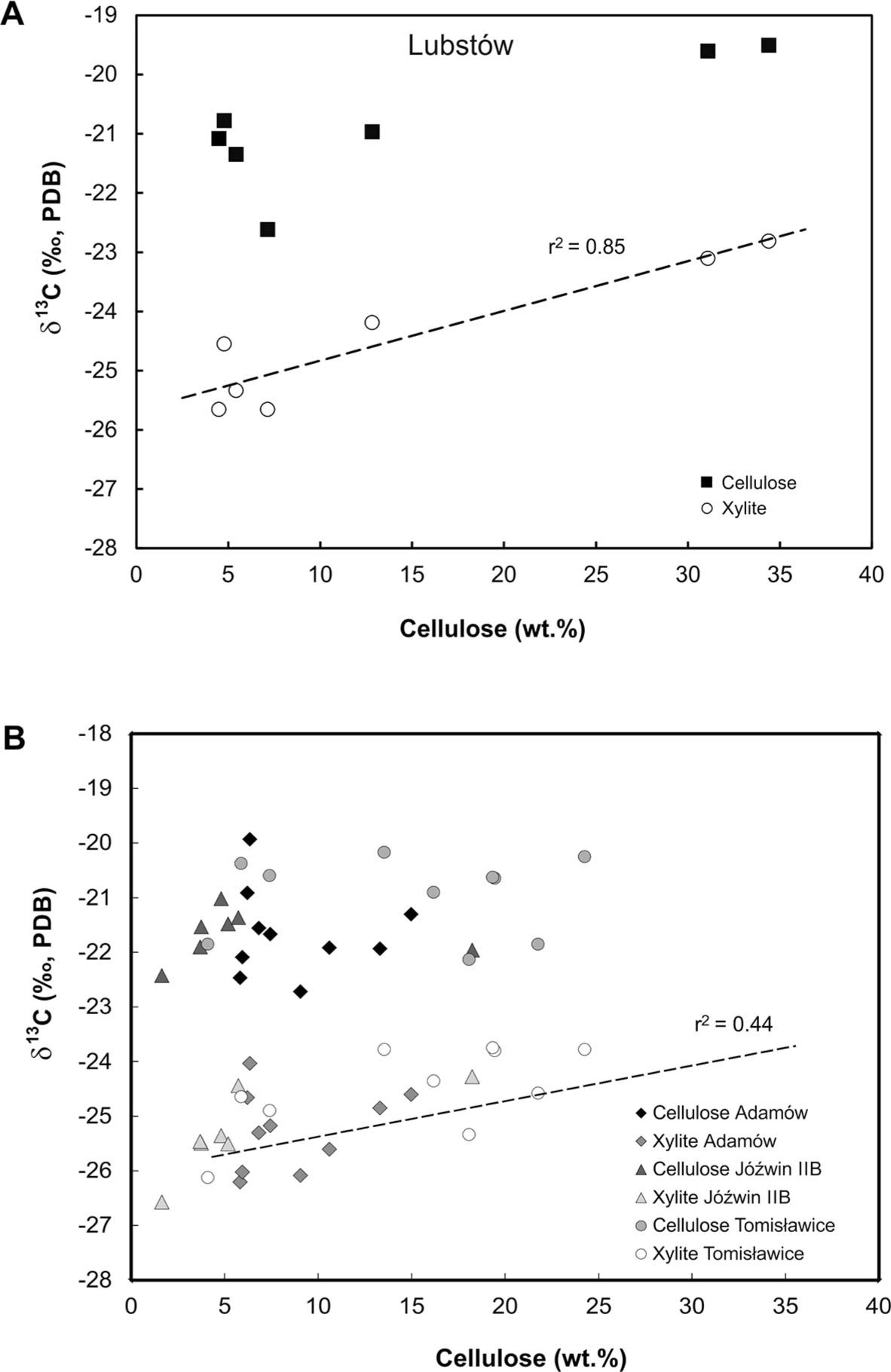
Fig. 6.
Cross-plot of δ13C values of xylite TOC versus extracted cellulose. A – Lubstów opencast mine (Bechtel et al., 2007); B – Adamów, Jóźwin IIB and Tomisławice opencast mines (modified according to Bechtel et al., 2020).
Discussion
5.
Insights into palaeovegetation and mire types
5.1.
The occurrence of xylitic lignite has been interpreted to reflect peat formation within wet- to dry forest swamps, whereas detritic lignite is suggested to indicate swamp bush to wetland environments with shrubs, grasses, and herbs as peat-forming vegetation (Teichmüller, 1989). Based on geochemical data obtained within Polish lignite deposits, Fabiańska & Kurkiewicz (2013) found indications for grasses and herbs as the peat-forming vegetation of detritic lignites, whereas xylitic lignites showed geochemical characteristics typical of conifers. These findings are supported by higher relative abundances of n-alkanes from leaf waxes and lower amounts of terpenoid biomarkers in the detritic samples, compared to the lipid composition of fossil wood fragments (xylite). Furthermore, terpenoid composition of detritic lignite samples reflects significant contributions from angiosperms (variable di-/(di- + tri-)terpenoid ratios; Table 2) in contrast to xylites, originating from conifers (high di-/(di- + tri-)terpenoid ratios; Table 1).
The phenolic abietane ferruginol was identified in most conifer families, especially in species of Cupressaceae and Podocarpaceae, but seems to be absent in Pinaceae (Otto & Wilde, 2001). Abietane type diterpenoids are considered as diagenetic products of abietic acid, preferably found in Pinaceae, or have been derived from phenolic derivatives (i.e., ferruginol; Otto et al., 1997). Recently, ferruginol was identified as one of the major characteristic markers for the Taxodioideae conifer subfamily of Cupressaceae (Simoneit et al., 2019). However, abietic acid has also been found in extracts from MPLS-1 samples (Bechtel et al., 2020). Pinaceae have been characterised by abundant pimarane and abietane type diterpenoids (Otto & Simoneit, 2001; Otto & Wilde, 2001). Tetracyclic diterpanes (kaurane and phyllocladane type) were identified in Cupressaceae, Araucariaceae, and Podocarpaceae families (Noble et al., 1985; Otto & Wilde, 2001; Otto et al., 2002).
The observed terpenoid composition indicates gymnosperms (i.e., conifers) as sources of wood fragments from LLS-2 and MPLS-1, most probably for predominant contributions from Cupressaceae (Bechtel et al., 2020). High abundances of abietane- and pimarane-type (tricyclic) diterpenoids may reflect enhanced contributions of wood fragments from Pinaceae in the Lubstów deposit (Fig. 5). The results are in agreement with palaeobotanical data, as elements of swamp forest (e.g., Taxodium, Glyptostrobus) and dry coniferous forest (e.g., Sequoia, Pinus) have been found within LLS-2 (Ciuk & Grabowska, 1991). Recently, lower tetracyclic/tricyclic diterpanes ratios have been interpreted to indicate decreasing contribution of Cupressaceae and increased input of Pinaceae in Miocene lignites from the coal mining district of Lusatia in eastern Germany (Kojić et al., 2021). Therefore, our data provide evidence for more frequent development of drier habitats during LLS-2 accumulation in comparison to MPLS-1 formation, as reflected by higher relative abundances of abietane-type diterpenoids and lower tetracyclic compounds in the Lubstów deposit (Tables 3, 4; Fig. 5). Higher average abundance of phyllocladanes relative to the sum of concentrations of diterpenoids was found in the xylites and detritic lignite samples from the MPLS-1 deposits (especially from the Adamów deposit; Fig. 5), indicating the predominant contribution of Cupressaceae and a raised (ground)water table during peat formation.
While diterpenoids have been considered as markers for gymnosperms (i.e., conifers; Otto & Wilde, 2001), oleanane, ursane, and lupane type triterpenoids have been reported to occur in angiosperms (Karrer et al., 1977; Sukh Dev, 1989). The variable di-/(di- + tri-)terpenoid ratios (Table 2) in the detritic lignite of MPLS-1 indicate mixed vegetation. In the case of MPLS-1, the occurrence of lupeol in detritic samples (Bechtel et al., 2019) suggests the contribution of Betulaceae to peat formation (Hayek et al., 1989). The results are in agreement with previous palaeobotanical data (Sadowska & Giża, 1991; Piwocki & Ziembińska-Tworzydło, 1997; Kasiński & Słodkowska, 2016). However, degradation of terpenoids during diagenesis must be taken into account because diagenetic alteration may result in erroneous estimates of relative contributions of plant families (Diefendorf et al., 2015).
Environment and mechanisms of wood decomposition
5.2.
Information on wood decomposition can be inferred from the degree of gelification, cellulose yields, and the hopanoid composition of lipids extracted from woody macrofossils. All xylite samples from LLS-2 and MPLS-1 were characterised by low to moderate gelification (Bechtel et al., 2007, 2020). In general, the Jóźwin IIB xylites show a higher degree of gelification than those from the other deposits. Cellulose yields of the xylites between 1.6 and 34.4 wt% indicate low (sample Lub 1) to high (sample JX-02) degrees of degradation. Consistent with their higher extent of gelification, several fossil wood fragments from the Jóźwin IIB mine are characterised by low cellulose yields (6.1 wt% on average; Table 1; Fig. 6B). Cellulose decomposition has been attributed to the activities of fungi (Benner et al., 1987), as well as microbial activities under aerobic and anaerobic conditions (Benner et al., 1984; Bechtel et al., 2007). Elevated hopanoid concentrations were observed in xylites with low cellulose yields (< 10 wt%) within the Jóźwin IIB mine, indicating enhanced bacterial activity (Bechtel et al., 2020), likely promoted by a raised (ground)water table.
Increased relative abundances of hopanoids in the hydrocarbon fractions of the detritic lignite samples (Fig. 3C) reflect enhanced bacterial activity in water-logged depositional environments. The detritic lignite samples from the Tomisławice mine yielded slightly higher hopanoid concentrations (49–111 μg/g TOC) than those from the other deposits (Table 2). The moderate hopanoid concentrations and low sulphur contents of all samples investigated (Bechtel et al., 2007, 2019, 2020), as well as the predominance of the C31 aβ-hopane (22R) indicate freshwater, acidic mire conditions (Casagrande, 1987; Inglis et al., 2018).
Insights from carbon isotopic composition of lignite and fossil wood
5.3.
The carbon isotopic composition of lignite has been shown to vary in response to changes in the peat-forming vegetation (Bechtel et al., 2008), in δ13C of atmospheric CO2 and climatic changes (Ahrens et al., 2000; Jahren & Sternberg, 2008). In previous studies, a major influence of the contribution of gymnosperms (i.e., conifers) versus angiosperms has been shown (Lücke et al., 1999; Bechtel et al., 2008, 2019), due to differences in isotopic fractionation between leaves and atmospheric CO2 and lipid biosynthesis (Diefendorf et al., 2011). This relationship is reflected in the positive correlation between the di-/(di- + tri-)terpenoid ratios and δ13C of detritic lignite in samples from MPLS-1 (Table 2; Fig. 7). The δ13C values of fossil wood remains (xylites) vary over comparable ranges as the lignite samples. Because all xylites represent pieces of conifer wood, variations in δ13C towards lower values are caused by cellulose decomposition and impurities from inherent detritic lignite, as indicated by decreased di-/(di- + tri-)terpenoid ratios (< 1.0; Fig. 7).
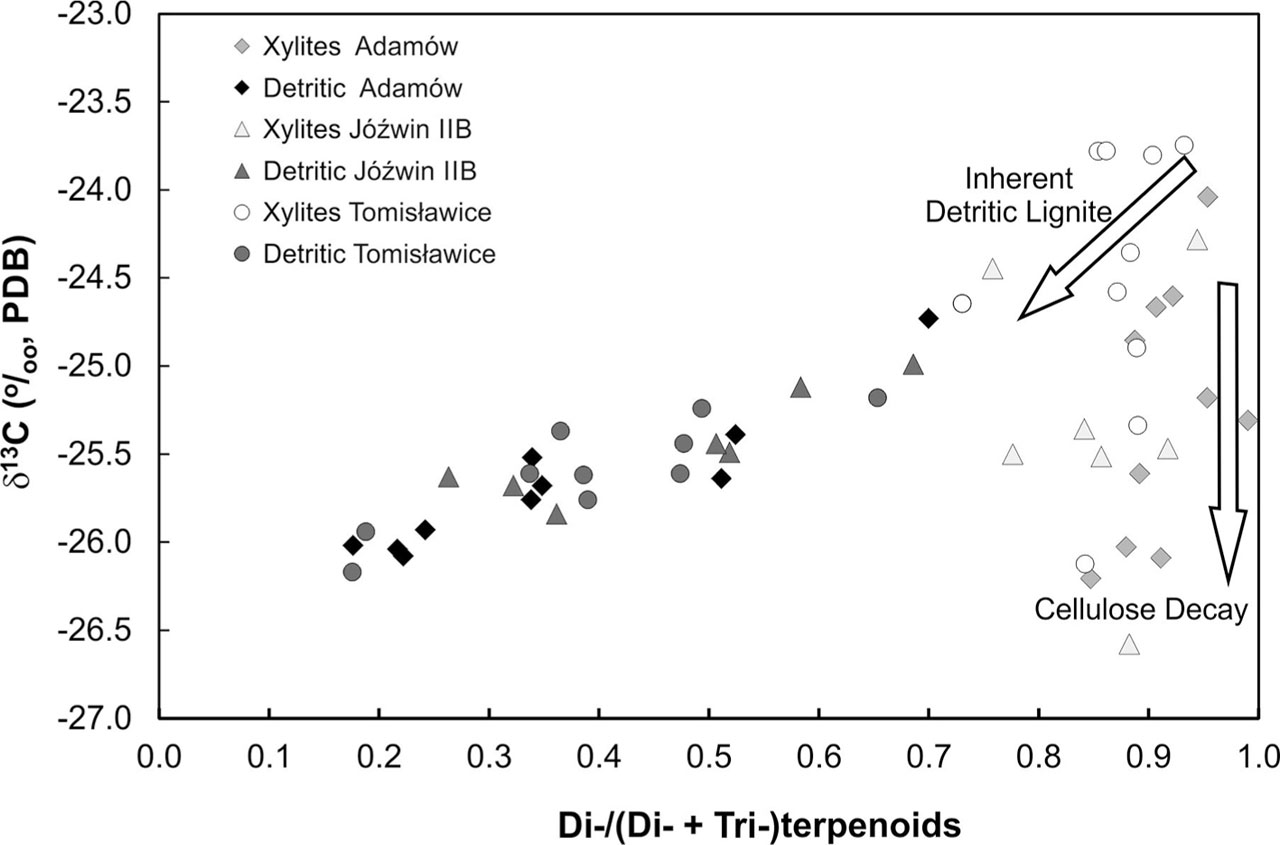
Fig. 7.
Correlation between TOC δ13C values and the relative contribution of diterpenoids, expressed as the di-/(di + tri)-terpenoid ratio, in detritic lignite samples (Bechtel et al., 2019) and xylites from the Adamów, Jóźwin IIB, and Tomisławice opencast mines.
The positive relationship between cellulose yield and δ13C values of total organic matter from xylites (δ13CFW; Table 1; Fig. 6) indicates the progressive depletion of wood in 13C during cellulose decomposition (Benner et al., 1987; Lücke et al., 1999). The obtained δ13C data of wood cellulose support the origin of xylites from woody conifers (Lücke et al., 1999; Stock et al., 2016), as already indicated by their terpenoid biomarker composition. Varying differences in δ13C of xylites and extracted cellulose (2.3–4.6‰; Fig. 6) are in general agreement with those obtained for Miocene lignites and xylites from the Lower Rhine Embayment in Germany (3.8‰; Lücke et al., 1999; Stock et al., 2016).
Because the xylites were derived from similar conifer sources (e.g., most likely from Cupressaceae and minor Pinaceae) inter-species variations are unlikely to be responsible for the observed variations in δ13C (between −19.5 and −22.7‰) of cellulose. Small fluctuations in δ13C within the lignite seam (< 1‰) of each mine may be caused by variations in δ13C of CO2 available to the plants, indicated by minor variations of δ13C of atmospheric CO2 during the Miocene Climatic Optimum (Zachos et al., 2001; Tipple et al., 2010). The observed differences in δ13C of cellulose were most probably caused by water availability to plants due to the adjustment of the stomatal aperture (Jahren & Sternberg, 2008; Diefendorf & Freimuth, 2017). This interpretation is supported by the data presented by Bechtel et al. (2020).
A slightly higher average isotopic composition of wood cellulose from the Lubstów deposit was obtained (δ13CCell = −20.8 ± 1.0‰), in comparison to the xylites from MPLS-1 (δ13CCell = −21.4 ± 0.8‰). Only the Tomisławice xylites yielded a nearly identical average δ13C value of cellulose, as obtained from the Lubstów deposit. Several xylites from the Tomisławice and Lubstów mines are characterised by high cellulose yields. Therefore, an influence of cellulose yields on their δ13C values cannot be excluded. This factor, and the fact that only 7 samples have been investigated from LLS-2 in contrast to 27 xylites from MPLS-1, should be considered for the discussion of the outlined minor difference in average δ13C values of cellulose from xylites of LLS-2 and MPLS-1, respectively. However, comparable tendencies in average δ13C of wood cellulose over the Miocene Climatic Optimum (17–15 Ma) were obtained from fossil wood of lignite deposits within the Lower Rhine Basin (Jordan, 1995; Fig. 8). The influence of decreasing air temperatures during uppermost Miocene and Pliocene on δ13C of cellulose from tree stumps of the Lower Rhine Embayement (Fig. 8) is obvious (Jordan, 1995). However, only minor temperature fluctuations during the Miocene Climatic Optimum (17–15 Ma) are unlikely to result in the observed differences in δ13C of cellulose from LLS-2 and MPLS-1. GDGT-based palaeotemperature proxies obtained from Miocene lignites (18–14 Ma before present) revealed a warm climate during deposition of the peats, shifting towards lower temperatures (2–3 °C) during deposition of the uppermost seam Garzweiler, i.e., at about 13–11 Ma before present (Stock et al., 2016).
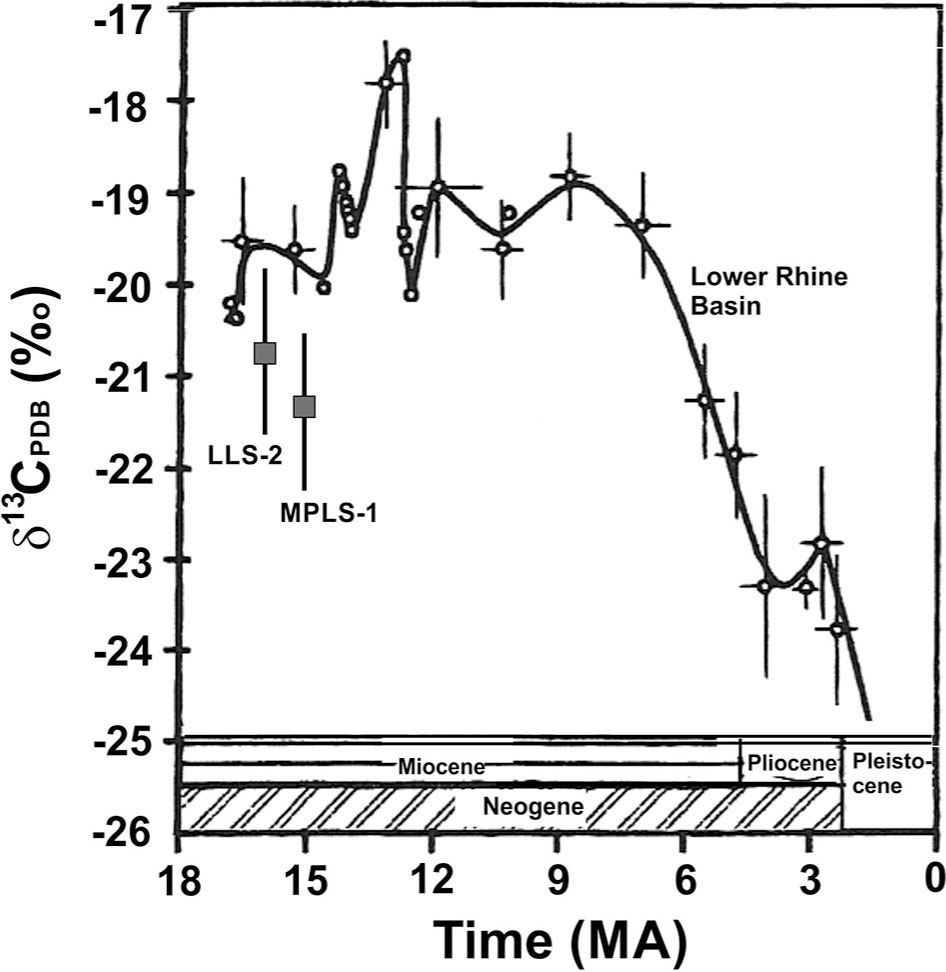
Fig. 8.
Cross-plot of δ13C of wood cellulose from LLS-2 and MPLS-1 lignite seams of the Konin Basin (Poland) versus age of peat accumulation. Data obtained from tree stumps within lignite deposits of the Lower Rhine Basin (Germany) are shown for comparison (adopted from Jordan, 1995).
The data may imply an increased (ground)water table in the mires during MPLS-1 peat accumulation induced by periods of increased precipitation. This interpretation is consistent with the higher average abundance of abietane-type relative to phyllocladane-type diterpenoids in the LLS-2 xylites compared with the MPLS-1 samples, suggesting a greater contribution of Pinaceae from relatively drier habitats.
Conclusions
6.
In this study, previously published results obtained from fossil wood (xylite) of the 2nd Lusatian lignite seam (LLS-2) and from xylites and detritic lignite samples of the 1st Mid-Polish lignite seam (MPLS-1) are re-evaluated to assess temporal and spatial differences in vegetation and depositional environments during peat formation. Low TOC contents of detritic lignite samples (due to dilution by mineral matter) and the presence of seam partings reflect periods of increased fluvial runoff. The terpenoid biomarker composition of detritic lignite samples indicates significant contributions from angiosperms (e.g., shrubs, grasses, elements of mesophytic forest) in contrast to xylites derived from woody conifers. The diterpenoid composition of the xylites indicates that Cupressaceae were the principal source of the fossil wood. High average abundances of tricyclic diterpanes (i.e., abietane-type) and low abundances of tetracyclic compounds (i.e., ent-beyerane, phyllocladane-type) in the xylites from the Lubstów deposit likely reflect decreasing contributions of Cupressaceae and greater input from Pinaceae in the peat-forming environment during deposition of LLS-2 relative to MPLS-1. Enhanced relative abundances of hopanoids in the hydrocarbon fractions of the detritic lignite samples reflect bacterial activity in water-logged depositional environments. A higher (ground)water table in the area of the Jóźwin IIB mine is indicated by enhanced gelification and lower cellulose contents of xylites.
The observed variations in δ13C of detritic lignite primarily reflect varying contributions of gymnosperms and angiosperms to peat formation. The carbon isotope composition of the xylites varies in response to cellulose decomposition and impurities from inherent detritic lignite. The δ13C values of cellulose most probably reflect changes in water availability to the conifers during growth, influenced by highly dynamic landscape evolution (e.g., changing flow directions of rivers, frequent floods, crevasse splays). Slightly higher average δ13C of fossil wood cellulose from LLS-2 may imply a temporarily lower (ground)water table in the mires. A similar trend in δ13C of cellulose from tree stumps of the Lower Rhine Basin has been reported. The results suggest slightly lower precipitation during the earlier phase of the Miocene Climatic Optimum. However, the potential influence of cellulose decomposition on δ13C values of cellulose should be considered.
Acknowledgements
We thank Holger Wissel for the preparation of cellulose and the respective isotope analyses. Marek Widera organised sample collection and provided valuable information about the geology of the mines.
Notes
[13] Contributed by Authors’ contributions
A.B.: conceptualization, methodology, original draft preparation, writing, review, editing, investigation, supervision; D.G.: writing, review, editing, investigation; A.L.: original draft preparation, writing, review, editing, investigation. All authors have read and agreed to the published version of the manuscript.