
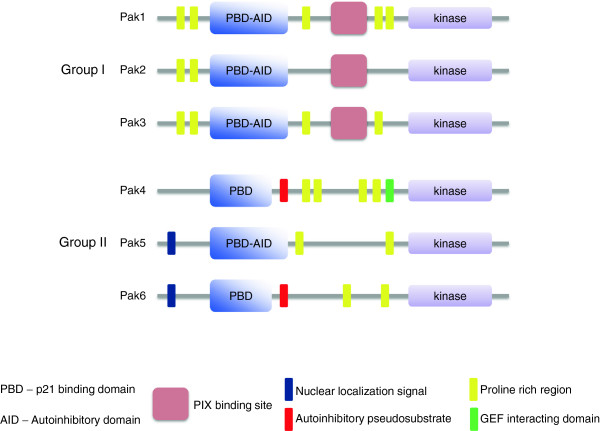
Figure 1
Domain structure of PAKs. A conserved N-terminal p21/GTPase domain (PBD) and a C-terminal serine/threonine kinase domain are shared by all family members of PAK. An autoinhibition mechanism is found available in all PAKs. Binding of activated Cdc42 or Rac1 to the PBD releases group I PAKs from the auto-inhibitory (AID) domain and activates the kinases. AID is also present in PAK5, whereas an autoinhibitory psuedosubstrate has been indentified in PAK4 and PAK6.
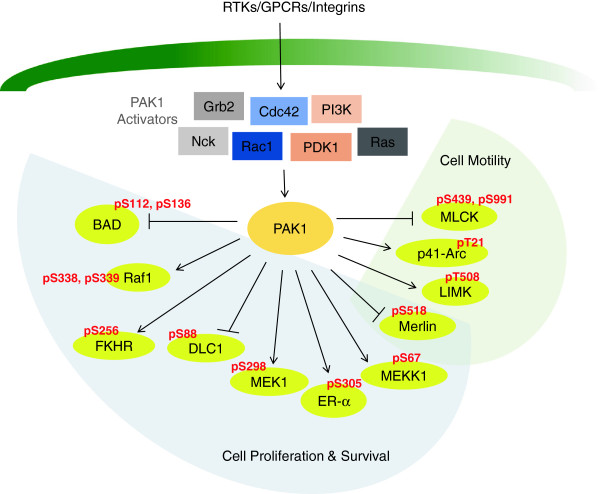
Figure 2
Signaling pathways of PAK1. The well-characterized upstream activators of PAK1 include the G protein-coupled receptors mediated Rho GTPases Cdc42 and Rac1, receptor tyrosine kinases mediated growth factor receptor-bound protein 2 (Grb2) and non-catalytic region of tyrosine kinase adaptor protein 1 (Nck), intergrins, serine/threonine kinases phosphatidylinositol 3 kinase (PI3K) and pyruvate dehydrogenase kinase isozyme 1 (PDK1) and Ras. A wide spectrum of substrates phosphorylated directly by PAK1 has been identified. Inhibition of of BAD, dynein light chain 1 (DLC1) and Merlin by PAK1 orchestrate to promote cancer cell survival. Likewise, activation of Raf1, forkhead in rhabdomyosarcoma (FKHR), MEK1, MEKK1 and estrogen receptor-α (ER-α) by PAK1 phosphorylation empower cancer cell to survive. PAK1 also phosphorylates substrates that regulate cytoskeletal dynamics, including myosin light-chain kinase (MLCK), LIM domain kinase (LIMK), p41-Arc and Merlin, cell motility is enhanced as a result.