
Figure 1
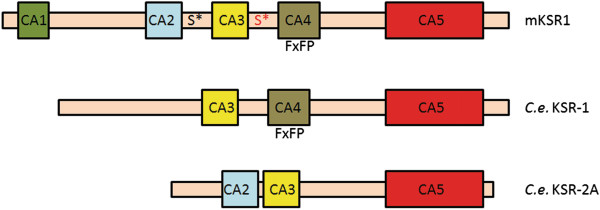
Domain organization of the worm KSR proteins related to murine KSR1. KSR proteins consist of five conserved areas (CA): CA1 (KSR-specific domain), CA2 (proline-rich region), CA3 (cysteine-rich region), CA4 (serine/threonine-rich region), CA5 (kinase-like domain). C. elegans (C.e.) KSR-1 and KSR-2A lack the CA1 domain. Worm KSR-1 lacks the CA2 domain, whereas in KSR-2A the CA4 domain with the FXFP motif (ERK/MAPK docking site) is absent. 14-3-3 binding sites Ser297 (S*) and Ser392 (S* marked red) located on either side of the CA3 domain in the mouse protein (mKSR1) are absent in the worm proteins.
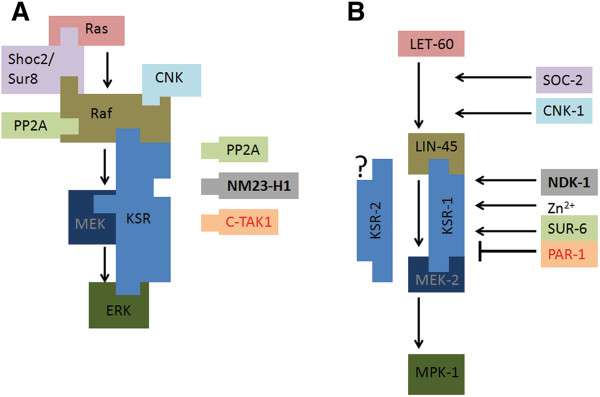
Figure 2
Scaffolds of the Raf/MEK/ERK cascade and regulation of KSR in mammals and in the nematode. SOC-2/SUR-8, CNK/CNK-1 and KSR are scaffolds of the Raf/MEK/ERK cascade. SOC-2/SUR-8 and CNK/CNK-1 are thought to facilitate Raf activation [52,53]. KSR assembles Raf/MEK/ERK complexes and functions downstream of Raf. A) Protein interactions in mammals [22]. C-TAK1 and Nm23-H1 phosphorylate Ser392 of mammalian KSR, while PP2A is able to dephosphorylate the same residue. B) Genetic interactions in C. elegans. PAR-1 inhibits, while SUR-6/PP2A activates KSR-1. NDK-1 activates Ras signaling at the level of KSRs. The molecular mechanisms are not known. The regulation of KSR-2 remains to be determined. The mammalian proteins and their nematode homologs are labeled by the same color.
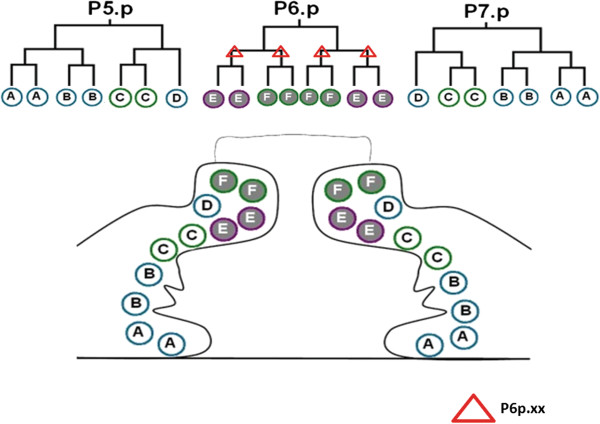
Figure 3
EGL-17/FGF, a known MAPK target shows reduced expression in ndk-1(−) mutant background. The vulva of wild-type hermaphrodites develops from a subset of epidermal blast cells, called vulval precursor cells (VPCs). P(5–7).p VPCs undergo three rounds of cell division and give rise to 22 vulval cells. The vulva at mid-L4 larval stage is composed of 22 cells, which can be grouped into seven cell types (vulA, B1, B2, C, D, E and F). These cells are the great-granddaughters of P5.p-P7.p VPCs (grey filled circles: primary lineages; white circles: secondary lineages). EGL-17/FGF is a known MAPK target, which is expressed in all daughters (P6p.x) and granddaughters (P6p.xx) of P6.p in the L3 stage in wild-type animals. EGL-17/FGF expression was reduced in P6p.xx cells (red triangle) in ndk-1(−) mutants suggesting that Ras/MAPK signaling is inhibited in the absence of NDK-1 [18].