
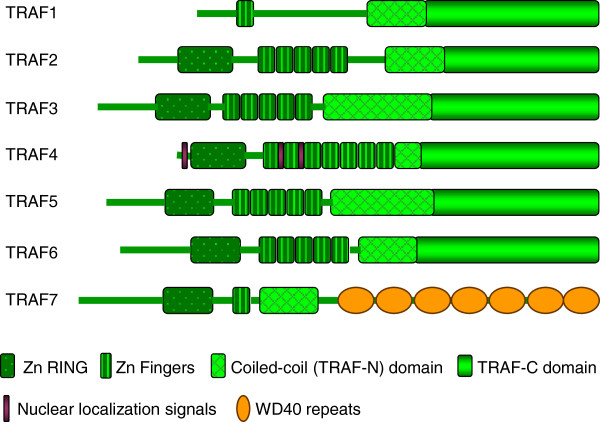
Figure 1
Domain structure of the seven TRAF proteins. Symbols for different domains are shown, including zinc RING (Zn RING), zinc fingers (Zn Fingers), coiled-coil (TRAF-N) domain, TRAF-C domain, nuclear localization signals, and WD40 repeats.
Table 1
TRAFs directly and indirectly employed by the TNF-R superfamily
| Receptors | TRAFs | References |
|---|---|---|
| TRAIL-R1 | TRAF2 via RIP1 | [67] |
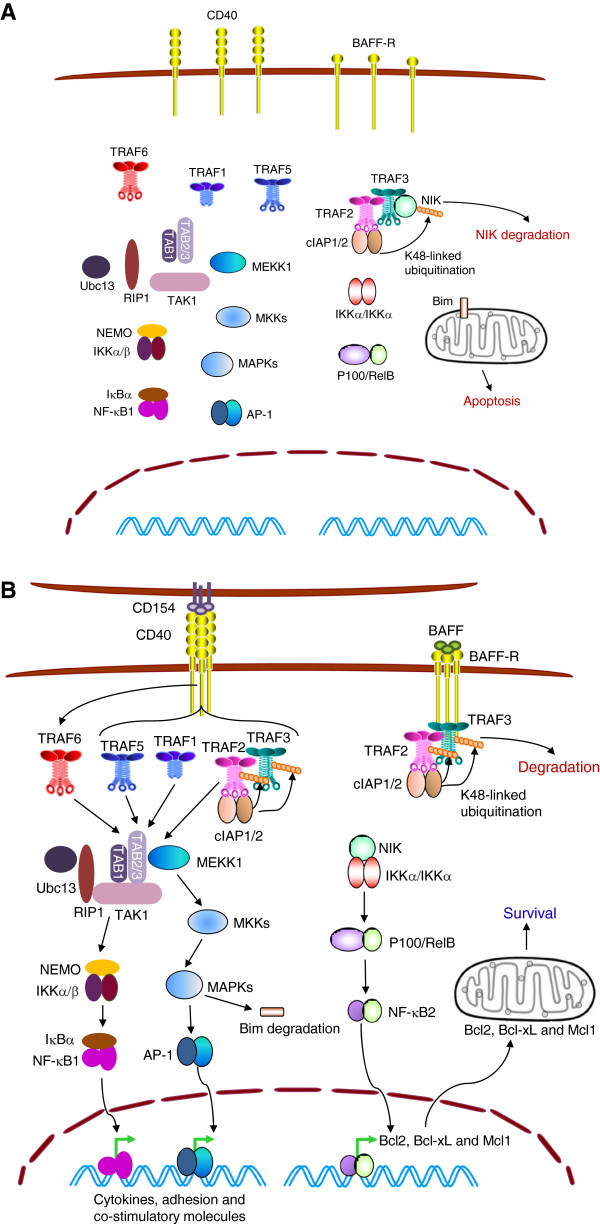
Figure 2
TRAFs in BAFF-R and CD40 signaling pathways in B lymphocytes. (A) In the absence of stimulation, TRAF3 and TRAF2 promote B cell apoptosis. TRAF3 and TRAF2 constitutively form a complex with cIAP1/2 and NIK, target NIK for K48-linked polyubiquitination and degradation, thereby inhibiting NF-κB2 activation in B cells. (B) BAFF-R and CD40 signaling pathways. Upon ligand engagement, BAFF-R or CD40 recruits TRAF3-TRAF2-cIAP1/2 to membrane rafts, thus allowing NIK accumulation and NF-κB2 activation, leading to B cell survival. In addition, TRAF1, 2, 5 and 6 mediate CD40-induced activation of NF-κB1 and MAPKs.
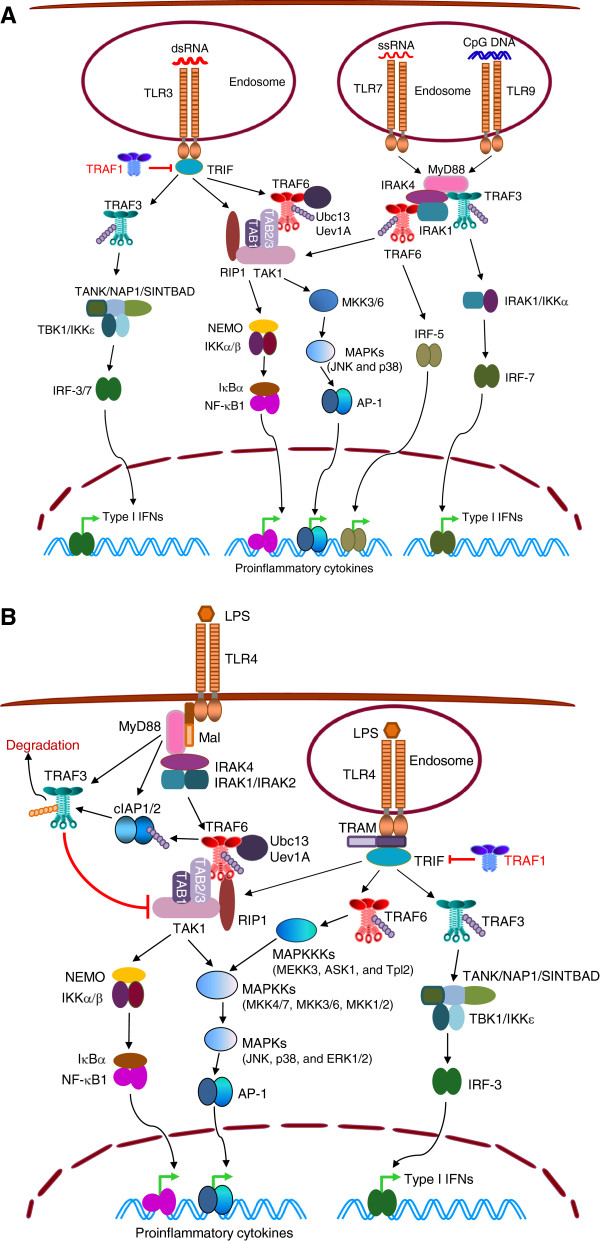
Figure 3
TRAFs in signaling by TLRs. (A) TLR3, 7 and 9 signaling pathways. Upon ligand binding in endosomes, TLR3 recruits TRAF3 and TRAF6 via TRIF, while TLR7 and TLR9 recruit TRAF3 and TRAF6 via MyD88-IRAK1. (B) TLR4 signaling pathways. Upon LPS engagement on the plasma membrane, TLR4 recruits TRAF6 and TRAF3 via MyD88-IRAK1. Internalized TLR4 recruits TRAF3 and TRAF6 to endosomes via TRIF. TRAF6 mediates MyD88- and TRIF-induced activation of NF-κB1 and MAPKs, while TRAF3 mediates MyD88- or TRIF-induced activation of IRF-3/7 in signaling by TLRs. In contrast, TRAF1 inhibits TRIF signaling.
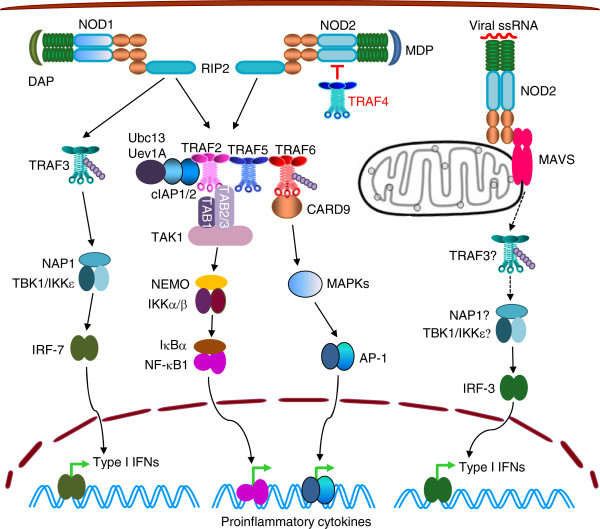
Figure 4
TRAFs in signaling by NOD1 and NOD2. Upon DAP engagement, NOD1 recruits TRAF2, TRAF5, TRAF6 and TRAF3 via RIP2. TRAF2, 5 and 6 mediate NOD1-induced activation of NF-κB1 and MAPKs, while TRAF3 mediates NOD1-induced activation of IRF7. In response to MDP binding, NOD2 also recruits TRAF2, 5 and 6 via RIP2, and thus induces activation of NF-κB1 and MAPKs. When engaged by viral ssRNA, NOD2 binds to MAVS on mitochondria and induces IRF3 activation and Type I IFN production, which is likely mediated by TRAF3.
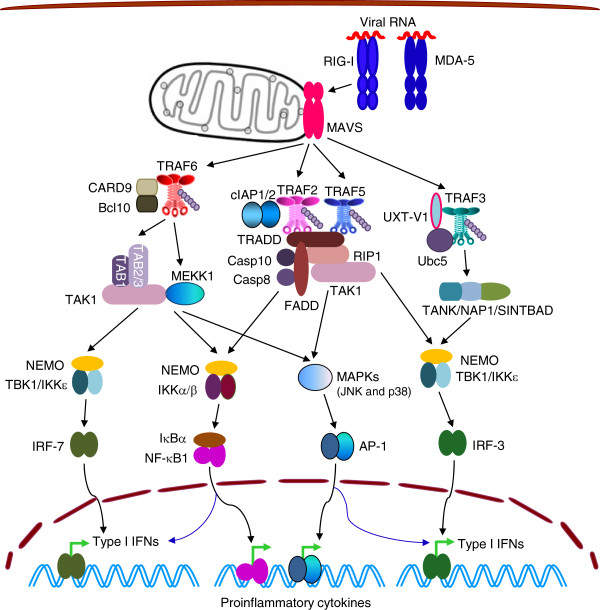
Figure 5
TRAFs in signaling by RIG-I. Upon ligand binding, RIG-I recruits TRAF3, TRAF6, TRAF2 and TRAF5 to mitochondria via MAVS. TRAF3 mediates RIG-I-induced IRF3 but not NF-κB1 activation. TRAF6 mediates RIG-I-induced IRF7 activation and also contributes to activation of NF-κB1, JNK, and p38. TRAF2 is important for p38 activation, and both TRAF2 and TRAF5 also contribute to activation of IRF3 and NF-κB1 in RIG-I signaling.
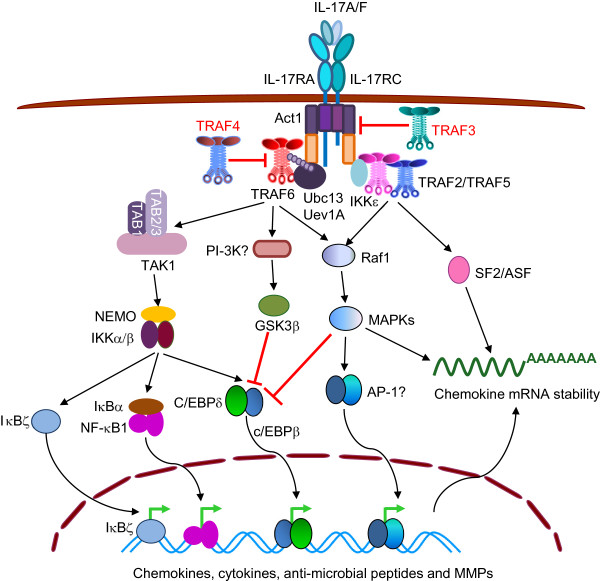
Figure 6
TRAFs in signaling by IL-17R. Upon ligand binding, heteromeric IL-17RA and IL-17RC recruit TRAF6, TRAF2 and TRAF5 via Act1. TRAF6 mediates IL-17-induced activation of NF-κB1, IkBζ, C/EBPδ and C/EBPβ. TRAF2 and TRAF5 transduce the IL-17 signals to stabilize mRNA transcripts of chemokines and cytokines by recruiting SF2 and by inducing activation of MAPKs. In contrast, TRAF3 and TRAF4 inhibit IL-17 signaling. TRAF3 interacts with IL-17RA and IL-17RC and thus interferes with the recruitment of Act1 by IL-17Rs, while TRAF4 binds to Act1 and interrupts the recruitment of TRAF6 by Act1.
Table 2
Substrates of the E3 ligase activity of TRAFs
| Substrates (Lys residues of ubiquitination) | E3 ligases | Receptor signaling | References |
|---|---|---|---|
| ECSIT | TRAF6 | TLR1, 2, 4-induced ROS production | [93] |
Table 3
E3 ligases that catalyze the ubiquitination of TRAFs
| E3 ligases | Target TRAFs (Lys of ubiquitination) | Receptor signaling | References |
|---|---|---|---|
| CHIP | TRAF2 | Cancer cell invasion | [213] |
Table 4
Deubiquitinating enzymes that target TRAFs
| DUBs | TRAFs | Receptor signaling | References |
|---|---|---|---|
| MCPIP1 | TRAF2, TRAF3, TRAF6 | IL-1, TLR4 | [219] |
Table 5
Pathogenic proteins that target TRAFs
| Viral or bacterial proteins | TRAFs | Mechanisms | Ref. |
|---|---|---|---|
| VSV | TRAF6 | Up-regulates miR-146a that targets TRAF6 and IRAK1 | [252] |
Table 7
Genetic variations of TRAFs in human diseases
| Diseases | Genetic variations of TRAFs | References |
|---|---|---|
| Hypohidrotic ectodermal dysplasia | Inactivating mutation of TRAF6 | [313] |