
Figure 1
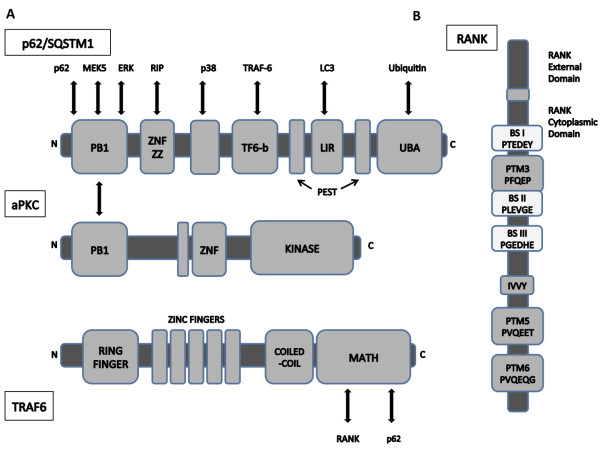
Interaction motifs and domains of RANKL signal intermediaries. A: p62 and an aPKC. The cytosolic p62 protein, encoded by the SQSTM1 gene, is a scaffolding protein that interacts with the RANK signaling complex, and is one of the functional links reported between RANKL and TRAF-6-mediated NF-κB activation. Multiple interaction motifs located within p62 enable recruitment of specific proteins and regulation of downstream signaling pathways. RIP binds to the ZZ domain, whereas TRAF6 interacts with the TF6-b sequence, and the aPKC isoforms, ERK, and others interact with the PB1 domain. This PB1 interaction directs the aPKCs in the NF-κB pathway. The UBA domain binds to polyubiquitin chains, and is important for the ubiquitination of TRAF6. PB1, PB1 dimerisation domain; ZZ ZNF, ZZ-type zinc finger; TF6-b, TRAF6 binding sequence; PEST, (P, Proline; E, Glutamate; S, Serine; T, Threonine) rich sequence; UBA, ubiquitin associated; PS, pseudosubstrate region; MATH, meprin and TRAF homology. B: The RANK receptor. RANK has six known putative TRAF-binding motifs (PTM 1-6) of which three have been involved in osteoclast signaling. TRAF6 binds to membrane-proximal motifs such as PTM3 (PFQEP369-373), whereas PTM5 (PVQEET559-564) and PTM6 (PVQEQ604-609) most likely interact with TRAF2 and TRAF5 [22,23]. In addition, three other TRAF6- binding sites have been identified, BS I (PTEDEY340-345), BS II (PLEVGE373-378) and BS III (PGEDHE447-452 [25,26].
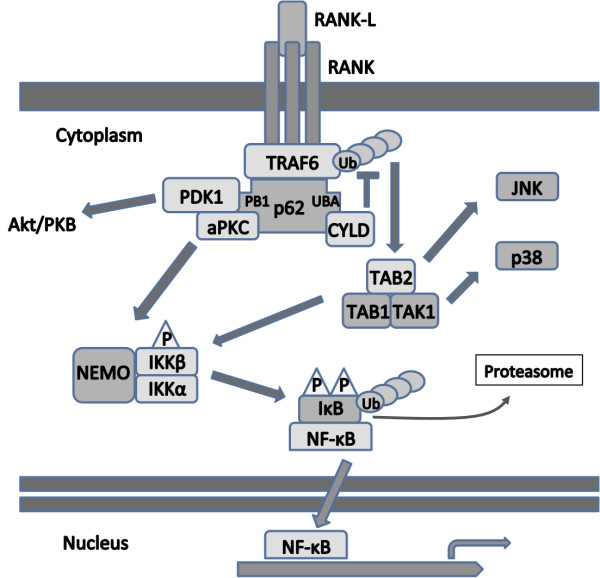
Figure 2
p62 in osteoclast signaling and protein trafficking. The binding of RANKL to the receptor protein RANK at the plasma membrane induces the formation of a trimer, triggering the recruitment of a series of adaptor proteins. TRAF6 catalyses Lys63-linked autoubiquitination via intrinsic E3 ubiquitin ligase activity, which is regulated by the UBA domain of p62, and eventually deubiquitinated post-recruitment of CYLD to p62. In the interim, this ubiquitination permits activation of the TAB1-TAB2-TAK1 complex, in turn activating the MAP kinases, as well as NF-κB-inducing kinase (NIK), which leads to phosphorylation and activation of IKKβ. Activation of TRAF6 and p62 also leads to activation of the Akt/PKB pathway. Simultaneously, p62 binds aPKC through its N-terminal PB1, allowing for the phosphorylation of IKKβ by the aPKC. Once activated, IKKβ phosphorylates IκB, which is subsequently ubiquitinated, and degraded through the proteasome system, liberating NF-κB to translocate to the nucleus and interact with transcription promoters.