
Figure 1
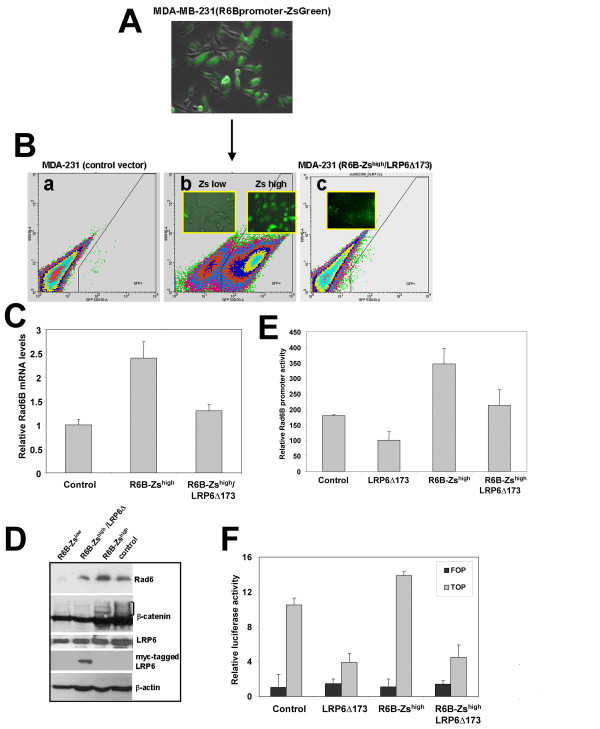
Breast cancer subpopulations selected for high Rad6B promoter activity display elevated β-catenin levels and activity, which is suppressed by LRP6 inhibition. (A) Fluorescence/phase contrast images of MDA-MB-231 cells stably transfected with Rad6B promoter-ZsGreen1 reporter vector. (B) FACS analysis of MDA-MB-231 cells transfected with promoterless (a) or Rad6B promoter-ZsGreen1 (b) vector. Panel c, FACS profile of R6B-Zshigh cells transfected with mutant LRP6Δ173. Insets in b represent fluorescence images of sorted subpopulations with low (Zs low) and high (Zs high) green fluorescence. (C) Rad6B mRNA expression relative to GAPDH in the indicated cells determined by semi-quantitative RT-PCR. (D) Steady-state levels of indicated proteins in the cytosols of indicated MDA-MB-231 subpopulations. (E) Relative Rad6B promoter activity in MDA-MB-231 cells transfected with Rad6B promoter-luciferase and pRLTK. (F) Relative pTOP/Flash or pFOP/Flash reporter activities in MDA-MB-231 cells. The data shown in E and F are averages (± S.E.M) of three separate experiments performed in duplicate.
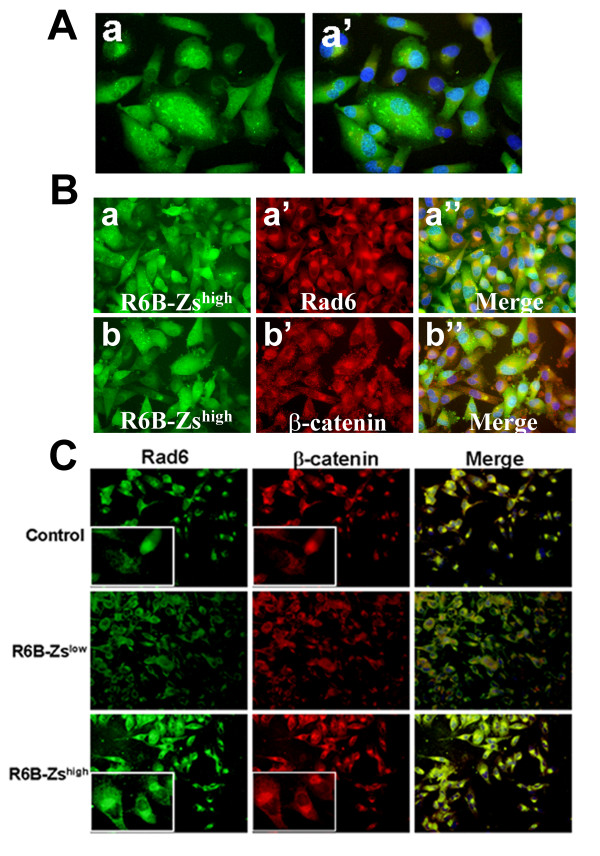
Figure 2
Subpopulations selected for high endogenous Rad6B expression (ZsGreenhigh) show elevated intracellular β-catenin. (A) ZsGreen fluorescence imaging of R6B-Zshigh MDA-MB-231 cells. a' is ZsGreen fluorescence merged with DAPI. Magnification ×20. (B) Immunofluorescence staining of R6B-Zshigh MDA-MB-231 cells with anti-Rad6 or anti-β-catenin, and detected with appropriate Texas Red conjugated secondary antibody. Endogenous ZsGreen fluorescence was merged with Texas Red and DAPI. Original magnification, ×40. (C) Immunofluorescence staining of control, R6B-Zshigh and R6B-Zslow MDA-MB-231 cells with anti-Rad6 or anti-β-catenin antibodies. Proteins were detected with FITC (Rad6) or Texas Red (β-catenin) conjugated secondary antibodies. Original magnification, ×20.
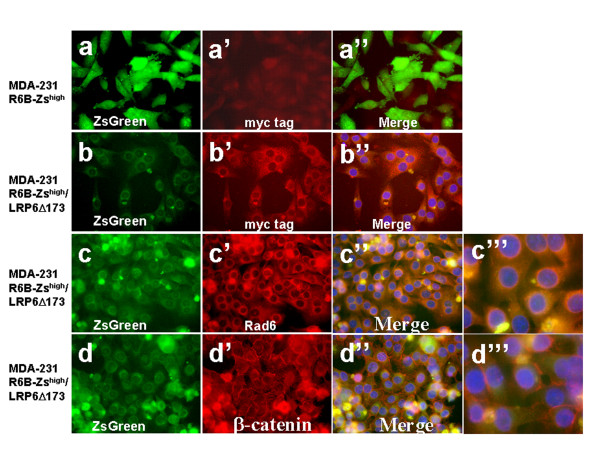
Figure 3
Wnt disruption in high Rad6B expressors decreases intracellular β-catenin, Rad6B promoter-directed ZsGreen expression, and suppresses EMT phenotype. Immunofluorescence staining of control R6B-Zshigh or R6B-Zshigh/LRP6Δ173 MDA-MB-231 cells with anti-myc tag (a', b'), anti-Rad6 (c'-c''') or anti-β-catenin (d'-d''') antibodies. Proteins were detected with Texas Red conjugated secondary antibodies. Endogenous ZsGreen fluorescence was merged with Texas Red and DAPI. Original magnification, ×20 for all panels except c''' and d''', X100.
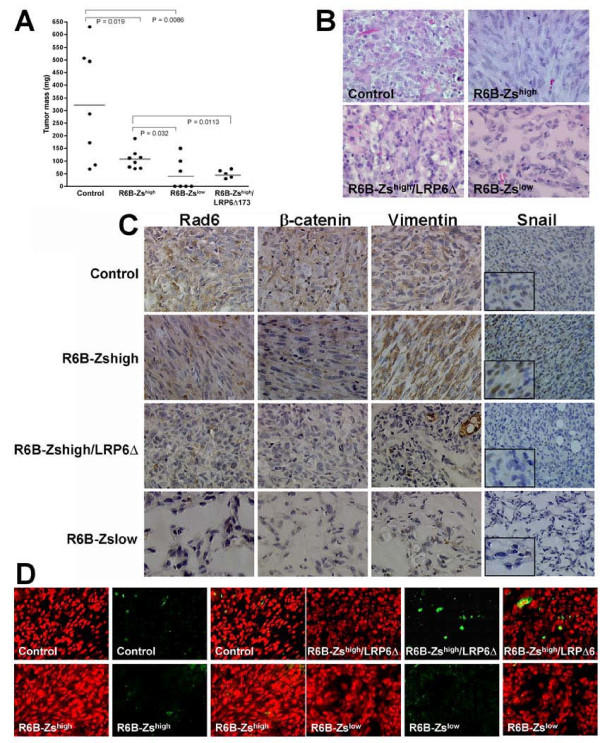
Figure 4
Tumors derived from high Rad6B expressors show homogeneous EMT phenotype that is suppressed by mutant LRP6. (A) Tumor masses produced by the indicated MDA-MB-231 subpopulations. (B) Tumor morphologies of xenografts derived from the indicated MDA-MB-231 subpopulations by H&E staining. (C) Immunohistochemical analysis of Rad6, β-catenin, Vimentin and Snail1 in vector control, R6B-Zshigh, R6B-Zshigh/LRP6Δ173 and R6B-Zslow tumors. Original magnification ×20. (D) TUNEL staining (green) of tumors produced by the indicated MDA-MB-231 subpopulations. Sections were counterstained with propidium iodide. Original magnification ×40.
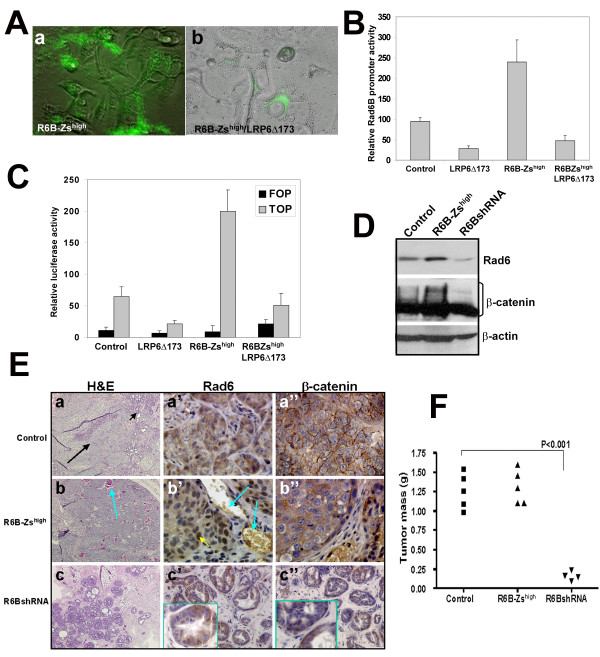
Figure 5
Inhibition of Wnt signaling in WS-15 breast cancer cells selected for endogenous Rad6B overexpression downregulates Rad6B gene expression and β-catenin transcriptional activity. (A) Fluorescence imaging of vector control R6B-Zshigh (a) or R6B-Zshigh/LRP6D173 (b) WS-15 cells. (B) Relative Rad6B promoter activities in WS-15 subpopulations. (C) Relative pTOP/Flash or pFOP/Flash activities in WS-15 subpopulations. The data shown in C and D are averages (± S.E.M) of three separate experiments done in duplicate. (D) Steady-state levels of indicated proteins in the cytosols of vector control, R6B-Zshigh or PLKO-Rad6BshRNA WS-15 cells. (E) Tumor morphologies of vector control (a), R6B-Zshigh (b), and Rad6BshRNA (c) WS-15 xenografts by H&E staining. Immunohistochemical analysis of Rad6 (a', b' and c') and β-catenin (a", b" and c") in vector control, Rad6B-Zshigh and Rad6BshRNA WS-15 tumors. Short arrow in panel a shows hyperplastic region and long arrow shows invasive carcinoma. Long arrow in b and b' show blood vessels in tumors, and the short arrow in b' shows nuclear Rad6 staining. Note the loss of cell membrane staining of β-catenin in R6B-Zshigh tumors (compare a" and b"). Insets in c' and c" show magnified images of Rad6 and β-catenin staining, respectively, in hyperplastic ducts of Rad6BshRNA tumors. Original magnification ×4 (a and b); ×10 (c); ×20 (c' and c"); ×40 (a', a", b', b"). (F) Comparison of tumor masses of vector control, R6B-Zshigh and Rad6BshRNA WS-15 derivatives.
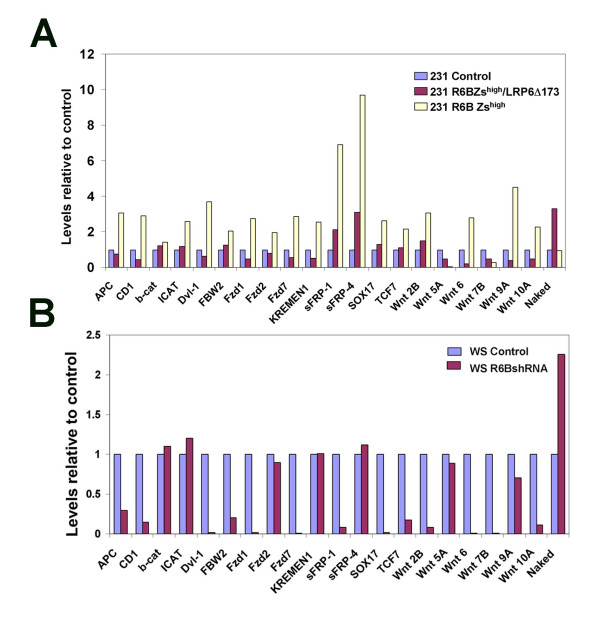
Figure 6
Expression analysis of Wnt-regulated genes by RT2 Profiler PCR SuperArrays. (A) Relative levels in the indicated MDA-MB-231 (A) and WS-15 (B) derivatives.
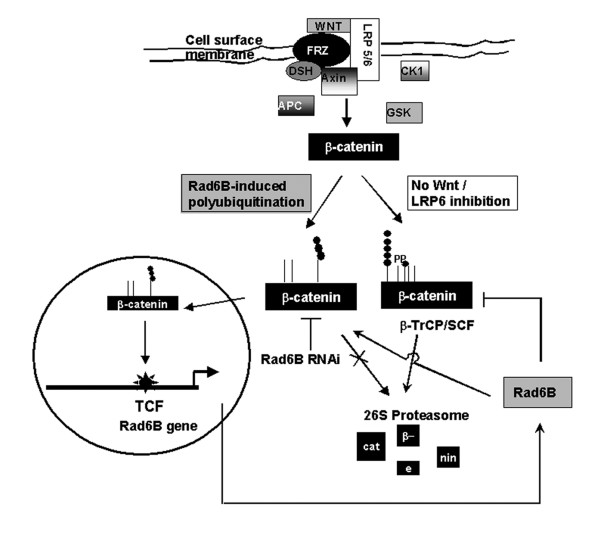
Figure 7
Model of Rad6B/β-catenin regulation in breast cancer cells with autocrine Wnt activity. Activation of the canonical Wnt pathway is regulated by Wnt ligand interactions with Wnt receptors Frizzled (FZD) and coreceptors LRP5/6 at the cell surface, and culminates in β-catenin stabilization by preventing its recruitment into the APC/Axin/GSK3 destruction complex. Rad6B transcription is induced by β-catenin, and Rad6B in turn stabilizes β-catenin by mediating K63 linked polyubiqitin modifications that render β-catenin insensitive to proteasomal degradation. Rad6B silencing disrupts the positive feedback loop between Rad6B expression and β-catenin stabilization with resultant decrease in ubiquitinated β-catenin and β-catenin transcriptional activity. The Rad6B induced β-catenin stabilization occurs downstream of Wnt activation and requires LRP6 mediated protection of β-catenin from incorporation into the destruction complex, as inhibition of LRP6 function in Rad6B overexpressors prevents β-catenin stabilization with resultant decreases in Rad6B expression.