
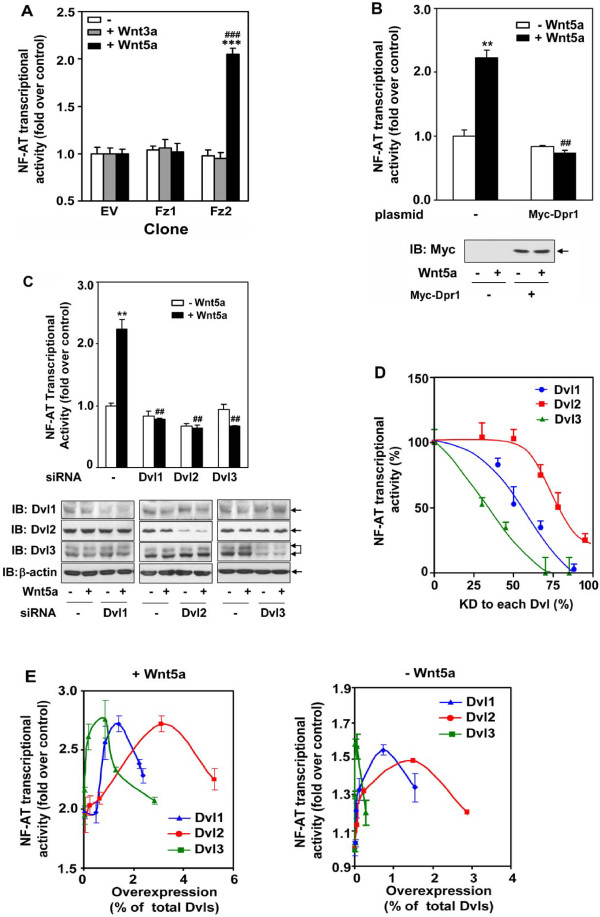
Figure 1
Dvl1, Dvl2, and Dvl3 expression are each required for Wnt5a/Fz2/NF-AT signaling. A, mouse F9 stable clones expressing rat Frizzled1 (Fz1), rat Frizzled2 (Fz2) or empty vector (EV) [30] were treated with vehicle (-), Wnt3a or Wnt5a for 6 hours and the activity of NF-AT-dependent luciferase was measured. ***p < 0.001, compared with corresponding vehicle-treated group; ###, p < 0,001, compared with Wnt5a-treated "EV" group. B, Myc-Dapper1 (Myc-Dpr) was expressed (assayed by immunoblotting, bottom panel) in F9 clones expressing Fz2. The activity of NF-AT reporter in response to Wnt5a was determined as described. C, Suppression of Dvl1, Dvl2, or Dvl3 using siRNA targeting a single Dvl isoform was conducted in F9 clones expressing Fz2. The activation of NF-AT-sensitive transcription in the presence (+) or absence (-) of Wnt5a was assayed by using a luciferase reporter. **, p ≤ 0.01, compared with basal (-Wnt5a) in control group; ##, p ≤ 0,01, compared with Wnt5a-treated (+Wnt5a) control group. Suppression of Dvl1, 2 or 3 by using siRNA was examined by immunoblotting. The blots of actin were shown as loading controls. D, F9 cells expressing Fz2 were treated with variable amounts of siRNAs targeting a single Dvl isoform. The activation of the NF-AT-dependent luciferase in response to Wnt5a was measured. The data are plotted as "% of maximal" of the Wnt5a-sensitive luciferase response versus the extent of knock-down (KD) in individual Dvl isoforms produced by treatment of increasing amounts of siRNA. The level of Knock-down for each Dvl was verified by immunoblotting (data not shown). E, Increased amounts of Dvl were expressed in F9 clones expressing Fz2. The activation of NF-AT-sensitive transcription in the presence (left panel) or absence (right panel) of Wnt5a was assayed by using a luciferase reporter. The luciferase activities were plotted versus the amount of immunoreactive staining for the HA-tag quantified in the blots (data not shown).
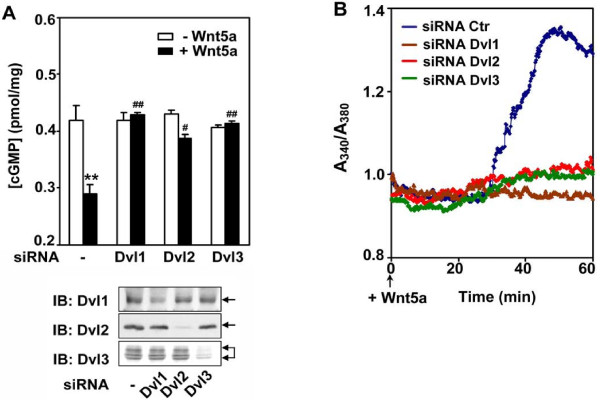
Figure 2
Dvl3 is requisite in Wnt5a/Fz2/cGMP/Ca2+signaling. A, Fz2 expressing cells were treated with control siRNA (-) or siRNA targeting individual Dvl isoforms. Cells were treated with vehicle (-Wnt5a), or Wnt5a (+Wnt5a) for 45 min and cellular cGMP was assayed (left panel). Suppression of Dvl1, 2 or 3 by using siRNA was examined by immunoblotting (right panel). B, cells were treated for 48 hr with either control siRNA (Ctr) or siRNA targeting individual Dvl isoforms. After loaded with Fura2, cells were challenged by Wnt5a (+Wnt5a). A representative graph of Ca2+ transient presented as A340/A380 for cells treated with different siRNA presented. Each line depicts the mean values obtained from 20 cells selected randomly.
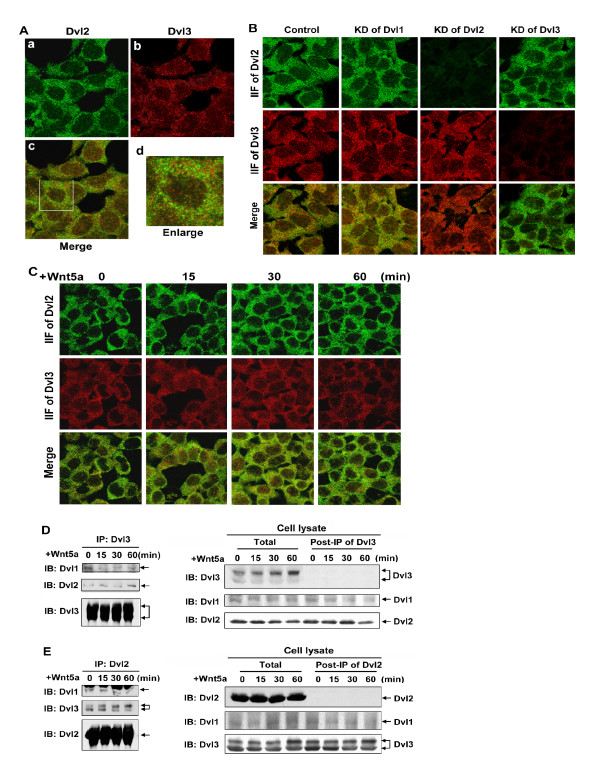
Figure 3
Dvl2 and Dvl3 form punctate complexes. A, Fz2 expressing cells were cultured on a cover-glass in a MatTak culture dish. Cells were fixed and Dvl2 and Dvl3 were doubly stained by using antibodies against Dvl2 or Dvl3. B, cells were treated with siRNA targeting individual Dvl isoforms for 2 days and cultured on a cover-glass in a MatTak culture dish. Cells were fixed and Dvl2 and Dvl3 were doubly stained by using antibodies against Dvl2 or Dvl3. C, cells were treated with Wnt5a for indicated time periods. Cells were fixed and cellular Dvl2 and Dvl3 were doubly stained by using specific antibodies against Dvl2 or Dvl3, respectively. D and E, cells were treated with Wnt5a for indicated time periods. Immunoprecipitation-based "pull-downs" from whole-cell lysates were performed by using specific antibodies that either recognizes only Dvl3 (panel D), or recognizes only Dvl2 (panel E). The Dvl-based complexes isolated in the pull-downs ("IP:Dvl3" and "IP:Dvl2"; left panels in D and E, respectively), whole-cell lysates ("Total"; right panel), as well as supernatant fraction following the immune precipitation ("post-IP of Dvl3" and "post-IP of Dvl2"; right panels in D and E, respectively) were subjected to SDS-PAGE and the resolved proteins transferred to nitrocellulose blots. The blots were stained with antibodies specific for each Dvl isoform. A set of representative images of immunoblotting are shown.
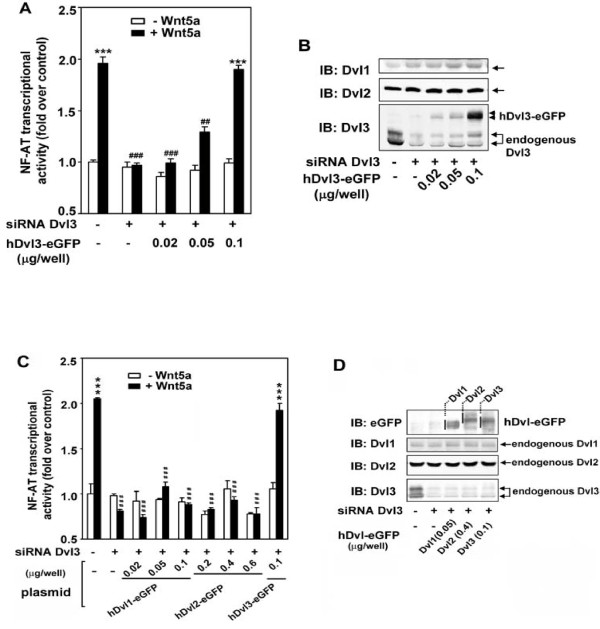
Figure 4
Expression of hDvl3, but neither hDvl1 nor hDvl2, rescues Wnt5a-stimulated NF-AT-sensitive transcriptional activation in Dvl3-depleted cells. F9 cells stably expressing Fz2 were treated with siRNA targeting Dvl3. Dvl3-depleted cells were transfected with various amounts of expression plasmid harboring hDvl3-eGFP (A and B), or hDvl1-eGFP or hDvl2-eGFP (C and D). The Wnt5a-sensitive transcriptional activation was performed by the assay of NF-AT-dependent luciferase reporter (A and C). ***, p ≤ 0.001, compared with basal (-Wnt5a) in control (-siRNA, -plasmid) group; ##, p ≤ 0.01, ###p ≤ 0.001, compared with (+Wnt5a) in control group. The cell lysates from the same batch used in reporter assay were subjected to SDS-PAGE and the resolved proteins transferred to nitrocellulose blots. The blots were stained with antibodies indicated (B and D). A set of representative images of immunoblotting are shown.
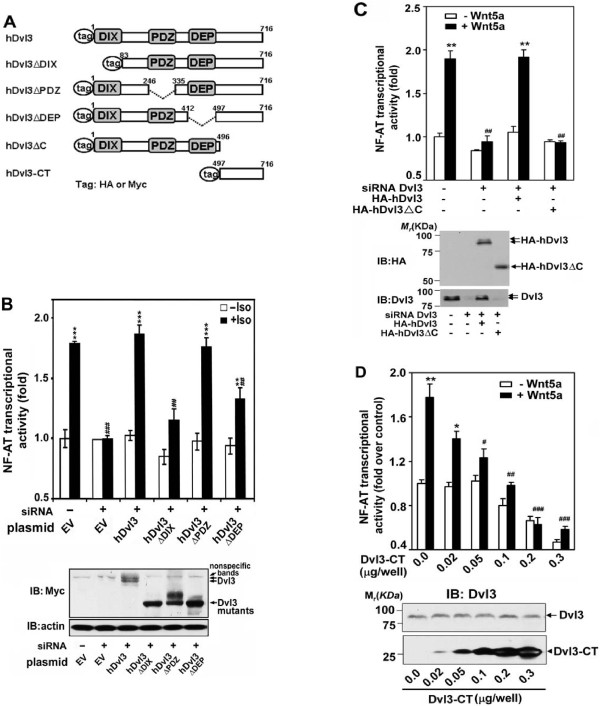
Figure 5
The DIX domain and C-terminal region of Dvl3 are obligate for non-canonical signaling. A, a schematic of deletion mutants of human Dvl3. B, F9 cells expressing β2AR/Fz2 were made deficient in Dvl3 by treating cells with siRNA targeting Dvl3. Myc-tagged hDvl3 or mutants (i.e. hDvl3ΔDIX, hDvl3ΔPDZ, hDvl3ΔDEP) were then expressed in these cells and NF-AT-dependent reporter activity induced by activation of the pathway (+Iso, 10 μM) was measured and displayed as "fold-activation", setting reporter activity in control cells (-siRNA, EV) as "1" (upper panel). **, p ≤ 0.01, ***, p ≤ 0.001 compared with basal (-Iso) in control (-siRNA, EV) group; ## p, ≤ 0.01, ###p ≤ 0.001, compared with stimulation (+Iso) in control group. Expression of hDvl3 or mutants was analyzed by immunoblotting (bottom panel). The blots of β-actin were shown as loading controls. C, F9 cells expressing Fz2 were treated with or without siRNA targeting Dvl3. Twenty four hours after siRNA treatment, cells were transfected with expression vector harboring either HA-hDvl3 or HA-hDvl3ΔC. Wnt5a-stimulated NF-AT reporter activity was measured (upper panel). **, p ≤ 0.01, compared with basal (-Wnt5a) in control (-siRNA) group; ##, p ≤ 0.01, compared with (+Wnt5a) in control group. Cell lysates were subjected to SDS-PAGE followed by immunoblotting (IB). Results from enhanced chemical luminescence (ECL) of the exposed blots are displayed (bottom panel). D, Various amounts of HA-tagged hDvl3-CT were expressed in F9 cells expressing Fz2. The activity of NF-AT luciferase reporter in response to Wnt5a was assayed (upper panel). *, p ≤ 0.05, **, p ≤ 0.01, compared with basal (-Wnt5a) in control group; #, p ≤ 0.05, ##, p ≤ 0.01, ###p ≤ 0.001, compared with Wnt5a-treated control group. Expressions of Dvl3-CT as well as endogenous Dvl3 in cell lysates were analyzed by immunoblotting (bottom panel).
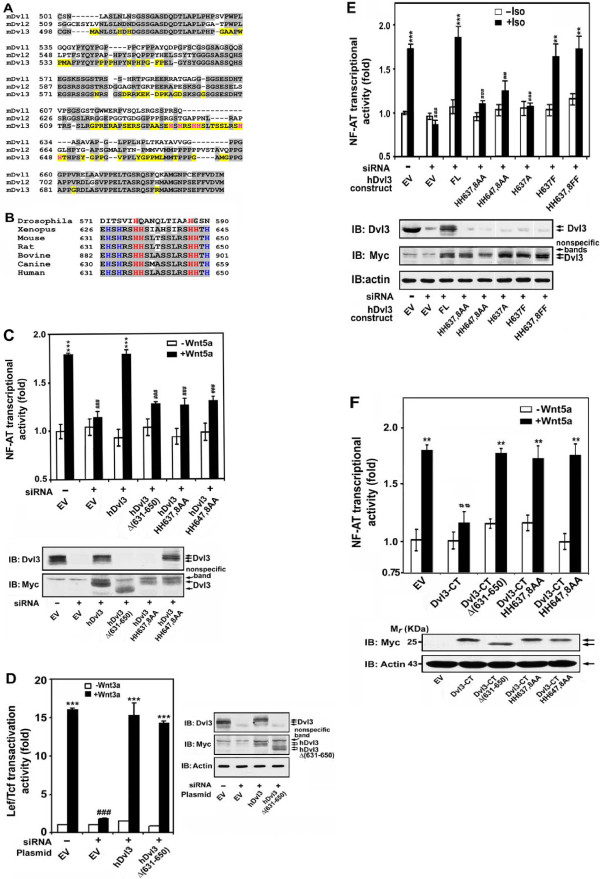
Figure 6
Single His-repeats at 637,638 and 647,648 are essential for Dvl3 function in Wnt5a/cGMP/Ca2+ non-canonical signaling to NF-AT-dependent transcription. A, sequence alignment of C-terminus of mouse Dvl1, 2, and 3 is displayed. Sequences that are common to at least two mDvls are shaded in gray. Unique sequences of mDvl3 are highlighted in yellow. His residues located within amino acid 631-650 of mDvl3 are displayed in red. B, Sequence alignment of mouse Dvl3 (631-650) with corresponding region of Dvl from fly Dsh, frog Dvl3 and mammalian Dvl3 is displayed. Common sequences are shaded in gray. HH637, 638 and HH647, 678 of mouse Dvl3 and corresponding single His-repeats of Dvl3 in other species are displayed in red. Other His residues in the region are displayed in blue. C, F9 cells stably expressing Fz2 were treated with siRNA targeting Dvl3 (siRNA). Dvl3-depleted cells were transfected with an empty vector (EV) or expression vector harboring either Myc-hDvl3, or one of hDvl3 mutants as indicated. Activity of NF-AT-reporter was measured in response to Wnt5a (upper panel). ***, p ≤ 0.001, compared with basal (-Wnt5a) in control (-siRNA and EV) group; ##, p ≤ 0.01, compared with (+Wnt5a) in control group. Expressions of Myc-hDvl3 or mutants were analyzed by immunoblotting by using anti-Dvl3 and anti-Myc antibodies (bottom panel). D, F9 cells stably expressing Fz1 were treated with siRNA targeting Dvl3 (siRNA). Rescue experiments were conducted by expression of either Myc-hDvl3, or Myc-hDvl3Δ(631-650) in Dvl3-depleted cells, followed by challenging cells with or without Wnt3a. Activity of Lef/Tcf-dependent transcription was measured by using a luciferase reporter (left panel). ***, p ≤ 0.001, compared with basal (-Wnt3a) in control (-siRNA and EV) group; ###, p ≤ 0.001, compared with (+Wnt3a) in control group. Expressions of Myc-hDvl3 or Myc-hDvl3Δ(631-650) were analyzed by immunoblotting (right panel). E, F9 cells expressing β2AR/Fz2 were treated with siRNA targeting Dvl3 (siRNA). Rescue experiments were conducted by expression of Myc-hDvl3 (FL), or one of Myc-hDvl3 mutants indicated, followed by activating the non-canonical pathway by treating cells with or without isoproterenol (Iso). Activity of NF-AT-reporter was measured and analyzed (upper panel). **, p ≤ 0.01, ***, p ≤ 0.001, compared with basal (-Iso) in control (-siRNA and EV) group; ##, p ≤ 0.01, ###, p ≤ 0.001, compared with (+Iso) in control group. The expression of each hDvl3 variant was evaluated by immunoblotting by using anti-Dvl3 and anti-Myc antibodies. The same blots were stained with anti-β-actin antibody (IB: actin) to establish loading equivalence. F, Dvl3-CT, Dvl3-CTΔ(631-650), Dvl3-CT HH637,8AA, or Dvl3-CT HH647,8AA was expressed in F9 clones stably expressing Fz2. The activity of NF-AT-dependent luciferase reporter was measured following stimulation of Wnt5a (upper panel). **p ≤ 0.01, compared with basal (-Wnt5a) in control (EV) group; ##, ≤ 0.01, compared with (+Wnt5a) in control group. Expression of Dvl3-CT or mutants at a similar level was shown by immunoblotting (bottom panel). The blots of β-actin are shown as loading controls.
Table 1
Comparison of His mutants of hDvl3 in the ability of rescuing Wnt non-canonical signaling.
| hDvl3 mutants | Rescue (%) |
|---|---|
| H637A | 9 ± 4 |
| H638A | 9 ± 7 |
| H647A | 36 ± 8 |
| H648A | 33 ± 8 |
| H632A | 72 ± 9 |
| H634A | 91 ± 1 |
| H650A | 61 ± 8 |
F9 cells expressing β2AR/Fz2 were treated with siRNA targeting Dvl3 (siRNA). Rescue experiments were conducted by expression of hDvl3, or hDvl3 mutants containing His to Ala point mutation as indicated. The non-canonical pathway was activated by treating cells with or without isoproterenol (10 μM). Activity of NF-AT-reporter was measured and analyzed, setting the full rescue by hDvl3 as 100%.