
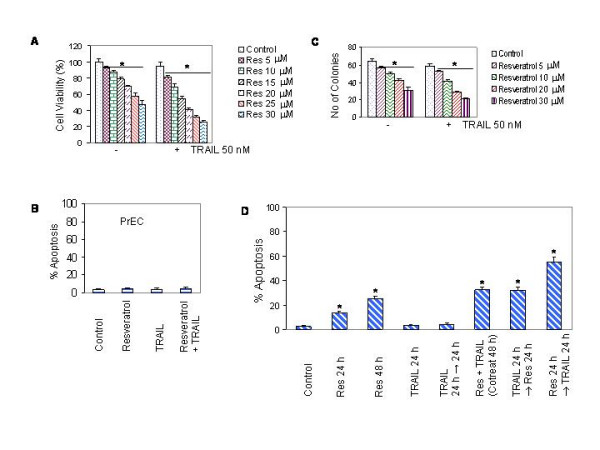
Figure 1
Interactive effects of resveratrol and TRAIL on cell viability, colony formation and apoptosis in prostate cancer cells. (A), Effects of resveratrol and/or TRAIL on cell viability in LNCaP cells. Cells were treated with various doses of resveratrol (0–30 μM) in the presence or absence of TRAIL (50 nM) for 48 h. Cell viability was measured by XTT assay as described in materials and methods. Data represent mean ± SD. * = Significantly different from respective control, P < 0.05. (B), Effects of resveratrol and/or TRAIL on apoptosis in human normal prostate epithelial cells (PrEC). PrEC were treated with resveratrol (20 μM) in the presence or absence of TRAIL (50 nM) for 48 h, and apoptosis was measured by TUNEL assay. (C), Effects of resveratrol and/or TRAIL on colony formation by LNCaP cells. Cells were treated with various doses of resveratrol (0–30 μM) in the presence or absence of TRAIL (50 nM). After three weeks, no of colonies were stained and counted. Data represent mean ± SD. * = Significantly different from respective control, P < 0.05. (D), Effects of different treatment combinations of resveratrol and TRAIL on apoptosis. LNCaP cells were treated with resveratrol (20 μM) in the presence or absence of TRAIL (50 nM). TRAIL was added simultaneously with resveratrol (cotreatment), before or after 24 h of resveratrol treatment. Apoptosis was measured by TUNEL assay. Data represent mean ± SD. * = Significantly different from respective control, P < 0.05.
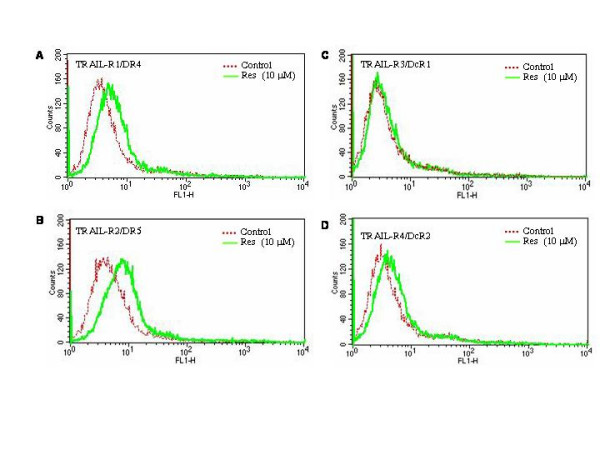
Figure 2
Effects of resveratrol on the surface expression of death receptors. (A, B, C and D), LNCaP cells were treated with resveratrol (0, or 10 μM) for 48 h and expressions of death receptors TRAIL-R1/DR4, TRAIL-R2/DR5, TRAIL-R3/DcR1 and TRAIL-R4/DcR2 were measured by flowcytometry.
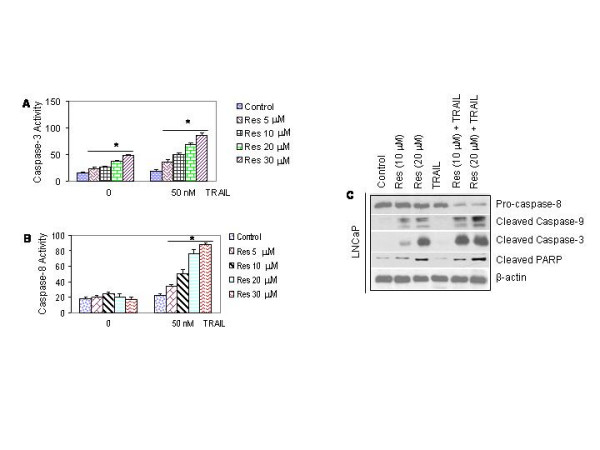
Figure 3
Interactive effects of resveratrol and TRAIL on caspase activation and PARP cleavage. (A), Effects of resveratrol and/or TRAIL on caspase-3 activity in LNCaP cells. Cells were treated with resveratrol (0–30 μM) in the presence or absence of TRAIL (50 nM) for 24 h. At the end of incubation period, caspase-3 activity was measured by flurometric assay. (B), Effects of resveratrol and/or TRAIL on caspase-8 activity. LNCaP cells were treated with resveratrol (0–30 μM) in the presence or absence of TRAIL (50 nM) for 24 h. At the end of incubation period, caspase-8 activity was measured by flurometric assay. (C), Effects of resveratrol and/or TRAIL on cleavage of pro-caspase-8, pro-caspase-3, pro-caspase-9 and PARP. LNCaP cells were pretreated with resveratrol (0, 10 or 20 μM) for 24 h followed by treatment with or without TRAIL (50 nM) for 24 h. At the end of incubation period, cells were harvested, and the Western blot analysis was performed to measure the expression of pro-caspase-8, cleaved-caspase-3, cleaved-caspase-9 and PARP. β-actin was used as a loading control.
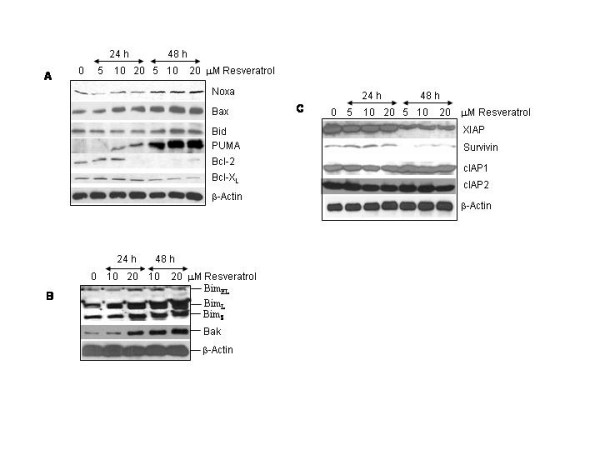
Figure 4
Effects of resveratrol on the expressions of Bcl-2 family members and IAPs. (A and B), Effects of resveratrol on protein expression of Bcl-2 family members. Cells were treated with resveratrol (0–20 μM) for 24 or 48 h. The expressions of Noxa, Bim, Bak, Bax, Bid, PUMA, Bcl-2, and Bcl-XL were examined by Western blot analysis. Actin antibody was used as a loading control. BimEL = Bim extra large, BimL = Bim large, BimS = Bim short. (C), Effects of resveratrol on the expressions of IAPs. Cells were treated with resveratrol (0–20 μM) for 24 or 48 h. Crude proteins were subjected to SDS-PAGE and immunoblotted with antibody specific for XIAP, survivin, cIAP1 or cIAP2. β-actin antibody was used as a loading control.
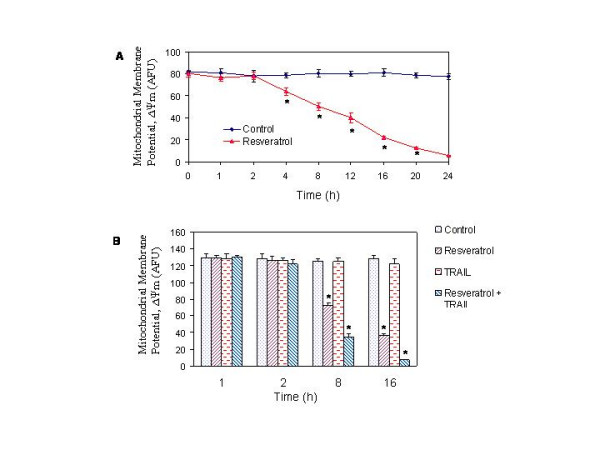
Figure 5
Effects of resveratrol and/or TRAIL on mitochondrial membrane potential (Δψm). (A), Resveratrol induces drop in Δψm. LNCaP cells were treated with or without resveratrol (20 μM) for 0–24 h. Cells were stained with JC1 dye, and Δψm was measured by a fluorometer as per manufacturer's instructions. (B), Interactive effects of resveratrol and TRAIL on Δψm. LNCaP cells were treated with resveratrol (20 μM) in the presence or absence of TRAIL (50 nM) for 1, 2, 8 and 16 h. Cells were stained with JC1 dye, and Δψm was measured.
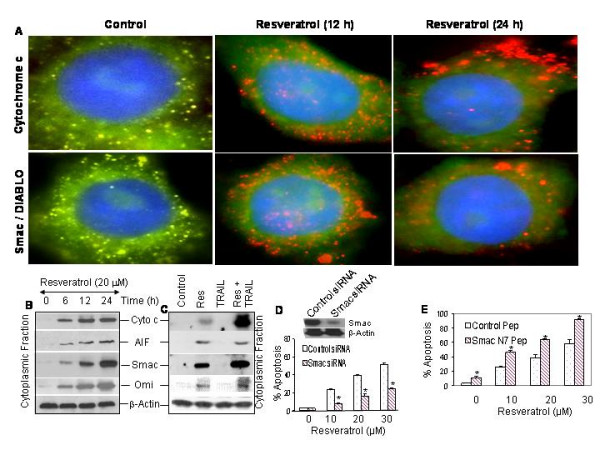
Figure 6
Effects of resveratrol and/or TRAIL on mitochondrial dysfunction. (A), Resveratrol induces the release of cytochrome c and Smac/DIABLO from mitochondria to cytosol. LNCaP cells were treated with or without resveratrol (20 μM) for 12 or 24 h. Cells were fixed, permeabilized and stained with anti-cytochrome c or anti-Smac/DIABLO antibody at 4°C for 18 h. After washing, cells were stained with mitotracker red (mitochondrial staining), DAPI (nuclear staining) and secondary antibody conjugated with FITC (for cyto c or Smac). Red color = mitochondria, green color = cytochrome c or Smac/DIABLO, blue color = nucleus, yellow = co-locolization of cyto c and Smac/DIABLO to mitochondria. (B), Resveratrol releases mitochondrial proteins. LNCaP cells were treated with resveratrol (20 μM) for 0, 6, 12, or 24 h, and cytoplasmic fractions were prepared. Crude proteins were subjected to SDS-PAGE and immunoblotted with anti-cytochrome c (Cyto C), anti-AIF, anti-Smac/DIABLO or anti-Omi antibody. β-Actin was used as a loading control. (C), Interactive effects of resveratrol and TRAIL on the release of mitochondrial proteins. LNCaP cells were treated with resveratrol (20 μM) in the presence or absence of TRAIL (50 nM) for 12 h, and cytoplasmic fractions were prepared. Crude proteins were subjected to SDS-PAGE and immunoblotted with anti-Cyto C, anti-AIF, anti-Smac/DIABLO or anti-Omi antibody. β-Actin was used as a loading control. (D), Effects of Smac siRNA on resveratrol-induced apoptosis. Western blotting data demonstrate that transient transfection of LNCaP cells with Smac siRNA plasmid inhibited Smac protein expression at 48 h. LNCaP cells were transiently transfected with either control plasmid or plasmid expressing Smac siRNA along with plasmid (pCMV-LacZ) encoding the β-galactosidase (β-Gal) enzyme. There was no difference in transfection efficiency between groups. Cells were treated with various doses of resveratrol (0–30 μM) for 48 h, and apoptosis was measured. (E), Enhancement of resveratrol-induced apoptosis by Smac N-7 peptide. LNCaP cells were pretreated with either 25 μM control Smac peptide or Smac N7 peptide for 4 h, and treated with various doses of resveratrol (10, 20 or 30 μM) for 48 h. Apoptosis was measured by TUNEL assay. Data represent mean ± SD. * = significantly different from respective control (P < 0.05).
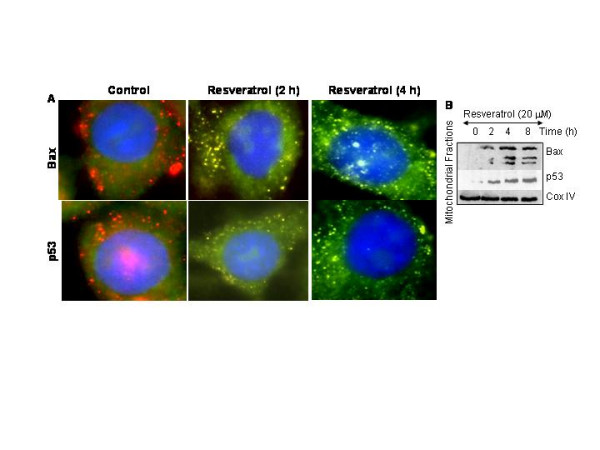
Figure 7
Translocation of Bax and p53 to mitochondria. (A), Resveratrol induces translocation of Bax and p53 to the mitochondria. LNCaP cells were treated with or without resveratrol (20 μM) for 2 or 4 h. Cells were fixed, permeabilized and stained with anti-Bax antibody at 4°C for 18 h. After washing, cells were stained with mitotracker red (mitochondrial staining), DAPI (nuclear staining) and secondary antibody conjugated with FITC (for Bax). Red color = mitochondria, green color = Bax, blue color = nucleus, yellow = translocation of Bax or p53 to mitochondria. (B), Translocation of Bax and p53 to mitochondria. LNCaP cells were treated with resveratrol for 0, 2, 4 or 8 h. Mitochondrial fractions were prepared, subjected to SDS-PAGE, and immunoblotted with anti-Bax, anti-p53 or anti-COX IV antibody.
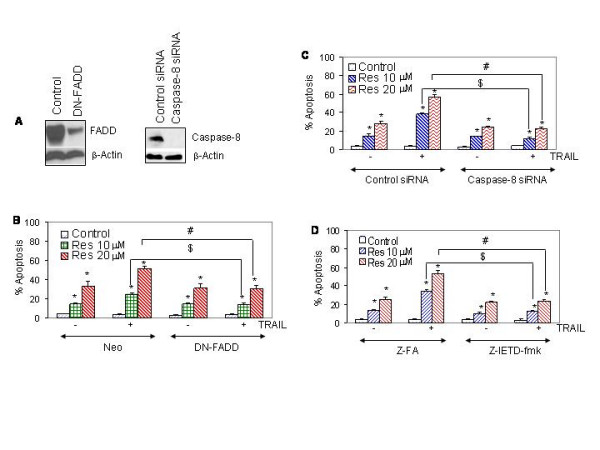
Figure 8
Involvement of death receptor pathway. (A), Expression of FADD and caspase-8 by Western blot analysis. LNCaP cells were transiently transfected with either control plasmid or plasmid expressing dominant negative FADD (DN-FADD) or caspase-8 siRNA along with plasmid (pCMV-LacZ) encoding β-galactosidase (β-Gal) enzyme. There was no difference in transfection efficiency among groups. Cell lysates were run on SDS-PAGE to measure the expression of FADD and caspase-8 by Western blot analysis. (B), Effects of dominant negative FADD on resveratrol and/or TRAIL-induced apoptosis. LNCaP cells were transiently transfected as described above. Cells were treated with resveratrol (0, 10 or 20 μM) in the presence or absence of TRAIL (50 nM) for 48 h, and apoptosis was measured. Data represent mean ± SD. * = Significantly different from respective control; # and $ = treatment groups were significantly different, P < 0.05. (C), Effects of caspase-8 siRNA on resveratrol and/or TRAIL-induced apoptosis. LNCaP cells were transiently transfected as described above. Cells were treated with resveratrol (0, 10 or 20 μM) in the presence or absence of TRAIL (50 nM) for 48 h. Apoptosis was measured by DAPI staining. Data represent mean ± SD. * = Significantly different from respective control; # and $ = treatment groups were significantly different, P < 0.05. (D), Effects of caspase-8 inhibitors on resveratrol and/or TRAIL-induced apoptosis. LNCaP cells were pretreated with either control peptide or caspase-8 inhibitor z-IETD-fmk (50 μM) for 4 h, followed by treatment with resveratrol (0, 10 or 20 μM) in the presence or absence of TRAIL (50 nM) for 48 h. Apoptosis was measured by DAPI staining. Data represent mean ± SD. * = Significantly different from respective control; # and $ = treatment groups were significantly different, P < 0.05.
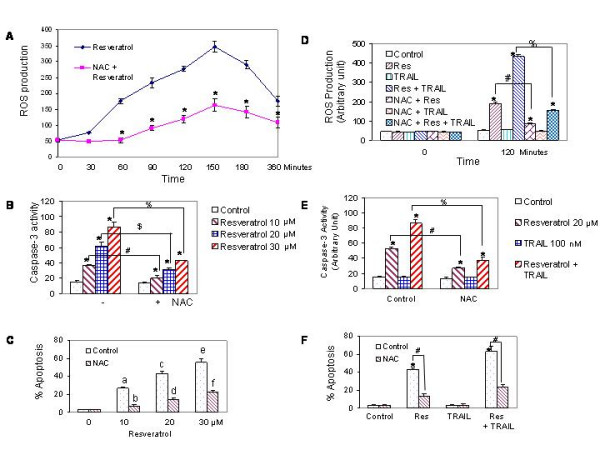
Figure 9
Involvement of reactive oxygen species in sensitization of TRAIL-resistant LNCaP cells by resveratrol. (A), Generation of ROS by resveratrol. LNCaP cells were seeded in 96-well plates, loaded with 5 μM CM-H2DCFDA dye for 30 min, and treated with either resveratrol (20 μM) or N-acetylcysteine (NAC) (50 mM) plus resveratrol (20 μM) for 0–360 min. Fluorescence was measured by a fluorometer as per manufacturer's instructions (EMD Biosciences/Molecular Probes). * = significantly different from respective controls, P < 0.05. (B), Inhibition of resveratrol-induced caspase-3 activity by NAC. LNCaP cells were pretreated with 50 mM NAC for 2 h followed by treatment with resveratrol (10, 20 or 30 μM) for 12 h, and caspase-3 activity was measured by a fluorometer as per manufacturer's instructions. * = significantly different from respective control; %, # or $ = significantly different from each other, P < 0.05. (C), Inhibition of resveratrol-induced apoptosis by NAC. LNCaP cells were pretreated with 50 mM NAC for 2 h followed by treatment with resveratrol (10, 20 or 30 μM) for 48 h, and apoptosis was measured by TUNEL assay. a, c and e were significantly different from b, d and f, respectively, P < 0.05. (D), Interactive effects of resveratrol and TRAIL on ROS production. LNCaP cells were pretreated with NAC (50 mM) for 2 h followed by treatment with resveratrol (20 μM) with or without TRAIL (50 nM) for 120 min., and ROS production was measured. * = significantly different from respective controls, P < 0.05; # or % = significantly different between groups, P < 0.05. (E), Interactive effects of resveratrol and TRAIL on caspase-3 activity. LNCaP cells were pretreated with 50 mM NAC for 2 h followed by treatment with resveratrol (20 μM) for 12 h, and caspase-3 activity was measured. * = significantly different from respective controls, P < 0.05; # or % = significantly different between groups, P < 0.05. (F), Interactive effects of resveratrol and TRAIL on apoptosis. LNCaP cells were pretreated with 50 mM NAC for 2 h followed by treatment with resveratrol (20 μM) with or without TRAIL (50 nM) for 48 h, and apoptosis was measured by TUNEL assay. * = significantly different from respective controls, P < 0.05; # = significantly different between groups, P < 0.05.