
Table 1
GPCR-mediated activation of signalling pathways leading to cell cycle modulation
| Intracellular Pathway | Cell Cycle Effect | References | |
| GPCR | |||
| G i/o -coupled | |||
| α1-adrenergic | ↑DNA synthesis | [15] | |
| ↑Src/C3G/Rap-1/B-Raf/ERK | ↑Proliferation | [77] | |
| Adenosine A3 | ↑PI3K/Akt/↓ERK | ↓Proliferation | [98] |
| CXCR1/2 | ↑MMP/EGFR/ERK | ↑Proliferation | [40] |
| CXCR3 | ↑ERK, ↑p38 | ↑DNA synthesis | [99] |
| CXCR4 | ↑Pyk2/PI3K/ERK | ↑DNA synthesis | [71] |
| Dopamine D2 | ↑PKC/NF-κB | ↑p21Cip1, ↑p27Kip1 | [60] |
| ↑Src/C3G/Rap-1/B-Raf/ERK | ↑Proliferation | [77] | |
| Dopamine D4 | ↑Src/SHC/Ras/ERK | ↑DNA synthesis | [78] |
| Sphingosine 1-phosphate EDG-1 | ↑p70rsk | ↑Cyclin D1 | [96] |
| ↑PDGFβ/ERK | ↑Proliferation | [100] | |
| κ-opioid | ↑PLC/PKC/Ras/ERK | ↑DNA synthesis | [16] |
| Lysophosphatidic acid LPA | ↑DNA synthesis | [17] | |
| Melatonin MT1 | ↓ERα/glucocorticoid receptor | ↓Cyclin D1 | [12, 13] |
| Serotonin 5HT1E | ↑Src/C3G/Rap-1/B-Raf/ERK | ↑Proliferation | [77] |
| Somatostatin SST1/4/5 | ↑ERK | ↑p21Cip1, ↑p27Kip1 | [50] |
| Somatostatin SST2 | ↑PI3K/Ras/Rap-1/B-Raf/ERK | ↑p27Kip1 | [90] |
| Somatostatin SST2a | ↑p38 | ↑p21Cip1 | [91] |
| Somatostatin SST2b | ↑PI3K/p70rsk/Akt | ↑Proliferation | [91] |
| G s -coupled | |||
| Dopamine D1 | ↑PLCβ/↓Raf-1 | ↓Cyclin D1/↑p27Kip1 | [101] |
| Glucagon-like peptide GLP-1 | EGFR/PI3K | ↑Proliferation | [42] |
| Glucagon-like peptide GLP-2 | ↑DNA synthesis | [18] | |
| GPR30 | ↑PKA/CREB | ↑Cyclin D2/CDK4-6 complex formation | [27, 28] |
| Lysophosphatidic acid LPA | ↑Proliferation | [19] | |
| Melanocortin MC5 | ↑JAK/STAT | ↑Proliferation | [82] |
| Parathyroid PTH | ↑cAMP/PKA | ↑p27Kip1 | [7, 22] |
| ↑cAMP/Epac/Rap-1/B-Raf/ERK | ↑Proliferation | [51] | |
| ↑cAMP/↑PKA/↓Raf-1 | ↓Proliferation | [51] | |
| ↑MKP-1/↓ERK | ↓Cyclin D1, ↑p21Cip1 | [52] | |
| Thyroid stimulating hormone TSH | ↑cAMP/CREB/c-Fos | ↑DNA synthesis, ↑Cyclins D1/E | [14, 23-25] |
| ↑PKA/Ras/PI3K | ↑DNA synthesis | [102] | |
| G q -coupled | |||
| α1B-adrenergic | ↑PKC/Raf-1/ERK | ↑Proliferation | [34] |
| ↑JNK, ↑p38 | ↓Proliferation | [55] | |
| ↑Src/Dbs/cdc42/MKK4/JNK | ↓Proliferation | [76] | |
| ↑Ras/Rac/JAK/STAT | ↑Proliferation | [81] | |
| Angiotensin II | ↑MMP/EGFR/ERK | ↑Cyclin D1 | [39] |
| ↑Ras/ERK/c-Fos/c-Jun | ↑Cyclin D1, ↑pRB phosphorylation | [48] | |
| ↑p125FAK/Rac1/JNK | ↑Proliferation | [67] | |
| Bombesin | ↑MMP/EGFR/PI3K | ↑Cyclins D1/E | [41] |
| ↑PKD | ↑Proliferation | [58] | |
| Bradykinin | ↑MMP/EGFR/PI3K | ↑Cyclins D1/E | [41] |
| Endothelin | ↑MMP/EGFR/ERK | ↑DNA synthesis | [39] |
| ↑PLCβ/Ca2+/Src/ERK | ↑Proliferation | [74] | |
| ↑Src/Rho/p125FAK/paxillin | ↑DNA synthesis | [70] | |
| ↑Pyk2/ERK | ↑DNA synthesis | [70] | |
| Gastrin-activated CCK2 | ↑Rho/integrin/p125FAK/paxillin | ↑Proliferation | [68,69] |
| ↑PKC/Src/p38 | ↑Proliferation | [75] | |
| ↑JAK/STAT | ↑Proliferation | [80] | |
| Lysophosphatidic acid LPA | ↑MMP/EGFR/ERK | ↑cyclin D1 | [39] |
| Muscarinic M1 | ↑PKC/Raf-1/ERK | ↑Proliferation | [34] |
| Muscarinic M3 | ↑JNK/c-Jun/SP-1 | ↓DNA synthesis, ↑p21Cip1/CDK2, ↓pRb phosphorylation | [56] |
| Muscarinic M5 | ↑Ras/Rac/JAK/STAT | ↑Proliferation | [81] |
| Muscarinic subtypes | ↑Src/ERK/CREB | ↑DNA synthesis | [103] |
| Platelet-Activating Factor receptor | ↑MMP/EGFR/ERK | ↑Proliferation | [104] |
| Purinergic P2Y2/4 | ↑PKC/Raf/MAPK | ↑DNA synthesis | [49] |
| Substance P (NK-1) | ↑Src/PKCδ/ERK | ↑Proliferation | [72] |
| Thrombin | ↑MMP/EGFR/ERK | ↑DNA synthesis | [39] |
| ↑RhoA/PI3K/Akt | ↓p27Kip1, ↑Cyclin D1/CDK4 | [92-94] | |
| ↑ERK | ↑CDK2 nuclear translocation | [95] | |
| ↑PI3K/Akt, | |||
| Vasopressin V1A | ↑PKD | ↑Proliferation | [58] |
| ↑Ca2+/PI3K/PKC/ERK | ↑G1-S phase | [105] | |
| ↑EGFR/Pyk2/Src/ERK/PI3K | ↑Proliferation | [106] | |
| G 12/13 -coupled | |||
| Lysophosphatidic acid LPA | ↑DNA synthesis, ↑Proliferation | [20] | |
| ↑EGFR/Rho/ROCK | ↑Cyclins A/D1, ↑p21Cip1, ↓p27Kip1 | [43,45] | |
| ↑JNK | ↑Cyclin A | [20,54] |
A selection of examples is presented that demonstrate the involvement of GPCR-mediated intracellular signalling pathways in the regulation of cell cycle progression. ↑, indicates an increase in protein levels or activity; ↓, indicates a decrease in protein levels or activity.
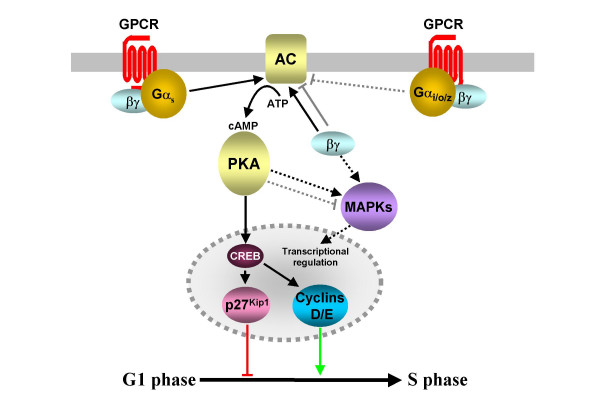
Figure 1
Modulation of intracellular cAMP levels by GPCR-coupled mechanisms affects cell cycle progression. Agonist activation of Gs-coupled receptors promotes increased AC activity and cAMP accumulation. Subsequent PKA activation leads to the activation of the transcription factor CREB and the regulation of the expression of cyclins and the CDK inhibitor p27Kip1. The resulting effect on cell cycle progression is dependent on a number of factors, including the concentration of cAMP generated. PKA can also regulate, positively or negatively, other mitogenic pathways, particularly those leading to the activation of MAPKs, (see text for further details). Activation of the AC/cAMP/PKA axis can be antagonized by the activation of GPCRs coupled to Gi/o-family proteins. However, the definitive involvement of these MAPK and Gi/o-coupled pathways in regulating proliferation has not been established (indicated by dashed lines).
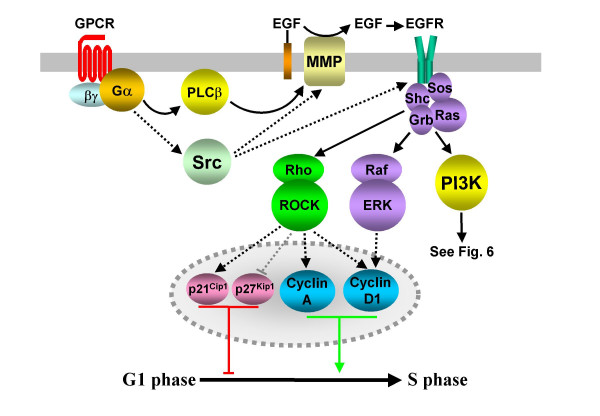
Figure 2
GPCR transactivation of EGFR leads to the activation of multiple mitogenic pathways. GPCR/G protein activity of many families of G protein promotes the activity of MMPs via PLCβ-dependent, or possibly Src-dependent (indicated by dashed lines – see text for further details), mechanisms. MMP activity releases EGF in its soluble form. The resulting EGFR activity promotes the formation of a signalling complex and the activation of PI3K, MAPK and ROCK kinases in a GPCR and cell type specific manner. The increased expression of cyclins promotes progression into S phase, while the upregulation of CDK inhibitors p21Cip1 and p27Kip1 delays S phase entry. Dashed lines also identify the probable involvement of multiple, unidentified intermediates in the transcriptional regulation of cell cycle proteins.
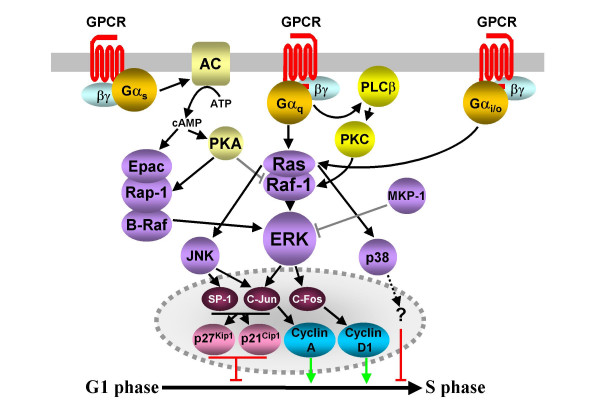
Figure 3
GPCR-mediated activation of MAPKs is also regulated by the generation of intracellular messengers. GPCR activity leads to the activation of AC/cAMP and PLCβ/PKC second messenger pathways. cAMP directly, or via PKA, activates RAP-1/B-Raf/ERK pathways, and potentially inhibits Raf-1 activated ERK activity. The Gαq/PLCβ/PKC pathway promotes Ras/Raf-1/ERK activity, and it is likely that Gq- and Gi/o-coupled GPCRs can activate JNKs and p38. The result of the interplay between these pathways is either proliferative or antiproliferative, depending on the expression of GPCRs and signalling intermediates. Dashed indicators identify the probable involvement of multiple, unidentified intermediates.
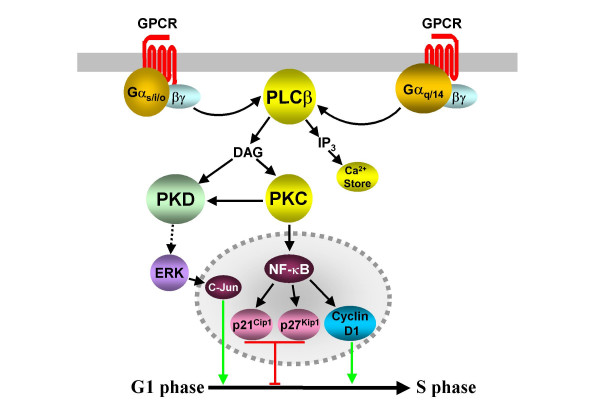
Figure 4
Further PKC-dependent cell cycle regulation. Gi/o-, Gs- and Gq-family coupled GPCRs can activate PLCβ and PKC activity via Gα or Gβγ subunits. Activated PKC can phosphorylate and activate PKD, leading to the activity of ERK-dependent proliferative pathways. PKC is also able to initiate a series of events that promotes the transcriptional activity of NF-κB. NF-κB activates the promoter regions of cyclin D1 as well as those of p21Cip1 and p27Kip1, causing S phase entry or delay. Dashed indicators identify the probable involvement of multiple, unidentified intermediates.
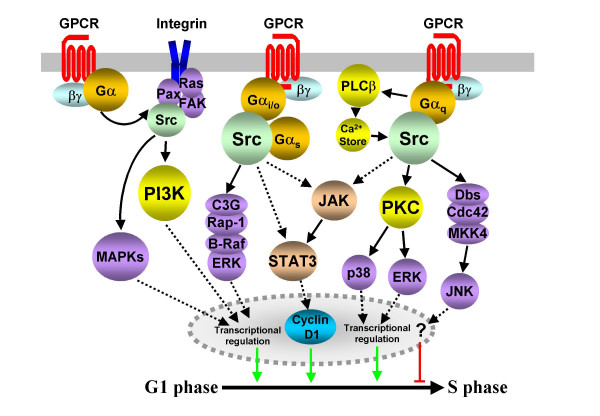
Figure 5
Src family kinase-dependent cell cycle control. Gq-, G12/13- and Gi/o-coupled GPCRs are all known to regulate mitogenesis via the transactivation of Src-dependent integrin signalling complexes. Gq- and Gi/o-coupled receptors also utilize Src to activate a variety of MAPK pathways. Gs-, Gi/o- and Gq-coupled receptors promote proliferation via the activation of the STAT transcription factors, and this has been postulated to be Src-dependent (shown in dashed lines). Full STAT activity may require phosphorylation by JAKs and MAPKs. Dashed lines also identify the probable involvement of multiple, unidentified intermediates in the transcriptional regulation of cell cycle proteins.
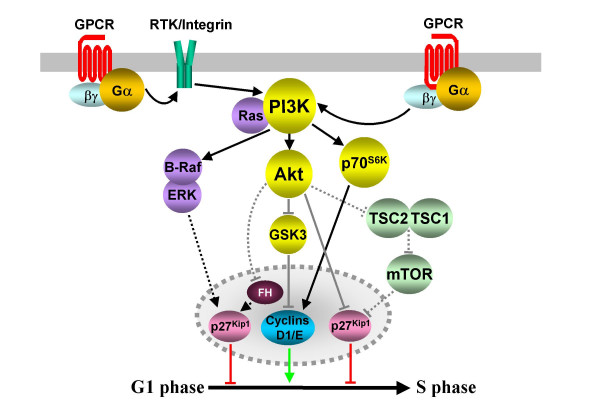
Figure 6
Activation of PI3K-dependent cell cycle regulation. The expression, stability and activity of cyclins and CDK inhibitors are regulated by the activity of several PI3K-dependent pathways. Numerous GPCRs activate PI3K isoforms either through Gβγ subunits or via RTK and integrin transactivation. PI3Ks activate ERKs and Akt, leading to the transcriptional regulation of p27Kip1. In addition, Akt phosphorylates p27Kip1, thereby affecting its nuclear localization. Acting through TSC1, TSC2 and mTOR, Akt can negatively affect the stability of p27Kip1, although GPCR regulation of proliferation through mTOR has not been established (indicated by dashed lines). PI3Ks may also promote proliferation by promoting cyclin expression (via p70S6K) and stability (via Akt and GSK3). Dashed lines also identify the probable involvement of multiple, unidentified intermediates in the transcriptional regulation of cell cycle proteins.