
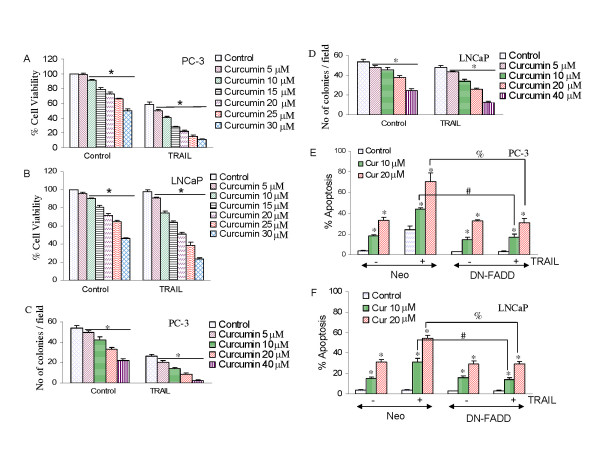
Figure 1
Interactive effects of curcumin and TRAIL on cell viability and colony formation of prostate cancer cells. (A), PC-3 cells were treated with various concentrations of curcumin (0–30 μM) for 24 h, followed by treatment with TRAIL (25 nM) for another 24 h. Cell viability was measured at the end of 48 h by XTT assay. (B), LNCaP cells were treated with various concentrations of curcumin (0–30 μM) for 24 h, followed by treatment with TRAIL (50 nM) for another 24 h. Cell viability was measured at the end of 48 h by XTT assay. (C), PC-3 cells were seeded in soft agar and treated with curcumin (5–40 μM) in the presence or absence of TRAIL (25 nM). After three weeks, no of colonies were counted. Data represent mean ± SE. (D), LNCaP cells were seeded in soft agar and treated with curcumin (5–40 μM) in the presence or absence of TRAIL (50 nM). After three weeks, no of colonies were counted. Data represent mean ± SE. (E and F), Effects of dominant negative FADD on curcumin and/or TRAIL-induced apoptosis. PC-3 and LNCaP cells were transiently transfected with either control plasmid or plasmid expressing dominant negative FADD (DN-FADD) along with plasmid (pCMV-LacZ) encoding the β-galactosidase (β-Gal) enzyme. There was no difference in transfection efficiency among groups. Transfected cells were treated with curcumin (0, 10 or 20 μM) in the presence or absence of TRAIL (25 nM for PC-3 cells or 50 nM for LNCaP) for 48 h. Apoptosis was measured by DAPI staining. Data represent mean ± SE. * = significantly different from respective control; # and % = treatment groups were significantly different, P < 0.05.
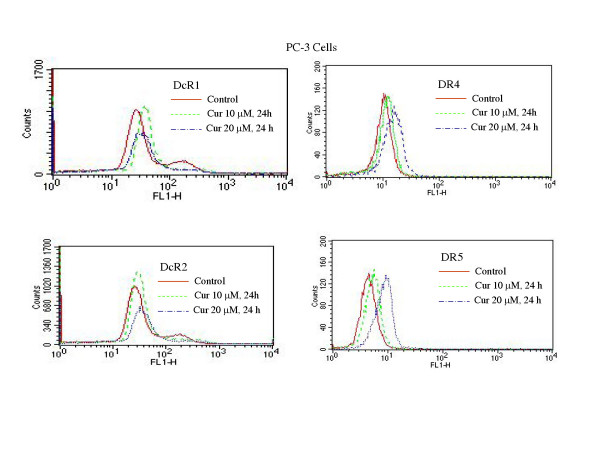
Figure 2
Effects of curcumin on cell surface expression of death receptors. PC-3 cells were treated with curcumin (0, 10 and 20 μM) for 24 h, and the expression of DcR1, DcR2, DR4, and DR5 was measured by flowcytometric analysis.
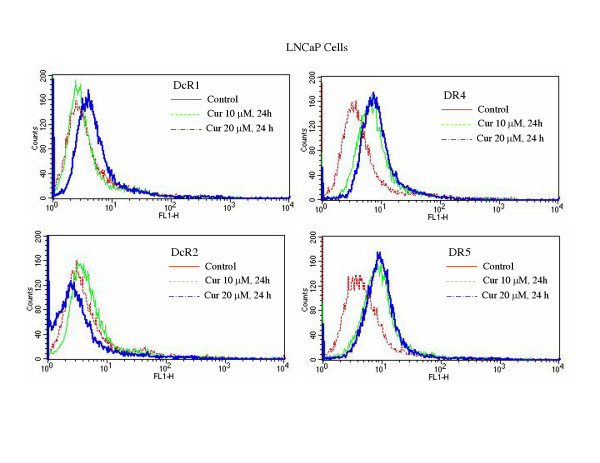
Figure 3
Effects of curcumin on cell surface expression of death receptors. LNCaP cells were treated with curcumin (0, 10 and 20 μM) for 24 h, and the expression of DcR1, DcR2, DR4, and DR5 was measured by flowcytometric analysis.
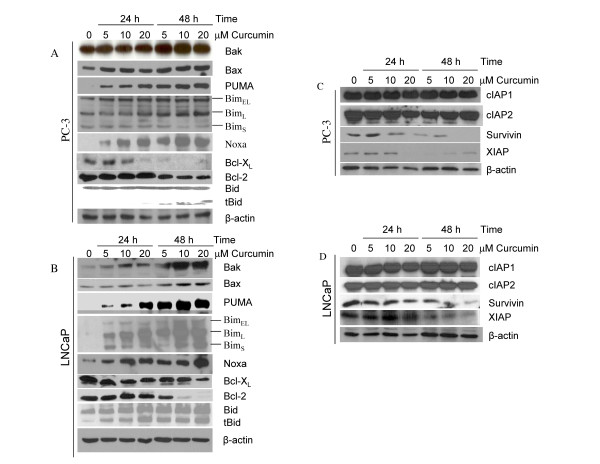
Figure 4
Effects of curcumin on the expression of Bcl-2 family members, and inhibitors of apoptosis proteins (IAPs). (A and B), PC-3 and LNCaP cells were treated with or without curcumin (0, 5, 10 and 20 μM) for 24 or 48 h, and the expression of Bcl-2 family members (Bak, Bax, PUMA, Bim, Noxa, Bcl-XL, Bcl-2 and Bid) was measured by the Western blot analysis. β-actin was used as a loading control. (C and D), PC-3 and LNCaP cells were treated with or without curcumin (0, 5, 10 and 20 μM) for 24 or 48 h, and the expression of IAPs (cIAP1, cIAP2, survivin and XIAP) was measured by the Western blot analysis. β-actin was used as a loading control.
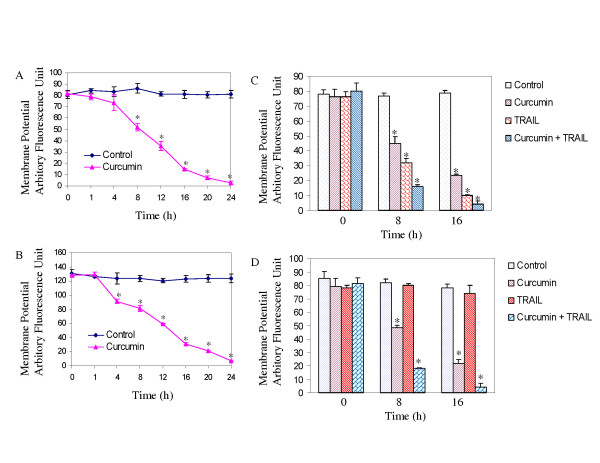
Figure 5
Effects of curcumin on mitochondrial membrane potential. (A and B), Curcumin induces drop in mitochondrial membrane potential (Δψm). PC-3 and LNCaP cells were treated with or without curcumin (20 μM) for 0–24 h. Cells were stained with JC1 dye, and Δψm was measured by fluorometer as per manufacturer's instructions. (C and D), Interactive effects of curcumin and TRAIL on Δψm. PC-3 and LNCaP cells were treated with or without curcumin (20 μM) in the presence or absence of TRAIL for 0, 8, or 16 h. Cells were stained with JC1 dye to measure Δψm. * = significantly different from respective control (P < 0.05).
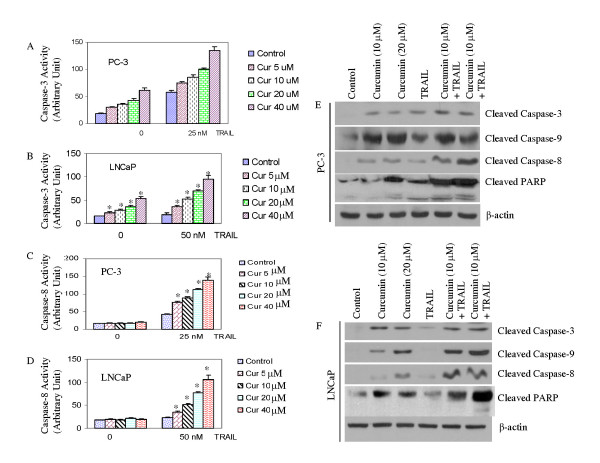
Figure 6
Interactive effects of curcumin and TRAIL on caspase activation and PARP cleavage. (A and B), PC-3 and LNCaP cells were treated with curcumin (0–40 μM), in the presence or absence of TRAIL, and caspase-3 activity was measured by fluorometric assay as per manufacturer's instructions. (C and D), PC-3 and LNCaP cells were treated with curcumin (0–40 μM), in the presence or absence of TRAIL, and caspase-8 activity was measured by fluorometric assay as per manufacturer's instructions. (E and F), PC-3 and LNCaP cells were treated with curcumin (0, 10 or 20 μM), in the presence or absence of TRAIL (25 nM for PC-3, and 50 nM for LNCaP), and the cleavage of caspase-3, caspase-9, caspase-8 and PARP was measured by the Western blot analysis. β-actin was used as a loading control.
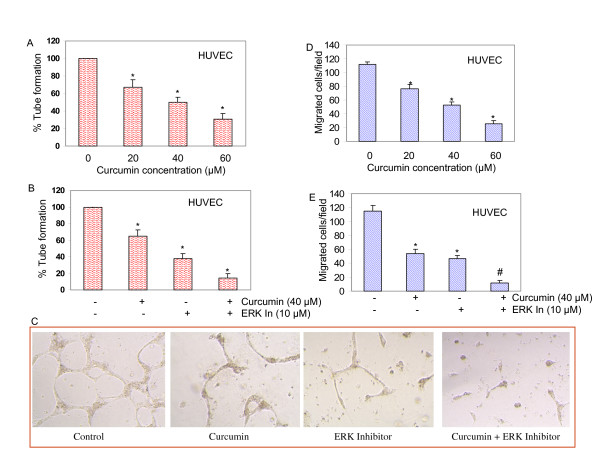
Figure 7
Curcumin inhibits capillary tube formation and migration of HUVEC cells. (A), HUVECs were seeded in 24-well plates containing matrigel, and treated with various concentrations of curcumin for 24 h. Capillary tubes were counted under a microscope. Data represent mean ± SD. * = significantly different from control, P < 0.05. (B), HUVECs were seeded in 24-well plates containing matrigel. Cells were pretreated with ERK inhibitor (10 μM) for 3 h, followed by treatment with curcumin (40 μM) for 24 h. Capillary tubes were counted under a microscope. Data represent mean ± SD. * = significantly different from control, P < 0.05. (C), Picture of capillary tube formation. HUVECs were treated as described in B. Pictures of capillary tubes were taken by a microscope. (D), HUVECs were treated with various concentrations of curcumin (20, 40 and 60 μM) or DMSO (control). Migration of HUVEC cells through the membrane was determined after 24 h of incubation at 37°C using Transwell Boyden chamber. Cells that had migrated to the lower chamber were fixed with 90% ethanol, stained with hematoxylin and eosin, quantified by counting the number of cells under a microscope. Data represent mean ± SD. * = significantly different from control, P < 0.05. (E), HUVECs were pretreated with ERK inhibitor (10 μM) for 3 h, followed by treatment with curcumin (40 μM) or DMSO (control) for 24 h at 37°C. Cells migrated to the lower chamber were fixed, stained and quantified.