
Figure 1
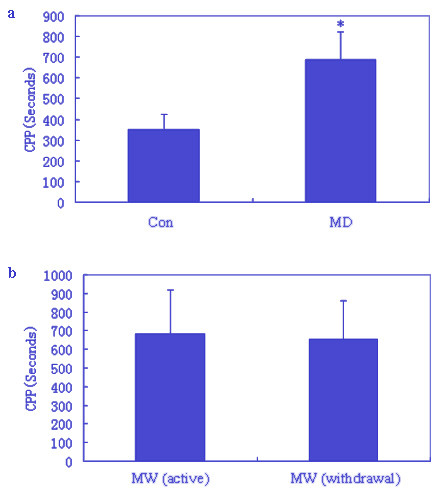
The conditioned place preference (CPP) results. Data of CPP in mice are given as mean (± S.E.M.) under the different conditions. a: CPP in the Con and MD groups (Con group after the 8th day of saline injection, MD group after the 8th day of morphine injection, * p < 0.05 tested by Student's t-test) b: CPP in the MW group (MW group after the 8th day morphine injection and after 5th day of morphine withdrawal).
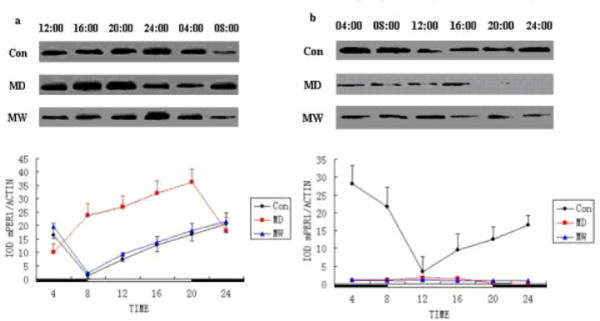
Figure 2
The mPER1 protein expression levels of mice at the different time points. Western blot analysis of the brains with anti-mPER1 polyclonal antibody reveals one distinct band at molecular weight of 110 kDa (Con, MD and MW, respectively). a: Top: mPER1 protein expressed in brains of mice. Bottom: data for mPER1 protein level were obtained by computerized analysis of the Western blots. Each value is the mean ± SEM. b: Top: mPER1 protein expressed in the kidneys of mice. Bottom: data for mPER1 protein level were obtained by computerized analysis of the Western blots. Each value is the mean ± SEM.
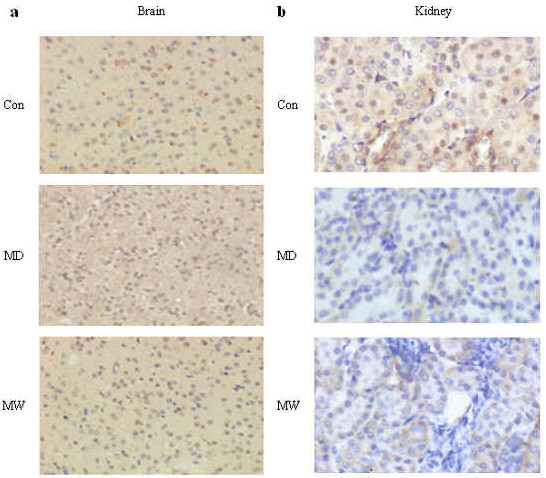
Figure 3
Immunohistochemical stain for determining mPER1 protein expression in brains and kidneys. a: Positive staining in the nucleus and cytoplasm are found in brains of Con, MD and MW mice. b: Representative cases show positive staining for mPER1 in kidneys of Con, MD and MW mice. Original magnification: 200× for all cases.
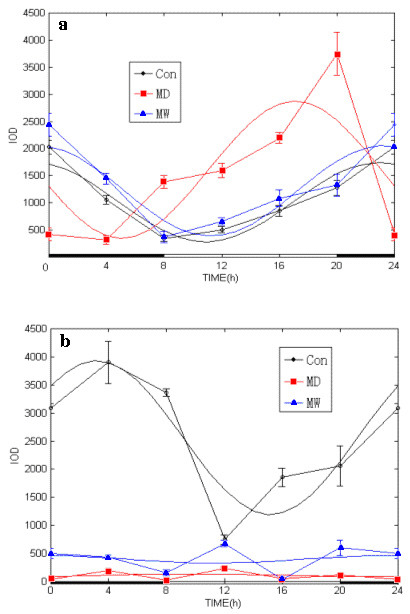
Figure 4
Circadian variation of mPER1 protein expressed in the brains and kidneys of Con, MD and MW mice. The integral optical density (IOD) of mPER1 immunoreactivity, an index of mPER1 protein expression level, was analyzed by image pro plus software. Time point means and SE of protein expression are shown along the 24-hour time scale. The best fitting cosine curves are shown in these panels. a: The mPER1 protein expression in brains was increased and acrophase of circadian rhythm was advanced in the MD mice as compared with Con and MW mice, statistically tested by the cosinor parameter test designed by Bingham et al. [18]. b: The mPER1 protein expression in the kidneys was severely inhibited and the circadian rhythm of mPER1 protein expression in the MD and MW mice was obliterated by morphine administration. Con mice exhibited robust rhythmicity in mPER1 expression.
Table 1
Cosinor analysis of mPER1 expression.
| Group | P | MESOR ± SE (IOD) | Amplitude ± SE (IOD) | Acrophase (95 %CL) Hour |
| Expression of m PER1 in the brains | ||||
| Con | < 0.001 | 1010.8 ± 47.2 | 728.6 ± 66.8 | -343.5° (-333, -354) 22:54 |
| MD | < 0.001 | 1609.5 ± 149.9* | 1263.1 ± 212.0* | -256.1° (-237, -275)* 17:04 |
| MW | < 0.001 | 1221.6 ± 66.6 | 832.6 ± 94.3 | -348.6° (-335, 0) 23:24 |
| Expression of mPER1 in the kidneys | ||||
| Con | < 0.001 | 2559.2 ± 110.3 | 1368.4 ± 156.1 | -47.7° (-34, -60) 03:11 |
| MD | 0.538 | 113.1 ± 15.9# | 25.4 ± 22.5# | -148.5° (0, 0)# 09:54 |
| MW | 0.602 | 396.8 ± 45.9# | 66.0 ± 64.9# | -350.5° (0, 0)# 23:22 |
* p < 0.05 compared with control or MW groups, separately, tested by the parameters of cosinor designed by Bingham et al. [18]. # p < 0.05 compared with control group, tested by the parameters of cosinor. The mPER1 protein expression level is represented by the IOD, which was the value of immunoreactivity of mPER1 in tissues reacting with mPER1 antibody determined by image pro plus software.
Con: Control; MD: Morphine-dependent; MW: Morphine-withdrawal. P in the table is the p-value of circadian rhythm coming from cosine function fitting. The hour in the table is the time of clock hour for the acrophase of the fitted cosine function.