
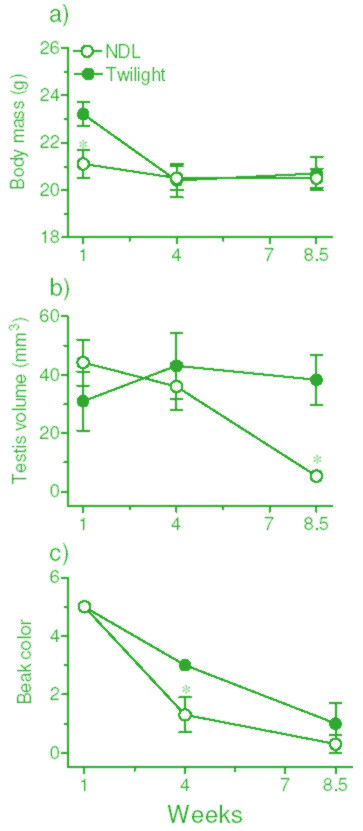
Figure 1
Effects of natural light (NDL) during twilight periods alone on body mass (a), timing of testicular regression (b), and changes in beak color (c). Of two groups of male sparrows (n = 6 each) with large testes housed in the outdoor aviary, beginning in the third week of April 2002 for 8.5 weeks, one group of birds was removed daily from the aviary at the time of sunrise and kept in a room under constant darkness (DD) until sunset, when it was returned to the aviary. The other group remained in the aviary, received NDL all day and served as control. Note testicular regression only in birds that experienced NDL all day.
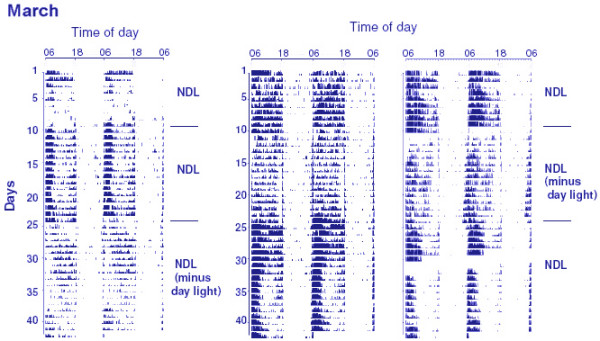
Figure 2
Double plotted activity recordings of three male house sparrows receiving NDL conditions in March. After initial synchronization when they were exposed to NDL all day for 2 weeks, they were exposed to NDL during twilight periods alone in two stages. First, half of them (n = 4) continued receiving NDL all day and served as control (left panel), while the other half (n = 4) was deprived of NDL from sunrise to sunset (NDL minus daylight; middle and right panels). Then, after two weeks, the lighting conditions of the two halves were swapped: the first half received NDL minus daylight (left panel), while the second half received NDL all day and served as control (middle and right panels). The movements of the birds within their cages (size = 60 × 45 × 35 cm) were detected by passive infrared motion sensors, continuously counted and recorded, and analyzed by the software program of the Stanford Software Systems (Stanford, USA). Note freerun between days 15 and 25 in one of the three representative sparrows exposed to twilight periods alone in March (right panel).
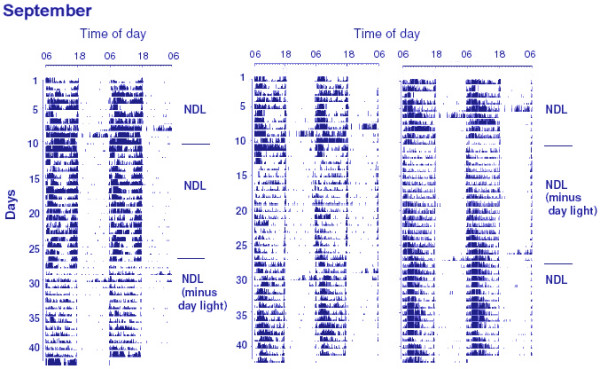
Figure 3
Double plotted activity recordings of three male house sparrows receiving NDL conditions in September. The other details of the experiments were the same as described in Figure 2.

Figure 4
Daily activity profile (counts per minute, mean ± SE, n = 7) of sparrows for the period when they were exposed to NDL during twilight periods alone along with 4 days before and after the twilight exposure (i.e., when they received NDL all day). Note the difference in amplitude of the daily activity rhythm between NDL and NDL minus daylight conditions.