
Introduction
1.
The process of nucleation is defined as the formation of a stable phase from an initial, metastable phase (Laaksonen et al., 1995; Slezov and Schmelzer, 1998; Weinberg et al., 2002; Ford, 2004; Kathmann et al., 2009; Karthika et al., 2016). Nucleation is involved in a wide range of physical reactions, from ordinary events such as ice formation, to crystallization and other processes of industrial importance. Also, nucleation is a crucial process in atmospheric phenomena, including cloud condensation and aerosol formation (Laaksonen et al., 1995; Slezov and Schmelzer, 1998; Merikanto et al., 2007; Hale and Thomason, 2010).
Our current understanding of nucleation has been enriched by a number of theories (Kathmann et al., 2009; Karthika et al., 2016), the most dominant of which is the Classical Nucleation Theory (CNT) (Volmer and Weber, 1926; Becker and Döring, 1935; Frenkel, 1939). While it generally predicts erroneous nucleation rates and critical supersaturations at extreme temperatures, CNT predictions for most gases have been within reasonable error (Cohen, 1970; Laaksonen et al., 1995).
According to the CNT (Volmer and Weber, 1926; Becker and Döring, 1935; Frenkel, 1939), the free energy involved in the formation of a nucleus is composed of the surface free energy and the bulk free energy . Here, represents the surface tension, density and the chemical potential difference of the bulk liquid and vapour phases (Merikanto et al., 2007; Chen et al., 2008). In terms of cluster size (n), the cluster’s free energy of formation is
Using Equation (1), the properties of finite-sized clusters can be extrapolated (Kemper and Hale, 1988; Slezov et al., 2005; Merikanto et al., 2007; Schmelzer, 2010):
Plotting versus shows a linear relationship with the slope m given as
Simplifying gives 4.836 where
From the cluster free energy of formation, the CNT provides a convenient way of extracting properties such as surface tension and density of various substances.
Meanwhile, surface tension determination in lab experiments are done using various methods (Adamson, 1976) with varying precision. With the advent of high-resolution cameras, the drop method became popular (Jaycock and Parfitt, 1981). Although this method coupled with Theoretical Image Fitting Analysis (TIFA) (Bateni et al., 2004) provides accurate surface tension measurements, the process is still complex and laborious. As such, a computational approach may offer an alternative means to calculate the surface tension property of a system, especially for realistic organic compounds (Kemper and Hale, 1988).
The steady improvement of computing power has paved the way for continuous advancement of smart algorithms and their implementations in the natural sciences, including the development of nucleation simulations to predict nucleation rates and thermophysical properties (Padilla and Toxvaerd, 1991; Laaksonen et al., 1995; Panagiotopoulos, 1995, 1996; Smit et al., 1995; Errington and Panagiotopoulos, 1999; Anwar et al., 2013; Diemand et al., 2013). Using these advanced computer techniques such as aggregation-volume-bias Monte Carlo (AVBMC) with umbrella sampling (US) (Chen et al., 2001, 2008; Chen and Siepmann, 2001; Nellas et al., 2010) and by invoking Equation (2), we can calculate the temperature-dependent values of any desired compound without resorting to experimental procedures. Previously, Kemper and Hale have demonstrated that the excess surface entropy , and by extension the surface tension, of water can be calculated from the simulated free energy profiles of small water clusters. They have successfully calculated with a margin of error of around 13% (Kemper and Hale, 1988). Unfortunately, the applicability of this method to realistic organic compounds has not been tested.
For this study, building on Kemper and Hale’s work, we shall be focusing on normal alkanes, the simplest organic molecules. Alkanes are the starting components of petroleum fluids and thus are essential to the petrochemical industry. Accurate estimates of thermophysical properties of these compounds are crucial in the development of recovery and refinery processes for petrochemicals (Smit et al., 1995; Luijten et al., 1998; Miqueu et al., 2000; Ford, 2004). Alkanes, as the simplest hydrocarbons, are also rudimentary organic molecules from which other functionalized organic molecules may be derived. The findings of this study may then serve as basis for future nucleation simulations studies with more complex organic compounds.
Systems and methods
2.
The nucleation simulations in this work were done using the AVBMC with umbrella sampling (US) techniques (Chen et al., 2001, 2008; Chen and Siepmann, 2001; Kathmann et al., 2009). AVBMC (Chen and Siepmann, 2001) enhances exploration of phases by employing direct swap moves between the monomer and cluster phases, while self-consistent US uses a biasing potential to enhance cluster frequencies. Aggregation-Volume-Bias Monte Carlo with Umbrella Sampling (AVUS) (Chen et al., 2008) has been proven to efficiently sample rare events such as the gas-to-liquid nucleation of multicomponent systems (Chen et al., 2001, 2008; Chen and Siepmann, 2001).
In this work, the grand-canonical version of the nucleation algorithm was employed (Panagiotopoulos, 1995; Chen et al., 2001) to obtain the nucleation free energy profiles of n-alkanes: n-propane, n-octane and n-dodecane. The free energy differences are calculated according to Equation (2). Alternatively, although the Bennett Monte Carlo method conducted by Kemper and Hale can also be applied (Kemper and Hale, 1988), its efficiency in sampling realistic organic compounds has not yet been explored.
The United-Atom Transferable Potential for Phase Equilibria (TraPPE-UA) (Martin and Siepmann, 1998) force field was used to model these n-alkanes. This model is one of the most accurate models currently available, predicting saturated liquid densities and critical constants for n-alkanes within experimental error (Errington and Panagiotopoulos, 1999). As previously done (Nellas et al., 2010), we employed here an energy-based Stillinger-type cluster criterion (Stillinger, 1963) for these chain molecules. Here, a cluster is defined as a group of molecules of which every molecule has at least one neighbour with an interaction energy of less than . This value is greater than the energy involved in methyl–methyl interactions (), but negligible compared to that of hydrogen bonding interactions () (Nellas et al., 2010).
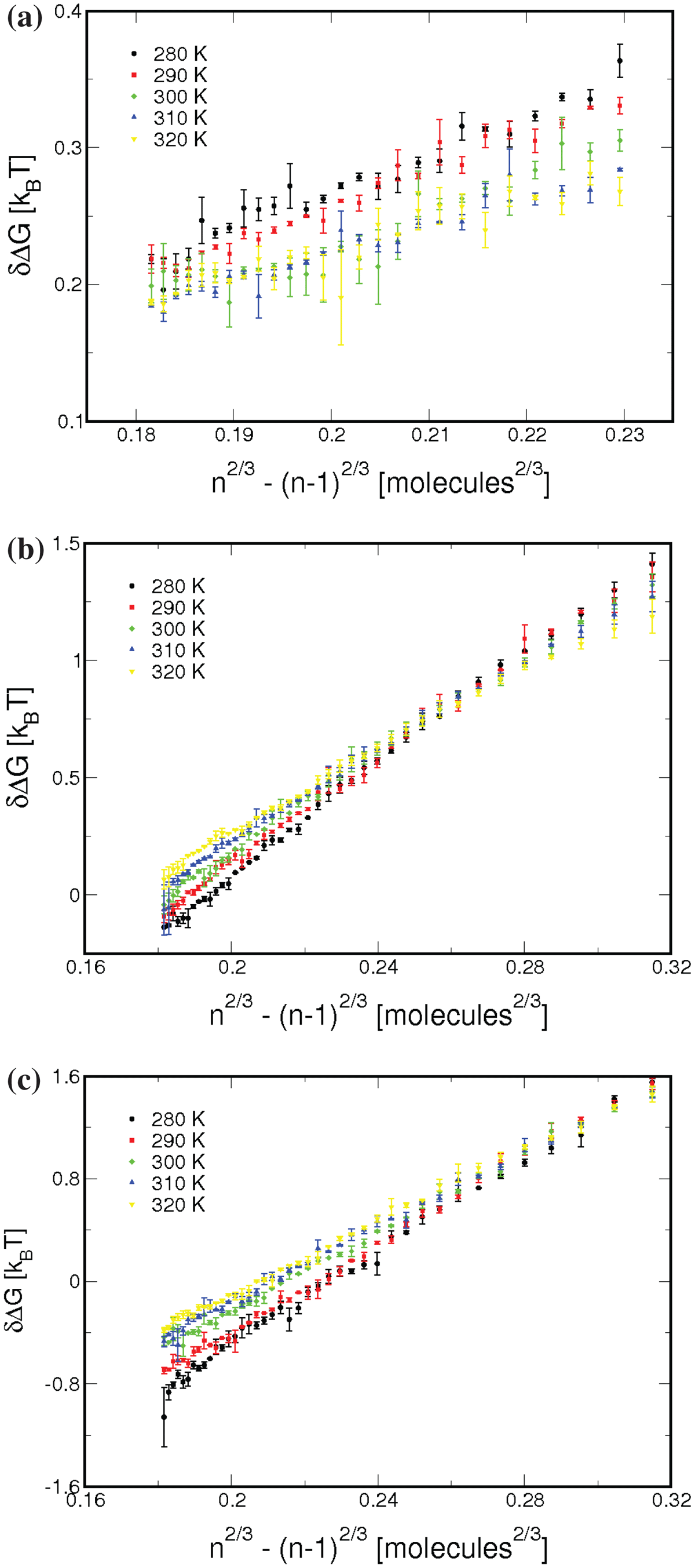
Figure 1.
vs plots of n-alkanes: (a) n-propane, (b) n-octane and (c) n-dodecane at different temperatures.
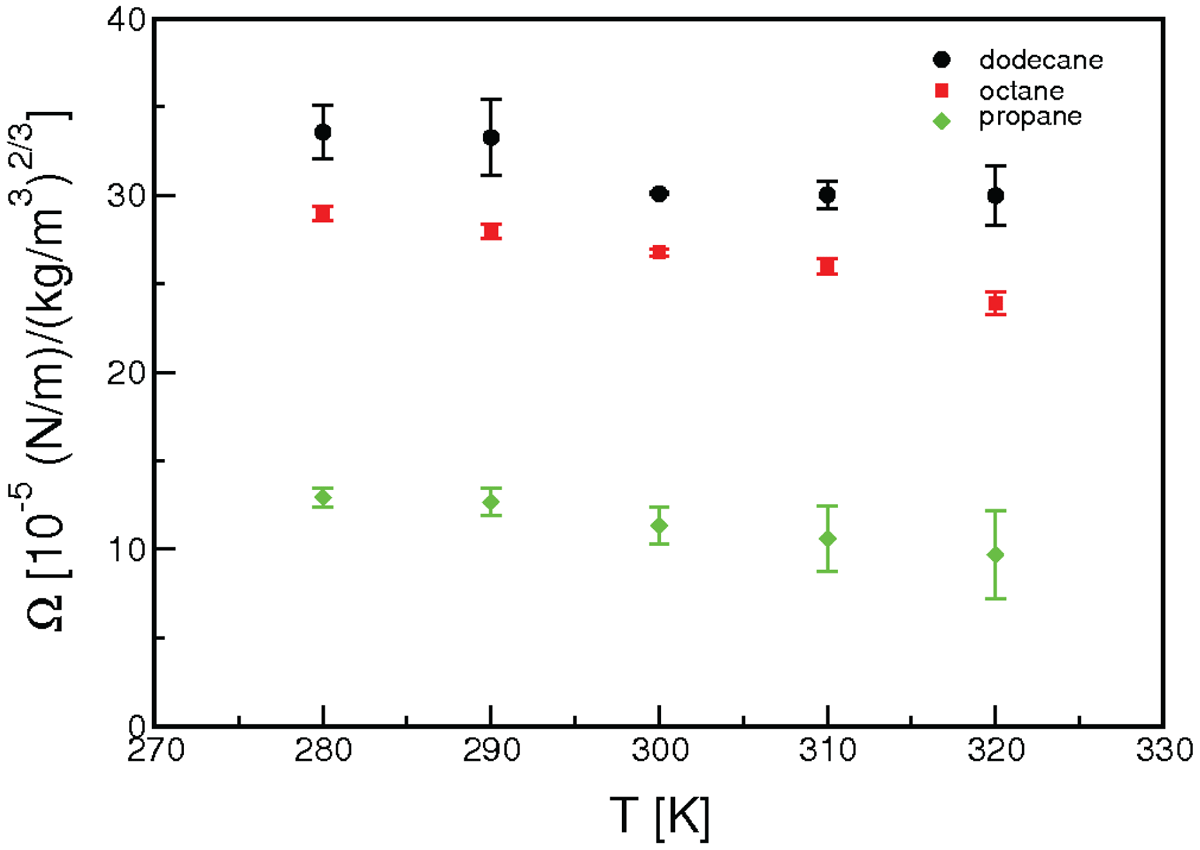
Figure 2.
Simulation ( ) values of n-alkanes: n-propane, n-octane and n-dodecane at different temperatures.
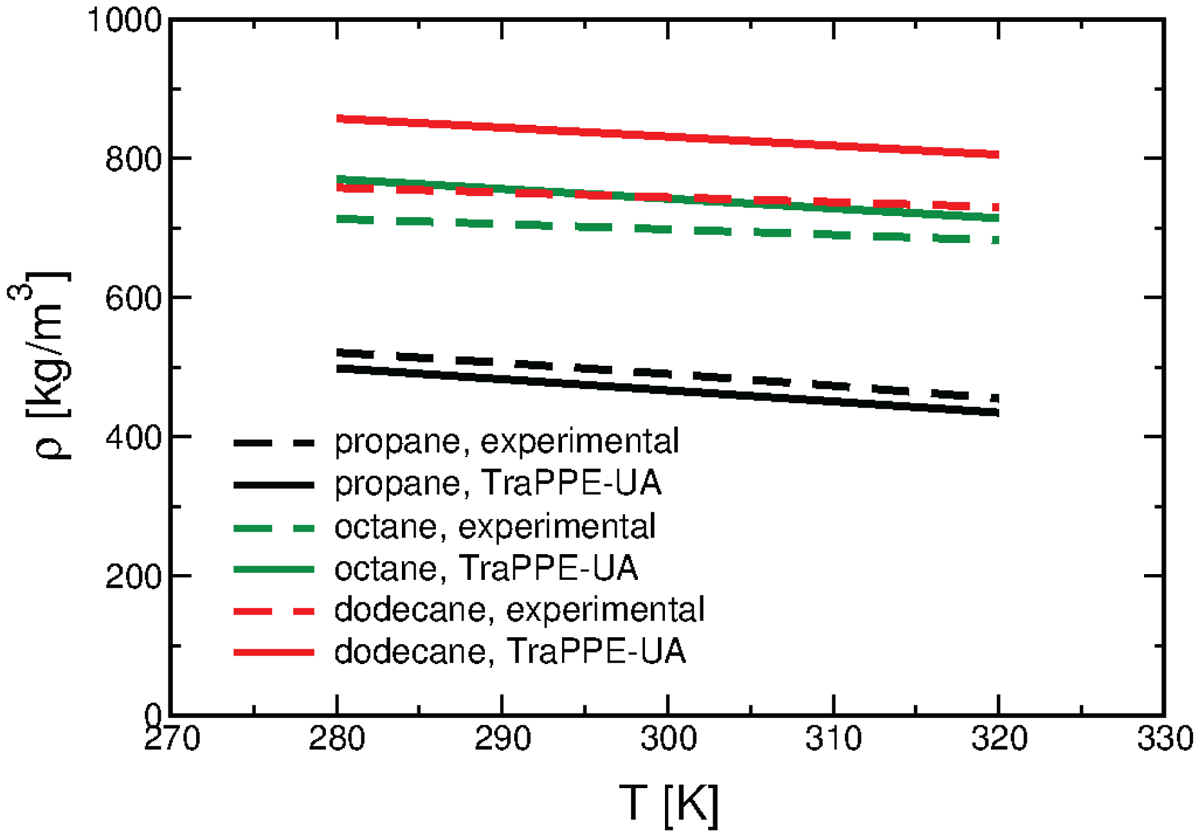
Figure 3.
Experimental and TraPPE-UA force field density of n-alkanes: n-propane, n-octane and n-dodecane at different temperatures.
Simulations require extensive calculations of the energy involved in all intra- and intermolecular interactions. Computational resources were supplied by the high-performance computing clusters of the Advanced Science and Technology Institute of the Department of Science and Technology (DOST-ASTI) (48 Intel Xeon CPU E5-2697 v2 @ 2.70 GHz) and the Computational Science Research Center (CSRC) (2 4-core Intel Xeon CPU E5405 @ 2.0 GHz). The nucleation free energy profiles were reiteratively modified until data convergence, that is, when each cluster size ( = 50 molecules) has been sampled at least 10 times.
Results and discussions
3.
Nucleation simulations were conducted for n-alkanes: n-propane, n-octane and n-dodecane from 280 K to 320 K at 10 K intervals. Clusters of interest were composed of 1 up to 50 molecules. From the converged free energy profiles and using Equation (2), the resulting G(n) plots were constructed as shown in Fig. 1 for n-propane, n-octane and n-dodecane. As shown, except for the n-propane system, the slopes are monotonically dependent with temperature. This observed behaviour could be due to the molecular clusters formed.
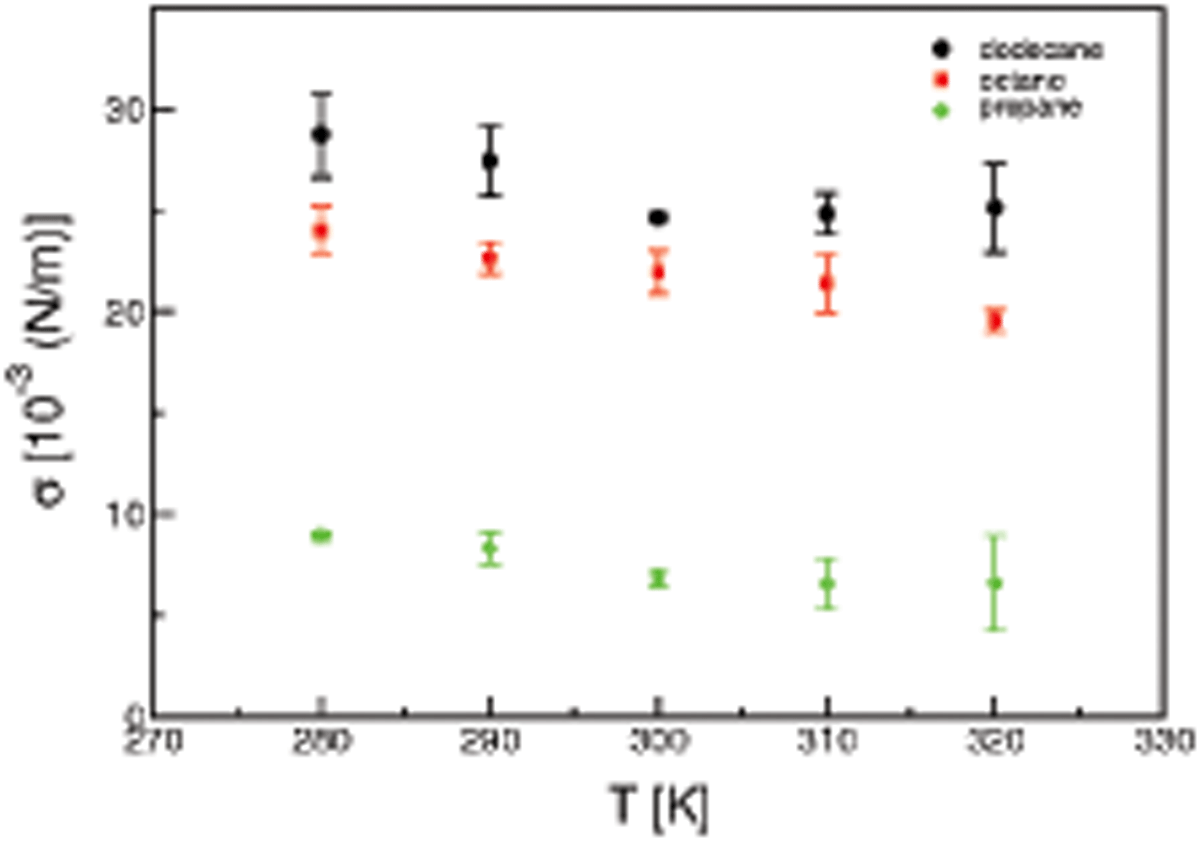
Figure 4.
Simulation surface tension data of n-alkanes: n-propane, n-octane and n-dodecane at different temperatures.
The temperature-dependent slopes, 4.836 , of the resulting G(n) plots are shown in Fig. 2. Compared to the experimentally derived values (Yaws and Pike, 2008; Yaws and Richmond, 2008), these values from nucleation simulations are within reasonable agreement with errors ranging from 0.2 to 4.5% for n-dodecane, from 0.2 to 2.0% for n-octane, and from 2.2 to 35.6% for n-propane. It seems that n-propane at 320 K behaves quite differently from what is observed in experiments. Also, this behaviour indicates fundamental differences of clusters containing large and small molecules. It is also interesting to point out that the critical temperature of propane is ca. 370 K.
For the density, we directly obtained values from the TraPPE-UA force field data (Martin and Siepmann, 1998) and compared them with available experimental values (Yaws and Pike, 2008). The comparison is shown in Fig. 3. Again, these values are within reasonable agreement with errors ranging from 10.3 to 13.1% for n-dodecane, from 4.6 to 8.0% for n-octane, and from 4.5 to 4.7% for n-propane. The errors are quite low since the TraPPE-UA force field has been optimized to achieve accurate experimental saturated liquid densities (Martin and Siepmann, 1998; Errington and Panagiotopoulos, 1999).
Using Equation (3), we calculated surface tension values from both the experiments (Yaws and Pike, 2008; Yaws and Richmond, 2008) and simulations. For comparison, these data are plotted in Fig. 4. Again, experimental and simulation surface tension values are within reasonable agreement, with errors ranging from 10.5 to 13.4% for n-dodecane, from 2.0 to 7.2% for n-octane, and from 0.05 to 32% for n-propane. These results indicate that deriving surface tension data from nucleation simulations, is viable, even for realistic organic molecules. The errors especially when obtaining surface tension of n-propane at close to the critical temperature poses limitations to this approach.
Concluding remarks
4.
Nucleation simulations have been performed on realistic organic compounds, namely n-alkanes: n-propane, n-octane and n-dodecane modelled using the TraPPE-UA force fields. A simple approach was applied in determining the surface tension of n-alkanes without performing lab experiments. Results are promising and within good agreement with available experimental data. Investigations as to the applicability and limitations of the proposed protocol to other classes of compounds with real industrial importance are on-going.
Acknowledgements
We acknowledge the computational support in part by the high-performance computing (HPC) facilities of the Advanced Science and Technology Institute (ASTI) and the Computing and Archiving Research Environment (CoARE) of the Department of Science and Technology (DoST), Philippines; the Computational Science Research Center (CSRC) of the College of Science, University of the Philippines Diliman and the Office of the Vice-Chancellor for Research and Development (OVCRD), University of the Philippines Diliman.