
Table 1.
Summary of reviewed papers.
approachesImplementation
approach.
Our interpretation using Nilsen’s
taxonomyBecker et al.USA2007To describe experiences in disseminating IPS in six states and the District of Colombia.Six states and the District of Colombia.Case study – based on description from project leadersProcess model:
Project leaders description of how they increased access to high-quality SE service (14)Bejerholm et al.Sweden2011To illustrate the IPS approach in the Swedish welfare system and the welfare system’s implications for IPS delivery, by studying those involved in the implementation of and IPS intervention in Sweden.A city in SwedenSingle case study, and two clients’ path through the welfare systemA soft version of a determinant framework approach:
Interpreting the welfare system’s impact on IPS principles (68)Boardman2013To summarize the existing evidence and the factors influencing implementationReviewDeterminant framework:
Factors influencing implementation (e-Article 2)Boyce et al.UK2008To examine the extent to which UK agency approaches reflect the principles of the IPS approach and the factors influencing this.Six IPS agencies in UKIPS fidelity scale. Interviews with 21 representatives from 16 sites: manager and support workers.Evaluations framework:
Fidelity evaluation (361)Cocks and BoadenAustralia2009Evaluation of an IPS programme to establish the programme’s level of fidelity to EBP principlesAustraliaLiterature review, and evaluation using the IPS fidelity scale: personal interviews, review of programme’s policies, procedures and data collection, phone interviewsEvaluations framework:
Fidelity evaluation (302)FolkessonSweden2014To evaluate the process and results of implementing IPS in Karlstad MunicipalityKarlstad, SwedenCase study; focus group interviews, document analysisEvaluations framework:
Combination
of a process, goal
and formative evaluation (12–16)Hasson et al.Sweden2011To describe initial implementation barriers of IPS in a Swedish contextMalmø, SwedenInterviews, observation and document analysisTransella and Thornicroft’s model of implementation of EBPDeterminant framework:
T&T’s model of implementing EBP, potential facilitators and barriers exist at individual, local and national level (334)Killackey and WaghornAustralia2008To identify the implementation issues encountered in IPS SE in AustraliaMelbourne/
AustraliaFidelity studyDeterminant framework /evaluation framework:
Fidelity evaluation.
Identifying challenges to service integration (64–65)Knaeps et al.Belgium2012To investigate the extent to which vocational rehabilitation services in Flanders apply to IPS principles and to understand what hinders and facilitates the future use of IPSFlanders/
BelgiumSemi structured interviews using IPS Fidelity scale and open ended questionsDeterminant framework /evaluation framework:
Fidelity evaluation (15) and predictors of successful vocational rehabilitation (16)Kostick et al.USA2010To examine the notion of client-centeredness from the perspective of SE specialists and supervisors, identifying barriers and facilitators to implementationConnecticut, USA, agencies with high fidelity ratingsSemi-structured interviewsA soft version of a determinant framework:
To describe approaches to client-centeredness from the perspective of employment specialist and supervisors, including facilitators and barriers to effective implementation (524)Markström et al.Sweden2015To study the implementation of ACT and IPS in a Swedish welfare context14 IPS sites/ SwedenMixed-methods-design: interviews, document analysis, fidelity assessment, case studies at 3 IPS sitesDeterminant Framework based on implementation theories/ a model for analysing dataDeterminant framework/Evaluations framework:
Combination
of a process, fidelity
and user evaluation (18–21)Marshall et al.USA2008To examine strategies and barriers for implementation of supported employment for mental health servicesNine IPS sites located in 3 states/USFidelity assessment, interviews and observations.Evaluation framework/ determinant framework:
Fidelity evaluation, and analysis of strategies and barriers for successful implementation (886–887)Menear et al.Canada2011To understand the factors that influence implementation of SE/IPS programme in a Canadian context guided by concepts from organizational studies20 SE programmes in three provincesA multiple case study, document, semi-structured interview following a snowball procedureConceptual framework base on two organizational approaches; coalition theory and theory of archetypesClassic Theories:
Conceptual framework base on two organizational approaches; coalition theory and theory of archetypes (1029)Oldman et al.Canada2005To examine the transformation of the employment services over a 15 year period – from sheltered employment to IPSCanada; Vancouver/BurnabyCase studyProcess model:
The case study examines the transformation of the employment services over a 15-years period (1437)Quimby et al.USA2001The experience of implementing IPS, focus on IPS specialist and clinical staffWashington D.CEthnographic observationsEthnographic approachA soft version of determinant framework:
The analysis is arranged into various tension experienced by clients, IPS specialist and clinicians (370)Rinaldi et al.UK2010A review of the existing evidence of the implementation of IPS approach in England, and the authors’ experiences with IPS in two MHS in EnglandReviewTransella and Thornicroft’s model of implementation of EBPProcess model:
Three phases: adoption of principle, early implementation, persistence of implementation (167)Schneider and AkhtaUK2012To inform those who wish to implement a new service of IPS in a mental health settingNottingham, UKCase studyImplementation theory – six core elements for successful changeImplementation theory:
Six core elements for successful change (326)Shepherd et al.UK2012To describe experiences derived from conducting fidelity reviews in clinical teamsFive ‘Centres of Excellence’ in the UK, pointed out as becoming part of the Centre for mental health network for IPS.IPS fidelity scale review, Telephone interviews with staffEvaluations framework:
Fidelity evaluation (31)Social-styrelsenSweden2014To evaluate the IPS trial in 32 municipalities32 IPS sitesWeb-based survey, interviews at 3 IPS sitesEvaluation framework:
Process evaluation combined with determinant framework (16–18)van Erp et al.Netherland2007To determine if IPS could be implemented in the Netherlands, with regard to level of fidelity, employment outcome, and barriers to imp. and strategies to overcome barriersNetherland, four Mental Health agenciesInterviews, direct observations and agency recordsDeterminant framework /evaluation framework:
Fidelity evaluation (1422) and data on barriers to and facilitators of implementation (1423)Waghorn et al.Australia2007A descriptive summary of the implementation issues encountered at seven sites in four states pioneering IPSSeven sites in four states in AustraliaAn e-mail request structured around the 15 items fidelity scaleDeterminant framework /evaluation framework:
Fidelity evaluation. Identifying challenges to implement EB SE (34–35)
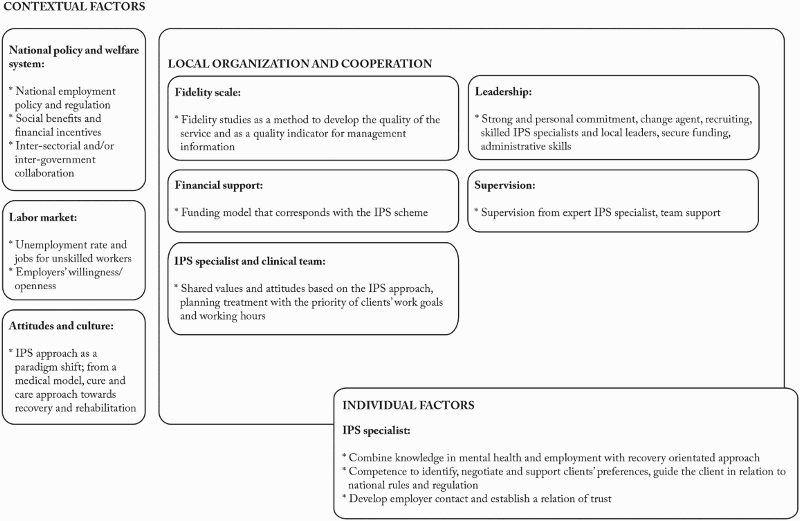
Figure 1.
Framework: factors influencing IPS implementation.