
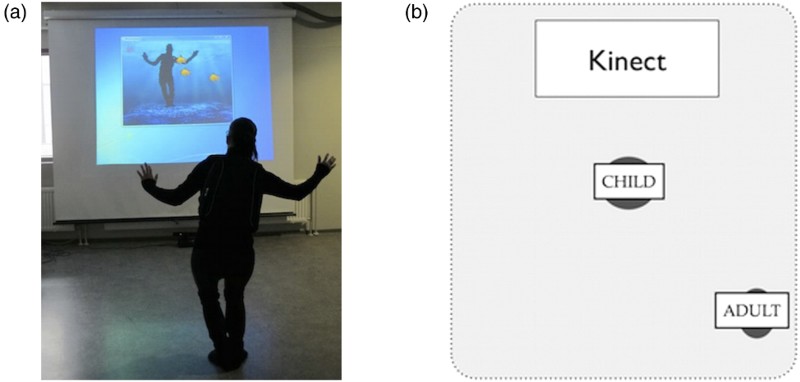
Figure 1.
(a) Example of the game playing using the Kinect technology in which the silhouette of the player is projected in the game via the Kinect sensor. Figure 1(b). The setting of the game room: the Kinect sensor and the white screen are in front of the player and an adult teacher can sit in the background during the game playing.
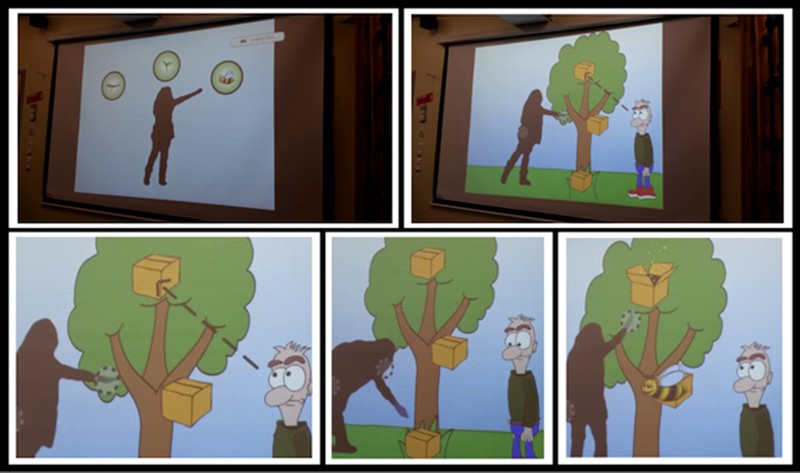
Figure 2.
The game view: top left (1) choosing preferred object (bumblebee); top right (2) both eye cue and arrow cue indicating the location (looking at the box on the top); bottom left (3) eye cue and arrow cue to the top box; bottom middle (4) eye cue only (looking at the box on the ground); bottom right (5) The topmost box is open and the participant is trying to catch the bee that flew from the box (can be seen on top of the middle box: bumblebee).
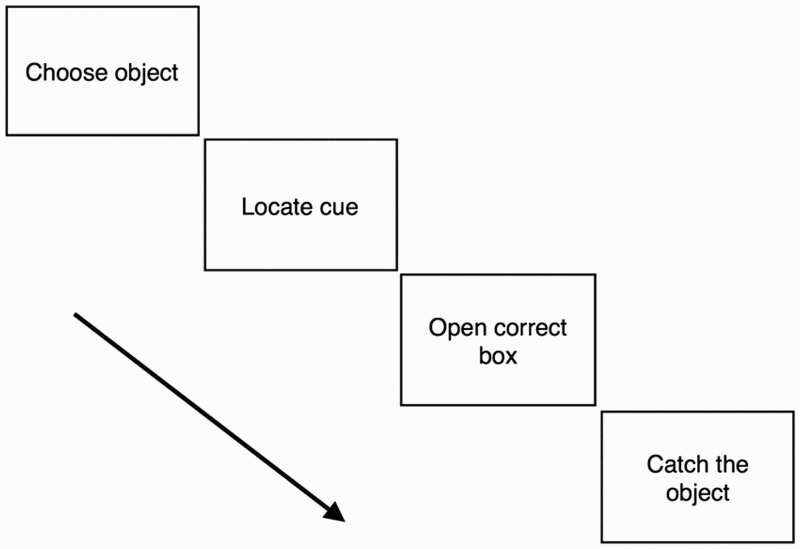
Figure 3.
The order of the events in the game: (1) the player chooses an object, which he would like to look for; (2) the player locates the correct box using the eye gaze or arrow cues; (3) the player opens the correct box; (4) the player catches the object that emerges from the box. After the final trial with either a gaze cue or the double cues, the participant can choose a different object to play the game again.
Table 1.
The results of the case-controls analyses using the DISSOCS_ES.EXE (Crawford, Garthwaite & Porter, 2010). The asterisk (*) indicates significant difference between controls and the participant in a given task.
Note: Crawford and Howell’s (1998) test for a deficit in task X and Y.