Have a personal or library account? Click to login
Alienation and struggle: everyday student-life of three male students with Asperger Syndrome Cover

Alienation and struggle: everyday student-life of three male students with Asperger Syndrome

Open Access
|Jun 2012

Figures & Tables

Table 1. Presents the basic information of the three cases.

AdamBertCesarUniversity sizeLargeSmallMediumUniversity subjectBiotechnologyTeacher educationTechnologyAge273222Received diagnosis232214Support for ASYesNoNoSituationOwn apartmentOwn apartmentLiving with parentsPersonal characteristicMelancholy and reticentActive and verbalWithdrawn and quietPromptingYesNoYes

Table 2. Length of interviews and length of time between interviews.
AdamBertCesarInterview 13 h 2 min3 h 47 min3 h 15 minDays between interviews 1 and 240 days42 days1 dayInterview 21 h 4 min4 h 50 min2 h 15 minDays between interviews 2 and 3162 days144 days33 dayInterview 31 h 22 min2 h 35 min2 h 8 minIn total5 h 28 min11 h 20 min7 h 38 min
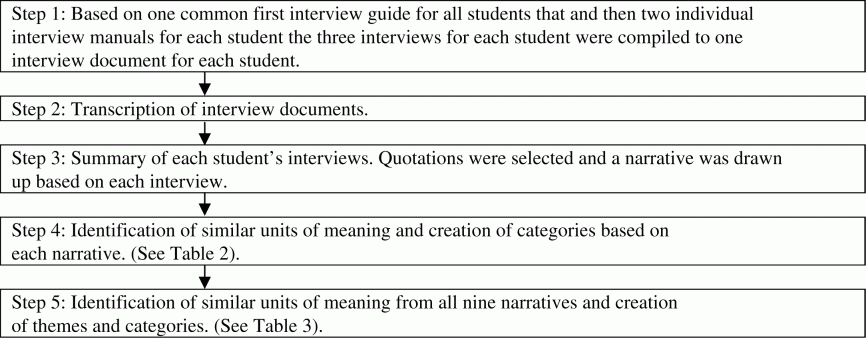
Figure 1. 

Steps in the data analysis process, modified model from Zakrirova-Engstrand and Granlund (2009).

Table 3. Examples of units of meaning from each student interview, assessed into categories.

Units of meaningCategory1. He is and wants to be very private and he says that it is strange to talk about himself and that he does not want to let anyone into his private sphere. He has a wish, as he says, not to be so ‘bloody handicapped’; he just wants to fit in and he says that this is important for him.Identity2. Cesar remembers that when he got his diagnosis it felt ‘okay, now I know why I am this way’. He considers his life to be restricted by the diagnosis: ‘if you are bad at something then it restricts you’.Diagnosis3. Bert was bullied and harassed through his entire childhood ‘I was a terrible preschool child’. There were many conflicts and fights with other children and Bert thinks he ‘was a bit tricky as a child’.Bullying4. In upper secondary school he started to smoke because ‘then you could be with the others, so it became a social thing’. Even at upper secondary school it was difficult to be with friends and he says that he was not so good ‘at the social side of things’.Loneliness5. He continues his story, telling how he learnt by observing others and he says that he is a ‘people collector’. One of his special interests is pedagogy and he tries to understand how other people think and act. It is a way to become less isolated with regard to other human beings.Special interests6. When I asked ‘if you had a dream or vision for the future, what would it involve you doing?’, the answer was ‘I don't know.’ He has no plans or dreams for the future, but he wishes he had, as this would be much easier.Future

Table 4. Summarizes the number of themes, categories and units of meaning from the three cases.

AdamBertCesarCommon for all studentsAlienation Identity1051530 Diagnosis11122043 Bullying413623 Loneliness431623 Spare time28717Struggle Studies vs. everyday routine15282467 Special interests12211245 Support14112550 Coping strategies6211744 Future891027

Table 5. Research colleague verification.

InterviewAuthor's narratives of each interviewAuthor's themes and categoriesAdam's interview 1 (check)Adam's narrative 1 (check)Adam's narrative (check)Adam's interview 2Adam's narrative 2 (check)Adam's interview 3Adam's narrative 3 (check)
Language: English
Page range: 177 - 194
Submitted on: Dec 19, 2009
Accepted on: Nov 30, 2010
Published on: Jun 2, 2012
In partnership with: Paradigm Publishing Services

© 2012 Ann Simmeborn Fleischer, published by Stockholm University Press
This work is licensed under the Creative Commons Attribution 4.0 License.